
News
AKD says no improvement at Sapugaskanda oil refinery since it went into production in 1969


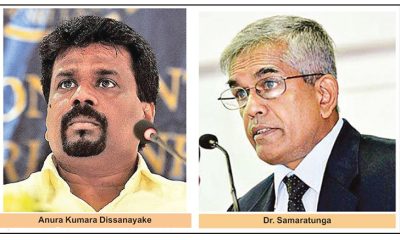
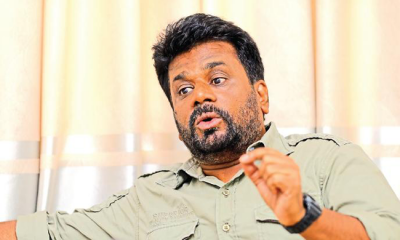
The capacity of the Sapugaskanda Oil Refinery (SOR) has not increased since it was established in 1969, National People’s Power (NPP) leader Anura Kumara Dissanayake says.
Speaking at a public rally recently he that in 1969, the SOR used the most advanced technology available at the time.
“CPC started construction in 1968 and SOR started operations, refining oil, on August 5th, 1969. During that time, the CPC could refine 50,000 MT of crude oil. 55 years later, the capacity remains the same. In 1969, the CPC started with the most advanced technology available at the time. Technology has improved now. We are still refining oil with 1969 technology,” he said.
Dissanayake said that Sri Lanka built a fertiliser factory to use the byproducts of the refinery and, in 1982, a newspaper reported that 5000 MT of urea, produced by that factory, was exported to Pakistan. Today, that factory is closed.
“The CPC also had a nylon factory, as a subsidiary. We built our own nylon thread fish nets. By-products of the refinery were used as pesticides and insecticides for our pineapple and flower production. Those factories were closed, too. We had a candle industry from the by-products, we produced lubricant oil. It was sold to American Caltex. Refinery produced fuel for airplanes. It has the capacity to sell USD 1.4 million worth airplane fuel per day. We can buy crude oil, refine, and sell to ships. These are opportunities we must use to earn foreign currency. Recently this section of the CPC was privatized,” he said.
The ruling class has failed to secure even the most important assets, he said. Agriculture, land, gems, ilmenite, our natural resources, so will these rulers protect what is left, he asked.
“They have absolutely no plan to build this country. Selling our resources, closing down factories and selling valuable machinery is what they know. Every government has taken part in the destruction of the refinery. This is why we need a change in the economy. We need to transform our economy. Only NPP can do that,” he said.
The NPP leader said that the existing constitution concentrates too much power in the hands of the executive president. Sri Lanka has had this executive presidential system for 40 years and executive power was used against the people, repressing them.
“Our economy was destroyed. It has done no good to this country. One man cannot develop the country. Individuals have capacities and limitations. We need to unite our capabilities to govern this country. It’s a collective effort and the NPP is the only party to undertake it. That’s the point of difference. There are talented people from all fields like history, economy, mathematics, law and so on. There are lawyers, university academics and professionals. The government has to unite these capacities and talents to bring optimum results for the country. NPP will do that. For that we have to abolish executive presidency and rewrite the constitution vesting more powers in the Parliament. We will bring about this change,” he said.
Dissanayake said an NPP administration will limit the number of Ministers to 18. He added that crossovers have distorted the democratic system and corrupted the political culture.
“People vote for them in one party but for money and positions they change political allegiance. This has become a public nuisance. Some MPs demand ransom to stay in the party. We will add a provision to the Constitution to ban crossing over,” he said.








The Ministry of Industries and Entrepreneurship Development has recommended the establishment of Sri Lankan Standards, i.e. the import testing methodology for imported tires used for passenger cars and pneumatic tires for three-wheelers with the aim of ensuring a fair competitive environment for local
manufactures and ensuring consumer safety and security.
Taking into the said recommendations, “Import and Export (control regulations N0.08 of the 2026)” has been enacted to amend the existing regulations by means of the Extraordinary Gazette Notification No. 2508/27 dated 2026-10-01, prescribing Sri Lanka standard 1212 for the import of passenger types (HS Code 4011.10.90) and Sri Lanka standard 1347 for the import of
pneumatic tires for three – wheeled vehicles (HS Code 4011.90.10).
Accordingly, the Cabinet of Ministers has approved the resolution furnished by the President in his capacity as the Minister of Finance, Planning, and Economic Development to submit the aforementioned regulations to Parliament for approval.
Approval of the Cabinet of Ministers was granted at their meeting held on 02.06.2025 to introduce a new act to promote and providing legal provisions for facilitating the Public Private Joint Enterprises within Sri Lanka as well as the establishment of the National Agency for Public Private Partnership Joint Enterprises.
Accordingly, the Legal Draftsman has formulated the relevant draft bill and the Attorney General has given his clearance to the said draft bill.
The Cabinet of Ministers approved the resolution furnished by the President in his capacity as the Minister of Finance, Planning and Economic Development to publish the said
draft bill in the government gazette notification and thereby submit it to the Parliament for its concurrence.
Regulation, development and control of indigenous medical sector in Sri Lanka comprised of Ayurvedha, Sidhdha, Unani, Local Therapies are carried out under the provisions of Ayurvedha Act No. 31 of 1961.
Although amendments were made to the act from time to time as per the requirements, the necessity of further amending the Ayurvedha Act has been identified to enable efficiently maintaining all activities of local medical field productively, further formalizing the regulation of the sector, taking actions to providing licenses applicable to export of local medicines, and achieving the progress and sustainable development goals in the local medical sector.
Based on the said factors, the Cabinet of Ministers granted approval to the resolution furnished by the Minister of Health and Mass Media to direct the Legal Draftsman to formulate a draft bill to amend the Ayurvedha Act No. 31 of 1961.

Import and Export (Control) Regulations No. 08 of 2026
Draft Bill of the Public Private Partnership Enterprises Act to be gazzetted
Amendment of the Ayurvedha Act No. 31 of 1961

Cabinet nod to amend the Sri Lanka Development Administration Institute Act No. 9 of 1982
Establishment of the National Higher Performance Centre
State patronage for the cremation ceremony of the late deputy prelate (Anu Nayaka Thero) of the Sri Laka Ramangya Maha Nikaya, Gatambe Rajopawanramadhipatha, Siri Chandawimala Wanshalankara, Chandrakeerthi Sri Amarawansha, Sadhdharmawageeshwara, Shasanashobhanna Most Venerable Keppetiyagoda Siriwimalabhidhana Thero

‘Dates have the highest sugar content to fight Coronavirus’

Sunday Island 27 December – Headlines

#SundayIsland 17th December – Headlines

Sunday Island – 28th March

Sunday Island Headlines – 21 March

Sunday Island – 21st February – Headlines
-

 Features3 days ago
Kotahena:A Small Enclave, An Extraordinary Legacy
-

 News7 days ago
Sri Lanka, India caught in US-Iran ship crisis
-
 News4 days ago
Asgiri Mahanayake calls for immediate release of Gnanasara Thera
-

 Latest News7 days ago
Missiles intercepted near Riyadh after Saudi coalition hits Yemen fuel depot
-
 Latest News7 days ago
Kusal Mendis’ unbeaten 87 hands Sri Lanka consolation win
-

 News2 days ago
Record 1,600 students take Russian Classical Ballet examination in Sri Lanka
-
 News6 days ago
AC President recuses himself from hearing prison attire case pertaining to Gnanasara Thera
-

 Latest News7 days ago
Heavy showers above 100 mm are likely at some places in the Western, Sabaragamuwa, Southern, Central, and North-western provinces and in Anuradhapura district.