
News
Indian Ocean temps vary from side to side

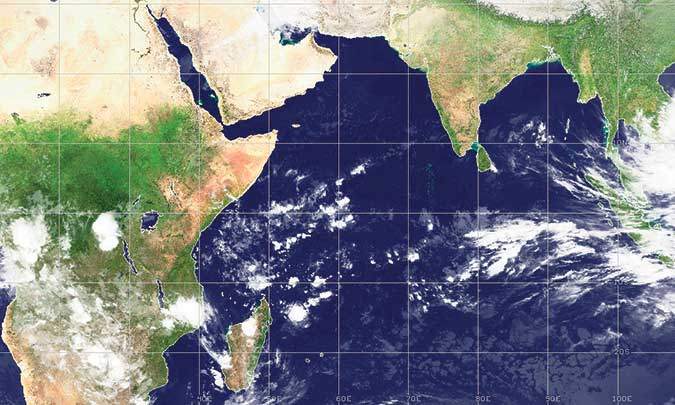
New research on the Indian Ocean dipole shows how melting ice water from massive glaciers can ultimately lead to droughts and flooding in East Africa and Indonesia.With a new analysis of long-term climate data, researchers say they now have a much better understanding of how climate change can cause sea water temperatures on one side of the Indian Ocean to be so much warmer or cooler than the temperatures on the other—a phenomenon that can lead to sometimes deadly weather-related events like megadroughts in East Africa and severe flooding in Indonesia.
The analysis, described in a new study in Science Advances, compares 10,000 years of past climate conditions reconstructed from different sets of geological records to simulations from an advanced climate model.
The findings show that about 18,000 to 15,000 years ago, as a result of melted freshwater from the massive glacier that once covered much of North America pouring into the North Atlantic, ocean currents that kept the Atlantic Ocean warm weakened, setting off a chain of events in response. The weakening of the system ultimately led to the strengthening of an atmospheric loop in the Indian Ocean that keeps warmer water on one side and cooler water on the other.
This extreme weather pattern, known as a dipole, prompts one side (either east or west) to have higher-than-average rainfall and the other to have widespread drought. The researchers saw examples of this pattern in both the historical data they studied and the model’s simulation. They say the findings can help scientists not only better understand the mechanisms behind the east-west dipole in the Indian Ocean, but also one day help to produce more effective forecasts of drought and flood in the region.
“We know that in the present-day gradients in the temperature of the Indian Ocean are important to rainfall and drought patterns, especially in East Africa, but it’s been challenging to show that those gradients change on long time-scales and to link them to long-term rainfall and drought patterns on both sides of the Indian Ocean,” says James Russell, a study author and professor of earth, environmental, and planetary sciences at Brown. “We now have a mechanistic basis to understand why some of the longer-term changes in rainfall patterns in the two regions have changed through time.”
In the paper, the researchers explain the mechanisms behind how the Indian Ocean dipole they studied formed and the weather-related events it led to during the period they looked at, which covered the end of the last Ice Age and the start of the current geological epoch.
The researchers characterize the dipole as an east-west dipole where the water on the western side—which borders modern day East African countries like Kenya, Ethiopia, and Somalia—is cooler than the water on eastern side toward Indonesia. They saw that the warmer water conditions of the dipole brought greater rainfall to Indonesia, while the cooler water brought much drier weather to East Africa.
That fits into what is often seen in recent Indian Ocean dipole events. In October, for example, heavy rain led to floods and landslides in Indonesian islands of Java and Sulawesi, leaving four people dead and affecting over 30,000 people. On the opposite end, Ethiopia, Kenya, and Somalia experienced intense droughts starting in 2020 that threatened to cause famine.
The changes the authors observed 17,000 years ago were even more extreme, including the complete drying of Lake Victoria—one of the largest lakes on Earth.
“Essentially, the dipole intensifies dry conditions and wet conditions that could result in extreme events like multi-year or decades-long dry events in East Africa and flooding events in South Indonesia,” says Xiaojing Du, a postdoctoral researcher in the Institute at Brown for Environment and Society and Brown’s department of earth, environmental and planetary sciences, and the study’s lead author. “These are events that impact people’s lives and also agriculture in those regions. Understanding the dipole can help us better predict and better prepare for future climate change.”
The dipole the researchers studied formed from the interactions between the heat transport system of the Atlantic Ocean and an atmospheric loop, called a Walker Circulation, in the tropical Indian Ocean. The lower part of the atmospheric loop flows east to west across much of the region at low altitudes near the ocean surface, and the upper part flows west to east at higher altitudes. The higher air and lower air connect in one big loop.
Interruption and weakening of the Atlantic Ocean heat transport, which works like a conveyor belt made of ocean and wind currents, was brought on by massive melting of the Laurentide ice sheet that once covered most of Canada and the northern US. The melting cooled the Atlantic and consequent wind anomalies triggered the atmospheric loop over the tropical Indian Ocean to become more active and extreme. That then led to increased precipitation in the east side of the Indian Ocean (where Indonesia sits) and reduced precipitation in the west side, where East Africa sits.
The researchers also show that during the period they studied, this effect was amplified by a lower sea level and the exposure of nearby continental shelves.
The scientists say more research is needed to figure out exactly what effect the exposed continental shelf and lower sea level has on the Indian Ocean’s east-west dipole, but they’re already planning to expand the work to investigate the question. While this line of the work on lower sea levels won’t play into modeling future conditions, the work they’ve done investigating how the melting of ancient glaciers impacts the Indian Ocean dipole and the heat transport system of the Atlantic Ocean may provide key insights into future changes as climate change brings about more melting.
“Greenland is currently melting so fast that it’s discharging a lot of freshwater into the North Atlantic Ocean in ways that are impacting the ocean circulation,” Russell says. “The work done here has provided a new understanding of how changes in the Atlantic Ocean circulation can impact Indian Ocean climate and through that rainfall in Africa and Indonesia.”
The study had funding from the Institute at Brown for Environment and Society and the National Science Foundation.

Latest News
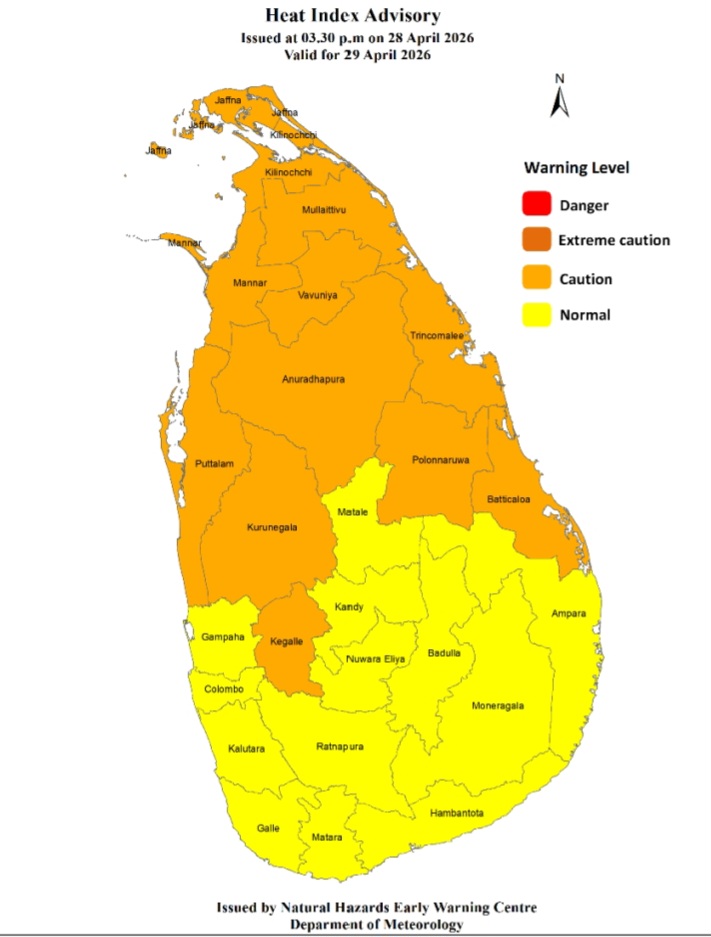
Heat Index at Caution Level in the Northern, North-central and North-western provinces and in Kegalle, Trincomalee and Batticaloa districts during the day time

Warm Weather Advisory
Issued by the Natural Hazards Early Warning Centre
Issued at 3.30 p.m. on 28 April 2026, valid for 29 April 2026.
The Heat index, the temperature felt on human body is likely to increase up to ‘Caution level’ at some places in the Northern, North-central and North-western provinces and in Kegalle,
Trincomalee and Batticaloa districts during the day time.
The Heat Index Forecast is calculated by using relative humidity and maximum temperature and this is the condition that is felt on your body. This is not the forecast of maximum temperature. It is generated by the Department of Meteorology for the next day period and prepared by using global numerical weather prediction model data.

Effect of the heat index on human body is mentioned in the above table and it is prepared on the advice of the Ministry of Health and Indigenous Medical Services.
ACTION REQUIRED
Job sites: Stay hydrated and takes breaks in the shade as often as possible.
Indoors: Check up on the elderly and the sick.
Vehicles: Never leave children unattended.
Outdoors: Limit strenuous outdoor activities, find shade and stay hydrated.
Dress: Wear lightweight and white or light-colored clothing.
Note:
In addition, please refer to advisories issued by the Disaster Preparedness & Response Division, Ministry of Health in this regard as well. For further clarifications please contact 011-7446491.

New controversy erupts over missing USD 2.5 mn:
Public interest activist Nagananda Kodituwakku has sought citizenship details of Finance Ministry Secretary Harshana Suriyapperuma from the Department of Home Affairs, Australia.
According to a letter dated 28 April, addressed to the relevant department, Solicitor England and Wales Kodituwakku sought the required information in terms of Section 15 of the Freedom of Information Act No 3 of 1982 of Australia. Suriyapperuma is also the Secretary to the Treasury.
The former Deputy Minister of Finance and Planning Suriyapperuma (from November 2024 to June 2025) is embroiled in a deepening controversy over the theft of USD 2.5 mn from the Treasury.
The leader of the Vinivida Foundation said that he intended to move court against Suriyapperuma for entering Parliament through the NPP National List in violation of the country’s Constitution (Article 91(1)(d)(xiiii).
Kodituwakku said: “This is clearly an accountability and integrity issue and violation of the Constitution of Sri Lanka and also this act contravenes the law of a member in the Commonwealth.”
USD 2.5 mn paid to a third party was meant to be an instalment of a loan taken from Australia. Suriyapperuma neither responded to an SMS nor answered his hand phone.
Geetha Kumarasinghe (UPFA/Galle District) and Diana Gamage (SJB National List) lost their seats in 2017 and 2024, respectively, over citizenship issues.
Meanwhile, public interest group ‘Free Lawyers’ that exposed the theft of Treasury funds questioned the failure on the part of Dr. Harsha de Silva, Chairman of Committee on Public Finance (CoPF), to pressure President Anura Kumara Dissanayake to temporarily remove Suriyapperuma to facilitate unhindered investigations.
On behalf of ‘Free Lawyers’, Rajith Keerthi Tennakoon yesterday expressed concern over the way the CoPF, under SJBer de Silva’s leadership, handled the issue at hand. Issuing an open letter, Tennakoon, urged the CoPF chief to explain his stand on a spate of vital issues which needed to be addressed without any further delay.
By Shamindra Ferdinando
News
President Anura Kumara Dissanayake handing over a sapling of the Sri Maha Bodhiya in Anuradhapura to Ven Bhikku Pannakara


President Anura Kumara Dissanayake handing over a sapling of the Sri Maha Bodhiya in Anuradhapura to Ven Bhikku Pannakara (Sue Tue Nhan) at the conclusion of the 161 km ‘International Peace Walk’ in Colombo yesterday. The Bo-sapling will be taken to the US by the spiritual leader. Pic by Sujata Jayaratne

Dulani and Samarawickrama set up Sri Lanka’s victory in T20I series opener

Heat Index at Caution Level in the Northern, North-central and North-western provinces and in Kegalle, Trincomalee and Batticaloa districts during the day time

Showers or thundershowers will occur in most parts of the island after 1.00 pm

Treasury chief’s citizenship details sought from Australia

President Anura Kumara Dissanayake handing over a sapling of the Sri Maha Bodhiya in Anuradhapura to Ven Bhikku Pannakara

USD 625,000 meant for US Postal Service goes missing

‘Dates have the highest sugar content to fight Coronavirus’

Sunday Island 27 December – Headlines

#SundayIsland 17th December – Headlines

Sunday Island – 28th March

Sunday Island Headlines – 21 March

Sunday Island – 21st February – Headlines
-

 News6 days ago
Lanka faces crisis of conscience over fate of animals: Call for compassion, law reform, and ethical responsibility
-
 News5 days ago
Whistleblowers ask Treasury Chief to resign over theft of USD 2.5 mn
-

 News5 days ago
No cyber hack: Fintech expert exposes shocking legacy flaws that led to $2.5 million theft
-

 News2 days ago
BIA drug bust: 25 monks including three masterminds arrested
-

 Business3 days ago
Nestlé Lanka Announces Change in Leadership
-

 News2 days ago
Banks alert customers to phishing attacks
-

 News3 days ago
Hackers steal $3.2 Mn from Finance Ministry
-

 News6 days ago
USD 2 mn bribe: CID ordered to arrest Shasheendra R, warrant issued against ex-SriLankan CEO’s wife