
Features
Oranee Jansz

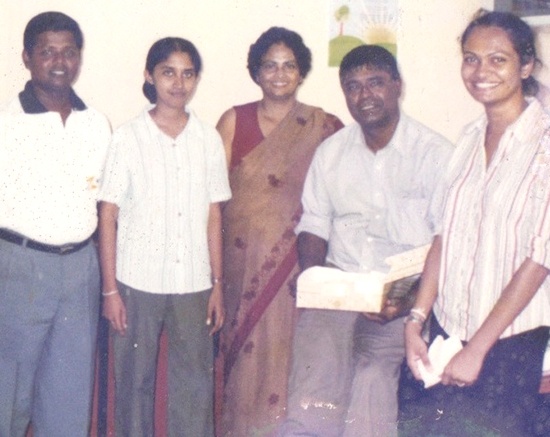
by Rajiva Wijesinha
Oranee Jansz died last month after a brave battle with cancer, one day after her 77th birthday. I knew her for just less than half her life, having first met her when I joined the University of Sri Jayewardenepura in 1992.
I had moved there mainly to look after the English courses at Affiliated University Colleges, the brainchild of Arjuna Aluwihare. But of course USJP wanted to make greater use of me, both to restructure its English courses and build up a Department, and also to revitalize teaching of English to all students through the English Language Teaching Unit.
This latter request did not go down well with the host of long serving ladies who ran the ELTU at the time, and amongst the most opposed to the intrusion of an outsider was Oranee. But fortunately, before I took any steps, I engaged in a thorough survey of the customers as it were of the ELTU, the heads of the different Faculties and Departments whose students were supposed to learn English through the ELTU.
I found almost total despair as to what they saw as the incapacity to enthuse or teach well of the different ladies, but they all thought very highly of Oranee and asked me to allocate her to their students. I realized from that that she was an exceptional person and I treated her with great respect, to which in time she responded positively. I believe we bonded when we walked up one day from the shed which housed the ELTU to the main gate of the university, and she asked me whether I believed the assurances her colleagues had given me that their programme was going well. I think she was relieved when I told her I knew there were problems.
Prof Palihawadana, a thorough gentleman as that other great gentleman J B Dissanayake described him, was acting as Vice-Chancellor at the time given the kerfuffle about the appointment of the university Librarian, Mr Dorakumbura, as Vice-Chancellor. Palihawadana was a shrewd judge of character and ability and had wanted to make Oranee the ELTU head, since the lady who had been there had resigned when told that I would be asked to take charge of their programmes. But Oranee’s colleagues, who were I think nervous of her, protested, and the former head took over again.
Instead Oranee was asked to take charge of English for the medical faculty USJP had just started. This was a salutary measure for she did a great job, using the participatory techniques she had developed, and her students blossomed. In the strange world of Sri Lankan medicine, where established universities roundly condemn the new ones and claim standards are being lowered, with the new universities that achieve respectability then joining the old brigade to condemn newer ones, USJP has the distinction of being the university that soonest gained enough respect to join the charmed circle. And while this was obviously due to the excellence of its teaching staff, I believe too that the self confidence Oranee developed, along with excellent communicative confidence in English, contributed to the speed with which USJP doctors achieved parity with their peers.
Oranee selected her own team for the medical faculty, and made short shrift of one of the nastier of her peers who fell like a vulture on the Tamils we recruited after I was put in charge of English. Even Parvathi Nagasunderam, whom I had enticed from the NIE, was driven to tears by the viciousness, claiming that USJP had been free of Tamils earlier and there was no room there for terrorists. But she had been recruited to the Languages Department and decided that she would have nothing more to do with them. This was their loss at the time, though soon enough the younger staff there looked on her as mentor and inspiration, as did the products of the English Department she presided over for many years.
Less confident was a Tamil gentleman who had in fact settled in Colombo as a refugee from Tiger violence, totally unprepared for the onslaught of the Amazons. Oranee promptly took him under her wing, and he became a loved teacher for the Medical Faculty.
That was Oranee, a woman of infinite courage and kindness, and a fantastic and inspiring teacher. She developed her own course for the Medical Faculty but deigned to make use of some of the materials I had prepared, which fortunately the other ladies teaching other students did not resist, not least because I took on the book for the AUCs that the ELTU head had prepared. This book, ‘People’ was actually quite good and, though I had to do some editing, this was much less than was needed for the second book. As to that I was delighted when, after I had revised it thoroughly, Prof Chitra Wickramasuriya of Colombo who had been Consultant to the AUC programmes before I took over remarked enthusiastically that ‘Objects’ had been transformed.
My own productions were a set of Student Workbooks which I later divided into two texts, ‘A Handbook of English Grammar’ and a reader called ‘Read, Think and Discuss’. This latter was in collaboration with Oranee for by then she and I were working together as Coordinators of the pre-University General English Language Teaching programme, the GELT which we rechristened a Training programme.
I had got involved because, on coming back to Sri Lanka in 1993 from my stay at the Rockefeller Centre in Bellagio, I met Prof A J Gunawardena on the plane and he said that they had not been able to find anyone satisfactory to take over the GELT. He knew I was acquainted with the programme, for while at the British Council I had been commissioned by the Canadians to produce readers for the course. A J suggested I call Arjuna Aluwihare and offer my services.
I did so, for it fitted in well with the AUC work, but Arjuna told me he had asked Oranee to take it over. I suggested that I could work with her, which pleased him for I think he had been wary about what the traditionalists in the ELTU would have said about Oranee, whose original degree had been in Chemistry, though she had of course qualified since in ELT through the Colombo University Master’s programme. This was a professional course unlike the one year apology for a course that Kelaniya offered at the time (since, I believe, upgraded to a reasonable one).
Oranee was not I think pleased at my involvement for she had looked forward to doing her own thing, but she soon found that I had no intention of restricting her. I was delighted at the many ideas she had for developing initiative and thinking skills, well aware then as others in her field were not of the importance of what are now described as Soft Skills. She was a great believer in group work, in setting exercises to get students to develop and defend their own ideas, and then setting guidelines for developing a productive consensus.
We got on superbly in the little office allocated to us at the UGC, along with the staff who had started the programme way back in the late eighties, Mr Saparamadu, Lilani Samaranayake, the indefatigable typist Padma, and the stolid office aide Joseph. Oranee kindly took charge of the office work, including the checking and signing of innumerable vouchers, while I travelled to monitor the centres, making it to almost all of them including Mannar Island and Tirukkovil, closing those which had few students and lazy teachers, encouraging the many who did excellent work.
I tried to get Oranee to visit the centres, but she was a good family woman and did not like to leave her husband and children. But she was wonderful at the training sessions for staff we held regularly in the auditorium, trying to ensure that traditional talk was abandoned and group work with unobtrusive but clear guidance was done. And Oranee also developed a system of getting the centres to Colombo, or rather those who came to the finals of the competition we established for dramatization of the projects we insisted all students engage in. These proved wildly successful, and the enthusiasm of the students, to look into a local problem and propound solutions for problems, was a joy to see.
When we started work Oranee was not enthusiastic about my effort to ensure accuracy, for she was then in thrall to the theories of a man called Krashen who pushed fluency and claimed insistence on accuracy inhibited that. But before long she granted that errors would get entrenched unless corrected, and became even more enthusiastic than I was about accuracy. She became a great proponent of the Grammar Handbook, while I bowed to her wonderful imagination and gave her free rein to introduce innovative exercises in the companion reader.
These were much loved by students but of course no other university wanted to use them, since they all made much of what they termed the production of materials for which of course they were paid (neither Oranee nor I took any money for what we produced). Later, when I was moving away from the university system, and realized that no one else would ensure the books were kept in print, I accepted the offer of Cambridge University Press in India to publish the two texts under their Foundation Books imprint.
Oranee was pleased that I attributed sole authorship of ‘Explorations’, as CUP entitled ‘Read, Think and Discuss’, to her, and delighted that she received royalties for the book, which had not of course happened in Sri Lanka. Indeed CUP had the books prescribed by some Indian universities, so we did well out of them, though in Sri Lanka endemic jealousy makes it impossible for students at other universities to benefit thus.
Indeed this came home to me when a member of the current UGC asked me about the GELT materials we had used, since he had been put in charge of reviving the GELT course and thought there was no need to reinvent the wheel. I sent him details, but since then I gather that the traditionalists have stepped in, and I suspect the new effort at a GELT will be as disastrous as the GELT became at the turn of the century when the UGC decided to decentralize it. Within a couple of years of that decision the UGC closed the programme on the grounds that very few students attended, which was indeed the case in urban areas run by the old universities but of course by then there was little concern about the rural students who had been the main beneficiaries. Incidentally the bonding we had developed had stood the students in good stead during the rag but that confidence was no more after GELT was abolished.
Oranee by then had enough to do for she had finally been appointed to head the ELTU at USJP. Meanwhile I had used her, as well as Paru, for the training I embarked on when I took on responsibility for the reintroduction of English medium in government schools at the end of 2001. Sadly Ranil Wickremesinghe forbade the Minister renewing my contract to coordinate this in the middle of 2002, and the programme began to collapse, as indeed Ranil’s brother told me in urging me to persuade the Prime Minister to take remedial action (which did not happen though I am not sure whether his animosity to English medium or to me was the greater reason for this stubbornness).
Fortunately Chandrika revived the programme, and by then Oranee was retired from USJP so I could get her to work at the Ministry, where she headed the lovely team I set up in 2004 and 2005. Once again I was fascinated by how much she inspired the staff I had taken on from Sabaragamuwa.
I saw less of Oranee later, after I entered the world of public affairs, but we kept in touch and when I heard she had cancer I made it a point to see her regularly. That had to cease when COVID struck, but I kept in touch on the telephone, and resumed my visits over the last couple of months. And whereas towards the end of last year she seemed to be weakening, she was much more feisty in the last few months, and was a great pleasure to talk to. As usual she did not mince her words and, having been enthusiastic last year about GELT being revived, she too thought this year that the initiative had fallen prey to the incoherence that bedevils our system, and lots of people will make lots of money reinventing wheels and producing second rate materials.
But we talked about much more, mutual friends, students whom she had nurtured, politics, fellow academics about whom she had entertaining stories. And her zest for life was exemplified too when she insisted on seeing my dog, who was generally with me for I usually saw her when travelling to my cottage. His name is Toby, but she insisted that he had to have a surname that matched his distinguished appearance, and designated him Toby Parker Bowles.
That too, that zany zest for life, along with a deep affection for all those weaker than herself, a forceful commitment to social justice, an indefatigable appetite for action, and a vivid imagination, contribute to the memory of a wonderful colleague and a dear friend.


 The abduction of Venezuelan President Nicolas Maduro by US special forces on January 3rd and his coercive conveying to the US to stand trial over a number of allegations leveled against him by the Trump administration marks a dangerous degeneration of prevailing ‘world disorder’. While some cardinal principles in International Law have been blatantly violated by the US in the course of the operation the fallout for the world from the exceptionally sensational VVIP abduction could be grave.
Although controversial US military interventions the world over are not ‘news’ any longer, the abduction and hustling away of a head of government, seen as an enemy of the US, to stand trial on the latter soil amounts to a heavy-handed and arrogant rejection of the foundational principles of international law and order. It would seem, for instance, that the concept of national sovereignty is no longer applicable to the way in which the world’s foremost powers relate to the rest of the international community. Might is indeed right for the likes of the US and the Trump administration in particular is adamant in driving this point home to the world.
Chief spokesmen for the Trump administration have been at pains to point out that the abduction is not at variance with national security related provisions of the US Constitution. These provisions apparently bestow on the US President wide powers to protect US security and stability through courses of action that are seen as essential to further these ends but the fact is that International Law has been brazenly violated in the process in the Venezuelan case.
To be sure, this is not the first occasion on which a head of government has been abducted by US special forces in post-World War Two times and made to stand trial in the US, since such a development occurred in Panama in 1989, but the consequences for the world could be doubly grave as a result of such actions, considering the mounting ‘disorder’ confronting the world community.
Those sections opposed to the Maduro abduction in the US would do well to from now on seek ways of reconciling national security-related provisions in the US Constitution with the country’s wider international commitment to uphold international peace and law and order. No ambiguities could be permitted on this score.
While the arbitrary military action undertaken by the US to further its narrow interests at whatever cost calls for criticism, it would be only fair to point out that the US is not the only big power which has thus dangerously eroded the authority of International Law in recent times. Russia, for example, did just that when it violated the sovereignty of Ukraine by invading it two or more years ago on some nebulous, unconvincing grounds. Consequently, the Ukraine crisis too poses a grave threat to international peace.
It is relevant to mention in this connection that authoritarian rulers who hope to rule their countries in perpetuity as it were, usually end up, sooner rather than later, being a blight on their people. This is on account of the fact that they prove a major obstacle to the implementation of the democratic process which alone holds out the promise of the prgressive empowerment of the people, whereas authoritarian rulers prefer to rule with an iron fist with a fixation about self-empowerment.
Nevertheless, regime-change, wherever it may occur, is a matter for the public concerned. In a functional democracy, it is the people, and the people only, who ‘make or break’ governments. From this viewpoint, Russia and Venezuela are most lacking. But externally induced, militarily mediated change is a gross abnormality in the world or democracy, which deserves decrying.
By way of damage control, the US could take the initiative to ensure that the democratic process, read as the full empowerment of ordinary people, takes hold in Venezuela. In this manner the US could help in stemming some of the destructive fallout from its abduction operation. Any attempts by the US to take possession of the national wealth of Venezuela at this juncture are bound to earn for it the condemnation of democratic opinion the world over.
Likewise, the US needs to exert all its influence to ensure that the rights of ordinary Ukrainians are protected. It will need to ensure this while exploring ways of stopping further incursions into Ukrainian territory by Russia’s invading forces. It will need to do this in collaboration with the EU which is putting its best foot forward to end the Ukraine blood-letting.
Meanwhile, the repercussions that the Maduro abduction could have on the global South would need to be watched with some concern by the international community. Here too the EU could prove a positive influence since it is doubtful whether the UN would be enabled by the big powers to carry out the responsibilities that devolve on it with the required effectiveness.
What needs to be specifically watched is the ‘copycat effect’ that could manifest among those less democratically inclined Southern rulers who would be inspired by the Trump administration to take the law into their hands, so to speak, and act with callous disregard for the sovereign rights of their smaller and more vulnerable neighbours.
Democratic opinion the world over would need to think of systems of checks and balances that could contain such power abuse by Southern autocratic rulers in particular. The UN and democracy-supportive organizations, such as the EU, could prove suitable partners in these efforts.
All in all it is international lawlessness that needs managing effectively from now on. If President Trump carries out his threat to over-run other countries as well in the manner in which he ran rough-shod over Venezuela, there is unlikely to remain even a semblance of international order, considering that anarchy would be receiving a strong fillip from the US, ‘The World’s Mightiest Democracy’.
What is also of note is that identity politics in particularly the South would be unprecedentedly energized. The narrative that ‘the Great Satan’ is running amok would win considerable validity among the theocracies of the Middle East and set the stage for a resurgence of religious fanaticism and invigorated armed resistance to the US. The Trump administration needs to stop in its tracks and weigh the pros and cons of its current foreign policy initiatives.

 The British School in Colombo (BSC) hosted its Annual Christmas Carnival 2025, ‘Gingerbread Wonderland’, which was a huge success, with the students themseles in the spotlight, managing stalls and volunteering.
The event, organised by the Parent-Teacher Association (PTA), featured a variety of activities, including: Games and rides for all ages, Food stalls offering delicious treats, Drinks and refreshments, Trade booths showcasing local products, and Live music and entertainment.

The carnival was held at the school premises, providing a fun and festive atmosphere for students, parents, and the community to enjoy.
The halls of the BSC were filled with pure Christmas magic and joy with the students and the staff putting on a tremendous display.
Among the highlights was the dazzling fashion show with the students doing the needful, and they were very impressive.

The students themselves were eagerly looking forward to displaying their modelling technique and, I’m told, they enjoyed the moment they had to step on the ramp.
The event supported communities affected by the recent floods, with surplus proceeds going to flood-relief efforts.

 Hi! This week I’m giving you some beauty tips so that you could look forward to enjoying 2026 with a glowing younger looking skin.
Face wash for natural beauty
* Avocado:
Take the pulp, make a paste of it and apply on your face. Leave it on for five minutes and then wash it with normal water.
* Cucumber:
Just rub some cucumber slices on your face for 02-03 minutes to cleanse the oil naturally. Wash off with plain water.
* Buttermilk:
Apply all over your face and leave it to dry, then wash it with normal water (works for mixed to oily skin).
Face scrub for natural beauty
Take 01-02 strawberries, 02 pieces of kiwis or 02 cubes of watermelons. Mash any single fruit and apply on your face. Then massage or scrub it slowly for at least 3-5 minutes in circular motions. Then wash it thoroughly with normal or cold water. You can make use of different fruits during different seasons, and see what suits you best! Follow with a natural face mask.
Face Masks
* Papaya and Honey:
Take two pieces of papaya (peeled) and mash them to make a paste. Apply evenly on your face and leave it for 30 minutes and then wash it with cold water.
Papaya is just not a fruit but one of the best natural remedies for good health and glowing younger looking skin. It also helps in reducing pimples and scars. You can also add honey (optional) to the mixture which helps massage and makes your skin glow.
* Banana:
Put a few slices of banana, 01 teaspoon of honey (optional), in a bowl, and mash them nicely. Apply on your face, and massage it gently all over the face for at least 05 minutes. Then wash it off with normal water. For an instant glow on your face, this facemask is a great idea to try!
* Carrot:
Make a paste using 01 carrot (steamed) by mixing it with milk or honey and apply on your face and neck evenly. Let it dry for 15-20 minutes and then wash it with cold water. Carrots work really well for your skin as they have many vitamins and minerals, which give instant shine and younger-looking skin.

US seizes two ‘shadow fleet’ tankers linked to Venezuelan oil

Showers above 100 mm are likely at some places in the Eastern and Uva provinces and showers about 50-75 mm in other areas

Easter Sunday attacks: Govt. says wife of Katuwapitiya Church bomber alive

Indian Army Chief here

Kelaniya Duruthu Perahera

Govt. not controlled by ‘Power Mafias’; electricity prices will fall further – Jayakody

‘Dates have the highest sugar content to fight Coronavirus’

Sunday Island 27 December – Headlines

#SundayIsland 17th December – Headlines

Sunday Island – 28th March

Sunday Island Headlines – 21 March

Sunday Island – 21st February – Headlines
-

 News2 days ago
Interception of SL fishing craft by Seychelles: Trawler owners demand international investigation
-
 News2 days ago
Broad support emerges for Faiszer’s sweeping proposals on long- delayed divorce and personal law reforms
-
 News3 days ago
Private airline crew member nabbed with contraband gold
-

 News1 day ago
Prez seeks Harsha’s help to address CC’s concerns over appointment of AG
-

 News1 day ago
Govt. exploring possibility of converting EPF benefits into private sector pensions
-

 News5 days ago
Health Minister sends letter of demand for one billion rupees in damages
-

 Features2 days ago
Educational reforms under the NPP government
-
 Features3 days ago
Pharmaceuticals, deaths, and work ethics