
Business
‘Stax Academy’ enabling graduates with global business exposure

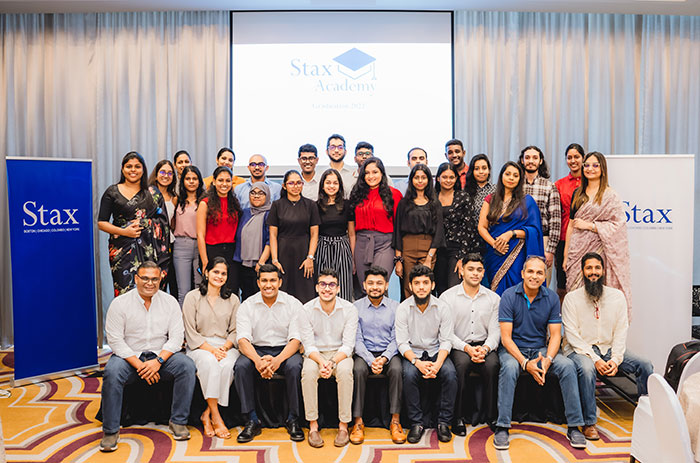
The Stax Academy, an initiative by Stax LLC, a global strategy consulting firm that specializes in delivering actionable, data-driven insights, recently conducted its graduation ceremony for the students of its first course in Colombo. The Academy was established as a platform to upskill future business leaders to take on the challenges of the global economy. The class consisted of 30 students representing various universities across Sri Lanka who successfully completed the four-month certification program.
In his address at the graduation ceremony, Dr. Kumudu Gunasekara, Managing Director, Stax, said, “Due to the current economic condition in Sri Lanka, lots of youth are seeking foreign employment opportunities and leaving our shores. As corporates, I believe that we can support our youth by providing these opportunities within the country so that they have the same overseas experience right here at home.” He also spoke about the importance of being dreamers and not followers. And the importance of dreaming big to achieve individual goals. “Age is not a barrier to achieving your dreams. This is a critical notion to break in Sri Lanka,” he added.
Adding his thoughts, Ruwindhu Peiris, Managing Director, Stax, said, “It is important that our new talent enter the workforce, ‘corporate prepared’ and ‘global ready’. The Stax Academy introduces young talent to modern skill sets demanded by the evolving corporate world. It nurtures and cultivates essential competencies to develop and transform them to be Sri Lanka’s future corporate leaders.”
Kethaka Weerasuriya, a graduate of Edith Cowan University (ECU) Sri Lanka noted that being able to embrace challenges makes you a competitive job candidate in any field. “Teamwork put us outside our comfort zone, and we realized that surrounding ourselves with the best people can help us achieve great things in life.” A student from the National School of Business Management (NSBM), Kavinda Hasaranga who joined the certification program spoke about how they learned many things that they didn’t know about the corporate world and how much they loved the work culture at Stax.
“Through data analytics we learned advanced Excel, and about web creating tools, social media analytics, work cloud, and so on. Even though data analytics was for our skill development, I have been using them for budgeting my personal expenses.” stated Omar Zaneefer, a graduate from the Royal Institute of Colombo (RIC).
A panel discussion was also held in parallel to the graduation ceremony and the panelists included Stax Managing Directors, Dr. Kumudu Gunasekara and Mr. Ruwindhu Peiris; Edith Cowan University (ECU) Sri Lanka Program Convenor/Lecturer, Dr. Anushka Siriwardana; RIC Chief Coordinator, Corporate, Alumni and Student Engagement, Ms. Sharmain Abeykoon; and NSBM Lecturer, Ms. Vageesha Rajapaksa.
The Stax Academy program offers a combination of micro-learnings across specific functional and professional skill pillars needed to establish a successful career in Management Consulting as well as in general industries. The program focuses on delivering practical learning experiences through exposing candidates to different types of workstreams and projects to uncover their strengths and explore their aspirations. The course is centered on the principles of Ikigai with the objective of enabling candidates to explore workstreams that are value-focused, fulfilling, and purposeful.
About Stax
Stax is a global M&A strategy consulting firm headquartered in Boston, USA with offices around the US, Asia, and London. Established 17 years ago, today the Asia office, based in Colombo, Sri Lanka supports its global Private Equity clients. Over the years, Stax has been advising 15 of the Top 20 global Private Equity investors and 25+ Fortune 500 companies. Since its inception, Stax has delivered over 2,500+ client engagements, across diverse industries covering 40+ international markets―Stax LLC inspires organizations to dream big, think outside the box, and complement gut-based decisions with fact-based research. Visit www.stax.com to find out more.


In response to the devastating impact of Cyclone Ditwah, The Ceylon Chamber of Commerce has been actively supporting national relief and recovery operations in collaboration with the Government of Sri Lanka, key partners, and its members.
As a co-chair of the Sri Lanka Preparedness Partnership (SLPP) alongside the Disaster Management Centre (DMC), the Ceylon Chamber together with Janathakshan, played a central role in coordinating emergency response efforts, ensuring rapid and efficient assistance to affected communities. From 28 November to 6 December 2025, the Chamber mobilised volunteers across the Chamber Secretariat, member companies MAS Capital Pvt. Ltd – Intimates Division, Aitken Spence PLC, and university student groups, contributing more than 190 hours of service and answering over 40,000 emergency assistance requests to support the DMC’s 24-hour Emergency Operations Center.
The Chamber also provided support to the DMC for the Rapid Disaster Needs Assessment (RDNA), assisting with data analysis of calls received and the development of the direct community needs component of the RDNA, which informed government planning and coordination of relief distribution.
With the generous support of its member companies, the Ceylon Chamber facilitated the collection and handing over of financial aid and essential relief items to affected areas. The Chamber is deeply appreciative of Aitken Spence PLC, BASF Lanka (Pvt) Ltd.. CDK Philip Hospital, Central Finance Company PLC, Cinnamon Hotels & Resorts, Devi Trading Company, Eastern Merchants PLC, Emar Pharma Pvt. Ltd., Finagle Lanka Pvt.Ltd., H Connect International Pvt. Ltd., Hemas Manufacturing (Pvt) Ltd., John Keells-Cinnamon Life, John Keells Holdings, John Keells Properties, Lakdhanavi, Lauke Shipping, Oxford College of Business, Perera & Sons, Shanthi Textile, Union Assurance PLC, Union Bank of Colombo PLC, Walkers Tours, Wealthtrust Securities Ltd., and a large number of private donors, both individuals and companies, for heeding the nation’s call, supporting communities and industries hardest hit by Cyclone Ditwah, and contributing to ongoing recovery and rebuilding efforts across the country.
Beyond immediate relief, the Chamber continues to support preparedness initiatives ahead of the North East Monsoon Season 2025, reinforcing resilience and readiness across the country.
“We are deeply grateful to our member companies and volunteers for stepping up in this critical time – demonstrating once again that the private sector has and will continue to play a strong and supportive role in ensuring stability and sustainability for Sri Lanka at all times’, said Krishan Balendra, Chairperson of the Ceylon Chamber.

The CSE kicked off yesterday on a bullish sentiment, but by the middle of the session it turned negative due to heavy selling pressure. Later, though, it returned to positive territory, market analysts said.
There was satisfactory buying pressure latterly, both in retail and institutional entities, following the return to normalcy of economic activities driven by international support for rebuilding the country.
Amid those developments both indices moved upwards. The All Share Price Index went up by 60.33 points while S and P SL20 was up by 11.67 points. Turnover stood at Rs 5.55 billion with nine crossings.
Top seven crossings were: Sunshine Holdings 13.6 million shares crossed to the tune of Rs 462 million and its shares traded at Rs 35, JKH 9.5 million shares crossed for Rs 198 million; its shares traded at Rs 21, Laugfs Gas (Non-Voting) 1.2 million shares crossed for Rs 73.2 million; its shares traded at Rs 61 Tokyo Cement (Non-Voting) 730,000 shares crossed tfor Rs 66.1 million; its shares traded at Rs 87, Commercial Bank 185,000 shares crossed for Rs 37 million and its shares sold at Rs 200, Access Engineering 300,000 shares crossed for Rs 23.1 million; its shares sold at Rs 77 and Laugfs Gas 300,000 shares crossed to the tune of Rs 22.4 million; its shares sold at Rs 73.90.
In the retail market top seven companies that mainly contributed to the turnover were; Colombo Dockyard Rs 485 million (two million shares traded), JKH Rs 468 million (22.4 million shares traded), Dialog Axiata Rs 245 million (8.4 million shares traded), Sunshine Holdings Rs 198 million (5.7 million shares traded), ACL Cables Rs 122 million (481,000 shares traded) and Lanka Credit Business and Finance Rs 108.5 million (11.4 million shares traded). During the day 171 million shares volumes changed hands in 34388 transactions.
It is said that manufacturing sector counters, especially JKH and Sunshine Holdings, led the market while the banking sector also fared reasonably well, especially Commercial Bank. The telecommunication sector, mainly Dialog Axiata, also performed well.
Meanwhile, Cargills Bank is looking to raise Rs 2.5 billion through a rights issue of shares at Rs 8.50 each to support lending activities.
It also will issue 294,200,000 ordinary voting shares at a ratio of 14 new ordinary shares for every 45 existing ordinary shares. The issue is expected to raise Rs 2,500,700,000 in capital, CSE sources said.
Yesterday, the rupee was quoted at Rs 308.95/309/05 to the US dollar in the spot market, weaker from Rs 308.80/90 the previous day, dealers said, while bond yields dropped significantly.
A bond maturing on 15.02.2028 was quoted at 9.05/15 percent, down from 9.15/20 percent.
A bond maturing on 15.09.2029 was quoted at 9.50/52 percent.
A bond maturing on 01.07.2030 was quoted at 9.55/65 percent.
A bond maturing on 15.12.2032 was quoted at 10.20/30 percent, down from 10.25/30 percent.
A bond maturing on 15.06.2035 closed at 10.63/70 percent.
By Hiran H Senewiratne
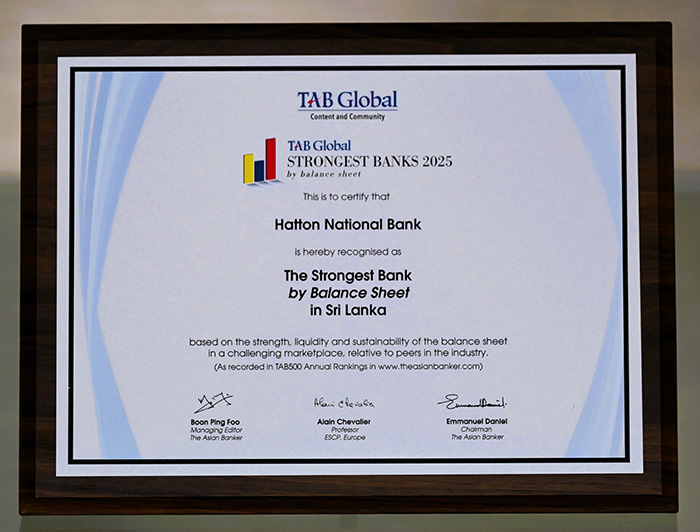
HNB PLC, the leading private bank in Sri Lanka, has been awarded the title of Strongest Bank in Sri Lanka for 2025 by TAB Global. The recognition was confirmed following the release of the TAB Global World’s 1000 Largest and Strongest Banks Rankings, with the announcement made recently
HNB’s Managing Director / CEO, Damith Pallewatte, stated that the accolade underscores the bank’s unwavering commitment to sustained financial strength and strategic resilience. “This honour shows the resilience and clarity of purpose that guide our institution. Our teams advanced through demanding cycles with discipline and accountability. The recognition confirms the trust placed in us by customers, investors and partners and it reinforces the duty we carry as a leading private bank. We remain fully committed to safeguarding long-term strength while contributing to Sri Lanka’s economic advancement with integrity and resolve.”
HNB achieves a landmark distinction in the 2025 rankings, establishing itself as Sri Lanka’s strongest bank. The assessment highlights HNB’s balance sheet quality, prudent risk discipline and the bank’s consistent ability to maintain stability through varied economic conditions. The ranking places HNB alongside leading global financial institutions acknowledged for sustained strength, institutional reliability and capacity to absorb external shocks.
Foo Boon Ping, President and Managing Editor at TAB Global, stated: “HNB demonstrated strong fundamentals and consistent delivery across multiple stress indicators. The bank’s performance placed it ahead of its domestic peers and aligned it with institutions recognised for structural strength. The ranking reflects measurable outcomes drawn from transparent criteria.”

Showers or thundershowers will occur at times in the Northern, North-Central, Eastern and Uva provinces and in Puttalam, Matale and Kurunegala districts

Rs 1. 3 bn yahapalana building deal under investigation

SL Railways suffers staggering losses; more than 2/3 of rail tracks out of service

US, SL advancing free, open, and resilient Indo-Pacific region: Embassy

Vetaran lankan artistes domiciled in UK felicitated in London ceremony

Forced disappearances, a contentious issue warranting NPP’s attention – FSP

‘Dates have the highest sugar content to fight Coronavirus’

Sunday Island 27 December – Headlines

#SundayIsland 17th December – Headlines

Sunday Island – 28th March

Sunday Island Headlines – 21 March

Sunday Island – 21st February – Headlines
-

 News4 days ago
Over 35,000 drug offenders nabbed in 36 days
-

 Features2 days ago
Finally, Mahinda Yapa sets the record straight
-

 News3 days ago
Cyclone Ditwah leaves Sri Lanka’s biodiversity in ruins: Top scientist warns of unseen ecological disaster
-

 Business6 days ago
LOLC Finance Factoring powers business growth
-

 News6 days ago
CPC delegation meets JVP for talks on disaster response
-
 News6 days ago
A 6th Year Accolade: The Eternal Opulence of My Fair Lady
-

 News4 days ago
Rising water level in Malwathu Oya triggers alert in Thanthirimale
-

 Features5 days ago
The Catastrophic Impact of Tropical Cyclone Ditwah on Sri Lanka: