
Features
Hail Mary pass to avoid arrest and/or imprisonment?


Early Announcement for Trump’s Candidature for 2024
by Vijaya Chandrasoma
On Tuesday, November 15, former disgraced, twice-impeached former President Donald Trump announced his candidacy for the Presidency in 2024, under the aegis of the Republican Party. The announcement was made unilaterally, without consensual agreement, even discussion, with members of the Party.An announcement of candidature for the presidency, over two years before the scheduled election, is unprecedented. It is the earliest such an announcement has been made in history. It was also made at a time when numerous Republicans are publicly declaring their intentions to run for the 2024 Presidency.
Trump will almost certainly not be the only Republican candidate in 2024, even if he wriggles out of his criminal charges. Already, several candidates, Florida Governor Ron DeSantis, Virginia Governor Glenn Youngkin, former Vice President Mike Pence and former Secretary of State, Mike Pompeo, have declared their intentions to run. There will be others.
Trump’s rally for his announcement was scheduled in the certainty, according to all polls, of celebrating an unprecedented Republican triumph in the midterms with substantial gains in both Houses. Also, to celebrate the election wins of the slate of Trump endorsed candidates in the House and the Senate. Sadly for the Republicans, and against all expert forecasts, Democrats retained their majority in the Senate, lost its majority in the House by a razor thin majority, in contrast to the polls’ prediction of a Republican flip of 50/60 seats.
Trump’s endorsees lost in all the competitive states and the incumbent Republican Congressmen endorsed by Trump, either lost, or won with reduced majorities, even in deep red districts. Although Trump only takes credit for the wins, many members of the rank and file have complained that their abysmal performance in the midterms was caused mainly by Trump’s involvement.
The atmosphere at the Republican rally was subdued and somber. Trump’s speech was lackluster, very different from his usual performance of vulgar histrionics. He read from the prepared speech, and did not stray onto his hypocritical displays of patriotic emotion. He had no reason to lie, because the lies were already included in the prepared script. He reflected the doleful mien of a desperate gambler who has played his last card, and is now facing dire consequences. I am personally familiar with that countenance.
Trump is facing several civil and criminal charges. Most of these investigations have reached conclusion, and an arrest of the former president is imminent. His crimes fall under several themes: financial, tax and insurance frauds during his presidency; extortion and obstruction of justice; his role in the January 6 insurrection; his alleged interference in the 2020 election; and the mishandling – a polite word for stealing – of confidential documents, 15 boxes of them, and storing them in an unsecured basement at his Mar-a-Lago home in Florida.
Some of these documents included Top Secret information about allies’ nuclear capabilities and information about the progress of CIA operations. The stealing of these documents, the rightful property of the government to be secured at the National Archives, is a felony tantamount to espionage and treason. It is alleged that his son-in-law, Jared Kushner, has already sold some of these Top-Secret documents to a foreign country.
I believe the primary motive behind this extraordinarily early announcement of his candidature for the 2024 election has nothing to do with a desire for a second term at the White House, and everything to do with staying out of prison. Trump has played his “Hail Mary” pass, which in American football parlance means “a very long forward pass, typically made in desperation, with an exceptionally small chance of achieving completion”. Trump, the Chosen One, is begging the Virgin Mary (his heavenly grandmother?) for strength and help in keeping him out of prison.
The law demands that no criminal action should be taken against a political candidate two months before an election, be it dogcatcher or president. Trump, in his convoluted logic, is of the lopsided opinion that the announcement of his candidacy for the highest post in the land two years before the election should give him immunity from arrest and/or imprisonment.
This will probably end up as his second Big Lie, that the period of immunity from arrest is not two months but two years. Ever the victim, Trump will replace his first slogan about the 2020 election, STOP THE STEAL with a new lie, “TWO YEARS, NOT TWO MONTHS” to his frenzied cult at rallies, which they will believe without a shred of evidence or any basis in the law. As they still believe the STOP THE STEAL lie even after two years after the election.
Which brings us to his second motive. This early announcement will succeed in fleecing his gullible supporters of millions of dollars, on the pretext of the need to pay legal fees to fight this second Big Lie in the courts. They continue to believe, in the face of conclusive evidence to the contrary, that Trump is the victim of a witch hunt surpassing the infamous witch trials in Salem, over 300 years ago. And again put millions of dollars into Trump’s pockets.
They will likely kiss the ring yet again, and recoronate Trump as their leader. Trump, in their bigoted minds, remains the last white hope to perpetuate White Supremacy, which they fear is slipping away. They will place the blame for the debacle in the recent midterms on someone else: Senator Mitch McConnell? Speaker Kevin McCarthy? His cokehead son, Donald Jr? For the radical right, any Republican, bar one, is expendable.
Who knows what people whose minds are twisted, whose hearts are full of hate, will do? They are more than likely to indulge in January 6 type riots if their Fuhrer is arrested. “Blood in the streets” has already been predicted/incited by Trump and Senator Lindsey Graham if Trump is arrested. But if that happens, the U.S. now has a President who will immediately use its military and law enforcement might to crush them and send them back into the woodwork where they belong.
The Democrats also face an important decision. Nancy Pelosi will no longer be the Speaker of the House. Sadly, she announced on Thursday that she will no longer seek to be the minority leader of the House. She is 82 years old, and the recent attack by a Republican white supremacist thug on her 82-year-old husband of 60 years, an attack in which she was the target, has probably persuaded her to leave the job she has been carrying out magnificently for over two decades.
Whoever takes over as minority leader of the House will have a tough act to follow; who will have to contend with a ruthless and vengeful Republican holding the gavel, and a Party which will use its slim majority to bring dishonour to President Biden and block his progressive legislation.
Nancy Pelosi has been one of the outstanding heroines of her generation who inspired, and continues to inspire, many women to challenge for positions of leadership which had hitherto been denied to them. Most importantly, she has been the perfect role model for the younger generation, the little girls of today, to be a part of the present global movement proving that the phrase, even in current usage, describing women as “the weaker sex” to be a total misnomer, as they dare to claim their rightful place of gender equality in society.
As English philosopher John Stuart Mill said in 1869, “The principle which regulates the existing social relations between the two sexes – the legal subordination of one sex to another – is wrong in itself and is now one of the chief hindrances to human improvement.” True in 1869, true in 2022.
Liz Cheney, the defeated Congresswoman from Wyoming and Trump bete noire, is considering presidential a run as an Independent. In a recent interview on NBC’s Today television show, Liz Cheney said, “It (a 2024 presidential run) is something I’m thinking about. I’ll make a decision in the coming months”, emphasizing that she’ll be “doing whatever it takes to keep Donald Trump out of the Oval Office”.
The idea that Liz Cheney would win the Republican nomination for 2024 is not within the realms of reality, today. She is playing the long game, given that the volatile political climate will change several times in the next two years. Once Trump is eliminated and hopefully punished for his numerous crimes, she may be welcomed back into the folds of the Republican Party. In which case, she would be a participant in Republican Primaries and pre-election debates, which will include other Republican aspirants. While Ms Cheney may not have much of a chance of winning the Republican nomination, she is undeniably the perfect person to expose Trump’s crimes of fraud, sedition and treason on national television. And also reveal those of her 2024 rivals who were Trump’s enablers/sycophants complicit in his crimes until he fell out of favour.
Cheney’s second route would be to announce her candidature, in due time, by joining an existing, though lesser-known Party (American Independent, Libertarian, Green, to name three) and contest the presidency as an Independent under its aegis. As things stand today, Liz Cheney surely would act as a spoiler (if such a spoiler is needed) to ensure the victory for the Democrats by splitting the Republican vote in 2024. Liz Cheney is a staunch old-school Conservative, with the integrity and values of the pre-Nixon Republican Party. She has already proved that she will not support any Party which threatens the preservation of U.S. Democracy.
It is of vital importance that Democrats field a candidate capable of conclusively defeating any racist and regressive Republican. Whether it is President Biden or someone younger, we have to ensure that Democrats will be allowed to continue on the path they have taken towards social and economic justice – universal healthcare, free schooling up to and including universities, realistic minimum wages, affordable housing and all those benefits enjoyed by the citizens of all developed countries, bar, shamefully, the richest and most developed country in the world.
The younger generation played a decisive role in defeating the Republicans in the midterms. Even more importantly, they represent the generation that played the pivotal role in saving democracy in the United States. As long as they continue to play that dominant role, the U.S.’ future is in good hands.



 Should Sri Lanka consider an 18th IMF programme? Some academicians exploring Sri Lanka’s development prospects in depth are raising this issue. It is yet to emerge as a hot topic among policy and decision-making circles in this country but common sense would sooner rather than later dictate that it be taken up for discussion by the wider public and a decision arrived at.
The issue of an 18th IMF programme was raised with some urgency locally by none other than Dr. Ganeshan Wignaraja,Visiting Senior Fellow, ODI Global London, one of whose presentations, made at the Regional Centre for Strategic Studies (RCSS), Colombo, was highlighted in this column last week, May 7th. An IMF programme is far from the ideal way out for a bankrupt country such as Sri Lanka but a policy of economic pragmatism would indicate that there is no other way out for Sri Lanka. Such a programme is the proverbial ‘Bird in the hand’ for Sri Lanka and it may be compelled to avail of it to get itself out of the morass of economic failures it is bogged down in currently.
While local economic growth possibilities are far from encouraging at present, such prospects globally are far from bright as well. Some of the more thought-provoking data in the latter regard were disclosed by Dr. Wignaraja. For example, ‘The IMF’s April 2026 World Economic Outlook projects global growth slowing to 3.1 percent in 2026; with downside risks dominating: prolonged conflict, geopolitical fragmentation, renewed trade tensions, bearing down hardest on emergent and developing economies.’
However, as is known, an ‘IMF bailout’ is fraught with huge risks for the people of a developing country. ‘The Silver Bullet’ brings hardships for the people usually and they would be required by their governments to increasingly ‘tighten their belts’ and brace for perhaps indefinite material hardships and discontent. For Sri Lanka, the cost of living is unsettlingly high and 20 percent of the population is languishing below the poverty line of $ 3.65 per day.
These statistics should help put the spotlight on the people of a country, who are theoretically the subjects and beneficiaries of development, and one of the main reasons, in so far as democracies are concerned, for the existence of governments. Placing people at the centre of the development process is urgently needed in the global South and shifting the focus to other considerations would be tantamount to governments dabbling in misplaced priorities.
Technocrats are needed for the propelling of economic growth but a Southern country’s main approach to development cannot be entirely technocratic in nature. The well being of the people and how it is affected by such growth strategies need to be prime focuses in discussions on development. Accordingly, discourses on how poverty alleviation could be facilitated need urgent initiation and perpetuation. There is no getting away from people’s empowerment.
In the South over the decades, the above themes have been, more or less, allowed to lapse in discussions on development. With economic liberalization and ‘market economics’ being allowed to eclipse development, correctly understood, people’s well being could be said to have been downplayed by Southern governments.
The development issues of Southern publics could be also said to have been compounded over the years as a result of the hemisphere lacking a single and effective ‘voice’ that could consistently and forcefully take up its questions with the global powers and institutions that matter. That is, the South lacks an all-embracing, umbrella organization that could bring together and muster the collective will of the South and work towards the realization of its best interests.
This columnist has time and again brought up the need for concerned Southern sections to explore the potential within the now virtually moribund Non-Aligned Movement to reactivate itself and fill the above lacuna in the South’s organizational and mobilization capability. In its heyday NAM not only possessed this institutional capability but had ample ‘voice power’ in the form of its founding fathers, with Jawaharlal Nehru of India, for example, proving a power to reckon with in this regard. The lack of such leaders at present needs to be factored in as well as accounting for the South’s lack of power and presence in the deliberative forums of the world that have a bearing on the hemisphere’s well being.
The Executive Director of the RCSS, Ambassador (Retd) Ravinatha Aryasinha, articulated some interesting thoughts on the above and related questions at a forum a couple of months back. Speaking at the launching of the book authored by Prof. Gamini Keerewella titled, ‘Reimagining International Relations from a Global South Perspective’, at the Bandaranaike Centre for International Studies, Colombo, Amb. Aryasinha said, among other things: ‘Historically, there is a precedent that has been realized by the Non-Aligned group of countries – unfortunately, rather than being reformed and modified at the end of the Cold War, it has been tossed away.’
The inability of the nominally existent NAM to come out of its state of veritable paralysis and voice and act in the name of the South in the current international crises lends credence to the view that the organization has allowed itself to be ‘tossed away.’ The challenge before NAM is to prove that it is by no means a spent force.
As indicted, NAM needs vibrant voices that could advocate value-based advancement for the global South. Moral principles need to triumph over Realpolitik. Such transformative changes could come to pass if there is a fresh meeting of enlightened minds within the South. Pakistan by offering to mediate in the ongoing conflict between the US and Iran, for instance, proved that there are still states within the South that could look beyond narrow self-interest and work towards some collective goals. Hopefully, Pakistan’s example will be emulated.
Along with Pakistan some Gulf states have shown willingness to work towards a de-escalation of the present hostilities in West Asia. This could be a beginning for the undertaking of more ambitious, collective projects by the South that have as their goals political solutions to current international crises. These developments prove that the South is not bereft of visionary thinking that could lay the basis for a measure of world peace. That is, there are grounds to be hopeful.
NAM needs to see it as its responsibility to make good use of these hopeful signs to bring the South together once again and work towards the realization of its founding principles, such as initiating value-based international politics and laying the basis for the collective economic betterment of Southern people.

 (The author is on X as @sasmester)
I have often been told by university colleagues how soulless and dangerous ‘artificial intelligence’ (AI) is to academia and humanity. They lament that students no longer read anything as they can now get various AI programmes to summarise what is recommended which is mostly in the English language to Sinhala or Tamil or get easier versions in English itself. They get their assignments and even dissertations fully or partially written by AI. And I am led to believe that universities do not have reliable detection software to assess plagiarism and academic fraud that have been committed using AI beyond the software freely available on the internet with their own limitations. This is due to financial restrictions in these institutions. Even these common malpractices have been done mostly with the aid of free AI programmes which are readily available, which means cheating in this sense is free and mostly safe. For teachers, this is a ‘menace’ in the same way ‘copying’ once was. But its implications are far worse.
But given the global investments made over AI, it cannot be wished away despite the enormous negative impact its use has on the environment, particularly due to its massive demand for energy. So, AI is with us to stay, and it has a considerable role to play in human civilisation even though like most innovations and inventions, this too carries its own burden of negativity. In this context, instead of demonising AI and lamenting its replacement of human agency and ingenuity, one needs to think seriously about how to deal with and engage with it reflectively and pragmatically as there is much it can offer if people are intelligent enough to make rational and sensible choices.
When I am making these observations, I am restricting myself to a handful of practices involving only writing both in university-based examination processes and in the fields of creative writing.
My initial introduction to AI was through the Research Methods class I used to teach in New Delhi. In 2022, this class was supposed to go to Dharmshala in Uttar Pradesh for fieldwork training, and we needed to write a funding proposal quickly. One of the students in the class, already familiar with ChatGPT introduced by OpenAI as a free programme in 2022, did the proposal with its help before the two-hour class was over. I edited it soon after and sent it off to the university administration for funding which we received. That stint of field work was completed in five days and was the most detailed work undertaken as a training programme up to that time in the university which had considerable output ranging from a documentary film to a detailed ethnography based on the findings.
While the technical details, the format of the proposal and its basic writing were done by AI due to the time constraints the class faced, its fine-tuning was done by me and a few students. AI could not then and even now cannot undertake that level of specificity without close human intervention. But the film, the ethnography and the actual process of research had nothing to do with AI. It was the result of human labour, thinking, planning and at times creativity and ingenuity. This was an early example of how AI could coexist in an academic environment if its technical usefulness was clearly understood and potential for excesses was also understood. But this was a time, easily accessible AI was just emerging, and we did not know much about it. But I was fortunate enough to have intelligent students in my class who gave me a crash course into this kind of AI use, which I followed up with my own reading and experimentation later on. As a result, I am keener now to see how it can be used for the betterment of academic practice rather than taking an uncritically demonising position, which I know will not lead anywhere.
But how is this possible? The lamentations of my colleagues about the abuse of AI in academic practice is not unfounded. It is a serious threat that remains mostly unaddressed not only in our country but almost everywhere else in the world too. This is mostly because the advancements of AI even in day-to-day free usage have far exceeded any thoughts for actionable codes of ethics to ensure its practice is sensible and ethical. At the same time, I cannot see why a student should not use AI to correct his spelling and grammar in assignments. I also cannot see why a student cannot seek AI’s help to secure research material from secondary sources available online which I have been doing for years. For instance, the originals of specific books and rare manuscripts might not be available in any repositories in our part of the world. In such situations, what AI might find us is all we have access to in a world where we are restricted in our mobility due to semi-racist visa regimes of failed empires and former superpowers as well as our own lack of ability to travel due to our own unenviable economic conditions. But unfortunately, the materials we need are often only available in research centers and libraries in those nations.
Similarly, when it comes to academic prose, it makes no sense now to take years to translate works from multiple languages to Sinhala and Tamil. This has always been a time-consuming, cumbersome and expensive process. Non-availability of Sinhala and English translations of core originals in languages such as English, French, German and so on has been a long-term problem for our country. But this can now be done well – at least from English to our languages – quite quickly and with a very low margin for error by using specific AI programmes which are meant to do precisely this. What this means is a quick expansion of knowledge in local languages which would have ordinarily taken years to achieve or might not have been possible at all. But still, this needs significant human intervention and time towards perfection. However, I do not think AI-based translations work as well for fiction and poetry or creative works more generally. But the ability for AI to emulate nuance and feeling in language is fast emerging. These are two clear examples of improving technical abilities in research and writing in which AI can be of help.
But looking for sources of information with help the help of AI or using it as a tool to undertake essential translations from one language to another is quite different from simply using it without ascertaining the accuracy of collected information, getting AI to do all your work without any reflection or without any hard work at all, including engaging AI to do the final product in a writing assignment — be that a term paper or a work of fiction. If one proceeds in this direction, as many unfortunately do nowadays, then, our ability to think and be creative as a species will become diminished over time and our sense of humanity itself will take a toll. This is what my colleagues worry about when they say AI is making younger generations soulless.
It is here that ethical practices on how to use AI responsibly without compromising our sense of humanity must play a central role. But these ethical practices must be formally written and taught, followed by viable programmes for detection and publication if unethical practices are followed. This needs to be the case particularly in teaching institutions as well as the broader domain of creative writing. After all, what is the fun in reading a novel or a collection of poetry written by AI?
It is time people began to think about what AI can do in their own fields without falling prey to its power and their own laziness. This brings to my mind Geoffrey Hinton’s words: “There is no chance of stopping AI’s development. But we need to ensure alignment; to ensure it is beneficial to us …” Similarly, as Yann LeCun observed, “AI is not just about replicating human intelligence; it’s about creating intelligent systems that can surpass human limitations.” In this sense, it is up to us to find our edge in creativity and common sense to find the most sensible way forward in using AI.

 The legendary Engelbert Humperdinck, who is known for his hit songs such as ‘A Man Without Love’, ‘Release Me’, ‘Spanish Eyes’, ‘The Last Waltz’, ‘Am I That Easy To Forget’, ‘Ten Guitars’ and ‘I Can’t Stop Loving You’, turned 90 on 02 May, 2026, and there were some lovely Hollywood-related celebrations.
Before his birthday, Engelbert’s new single ‘I’ve Got You’ was released – on 23 April – and Engelbert had this to say: “‘I’ve Got You’ is especially close to my heart. It speaks to love, loyalty, and the quiet strength we find in one another”.
The main birthday event was held at The Starlight Cabaret, in Los Angeles, California, and Sri Lankan Raju Rasiah, now based in the States, and his wife Renuka, who are personal friends of Engelbert, were invited to participate in the celebrations, along with Ingrid Melicon – also a Sri Lankan, now domiciled in America.
The invitation said “An evening of music, memories and celebration. Let’s make it a night to remember!” And it certainly turned out to be a night never ever to be forgotten!
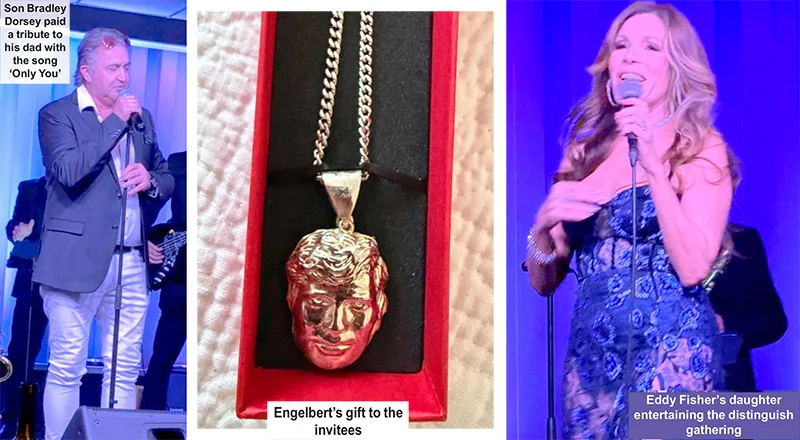
Invitees experienced a “magical entrance” with Engelbert’s name lighting up the screen and showing him performing his hit songs.
The invitees were also presented with a unique gift – a necklace with Engelbert’s face, engraved with the words “Remember, I Love You.”
Engelbert’s son, Bradley Dorsey, sang a tribute song ‘Only You’ for his dad, while Eddy Fisher’s daughters, Tricia and Joely, also got on stage to entertaining the distinguish gathering.
Engelbert didn’t perform but got on stage for the cutting of the birthday cake.
There was also a video compilation of birthday wishes from fellow celebrities, and the lineup included Gloria Gaynor, Micky Dolenz, Wayne Newton, Pat Boone, Lulu, Judy Collins, Deana Martin, Angélica María, Rupert Everett, Matt Goss, and more.

Birthday boy Engelbert Humperdinck
At 90, Engelbert is still performing. He’s on THE CELEBRATION TOUR for his 90th year, with over 50 international dates in 2026, including Australia, Germany, the US, and Canada. He’ll be at Massey Hall in, Toronto, on 06 October, 2026. He said: “The stage is my home… Canada has always been a highlight”.
He performed 60+ concerts, worldwide, in 2025, and says karaoke keeps his songs fresh: “Most of my songs are on karaoke because people love to sing them”.

Vaibhav Sooryavanshi picked in India ‘A’ squad for one-day tri-series in Sri Lanka

Saudi Arabia set to host Dunes League T20 from October

The guidance of Religious Leaders is essential to strengthen coexistence among communities. — Prime Minister

‘Watermelon deaths’ in Mumbai puzzle investigators

Mass sex abuse allegations force closure of boarding school in Indonesia

Gunshots fired in Philippine Senate where lawmaker wanted by ICC is holed up

‘Dates have the highest sugar content to fight Coronavirus’

Sunday Island 27 December – Headlines

#SundayIsland 17th December – Headlines

Sunday Island – 28th March

Sunday Island Headlines – 21 March

Sunday Island – 21st February – Headlines
-

 News5 days ago
Lanka Port City officials to meet investors in Dubai
-
 News2 days ago
Ex-SriLankan CEO’s death: Controversy surrounds execution of bail bond
-

 News6 days ago
SLPP expresses concern over death of former SriLankan CEO
-

 Editorial7 days ago
The Vijay factor
-
 News6 days ago
Police inform Fort Magistrate’s Court of finding ex-CEO of SriLankan dead under suspicious circumstances
-
 Features3 days ago
When University systems fail:Supreme Court’s landmark intervention in sexual harassment case
-
Features3 days ago
High Stakes in Pursuing corruption cases
-

 Features7 days ago
Palm leaf manuscripts of Sri Lanka – 1