
Business
Is the interim budget speech growth-oriented?


Seneka Abeyratne
The interim budget speech, presented in parliament on August 30th, is eloquently written. It is easy to read and sprinkled with the right buzz words. It is crisp and flows like a meandering stream. But an interim budget speech should be a little more than a meandering stream. Though it possesses many positive features, what it lacks is a focal point, which could be articulated in the form of a question: “How do we resuscitate an ailing economy that is showing no signs of picking up?” The ADB’s GDP growth forecast for Sri Lanka in 2022 is a staggering -7.6 %. The private sector is the engine of growth.
As long as the engine remains in poor condition, the prospect of a strong economic recovery in this island will remain an elusive goal. The interim budget speech does not indicate how the government intends to breathe life into the crippled economy and stimulate rapid private-sector development, which is the key to attaining sustainable, catch-up growth. If the economy does not pick up soon, it is bad news for the country. Shortages of essential goods, including food, fuel and medicines, will worsen, inflation will continue to gallop like a racehorse, and the incidence of both absolute and relative poverty will reach obscenely high levels. A sense of urgency is missing in the interim budget speech.
The all-pervasive nature of the
economic crisis
The current economic crisis is so severe that it is threatening to transform the country into a basket case. How many businesses, including factories, shops, beauty parlors, and restaurants, have shut down during the past two years? How many workers have lost their jobs and fallen below the poverty line? How many families are suffering from extreme hunger and deprivation? How many outpatients and inpatients have died or are about to die due to the acute shortage of medicines? How much damage has the economic crisis inflicted on the educational sector? How many global business companies and financial institutions are staying away from Sri Lanka not only because it has committed the cardinal sin of going into debt default, but also because of its tepid business climate, its low global ranking in respect of business-friendly regulations, and its cavalier approach to macroeconomic policy formulation? What progress have the foreign lawyers and advisors hired by the government at prohibitive cost made to date in respect of negotiations pertaining to debt restructuring? What are the terms and conditions of the Staff-level Agreement reached by the IMF on an Extended Fund Facility (EFF) arrangement with Sri Lanka which even the parliamentarians have not yet seen? What proportion of the EFF of $ 2.9 billion will be diverted to the repayment of foreign loans obtained by the government from official lending agencies? How open and transparent is the government in the preparation of reform plans? How long will it take for the nation to emerge from the economic doldrums and learn to stand on its own two feet? The answer to all these questions is, “Heaven knows.”
The economy has been stuck in the emergency room for more than two years, rather like a bed-ridden patient who cannot survive without continuous blood transfusions. In this regard, a glaring omission in the interim budget speech is a section that outlines the core elements of an economic revival and stabilization strategy. Though the speech, by and large, is elegantly composed, there is no thread running through it that binds the narrative into a cohesive and consistent whole. The speech does make a serious attempt to dissect the true nature of the economic crisis or to enlighten the public about how it intends to extricate the economy from the mire of negative growth and stimulate sustainable, pro-poor growth. The narrative on the whole lacks depth due to the general absence of critical analysis and innovative thinking.
Will government fight corruption, nepotism and political patronage?
Be that as it may, the importance attached to some key areas of government policy intervention such as monetary and fiscal sector reforms, public sector reforms, restructuring of loss-making state-owned business enterprises, social welfare reforms, educational sector reforms, skills development, and the strengthening of macroeconomic fundamentals is a positive feature of the interim budget speech. To generate a primary surplus in the government budget by 2025 via higher revenues and lower expenditures is a notable goal, but to attain it, the government must make a serious attempt to eliminate corruption, nepotism, and political patronage. In this regard the sudden removal of the COPE Chairman, who was in the process of exposing the intimate link between political patronage and the current economic crisis, does not augur well for the future.
If the current administration continues with the abhorrent practice of replacing senior government officials who have no truck with corruption or political patronage with political stooges, it will be doing the country an immense disservice. Corrupt political stooges have wrecked the economy and will continue to wreak havoc in the nation as long as the deeply entrenched system of political patronage remains unchanged.
Private-sector must play key role
in economic revival
A central concern is whether the policy and regulatory reform agenda broadly identified in the speech is sufficient to stimulate rapid private-sector development and transform the nation from a high-cost producer of goods and services into a globally competitive economy. There is little or no mention in the interim budget speech of the critical need to address key constraints on private sector development and foreign direct investment inflows, given the current administration’s misguided notion that protectionism is the way out of the economic crisis.
Since the private sector (both local and foreign) must play a pivotal role in improving productivity, export performance, and global competitiveness, it follows that in the absence of a healthy business environment, the economy will continue to stagnate and government efforts to strengthen macroeconomic fundamentals will fail. If concrete measures are not introduced to create a salubrious ease-of-doing business climate, the economy is likely to remain in the doldrums.
In conclusion, as per the question: “Is the interim budget speech growth-oriented?” the answer is an emphatic, “No.”
The author is a retired economist/international consultant to ADB MANILA. He can be contacted at snabeyratne@gmail.com



National Airport Exit Survey tells quite a story
Australia’s role here is strategic, not charitable
In a quiet but significant shift, Sri Lanka’s tourism sector is moving beyond traditional destination marketing and instinct-based planning. The recent launch of the “From Data to Decisions” initiative jointly backed by Australia’s Market Development Facility and the Sri Lanka Tourism Development Authority, sent an unambiguous message: sentiment is out, statistics are in.
The initiative is anchored by a 12-month National Airport Exit Survey, a trove of data covering 16,000 travellers. The findings sketch a new traveller profile: nearly half are young (20–35), independent, and book online. Galle, Ella, and Sigiriya are the hotspots; women travellers outnumber men; and a promising 45% plan to return. This isn’t just trivia. It’s a strategic blueprint. If Sri Lanka Tourism listens, it can tailor everything from infrastructure to marketing, moving from guesswork to precision.

Tourists have a real sense of achievement after hiking the trail to Ella Rock
The keynote speaker, Deputy Minister Prof. Ruwan Ranasinghe called data “a vital pillar of tourism transformation.” Yet the unspoken truth is that Sri Lanka has long relied on generic appeals -beaches, heritage, smiles. In today’s crowded market, that’s no longer enough. As SLTDA Chairman Buddhika Hewawasam noted, this partnership is about “elevating how we collect, analyse, and use data.”
Australia’s role here is strategic, not charitable. By funding research and advocating for a Tourism Satellite Account, it is helping Sri Lanka build a tourism sector that is both sustainable and measurable. Australian High Commissioner Matthew Duckworth linked this support to “global standards of environmental protection” – a clear nod to the growing demand for green travel. This isn’t just aid; it’s influence through insight.
“The real test lies ahead,” a tourism expert told The Island. “Data is only as good as the decisions it drives. Will these insights overcome bureaucratic inertia? Will marketing budgets actually follow the evidence toward younger, independent, female travellers?,” he asked.
“The comprehensive report promised for early 2026 must move swiftly from recommendation to action. In an era where destinations are discovered on Instagram and planned with algorithms, intuition alone is a high-stakes gamble. This forum made one thing clear: Sri Lanka is finally building its future on what visitors actually do – not just what we hope they’ll do. The numbers are in. Now, the industry must dare to follow them,” he said.
By Sanath Nanayakkare

In his inaugural address as the new Chairman of the Asia Tea Alliance (ATA), Nimal Udugampola placed the region’s millions of smallholders at the core of the global tea industry’s future, asserting they are the “indispensable engine” of a sector that produces over 90% of the world’s tea.
Udugampola, who is also Chairman of Sri Lanka’s Tea Smallholdings Development Authority, used his speech at the 6th ATA Summit held in Colombo on Nov. 27 to declare that the prosperity of Asian tea is “entirely contingent” on the resilience of its small-scale farmers, who have historically been overlooked by premium global markets.
“In Sri Lanka, smallholders account for over 75% of our national production. Across Asia, millions of families maintain the quality and character of our regional teas,” he stated, accepting the chairmanship for the 2025-2027 term.
To empower this vital community, Udugampola unveiled a vision focused on Sustainability, Equity, and Digital Transformation. The strategic agenda includes:
Climate Resilience: Promoting climate-smart agriculture and regenerative farming to protect smallholdings from environmental disruption.
Digital Equity: Leveraging technology like blockchain to create farm-to-cup traceability, connecting smallholders directly with premium consumers and ensuring fair value.
Market Expansion: Driving innovation in tea products and marketing to attract younger consumers and enter non-traditional markets.
Standard Harmonization: Establishing common regional quality and sustainability standards to protect the “Asian Tea” brand and push for stable, fair pricing.
Linking the alliance’s goals to national ambition, Udugampola highlighted Sri Lanka’s target of producing 400 million kilograms of tea by 2030. He presented the country’s “Pivithuru Tea Initiative” as a model for other ATA nations, designed to achieve this through smallholder empowerment, digitalization, and aligned policy objectives.
By Sanath Nanayakkare
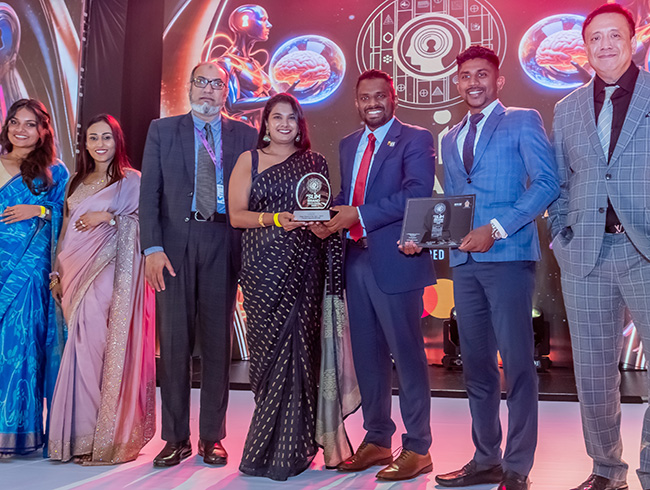
Brandix Apparel Solutions was recognised as the Green Brand of the Year at the Sri Lanka Institute of Marketing (SLIM) Brand Excellence Awards 2025, taking home Silver, the highest award presented in the category this year.
The ‘Green Brand of the Year’ recognises the brand that drives measurable environmental impact through sustainable practices, climate-aligned goals and long-term commitment to protecting natural resources.
A pioneer in responsible apparel manufacturing for over two decades, Brandix has championed best practices in the sphere of sustainable manufacturing covering environmental, social, and governance aspects. The company built the world’s first Net Zero Carbon-certified apparel manufacturing facility (across Scope 1 and Scope 2) and meets over 60% of its energy requirement in Sri Lanka via renewable sources.
Head of ESG at Brandix, Nirmal Perera, said: “Being recognised as Green Brand of the Year is an encouraging milestone for our teams working across sustainability.”

New landslide alerts as Ditwah aftermath worsens

Over 35,000 drug offenders nabbed in 36 days

Rising water level in Malwathu Oya triggers alert in Thanthirimale

US INDOPACOM deploys airlift and logistics support for Lanka’s Cyclone Ditwah response

Seizure of drug haul off Kalpitiya:Father, son among 5 arrested

Chef arrested in exotic bird theft from Dehiwala Zoo

‘Dates have the highest sugar content to fight Coronavirus’

Sunday Island 27 December – Headlines

#SundayIsland 17th December – Headlines

Sunday Island – 28th March

Sunday Island Headlines – 21 March

Sunday Island – 21st February – Headlines
-
News5 days ago
Lunuwila tragedy not caused by those videoing Bell 212: SLAF
-
 News4 days ago
Level III landslide early warning continue to be in force in the districts of Kandy, Kegalle, Kurunegala and Matale
-
 Latest News6 days ago
Level III landslide early warnings issued to the districts of Badulla, Kandy, Kegalle, Kurunegala, Matale and Nuwara-Eliya
-

 Features6 days ago
Ditwah: An unusual cyclone
-

 Latest News7 days ago
Updated Payment Instructions for Disaster Relief Contributions
-

 News2 days ago
CPC delegation meets JVP for talks on disaster response
-

 Business2 days ago
LOLC Finance Factoring powers business growth
-

 News2 days ago
A 6th Year Accolade: The Eternal Opulence of My Fair Lady