
Midweek Review
A forgotten episode: Black Sea Tiger raid on Colombo port

By Shamindra Ferdinando
Having read the writer’s review of ex-Lankadeepa defence correspondent Ratnapala Gamage’s Ranabime Panhinda (Notes from the battlefront), retired Lieutenant L.S.A.N.T. Siriwardhana sought an explanation regarding the absence of at least a reference to the high profile raid on the Colombo harbour, in April 1996.
The Australia-Sri Lanka dual citizen pointed out that the unprecedented LTTE (Liberation Tigers of Tamil Eelam) foray into the heavily guarded Colombo port never received the attention it deserved.
“Ratnapala Gamage discussed the commando-style LTTE raid on the Bandaranaike International Airport, carried out in late July 2001 though he left out April 1996 raid on the Colombo port,” Siriwardhana said, asserting perhaps the media never had sufficient access to the required information.
Siriwardhana declared that he felt the need to discuss the Colombo port attack against the backdrop of Sri Lanka’s latest humiliating defeat at the Geneva-based United Nations Human Rights Council (UNHRC). In the absence of a comprehensive examination of the overall war, with the focus on major specific incidents and developments, successive governments failed to counter continuing propaganda against the country, and its valiant fighting men, by interested parties.
Siriwardhana said that even over 12 years after the successful conclusion of the war, the government hadn’t been able to properly record the conflict. Therefore, Sri Lanka’s failure to effectively counter propaganda and the resultant developments should be a matter of serious concern, Siriwardhana said.
LTTE issues statements from London
 Following the raid on the Colombo port, on April 12, 1996, the LTTE issued two statements from its International Secretariat, situated at 211, Katherine Road, London E 6, IBU, UK. The LTTE credited the Black Sea Tigers with the attack. It also showed how the British continued to mollycoddle the terrorists, on its soil, even long after the Tigers assassinated former Indian Prime Minister Rajiv Gandhi, in May 1991, on all types of pretexts. The UK turned a blind eye to the assassination of President Ranasinghe Premadasa and several lawmakers. Having openly nurtured Tiger terrorists we wonder whether the UK has any right to accuse us of doing any wrong in single handedly crushing that organization, termed by none other than the US Federal Bureau of Investigation, as the most ruthless terrorist organization.
According to the LTTE statements, dated April 13 and 15, 1996, Black Sea Tigers succeeded in destroying three Fast Attack Craft (FACs) and three supply vessels, in the Colombo harbour. The writer covered the Black Sea Tiger incursion which, according to the Sri Lanka Ports Authority (SLPA), had been detected by two minor employees. The two employees, identified as boatmen, had made the chance detection, off the Jaya Container Terminal Stage One. Swift intervention, by the Navy, led to the destruction of an explosive-laden suicide craft, close on the heels of the killing of two underwater saboteurs (LTTE frogmen, identified themselves as ‘Aiya’ (April 15, 1996, The Island). But, later, the deaths of altogether at least four underwater saboteurs were reported.
The Black Sea Tigers raided the Colombo port one year after the LTTE’s extraordinary success in the East, as it launched Eelam War III. The LTTE resumed open warfare, without any warning, with the sinking of two Shanghai Class gunboats moored at the gunboat pier at the SLN dockyard, in the Trincomalee harbour. Underwater saboteurs blasted the vessels SLNS Ranasuru and SLNS Soorya, acquired in 1991 and 1971, respectively, just hours after the LTTE quit the Norwegians arranged negotiations. The LTTE credited two men, and an equal number of women of the Black Sea Tigers, for the attack. A week later, the LTTE brought down two Avro transport aircraft over the strategic Palaly airbase, on two consecutive days. The military lost over 100 officers and men. Shoulder-fired heat-seeking missiles, acquired from the Mujahedeen, in Afghanistan, delivered stunning blows. The suicide strikes, and the introduction of missiles, stunned the Chandrika Bandaranaike Kumaratunga government.
But, the raid on the Colombo port, a year later, involved both Black Sea Tigers and an explosive-laden boat.
It was meant to cripple the economy by discouraging foreign vessels, plying international shipping lanes, calling on Colombo. Had the LTTE succeeded, Sri Lanka would have suffered irreparable damage.
It would be pertinent to mention that the LTTE targeted the Colombo port, in the aftermath of the loss of the Jaffna peninsula. Operation ‘Riviresa,’ involving three Divisions, brought back Jaffna town, and its suburbs, under government control, in the first week of Dec. 1995. Having secured the Waligamam region, by Dec. 1995, the military consolidated about 50 percent of the Thennamarachchi and Vadamaratchcy sectors, in the peninsula, by April 1996. The then President CBK’s administration had the upper hand with the entire peninsula under its control. Having launched Eelam War III, the LTTE lost Jaffna peninsula, before the end of that year, and sought to deliver a knock-out blow. The LTTE picked Colombo port to stage a spectacular attack. In spite of 24-hour surveillance, after months of reconnaissance, undertaken by Tiger intelligence operatives, the LTTE mounted the operation on April 12, 1996, as the country was preparing to celebrate the Sinhala and Tamil New Year.
Successful counter-attack
Siriwardhana, who had been the Command Operations Room officer (West) of SLNS Rangala, on the day of the Black Sea Tiger foray, made available to the writer the correspondence he had with Navy headquarters, as well as the Office of the President, pertaining to the incident. In addition to them, there were other documents that dealt with the issue.
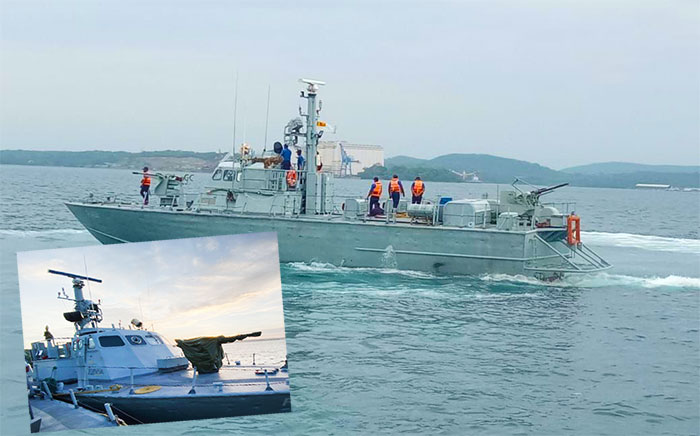
Interestingly, the correspondence had taken place two years after the attack on the Colombo port, after Navy headquarters announced awarding of the ‘Rana Wickrama Padakkama’ (gallantry medal) to Lieutenant Commander L.R.N.A. Wijetunga, who had joined the crew of Dvora (P441) that destroyed the explosives-laden Black Sea Tiger boat, tasked to destroy one of the vessels in the harbour.
Siriwardhana challenged the awarding of gallantry award to Wijetunga, who had been the Duty Staff Officer (DSO) (West) at the time of the attack. Why did Wijetunga take the risk of a ‘Dvora ride’ at the time the Colombo port was under attack? What made him skip his primary task of taking control of the Command Operations Room? Instead, Wijetunga, who had been the senior most officer at the scene, boarded the Dvora contrary to his primary responsibility. Did Wijetunga shirk his primary responsibility? But, did he voluntarily risk his life by joining the Dvora crew facing a possible suicide attack?
At the time of the attack, four top officers, responsible for the Western Command, hadn’t been available. Commander Western Naval Area Commodore H.R. Amaraweera, Deputy Area Commander, Captain S.P.F. Wijeratne, Commanding Officer, SLNS, Rangala and Executive Officer, SLNS Rangala, hadn’t been available. Therefore, DSO Wijetunga had been the senior most officer responsible for taking counter measures. Perhaps, he felt confident in joining the Dvora crew, leaving the counter-attack in the hands of Lieutenant Siriwardhana who, efficiently, manned the Command Operations Room. In hindsight, the counter-attack couldn’t have been handled in a better way.
Lieutenant Siriwardhana, in a letter dated Sept. 23, 1998, addressed to the then Commander of the Navy, raised the issue, while categorically denying his intention was to secure a medal.
Having joined the Navy, through the Kotelawela Defence Academy (KDA) Intake IX, as an Officer Cadet, Siriwardhana served as an Electrical Officer and left the service, in 1999, due to an injury suffered playing rugger for the KDA and the Navy. Siriwardhana migrated to Australia in 2012. In spite of leaving the country, Siriwardhana pursued the matter, even after Gotabaya Rajapaksa won the presidency at the Nov. 2019 election.
A bid to deceive Navy
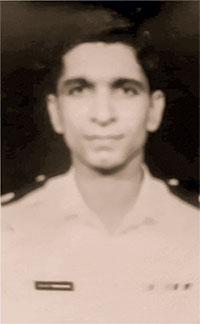
Lieutenant L.S.A.N.T.
Siriwardhana
The Black Sea Tiger operation got underway, on April 11, at 7.40 pm, with an anonymous call to the Command Operations Room that sea pirates were planning to board a merchant vessel, outside the Colombo harbour. The call was received by Siriwardhana, who had been, manning the Command Operations Room, at SLNS Rangala. Siriwardhana, however, felt that the caller was making an attempt to trick the Navy to deploy available vessels to track down sea pirates, and, thereby, would have facilitated the Black Sea Tiger operation. Siriwardhana based his assessment on the basis of specific information pertaining to (1) expected arrival of Lanka Asitha, carrying the multi-role Kfir ground attack aircraft. The fighter aircraft were to be unloaded at the Jaya Container Terminal (JCT). The aircraft were the first fighter jets acquired by Sri Lanka since the 1991 acquisition of Chinese fighters (2) Mercs Hendala, another merchant vessel, was being loaded with military hardware, at the Bandaranaike quay. The north-bound cargo was for troops engaged in operations in the Jaffna peninsula (3) SLNS Shakthi (Landing Ship Tank), too, was being loaded at the Rangala pier number 1 with military cargo for troops deployed in the North and (4) another vessel was discharging LP gas near the guide pier.
Anticipating a possible LTTE bid to infiltrate harbour defenses, Siriwardhana, in his capacity as the Command Operations Room officer, having alerted the DSO, regarding the anonymous call received, deployed two lightly armed locally-built Inshore Patrol Craft (IPCs) at the two entrances to the Colombo harbour. The officers-in-charge were told not to chase any suspicious moving craft in the vicinity. The sailor, at the radar watch, and other units assigned for the unenviable task of guarding the harbour, too, were alerted. At 8 pm, April 11, Siriwardhana handed over the Command Operations Room responsibilities to the next officer. Siriwardhana returned to the station at 4 am, on the following day, April 12, and was told of the withdrawal of one IPC. That left one IPC with the daunting task of meeting unforeseen threats. According to Siriwardhana, the sentry at the pilot station, detected the underwater movement and brought the development to his notice at 5.45 am, though the SLPA, at that time,claimed the initial detection was made by two of its minor employees. One cannot deny the ambiguity therein, but regardless of who received the credit for the detection, the Navy cannot, under any circumstances, absolve itself of the responsibility for security at ports.
Dvora confronts Black Sea Tiger craft
Responding to the warning from the sentry at the pilot station, Siriwardhana dispatched two smaller patrol craft to the area where underwater movements were alleged to have taken place. The looming threat was also brought to the notice of the DSO (West). Then one of the two patrol craft confirmed the presence of a diver to Siriwardhana and proceeded to use explosives against the target. As the Navy eliminated the underwater threat, the sailor at the radar point had brought to the notice of his superior that an unauthorized boat was making a bid to enter the harbour through the northern entrance. Siriwardhana, struggling to cope up with the new threat, directed two patrol craft though one of them lacked the main armament. The two boats, and the sailor at the sentry, engaged the boat as Black Sea Tigers fired Rocket Propelled Grenades (RPGs).
However, Dvora P 441, that had been moored at the Rangala pier, had immediately intervened without being directed by the Command Operations Room. Siriwardhana, in his Sept. 23, 1998. letter acknowledged the timely intervention made by the Dvora. Siriwardhana stated: “Then I realized that P 441(Dvora) had gone for assistance and subsequently heard a loud explosion, learnt that the terrorist boat had been destroyed by the Dvora.” The LTTE craft is believed to have been manned by at least five persons.
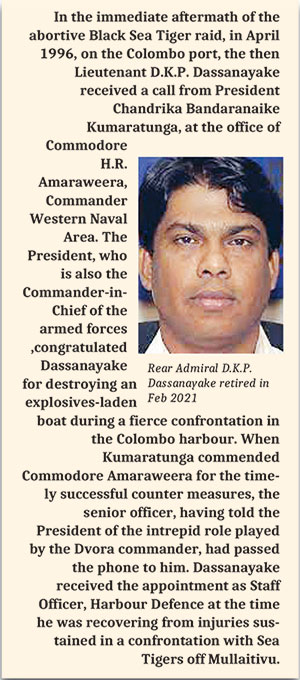
The then Lt. D.K.P. Dassanayake, Staff Officer, Harbour Defence (later Navy spokesman) had commanded the Dvora in the absence of its Commanding Officer Lt. Commander Manoj Jayasuriya. A salvo from the Dvora blew up the enemy craft. The blast indicated that it had been laden with high explosives. In addition to Dassanayake, the second-in-command of the Dvora Lt. Nalina Dayananada had been onboard the vessel but can the Navy justify Wijetunga joining the crew at the expense of his given task.
Oil tanker ‘ARMA,’ moored at the North pier, car carrier SINGHA ACE at the guide pier, SEA LAND ENDEAVOUR docked at the Jaya Container Terminal 1 pier, and NEDLOYED OBRIDJAN berthed at the Queen Elisabeth Quay, were damaged as a result of RPGs and other weapons fired by Black Sea Tigers.
Perhaps the LTTE had inside information regarding the arrival of four Kfirs and the unloading of a large stock of artillery shells and mortars. The Army warehouse, within the harbour, was one of the key targets whereas there were other ships and assets. The Navy recovered bodies/parts of bodies of four terrorists though six were believed to have been involved in the operation. The boat, laden with explosives, was to enter the port, following near simultaneous attacks carried out by the six infiltrators. But, the chance detection of underwater saboteurs, and the ensuing blasts, prompted Black Sea Tigers, operating the explosives laden boat, to enter the port.
P 441 had been tasked on that particular day to meet any eventuality. Had there been a minute delay, on the part of Dassanayake in taking the Dvora out, the consequences would have been catastrophic. But, P 441 wouldn’t have made a difference if not for the detection made by the sentry at the pilot station, according to the Navy. However, for some reason, the Navy deliberately failed to ascertain the circumstances leading to the detection and the counter-attack. Some officers expressed disgust and disappointment and, at least one, protested.



Iranian Ambassador in Colombo Dr. Alireza Delkhosh says the Islamic Republic of Iran remains fully prepared to face US-Israeli aggression.
In an interview with The Island at the Iranian Embassy, in Colombo, Dr. Delkhosh emphasised that in case of a fresh outbreak of hostilities, the aggressors, as well as those who provided bases for unprovoked military campaign ,should be prepared to face the consequences.
Excerpts of the interview:
The Island: Did Iran anticipate Israel-US launching unprovoked attacks in the midst of indirect nuclear talks between Iran and US in Geneva, mediated by Oman?
Ambassador: Iran’s wall of mistrust towards the US is rooted in decades of hostile policies and, specifically, Washington’s dark record of broken promises. We always welcomed diplomacy in good faith and serious intent, entering diplomatic channels accordingly; yet, we have repeatedly witnessed the US chose the path of betraying diplomacy in the midst of negotiations.
We do not build our foreign policy on optimism toward the US, as we fundamentally do not view the current US administration as a trustworthy party. The recurrence of provocative patterns and coordination with the Zionist regime’s actions during sensitive negotiations indicate a systematic approach to discredit diplomacy.
From our perspective;
“Any coercive or military action taken alongside mediation efforts serves as further evidence of Washington’s lack of sincere will for diplomacy and its attempt to exert pressure under the guise of dialogue—an approach that will not go unanswered.”
The Island: Do you think the latest war and regional developments, such as the UAE pulling out of OPEC, should be examined, taking into consideration the Oct0ber 7, 2023, Hamas attack on southern Israel.
Ambassador: Allow me to rephrase your question: Is there a link between the attacks carried out by the US and Israel against Iran and the Zionist regime’s warmongering policies? My answer is a definitive “yes”.
Any serious analysis of the current regional dynamics must be placed within the broader historical and structural context of the Palestinian question and the continuation of occupation and blockade. Iran has consistently maintained that the developments of October 7, 2023, did not emerge in a vacuum, but are rooted in decades of unresolved injustice, the denial of legitimate rights of the Palestinian people, and the absence of a credible political horizon.
From this perspective, the subsequent escalation in the region reflects a chain of reactions shaped by long-standing structural tensions, rather than isolated incidents. Iran has repeatedly emphasised that sustainable stability can only be achieved through ending occupation, addressing the root causes of the crisis, and upholding the inalienable rights of the Palestinian people.
Thus, it is important not to reduce complex geopolitical developments to a single starting point. Energy market decisions, alliance shifts, and military escalations are influenced by a broader set of strategic, economic, and political factors.
The Island: What is the status of talks mediated by Pakistan?
Ambassador: A high-ranking Iranian delegation attended an intense day of negotiations, with American negotiators, in Pakistan, on 12th of April, to permanently end a US-Israeli aggression against the country. Iran agreed to participate in the negotiations after US authorities indicated they had accepted Iran’s general conditions as a baseline for peace deal discussions. However, during 20 hours’ intense talks, the US changed its position.
The main sticking point in the talks was the US reluctance to agree to Iran’s legitimate rights to have a peaceful nuclear programme, which Iran has insisted on for years and just before entering the talks, based on the UNSC resolution and the relevant laws.
Iran’s foreign policy is firmly grounded in the principles of dignity, mutual respect, and rejection of coercion or imposed negotiations. Within this framework, Iran has consistently stated that it remains open to indirect diplomatic engagement through mediators, including regional partners, such as Pakistan, provided that diplomacy is conducted in a balanced and credible environment. At the same time, Iran has repeatedly emphasised that the effectiveness of any negotiating track is directly undermined by the US coercive measures, unilateral sanctions, and pressure-based policies.
Sustainable diplomacy necessitates a complete decoupling from pressure tactics; it must be grounded in genuine reciprocity and respect for national rights and interests. Guided by this principled approach, Iran continues to engage in mediation efforts, in good faith, while resolutely safeguarding its sovereign rights and rejecting any framework that resembles ‘dictation under pressure’.”
The Island: The UN has pathetically failed to intervene in the current West Asia conflict. Both Israel and the US simply ignored the UN and the world body seems irrelevant. As a seasoned diplomat what is your opinion on the UN? What is wrong with the global body”
Ambassador: Iran views the UN as an important multilateral institution established to safeguard international peace and security; however, its effectiveness has increasingly been constrained by the selective application of its Charter and the politicisation of decision-making, particularly within the Security Council.
Currently, the international community is witnessing highly dangerous interpretations of ‘peace,’ ‘rights,’ and ‘aggression’ by the US and the Israeli regime. In their lexicon, if they attack a country, it is labelled a ‘peace operation’ or ‘legitimate defence’; yet, if a nation defends itself, it is branded as ‘warmongering.’
“When the innocent people of Gaza, Lebanon, Syria, Yemen, Iran, and Iraq are stripped of their fundamental human and humanitarian rights and endure profound suffering due to attacks, genocides, and inhumane sanctions, it is as if—in the prevailing international discourse—’human rights’ are not being violated at all.”
The world witnessed, on many occasions, that when certain permanent members are directly involved, or aligned with one side of a conflict, the UN’s ability to act impartially is significantly weakened.
From this perspective, the current situation does not reflect irrelevance of the United Nations itself, but rather highlights the structural imbalance in the international order, where enforcement mechanisms are often subject to geopolitical considerations. Iran has, therefore, consistently called for fundamental reform of global governance structures, including democratisation of the Security Council and strengthening of multilateralism, based on justice, equality, and respect for sovereignty.
The Islamic Republic of Iran supports a United Nations that truly represents the rights of nations and establishes justice. The current state of global affairs reflects the failure of certain powers to adhere to the fundamental principles of the UN Charter.
While emphasising the necessity of effective multilateralism to guarantee international peace and security, the Islamic Republic of Iran has consistently reaffirmed its commitment to an international order, based on international law and the principles of the UN Charter.
In conclusion, I must state that: “Unilateralism negates the essential and fundamental principles of the United Nations. Unilateralism is an invitation to injustice, confrontation, and war.”
The Island: In spite of sustained US pressure, its NATO allies declined to join military action against Iran or commit forces to Hormuz Strait. The British and French positions caused an unprecedented rift between them and the US. Do you think NATO countries’ split position on Iran war caused irreparable damage to the largest military organisation in the world?
Ambassador: Differences among NATO members on the use of force in external theatres are not unprecedented. Divergent approaches to specific regional conflicts can place strain on political unity and strategic messaging within this alliance. Whether such differences translate into long-term structural damage depends on how effectively members manage internal consultation and reaffirm shared principles.
Let’s not forget that NATO is fundamentally a military alliance shaped by the strategic priorities of the United States, and differences among its members often reflect not a principled divergence, but rather varying degrees of alignment with Washington’s regional policies.
What is presented as “internal consultation” within NATO is frequently constrained by asymmetric influence, where key decisions on the use of force are effectively driven by the US agenda.
In this context, disagreements among NATO members on external military actions are seen in Tehran less as an institutional safeguard and more as evidence of the alliance’s limited strategic autonomy, particularly in relation to West Asia. Therefore, these divergences do not merely represent tactical differences, but highlight a deeper structural issue: the growing questioning of interventionist policies and the sustainability of military blocs in addressing complex regional crises.
The Island: When did you first hear about the unprovoked US attack on Iran frigate off Galle? (The date and time, please). Who told you about the unfortunate incident? What was your first reaction?
Ambassador: What was particularly concerning was that the IRIS Dena was understood to be undertaking a routine passage in the region, returning from an official visit to India, and was not engaged in any combat or hostile activity. Any incident involving a naval vessel, under such circumstances, is naturally a matter of serious concern and a war crime, especially when it raises questions about maritime safety and the protection of unarmed or non-combat assets.
My immediate priority, upon receiving credible confirmation about this attack, would have been the safety of personnel and the prevention of any escalation. From the first moments of receiving this information, I have been in direct talks and consultations with the Ministry of Foreign Affairs of Sri Lanka and other relevant government authorities, while ensuring that no conclusions are drawn until all facts are verified.
The Island: Did you visit the Iranian vessel and sailors now at Trincomalee?
Ambassador: At this stage, I would like to state that the primary responsibility of the mission has been to maintain continuous contact with the relevant Sri Lankan authorities and ensure the safety, welfare, and proper handling of Iranian personnel and assets involved. In this regard, we have been in close and ongoing coordination with the Ministry of Foreign Affairs of Sri Lanka and other competent government institutions to follow up on all necessary arrangements.
Our focus has been on ensuring that all matters are addressed through official diplomatic channels in accordance with international maritime and humanitarian procedures. The well-being of our personnel and the proper management of the situation remain our highest priority.
The Island: Ambassador, you presented your credentials to the then President Ranil Wickremesinghe in late October, 2023. What were the previous diplomatic stations you served before taking over the Colombo mission?
Ambassador: Prior to my mission in Sri Lanka and the Maldives, I served in various diplomatic capacities in Turkey, Sweden, and Uzbekistan.”
The Island:Would you mind stating Iranian red lines about issues that Iran would never give up such as the right to use nuclear power for civilian purposes and control over Hormuz Strait?
Ambassador: Iran’s foreign policy is based on the principles of sovereignty, deterrence, and the rejection of coercion and unilateral pressure, while simultaneously affirming its commitments under international law. In this framework, we have consistently emphasised that the Islamic Republic will never relinquish its inalienable right to peaceful nuclear energy, including enrichment for civilian purposes, such as energy production, medical applications, and scientific development. As we continually maintained, this right is fully consistent with the Non-Proliferation Treaty.
At the same time, Iran regards the security and management of the Strait of Hormuz as a strategic national responsibility, given that it lies within Iran’s sovereign waters and is one of the world’s most sensitive maritime corridors. Our officials have repeatedly stated that the security of the Persian Gulf and Hormuz must be maintained by regional states themselves, without external militarisation or domination.
However, Iran has consistently expressed concern over certain regional developments in which neighbouring territories have been utilised for the projection of external military power, including by the United States, which, in Tehran’s view, contributes to heightened tensions and undermines regional stability. From Iran’s perspective, such dynamics are among the key factors affecting and jeopardising the security environment of the Persian Gulf and the Strait of Hormuz.
Within this framework, Iran has emphasised that any threat to its sovereignty, territorial integrity, or strategic security interests would be met with firm and proportionate resistance, while at the same time reaffirming its commitment to freedom of navigation in accordance with international law.
Taken together, from a broader perspective: “The overarching framework of Iran’s foreign policy is built upon three primary pillars: countering diplomatic pressures, maintaining autonomy in strategic decision-making while safeguarding national interests and sovereignty, and emphasising the principle of reciprocity. This approach—rooted in the three guiding principles of ‘Dignity, Wisdom, and Expediency’—reflects Tehran’s explicit opposition to unilateralism and bullying in the global arena.”
The Island: Iran proved that it had the strength and the will power to face daunting military challenges and, in spite of civilian protests, influenced by economic hardships, the public stood by the leadership during the hour of crisis. What is Iran’s message to the world?
Ambassador: Iran is the heir to a great civilisation, spanning several millennia. Iran’s message to the world is that national resilience is ultimately rooted in the bond between the state and its nation, particularly, during times of external pressure and security challenges. Despite economic hardships, the Iranian people have demonstrated that in moments of national crisis, priorities converge around the defence of sovereignty, territorial integrity, and national security.
From this perspective, the experience of recent years is a clear testimony that external pressure, military threats, or coercive policies do not weaken national cohesion; rather, they reinforce a shared sense of resistance and the bond between the leadership and segments of society around core national principles. It highlights that such domestic economic issues are addressed within the framework of national stability, not through external intervention.
There exists an inviolable principle: “Sustainable national cohesion is achieved only in the light of full sovereignty over internal affairs and the rejection of any intervention or the politicisation of domestic developments by foreign powers.”
The Island:Wishful Israel-US assessment for regime change, following the Supreme Leader’s assassination failed. Against the backdrop of US success in Venezuela, they seemed to have wrongly asserted the situation and Iranian military response. How do you see the next few weeks as the US and Israel maintain a fragile ceasefire, regardless of some isolated incidents?
Ambassador: The assumptions that external pressure, military action, or targeted scenarios, such as the assassination of its leadership, would lead to structural political change in Iran, have repeatedly proven to be a strategic miscalculation. “Iran’s security architecture is not modelled after classic Western patterns that could be brought down, through sanctions or threats; rather, it possesses its own unique design.
Iran’s strategic decision-making is rooted in institutional continuity, national sovereignty, and a well-established defence and command structure—one that cannot be disrupted by external pressures or short-term military developments.”
Regarding the current situation, the existing ceasefire environment looks to be fragile and highly sensitive. As repeatedly stressed by our officials and leadership, stability cannot be sustained through coercive measures, continued military pressure, or selective escalation. Therefore, any lasting calm depends on adherence to commitments, respect for sovereignty, and cessation of hostile actions.
In the coming weeks, the situation will remain volatile, yet manageable, and Iran will continue to maintain its readiness to respond to any potential adventurism.
Iran continues to emphasise that sustainable regional security cannot be built on failed assumptions of regime change or military superiority, but only through recognition of political realities and mutual respect under international law.
The Island: Finally, the senseless killing of over 150 schoolgirls and teachers at an Iranian school, at the onset of the latest conflict, horrified the world. However, the response of Western governments, and various human rights bodies, seemed inadequate. Some refrained from commenting on the incident. The situation in Lebanon, too, is deteriorating. Why do they act differently when the perpetrators happened to be the US or Israel?
Ambassador: I believe that the disparity in reactions reflects a long-standing flaw in the international system: the selective application of international law and humanitarian principles, based on political considerations rather than universal standards.
As you noted, when incidents involve the US or Israel, many international actors—including certain Western governments and institutions—tend to interpret events through the narratives of ‘security,’ ‘self-defence,’ or ‘strategic necessity.’ The brutal attack on the Minab girls’ school, which resulted in the slaughter of over 168 students and teachers, has pulled back the curtain on the double standards of those who claim to champion human rights. While the smallest incidents in other countries trigger immediate global outcries. We witness a response characterised by silence, projection, and brazen falsehoods regarding this blatant crime—as well as the horrific atrocities in Gaza and Lebanon. These tactics aim at nothing but distorting reality and whitewashing the perpetrators of these tragedies. This pattern has undermined the credibility of international law and the global human rights framework, as it ignores the principle of ‘sovereign equality’ and suggests that accountability is not applied equally to all members of the international community.
This is not merely a legal issue but an expression of a structural imbalance in the international order, where political alliances and strategic interests dictate the interpretation and enforcement of norms. Therefore, I maintain that: “The only way to restore trust in the international system is through the consistent and non-selective enforcement of international law, without exceptions or double standards, regardless of the identity of the parties involved.”
As a final word: “Ibn Khaldun 1332-1406, a famous philosopher and historian, believes that ‘politics is the product of geography.’ The essence of this hypothesis is that the temporary presence of extra-regional powers in West Asia and the Persian Gulf must not lead certain small coastal states of the Persian Gulf into a strategic miscalculation.
The time will come when outsiders are expelled from this region, leaving only the neighbours who are destined to coexist. Instead of focusing on Outsourced Security and legitimacy from distant powers, they must return to geographical realities. They ought to study history to recognise which nation has been the source of security and stability in the Persian Gulf for millennia.
By Shamindra Ferdinando

‘Aragalaya’ betrayed? ‘The treason of the intellectuals’ in the age of populism – Part III
The JVP/NPP government, which relied heavily on social media to come to power, seems to be deeply afraid that it will be overthrown by a second aragalaya fuelled by social media. The government has been accused of organising and directing forces—including pro-government social media activists—from behind the scenes to prevent criticism of the government’s actions from shaping public opinion against the government through social media. Critics say that the aim is to discourage, silence, and drive away critics of the government through ridicule, insults, obscene statements, and intimidation.
Leaving aside these behind-the-scenes manoeuvers, the news that a group of YouTubers, who are identified as “dhobies” or “washers,” recently attended a private press conference at the JVP party headquarters at the invitation of the President and the Minister of Mass Media and Cabinet Media Spokesperson, is a powerful example of the weight the current government places on social media.
“Dhobies”/”washers”
The intelligentsia and intellectuals in democracies play a key role in shaping public opinion, which is traditionally vital in determining the outcome of elections or in building public protests. In the era of social media ubiquity, the primary location of the intelligentsia engaged in politics has shifted to social media. Influencing social media users is now seen as the key to political victory—hence the significance of the phenomenon identified by the term “dhobies”/”washers” (literally laundrymen).
Manifested as a voluntary social media activity—dominated by Facebook and primarily occurring in the Sinhala medium (this article does not cover Tamil social media)—the phenomenon of “washers” is an unprecedented and unique addition to the political process in Sri Lanka. This is an activity of political significance with a certain level of intellectual content that goes beyond the level of mere social media activism, and is carried out by the intelligentsia and intellectuals. These “washers”, alongside the academics who lead them, emphatically state that it is their responsibility to work vigorously to protect this government—one that they brought to power and which aligns with the ideology they believe in.
This group also includes social media journalists who identify themselves as left-wing political activists and as ‘analytical’ discussion presenters via content creation—podcasts and video interviews—as opposed to being mere social media activists.
To achieve their goal, the “washers” understand their role as “cleaning” or “whitewashing” the government in the face of criticism or controversy. They seek to prove the government right by targeting, attacking, and silencing critics through quibbling and intimidation, thereby “protecting” the government.
Although these attacks primarily come in the form of “intellectual” attacks, the range of attacks unleashed under that “intellectual leadership” includes ridicule, insults, and harassment, which are encouraged to be directed at opponents at various levels. Posts are published subtly or directly inviting the “people” who habituate social media as “friends” to post their emojis—likes, dislikes, laughter, ridicule—which may take the form of reaction images, or verbal “comments” against political opponents who publish their views on social media.
In addition to organised “washers,” there are highly credentialed academics who contribute to the “washing” process on their own Facebook pages, either directly or in tacit, subtle ways. Those who do not actively join indicate their support tacitly as “friends” of the organized “washers”—either via emojis or by participating through seemingly innocuous comments that nevertheless get the job done.
They claim this activity of ‘washing’ is the real ground on which politics is determined today. Their stated argument is that in the current era of social media, ridicule, insults, and harassment are inevitable in politics; therefore, those who cannot face them should not be involved in politics. In other words, in this view, politics dominated by social media seems to reenact Hobbes’”state of nature,” which is “nasty, poor, solitary, brutish, and short,” indicating an unprecedented level to which Sri Lanka’s intellectual culture has descended.
Isn’t it an indictment of academia that the practice of “washing” led by academics comes under serious scrutiny from their academic “friends” on social media, especially in relation to the vocation of intellectuals and their role in politics? Notably, the self-identified intellectual leaders of left populism—some of whom are themselves drawn from academia—circulate within these same social media circles.
What they are trying to protect the government from by silencing their rivals and banishing them from the public arena is a second aragalaya that they and the government seem to firmly believe will build on social media operations if criticism of the government is allowed to spread unabated. Hence, there is the need to somehow suppress criticism while giving the act a veneer of intellectual activity. They are participating in this effort, rallying as both organisations and individuals at different levels.
It needs to be added that while these “washing” activities take place mainly in the medium of Sinhala, related “higher” intellectual content is aired in the English medium as well, mainly in the form of interviews with academics.
Criticising the government from a left political perspective
What has come to be expressed as the essence of this “washing” process is the idea, presented in the form of a theoretical formulation, that when criticising the current government from a leftist political perspective, one should first consider who benefits from it. What it means is that if the current government is criticised from a leftist perspective, it could result in a second aragalaya, leading to the return of those who are currently out of power.
A related question that critics are often asked is this; whom do they see as the leaders of a government that could replace the current government? It is as if citizens should only criticise a government that affects their lives if they have a clear alternative to replace it. It is as if criticism is not something that can be done with the intention of correcting something, or a way to develop an alternative.
This argument rejects the traditional liberal political science argument about bourgeois democracy, which considers holding elections at regular intervals to bring governments to power and changing governments when necessary as positive—which requires accepting as positive the development of a critique of the government in power. Accordingly, it implies that the current government must be kept in power at all costs to prevent the power groups that the people rejected from coming back to power, and that is why the Left should stop criticizing the current government. This is a very strange idea of democracy. It is clearly not the bourgeois liberal democracy we have known so far. So, what kind of democracy is it? As some are wont to do, we can keep on tweaking the term to suit the changing conditions instead of developing a critique in the name of the ideal of democracy. So, what is the new term for what is done with democracy under the new regime? Or, do they think that we have reached an era of post-democracy?
Traditionally, the role of intellectuals and the intelligentsia has been to provide the critical thinking that society needs. But the intellectuals who are engaged in “washing” say that the Left should silence its criticism in order to save the government, and then everything will be fine. Some who support “washing” argue that what the Left should do is not criticize the current government, but push it further to the left. While this argument presumes the government to be Left notwithstanding the Left criticism of it, what it fails to take into account is that one of the reasons the government needs repressive social media forces and “washers” may be that the government is intolerant of criticism that pushes it to the left.
The NPP government came to power by rallying around the NPP organisations and individuals who called themselves liberal, progressive, leftist, radical, etc., outside of the JVP membership. The group that can be called intellectuals among them identified themselves with the NPP through a series of actions—starting from contributing to the work of building the National People’s Power and the formulation of its policies, to taking the leadership of relevant committees at various levels and appearing publicly at various public events of the NPP, even on the election platform. Some of them won the elections on the basis of their identity-based vote blocks or became members of parliament from the national list and even became ministers. Many others, as is customary after an election victory, got themselves appointed to various positions in the government bureaucracy as chairpersons, board/council members, directors, etc., either immediately or later.
Some, whether or not they were appointed, abandoned the critical role they were previously playing in society and have remained silent. Some of them have abandoned the theoretical interventions they were making in the public arena with a view to a “system transformation” until they brought the current government to power, in favour of safe literary or other topics as if the transformation that all those criticisms targeted had been achieved with the coming to power of the current government. Others entered the “washing” business while holding official positions in the current ruling regime. Although not all those involved in the “washing” process are in positions of power, there have been allegations that some of those who are involved without holding positions do so in exchange for payment. Among these groups are those who, traditionally known as independent journalists, are now mostly known as content and/or digital creators, questioning the validity of their claims to represent independent journalism.
Some leftists assume that this will be the last time a left-wing government has come to power in Sri Lanka, and therefore have joined the government believing that they should achieve the maximum good for the people, as if they think that history has ended.
Conclusion: Populism and the treason of intellectuals
In conclusion, returning to the ideology of populism that provided the backdrop for this article, it is relevant to note how some of the key characteristics of populism identified in the literature align with critics’ accounts of the policies followed by the current JVP/NPP government.
At its core, populist ideology presents a dichotomy between a “pure,” idealised conception of the people and a “corrupt” elite. It frames politics as a moral struggle against corruption, seeking to displace the traditional class basis of politics. Being deeply anti-institutional, populism dismisses expert and academic knowledge as elitist.
Driven by a Schmittian logic of friend-versus-enemy politics, populist leaders and the intelligentsia seek to displace the traditional elite, aiming to purge them from politics, academia, and culture with a view to appointing themselves as the new elite.
Populism rejects the democratic state in the name of the people. Political theorist Wendy Brown points out that populism focuses instead on aggressive law and order, statism, and a non-democratic view of liberty—where authority rules, yet individuals claim libertarian freedom.
Globally, populism tends to breed authoritarian leaders who centralise power in the executive branch, stripping judges of their independence and turning elected parliaments into mere rubber stamps. To stay in power, populist movements systematically target checks and balances, the free press, and universities, labeling them as roadblocks against the people’s mandate. Once in control, these regimes use legal gray areas to oppress opposition parties and subvert democracy to ensure they remain in power.
The Treason of the Intellectuals
For the title of my article, I have borrowed the title of a seminal work by the French philosopher and essayist Julien Benda, The Treason of the Intellectuals (1927). Almost a hundred years ago, Benda critiqued the intelligentsia’s betrayal of their vocation as intellectuals, focusing on their abandonment of the Enlightenment ideal of universal humanity. In our case, I would argue that intellectuals have abandoned their vocation in the very name of the “renaissance” and “enlightenment” ideals—or the punarudaya—they claim to stand for, allowing political partisanship to dictate their understanding of the intellectual vocation itself.
In her 2023 book, Nihilistic Times, political theorist Wendy Brown argues that we are living in deeply nihilistic times. Placing this rise in nihilism at the very center of our current political crisis, she warns that it is actively undoing democracy while degrading and confounding both political and academic life. In Brown’s view, nihilism leads to the devaluation of both knowledge and political responsibility—a crisis that is especially clear in academia. She argues that intellectuals have abandoned democracy, the common good, and the pursuit of objective truth, choosing instead to align themselves with whoever holds political or cultural power to serve partisan or authoritarian goals. Ultimately, Brown argues that public intellectuals must act as honest, thoughtful analysts who hold politicians accountable rather than seeking to win their favor. Finally, she issues a direct challenge to left-wing intellectuals to make good on their foundational commitment to true critical thinking.

Cutting across the brooding greenery,
Of the big city’s outlying wetlands,
That are verily its purifying lungs,
Are roads less traveled and sought,
That teem with Nature’s All,
Beginning with the tiniest forms of life,
To sprawling giants of the wilds,
Not to speak of birds and butterflies,
Rising to the skies in mesmeric flight…
But nature lovers are nowhere in sight,
Except for frolicking young couples,
Whose purses are pinching so much,
That they can’t afford costlier hideouts,
But there’s no denying that our wetlands,
Need to be right away protected,
Lest they win mention in the Red List,
Of earthly beings heading for extinction.
By Lynn Ockersz

Let us dispel the roots of greed, hatred, and delusion, and transform our lives into a nobel period that brings peace and serenity – PM

Prime Minister and United Nations Resident Coordinator discuss post-Ditwah recovery and humanitarian cooperation

Further embrace the values of Buddhism founded upon non-violence, compassion and boundless loving-kindness towards all living beings – President

Showers will occur at times in the Western, Sabaragamuwa and North-western provinces and in Galle, Matara, Kandy and Nuwara-Eliya districts

IMF urges Lanka not to meddle with exchange rate

Court orders arrest of Basil in Rs. 7.8m poll funds case

‘Dates have the highest sugar content to fight Coronavirus’

Sunday Island 27 December – Headlines

#SundayIsland 17th December – Headlines

Sunday Island – 28th March

Sunday Island Headlines – 21 March

Sunday Island – 21st February – Headlines
-

 News6 days ago
All-New GRAVITE launches at LKR 6.99 Mn
-

 Features6 days ago
The NPP’s pivot to the past
-
 News5 days ago
Police probe underway to ascertain links between criminals deported from UAE and local politicians
-
 News4 days ago
Easter Sunday carnage: Court told Maulana’s statement cannot be accepted without cross-examination
-
 Features6 days ago
End of Peacekeeping
-
 Opinion4 days ago
Undermining the democratic political framework
-

 News4 days ago
UK passport holder hiding here wants to have deportation order rescinded to leave without blemish
-
 News5 days ago
Dickoya double murder suspect arrested