
Opinion
Effort by All Ceylon Buddhist Congress to help govt. of Sri Lanka escape from dollar trap


By DR L M K Tillekeratne
Chairman of the National Development Committee of the ACBC
It is a well-known fact that one the problems faced by Sri Lanka today is caused mainly by shortage of electricity for domestic purposes and industries. Three decades ago, only 20 % of houses had electricity for lighting. But, today over 95 % of houses in the whole country have electricity. Total electric power the country needs is about 2,750 MW a day. In order to generate 65% of it by using diesel and coal, the cost involved now is tremendous and that is the main reason for the creation of dollar shortage in the country. Besides, when Russia’s invasion in Ukraine six months ago equally attributed to the fuel shortage in the whole world thus creating enormous social and economic impacts, and petroleum prices in the Sri Lankan market increased by over 300%, which is bound to increase further at an alarming pace.However, while having enough bright sunlight all over Sri Lanka throughout the year to generate solar power and enough wind power particularly in areas like Mannar and Puttlam districts, only 40% of our electricity requirements are supplied by non-conventional renewable energy, while 65% of the balance need is produced by burning imported fuel oil and coal at a cost of Rs 80 to 100 per unit, thereby subjecting the environment of the country to a great threat by increasing the level of Green House gases to our atmosphere. Further, this conversion of generating electricity by burning oil and coal thereby lowering the liberation of Green House gases to the atmosphere will enable Sri Lanka to earn huge amount of Dollars by trading Carbon.
According to energy experts, it is expected to reduce this 65% of the energy requirement by burning fuel oil and coal down to 40% thus using more renewable energy by year 2030, thereby lowering the cost of producing a unit of electricity to about Rs 35.00.
Surprisingly, according to hydro power generating experts, there are over 400 streams and small waterfalls distributed all over the country without exploiting yet for setting up of mini hydro power generators. If these over 400 water sources are converted to hydro power generators producing not less than 1000 mega Watts of power are started, and by converting the wind power and solar power available in unlimited quantities, Sri Lankans can earn more foreign exchange by selling the extra electric power available to neighboring countries.
Hence, at present most of the dollars available are spent for importing diesel and coal to the tune of USD 6,000 million per annum. It should be mentioned here that out of this USD 6000 million, about 4,500 million is used for transport leaving a balance of USD 1,500 million to import fuel oil for power generation. According to energy experts, USD 1,500 million could easily be saved here for the other priority areas of the country, if mini hydro power generators are set up in those streams which are idling now. However, sadly no payments have been made for the power generated and supplied to the national grid by the few existing mini hydro power plants; they have supplied power to the tune of over Rs 20 billion for several months and hence some of them have been compelled to close their power plants.
Based on this objective, the ACBC, the premier Buddhist and Social organization in the country realized the need to create awareness of the options available and organized an exhibition of inventions last week on generating power utilizing those three natural sources and to display the public as to how they could conserve scarcely available electricity thereby saving extra money spent for generating power wasted due to lack of knowledge.
This event was not merely organized as an exhibition but to showcase the new inventions to the public, but as a workshop for the interested water source owners to select the appropriate invention suit to them best according to the conditions available in his source of water/ solar power/ or wind. Once the prospective investor identifies the suitable invention ideally needed to his needs, the power expert committee of the ACBC is planning to provide them with every technical support they need to do the feasibility study and even to the level of selecting machines etc. up to the level of setting up the complete power station. Further, the Bank of Ceylon has already agreed to provide them with a soft loan of Rs 3 million at 16% interest rate for setting up of the power unit.
It should be mentioned here with appreciation that the Ministry of Power and Energy has already decided to pay Rs 35 per unit of renewable energy produced from the 17.39 paid previously and also to pay all the back accumulated payments due to power generators. ACBC takes an innocent pride to place on record that the power generation project designed and launched by the expert panel members of the ACBC consists of renowned scientists and engineers who have earned distinctive reputation in their respective disciplines. This particular project perhaps is one of the key projects engineered by the ACBC in its proudest history of over 100 years with a view to finding solutions to the macro-economic issues whilst enhancing income generation at the peripheral level so that it would provide a helping hand to reduce the poverty level of the country.
With these important decisions taken by the government to encourage renewable energy production in all unexploited natural energy sources, it is not a difficult task to generate nearly 1000 MW of power within the next two to three years. Minimizing energy wastes by households and industries through the educational campaign initiate by the ACBC recently, another sizable saving of electrical energy saving could be achieved. Hence, the Development committee of the ACBC is optimistic in saving substantial portion of the dollars spent on Oil and Coal imports thereby making savings available in the country to help Sri Lanka to be the Wonder of Asia by year 2050.


I venture to make this appeal because I am increasingly concerned about what appears to be an inexplicable silence surrounding one of the most consequential challenges confronting Sri Lanka, the country’s emerging demographic crisis.
Nearly a year has elapsed since the official release of the latest Census population findings by the Department of Census and Statistics. The demographic signals revealed by the Census deserve far greater public scrutiny than they have received. An ageing population, declining fertility and a contraction of the working-age population are not merely statistical observations. Together, they have profound implications for the future economic, social and institutional sustainability of the country.
Yet, remarkably, the subject has not generated the level of informed public debate one would reasonably expect from a matter of such national importance.
What concerns me even more is the apparent reticence of those who are best placed to enlighten the public, the planners, demographers, academics and scholars attached to our universities and other institutions of national importance. Their silence is difficult to understand when the demographic trajectory of a country can influence virtually every aspect of its future: economic growth, labour-force availability, pension obligations, healthcare expenditure, education planning, family structures and the sustainability of social protection systems.
This is not an issue that can safely be postponed until the consequences become unmistakable. Demographic change is notoriously slow to reverse. By the time its consequences become visible in the form of labour shortages, an excessive dependency burden or an unsustainable ageing population, the policy options available to governments may already have narrowed considerably.
The public therefore has a legitimate right to ask some fundamental questions.
Where is the national demographic strategy? What are the projections for the next 20, 30 and 50 years? How rapidly is the working-age population expected to decline? What will be the implications for economic growth and productivity? How will Sri Lanka finance the needs of an ageing population? What measures are contemplated to address declining fertility? And, perhaps most importantly, has the country begun preparing now for a demographic reality that is already taking shape?
These are not questions that should be confined to academic journals or government reports. They deserve to be debated openly in the national press and explained to the ordinary citizen in language that everyone can understand.
At the same time, I would urge our demographers, economists, planners and scholars to come forward with evidence-based assessments rather than remain silent. If my interpretation of the demographic trends is misplaced, I would welcome a scholarly rebuttal. If the situation is more serious than is generally recognized, the public deserves to know that as well.
Silence is not a demographic policy.
Sri Lanka has already experienced the consequences of failing to anticipate several national crises. We should not allow demographic change, which operates quietly but relentlessly, to become another crisis that we recognise only when it is too late to manage.
The time to discuss Sri Lanka’s demographic future is not when the crisis arrives. The time is now.
Athula Ranasinghe

Prof. Ranjith Bandara,
PhD (Qld.,) Emeritus Professor, University of Colombo
Investment promotion has been Colombo’s default strategy for two decades. The real barrier to foreign capital was never Sri Lanka’s pitch — it is Sri Lanka’s paperwork and administrative complexity.
For more than two decades, investment promotion has been one of Sri Lanka’s key development strategies. Successive governments have introduced investment incentives, established export-processing zones, strengthened promotion agencies, and dispatched delegations to road shows and conferences across the world. The message abroad has remained largely unchanged: Sri Lanka is open for business, and the opportunity is real.
That opportunity is not in question. The island sits strategically alongside some of the world’s busiest shipping lanes in the Indian Ocean. It has a relatively well-educated workforce, established commercial institutions, a strong tourism base, natural resources, and direct access to a South Asian market of well over a billion people. On paper, Sri Lanka should be attracting foreign capital on a much larger scale.
It is not. And the reason is not that the world has failed to hear Sri Lanka’s investment pitch. The problem is that promoting an investment opportunity and delivering the conditions promised to investors are two very different things — and Sri Lanka has historically devoted far more energy to the former than to the latter.
A recovery that still falls short
There has been genuine improvement recently. According to UNCTAD figures, inward FDI rose from roughly US$759 million in 2024 to US$1.04 billion in 2025 — the strongest performance since 2022, when inflows reached US$884 million, before falling back to US$713 million in 2023.
That trajectory is welcome. Yet, in the context of what Sri Lanka needs, it remains modest. Set against a GDP exceeding US$100 billion, US$1 billion in FDI represents roughly 1% of national output — only a fraction of what an economy pursuing serious industrialisation, technological upgrading and export expansion requires.
For comparison, Vietnam, a country against which Sri Lanka is often benchmarked, attracted more than US$20 billion in FDI in 2025 alone. Nobody expects Sri Lanka to match that scale overnight. But the gap is instructive: global capital is mobile, and investors have choices. Sri Lanka is not merely competing against its own past performance. It is competing with India, Vietnam, Indonesia, Bangladesh, Malaysia and Thailand, all pursuing the same global pool of investors.
Moreover, the issue is not only the quantity of investment, but also its quality. A country does not simply need short-term capital inflows; it needs investment that brings technology, managerial expertise, links to global markets, skills development, productivity gains and long-term export capacity. FDI policy should therefore move beyond asking, “How much investment came in?” It should also ask: “How much did that investment contribute to productivity, exports, technology transfer and the quality of employment?”
That leads to the question that should sit at the centre of national economic strategy: why, specifically, should an investor choose Sri Lanka over these alternatives?
Real obstacle is cumulative friction, not a single flaw
Investors do not evaluate countries on rhetoric. They compare them, line by line, on production costs, energy prices, logistics, taxation, regulatory predictability, political stability, labour relations, infrastructure quality, and the speed and reliability of approvals.
Sri Lanka is not catastrophically weak in any single one of these areas. The problem is cumulative. Small inefficiencies and delays across multiple fronts eventually add up to a high overall cost of doing business, even when no single obstacle appears decisive on its own.
This cumulative friction can be particularly damaging to small and medium-sized foreign investors. A large multinational may be able to employ legal advisers, consultants and government-relations teams to navigate a complicated administrative system. A medium-sized investor may be unwilling or unable to bear those additional costs. An unnecessarily difficult administrative environment therefore does more than delay investment — it can reduce both the number and diversity of investors willing to enter the country.
Bureaucracy is a central part of that friction. Investors routinely have to navigate multiple agencies with overlapping mandates and, at times, inconsistent rulings. The deeper problem is not regulation itself, but the absence of clear procedures and predictable timelines.
A guaranteed 60-day approval process is workable, even if it is not ideal. A process that may take one month or may take six is not. Investors can price a known delay into a project. What they struggle to price is uncertainty.
And uncertainty has a real financial cost. Every month that a project waits for approval can mean higher financing costs, delayed machinery orders, missed market opportunities and, ultimately, the possibility that the investor relocates the project to another country. Administrative delay is therefore not merely an inconvenience within government offices; it is a national competitiveness problem.
A genuine single-window system — one application, one digital file, one responsible case manager and fixed statutory deadlines — could do more to improve investor confidence than another round of tax incentives.
But a genuine single window must be more than a single desk at which applications are submitted. All relevant agencies should be digitally connected through the same platform. The investor should be able to see where an application stands, which agency or officer is responsible, what requirements remain outstanding, and when a decision is legally due. The investor should not have to become the coordinator of government agencies.
Policy volatility compounds the problem. Investors can plan around relatively high taxes. They cannot plan around taxes, incentives, import rules and foreign-exchange controls that shift unpredictably with every change in government or fiscal circumstance.
Such instability embeds a “policy-risk premium” into every long-term investment decision. That cost may never appear directly in headline statistics, but Sri Lanka pays it through investments that are delayed, scaled down or never made.
The answer is not to freeze every policy permanently. Economic circumstances change and governments must retain the ability to respond. What matters is that changes are introduced with reasonable notice, clear transitional arrangements and predictable implementation periods. Long-term investors do not require a world in which nothing changes; they require a system in which change itself can be anticipated.
Administrative discretion adds another layer of risk. Where licensing and approval outcomes depend more on relationships than on published, rule-based criteria, investors correctly interpret that as exposure — to delay, arbitrariness or worse.
Digitising approvals, publishing statutory timelines, reducing unnecessary discretionary authority and opening public procurement to transparent competition would reduce this risk directly. The governance benefits of such reforms would extend well beyond the investment climate.
None of this is an argument against labour protection. Strong labour standards are entirely compatible with a competitive investment environment, as many advanced and emerging economies demonstrate. The problem arises when industrial relations become unpredictable or politicised. That is a governance problem that can be addressed, not an unavoidable trade-off between worker welfare and competitiveness.
Nor is low labour cost, on its own, a winning strategy. What investors ultimately price is unit labour cost, which reflects productivity as well as wages. A country that competes purely on cheap labour while tolerating high energy prices, logistics delays and regulatory friction is not really offering investors a cost advantage — it is offering a false economy.
Physical infrastructure, too, is only part of the picture. Reliable electricity and serviced industrial land matter, but so does the institutional architecture around them: efficient customs, functioning courts and arbitration mechanisms, digital government services, reliable certification systems and predictable regulatory enforcement.
Investors are not simply buying land and electricity. They are buying access to a functioning business ecosystem.
From announcements to outcomes
Perhaps, the most consequential shift Sri Lanka needs is in how it measures its own success.
For too long, the metric has been approvals granted, memoranda signed and projects announced — announcements rather than outcomes.
What should matter instead is capital that actually enters the country, factories and businesses that actually commence operations, jobs that genuinely materialise, exports that expand, and investors that remain and reinvest.
The gap between approved investment and realised investment is where much of Sri Lanka’s promise has historically evaporated. Closing that gap requires dedicated project management and systematic follow-through, not another press release.
Every major investment project should therefore have clear post-approval responsibility. If a project is stalled because of land, electricity, a licence, customs, infrastructure or financing, the problem should be identified quickly and escalated to the appropriate authority.
The present logic must be reversed. Rather than forcing the investor to move from ministry to ministry and agency to agency searching for solutions, government should have a system that actively identifies and removes obstacles preventing an approved investment from becoming operational.
The performance of investment-promotion institutions should likewise be measured not by the number of MoUs signed or approvals issued, but by capital actually invested, projects implemented, jobs created, exports generated and reinvestment secured. This would begin to close the institutional gap between investment promotion and investment implementation.
Global competition is only intensifying. The sectors now driving some of the largest FDI flows worldwide — semiconductors, artificial-intelligence infrastructure, renewable energy, advanced manufacturing, pharmaceuticals and critical minerals — are increasingly dominated by economies capable of offering subsidies on a scale Sri Lanka cannot realistically match.
That reality should clarify Sri Lanka’s strategy rather than discourage it. If Sri Lanka cannot out-subsidise its competitors, it must out-execute them.
Speed, certainty and administrative efficiency are not consolation prizes. For a country in Sri Lanka’s position, they may be among the most valuable incentives it can offer. Unlike large cash subsidies or tax concessions, they can be delivered at relatively low fiscal cost once the right systems are established.
The policy choice ahead
Sri Lanka’s renewed international engagement — including recent outreach to markets such as Australia — is a reasonable and necessary part of any investment strategy. No country can attract capital it never asks for.
But promotion without domestic reform is ultimately a roadshow with too little behind it. A conference can bring investors to the table; only institutional efficiency determines whether they sign, build, operate, expand and stay.
The government now faces a straightforward choice, and it is one that should be measured in policy rather than rhetoric: continue treating FDI primarily as a promotional challenge, or commit to a genuine Investment Competitiveness Programme.
Such a programme should include a true digital single window, enforceable approval timelines, a stable multi-year tax framework, reduced administrative discretion in licensing, and a public dashboard that tracks actual investment outcomes rather than signed intentions.
That dashboard would also be an important instrument of public accountability. Information such as the value of approved investment, the value actually realised, average approval times, causes of delay and performance by responsible agency should be publicly available. Such transparency would not only strengthen investor confidence; it would also create accountability across government institutions for the speed and quality of implementation.
Most importantly, FDI reform should not be viewed as providing special privileges to foreign investors. Clear rules, faster approvals, efficient public services, transparency and policy stability are equally important to domestic entrepreneurs.
Making Sri Lanka easier for a foreign investor is therefore, in the final analysis, about building a more efficient economic system for every business operating in Sri Lanka.
The question Sri Lanka’s policymakers should now be asking is no longer, “Have reforms been introduced?” Instead, it is this: “Has investing in Sri Lanka actually become easier?”
Once the answer to that question is in the affirmative, the country may find that it needs far fewer roadshows. Because the most persuasive advertisement for Sri Lanka will not be a delegation travelling abroad. It will be an investor already operating in Sri Lanka telling the next investor: “The system worked.”
Opinion
Judiciary must not become price of political power: A call for conscience, restraint and public confidence

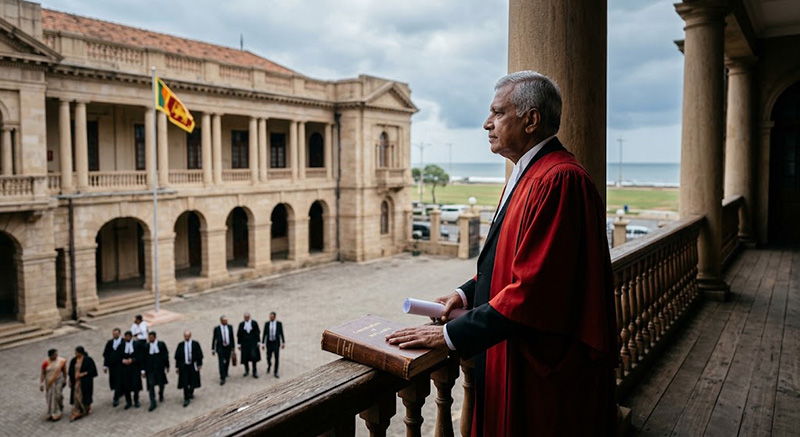
by Shelton Dharmaratne
Sri Lanka is now confronted with an issue that goes far beyond the retirement age of a few judges. At stake is something infinitely more valuable, the confidence of the people in the independence, impartiality and dignity of the judiciary.
An intervention by Emeritus Professor A. N. I. Ekanayaka deserves serious public attention because it identifies a fundamental danger: when the conditions of judicial tenure are altered in circumstances that generate public suspicion, the damage may extend far beyond the immediate legislation.
The government has proposed the 22nd Amendment to the Constitution, under which the retirement age of Supreme Court judges would rise from 65 to 67 and that of Court of Appeal judges from 63 to 65. The Bill also proposes increasing the maximum number of Court of Appeal judges from 19 to 24.
There may be perfectly legitimate arguments for increasing judicial retirement ages. Longer life expectancy, accumulated judicial experience, the need for additional judges and the enormous backlog of cases can all be discussed rationally. Indeed, the government has presented judicial capacity and the expansion of the court system as reasons for the proposal.
But that is not the whole question.
The more fundamental question is why now; why in this manner, and why should the public be expected to accept an alteration of the constitutional tenure of sitting superior-court judges without the fullest possible consultation and reassurance?
That question cannot simply be dismissed as political opposition or resistance to reform.
The Bar Association of Sri Lanka has expressed precisely this concern. Its July resolution states that security of tenure is an essential safeguard of judicial independence and questioned the absence of demonstrated compelling necessity, objective evidence and comprehensive consultation. The Commonwealth Lawyers Association similarly warned that constitutional reform should not be undertaken piecemeal or ad hoc and emphasised the importance of public and stakeholder consultation. More recently, the UN Special Rapporteur on the independence of judges and lawyers raised concerns that the proposed change, in its reported form and implications, could affect judicial independence, separation of powers and public confidence in the courts.
These concerns deserve to be heard—not because every criticism of the government must necessarily be correct, but because the judiciary is different from every other institution of the State.
A government can survive criticism. A political party can survive defeat. An administrative department can survive controversy. But a judiciary cannot function effectively if the public begins to believe that judges may owe their continued tenure to the political authority that changes the rules governing their retirement.
Justice must not only be done; it must also be seen to be done.
This is where Professor Ekanayaka’s proposal deserves particular consideration. He does not suggest that judges should determine whether the proposed retirement age is a good or bad policy. Instead, he appeals to those judges who might personally benefit from the proposed extension to voluntarily declare that they will retire according to the existing retirement provisions and will not personally take advantage of the extension.
That would be an extraordinary act of judicial statesmanship.
Such a declaration would immediately separate the individual judge from the political controversy surrounding the legislation. It would tell the country: My loyalty is not to my position. My loyalty is to the institution of justice.
It would also remove much of the suspicion that inevitably arises when a constitutional amendment appears capable of benefiting people already occupying the very offices affected by it.
This is not an accusation against any individual judge. Nor should it be interpreted as suggesting that judges who remain in office under a new law would necessarily act improperly. That conclusion would be unfair and unjustified.
The issue is one of institutional perception.
If the public sees the government changing the constitutional retirement framework while particular judges are approaching retirement, suspicion is almost inevitable. Even a completely independent judge may then find that the credibility of a perfectly lawful judgment is questioned merely because of the circumstances surrounding his or her continued tenure.
That is an intolerable burden to place upon the judiciary.
Sri Lanka’s constitutional history provides ample reason for caution. The country has previously witnessed bitter confrontations between political power and judicial independence. The lesson from such episodes should not be that one political party was uniquely guilty while another is uniquely virtuous. The deeper lesson is that no government, however popular, should ever become so confident of its own righteousness that it regards institutional criticism as an obstacle to be overcome by parliamentary numbers alone.
A two-thirds majority is a constitutional instrument. It is not a substitute for wisdom.
And if the Supreme Court ultimately determines that a referendum is constitutionally required, that constitutional process must be respected without political intimidation, triumphalism or resentment. The question should not be whether the government has sufficient political strength to prevail. The question should be whether the constitutional order has been strengthened or weakened by the manner in which the change is pursued.
This is, therefore, not fundamentally an NPP issue, a JVP issue, an Opposition issue or a government Issue. It is a Sri Lankan issue.
The beneficiaries of the proposed extension should also understand this. If the amendment eventually becomes law, accepting its benefits may be entirely lawful. But legality and legitimacy are not always identical concepts. A judge who voluntarily declines a personal benefit arising from a controversial alteration of tenure would send a message of exceptional moral strength.
The people of Sri Lanka need such reassurance.
The government should, therefore, pause, consult the Judiciary, the Bar, academics and wider civil society, and demonstrate that judicial reform is being undertaken for the enduring benefit of justice rather than for the immediate convenience of government.
And the judges, who may personally benefit, have an equally historic opportunity.
They can rise above the controversy.
They can voluntarily relinquish the personal advantage.
They can demonstrate that the office is greater than the office-holder, the Constitution is greater than the government, and justice is greater than political power.
If they do so, they will not merely be retiring from judicial office; they will be leaving behind something far more important, a renewed measure of public faith in the proposition that, in Sri Lanka, justice remains above politics.

At least eight killed, hundreds missing after Nepal flash flood

India close in despite Sooriyabandara, Kamindu fifties

Advisory for High Waves for the sea areas extending from Colombo to Pottuvil via Galle, Matara and Hambantota

We must create social awareness to ensure the physical and mental well-being of children with disabilities – PM

BCCI AGM set for September 18 in Mumbai

Three franchises sold in Afghanistan Premier League T20

‘Dates have the highest sugar content to fight Coronavirus’

Sunday Island 27 December – Headlines

#SundayIsland 17th December – Headlines

Sunday Island – 28th March

Sunday Island Headlines – 21 March

Sunday Island – 21st February – Headlines
-
 News6 days ago
Country’s first woman Surveyor General appointed
-

 Business5 days ago
SriLankan Airlines makes ShakthiSAT Mission possible for talented Sri Lankan student
-

 Sports7 days ago
Tharanga, Weber headline stellar Lausanne javelin field
-

 Features6 days ago
Medical education in Sri Lanka: Then and now
-
 Business7 days ago
Mannar’s offshore opportunity: the dollar question behind Sri Lanka’s oil and gas search
-
 Latest News5 days ago
Imran Khan moved to private hospital amid deteriorating health
-

 Latest News5 days ago
Government has declared 21, 22 and 23 August 2026 as national days of mourning
-
Latest News4 days ago
Tharanga edges out Chopra in 88m javelin battle