
Features
Maha ovita (My Grandfather’s Vegetable Plot )

A SHORT STORY
By Dr. Siri Galhenage
As I stood at the edge of a strip of mangroves that separated the dry land [goda] from the wet [mada], the vast expanse of the paddy field rolled out in front of me. The embankment of the Boralu Wewa, the lake that fed the crops of many generations of my ancestors, could be seen in the horizon. The paddy, except for a nearby abandoned patch, was pregnant with grain ready for harvest. A cool breeze swept across the field, making a golden ripple, bringing some relief from the oppressive humidity. Few women chuckled as they bathed in a nearby well hedged by bamboo trees. One of them washed her clothes by striking them on a rock face, sending an echo across the field. Two kids ran along a niyara in an abortive attempt at getting their kite airborne.
Behind me was a neglected plot of land, nearly an acre in extent, which stretched between the mangrove and the gravel path. The path snaked through the village towards the ancient Buddhist temple of Royal patronage. The dagoba and the bell tower of the temple loomed over a growth of coconut palms that surrounded the sacred site like a group of devotees. I remember, my father saying, that the legendary poet of the ‘Colombo era’, who wrote ‘To an Unborn Child’, once lived somewhere beyond the temple.
The neglected plot of land was the vegetable patch of my grandfather. We used to call it the Maha Owita. No vegetables have been grown here for several years. A few feral vines of pumpkin had braved the invasion of an army of weeds. A horde of mimosa amongst them, with their flowery helmets, spread across the field like an occupying force. Their thorny weaponry was hostile towards me, oblivious of my inheritance to the property. A dilapidated mud-brick hut stood at the centre of the Owita. In it a few broken pots, strewn around an abandoned wood fire, appeared like museum artefacts. In a shallow well beside the hut, tadpoles swam vigorously in the murky water lashing their tails. A young frog, after a brief exploration of the land, leapt back into the water in glee. A lone egret dipped its beak into the water in search of its morning meal.
Temple bells chimed. The tapping of the drums and the initial testing of the flute heralded a procession of monks preparing to attend an almsgiving. Measured movement of yellow robes could be seen through the coconut palms.
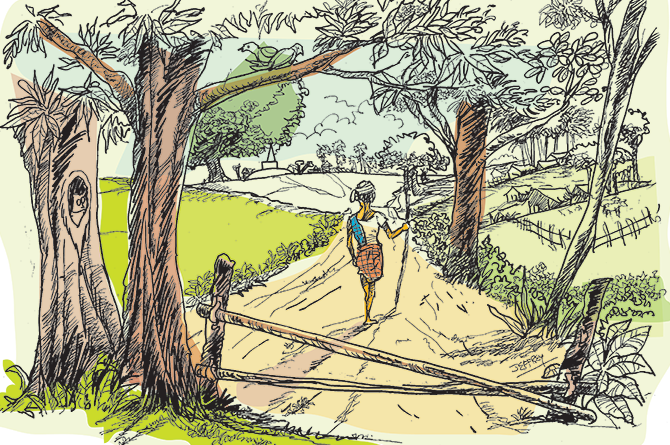
My brother was awaiting the arrival of Abaran Appu. No relative of ours, we called him Abaran Aiya as a gesture of respect and endearment; aiya in Sinhala meaning elder brother. An elderly figure appeared at the kadulla, a ramshackle gate with wooden poles, an entry point to the Owita from the gravel path. He wore a new sarong, with a tartan design, tied to his waist with a silver chain. His arms were strong despite his advanced age. His deeply pigmented body carried a profuse growth of grey hair, mainly over his chest, barely covered with a white vest, and a towel thrown over his right shoulder. He cautiously climbed over the kadulla, with some assistance from my brother.
As I approached Abaran Aiya, he greeted me with a broad smile. As a respectful gesture he removed the towel from his shoulder while tilting his body slightly to the right. I reciprocated with a verbal greeting of ayubowan, holding both his hands with mine, and with a feeling of gratitude and warmth. An archetypal ‘wise old man’, he certainly was – a figure, symbolic of my past.
“Your brother sent word that you have arrived, and would like to visit the Owita. I know that you come home from time to time, but I never get a chance to meet you. I last saw you at your mother’s funeral, but you were too busy. Your brother, of course, I meet often at the village temple.”
“I am too old now – almost ninety.” Abaran Aiya looked much younger than his years. Then he went on to talk about hi various ailments, which I thought were age-related. I lent a sympathetic ear. “There must be a lot of new medicines for these sicknesses in those countries,” he said. I nodded. “You must come back to your own country. We could do with more doctors.”
After a pause Abaran Aiya started chatting again. Looking around the Owita, he said, “It breaks my heart to see this place neglected. Until a few years ago, I grew vegetables in this patch. It is too hard for me now. My sons are not interested in working in the field; they don’t like getting their hands dirty; they prefer to do an office job in the city. Until recently, I managed to get Sugathan, my brother-in-law to do the paddy field; he too is getting old. And you can’t find reliable people these days.” My brother nodded in approval.
Abaran Aiya continued. “I am worried that squatters may occupy this place, and you will have a hard time evicting them; there is hardly any vacant land left around here”.
My brother joined in the conversation at this stage.”Yes, you can’t find good vacant land around here now; one pays an exorbitant amount for a perch, especially after the University was built; it is round the corner from here. Look at the number of new houses that has come up in the neighbourhood. It used to be bushland; all those beautiful trees around here are gone.”
There was a brief pause in our conversation as the procession of monks passed by gracefully along the gravel path. Abaran Aiya whispered in my brother’s ear that the monks were attending a customary almsgiving for a village elder who passed away three months ago. They both knew who he was. I felt like an alien.
Abaran Aiya had grown vegetables in this owita for nearly four decades, leasing the property from my family for a meagre fee. He sold his produce at the village fair held on Sundays. I remember, when my parents were alive, he brought in a sackful of vegetables, from time to time, as a gesture of goodwill. It often contained okra, snake beans, aubergines, bitter gourd, snake gourd, pumpkins and a variety of yams, which my mother received with delight. She shared the produce with friends and family.
My family had owned this land since the mid-nineteenth century. Being the elder sibling, my brother had been delegated the task of looking after family property and documents since the death of my parents.
Over many generations my people have toiled this land to sustain themselves. Since the death of my grandfather in1926, the Maha Owita was neglected for several years, before Abaran Aiya, the son of one of his loyal assistants was allowed to cultivate this land by my father.
My grandparents died long before my parents married. But over the years, I have developed a mental image of their persona through bits of information picked up from family elders and have put them together as a jigsaw. The most reliable informant would have been my father, but he passed away before I developed a keen interest in my ancestors. Since I emigrated in 1972 my interest in my progenitors grew.
When I left my motherland, I took this landscape with me. The village occupied my mental domain and my ancestors continued to dwell in it. I watched them plough this field, sow seeds, harvest their paddy, grow vegetables in the Owita. I listened to their folk songs. I followed them to the village temple, saw them offer ‘new rice’ [aluth bath] to the monks, and listened to the sermons by the head monk. I joined them during their festivities, and shared their hardship and their grief, and admired their resilience in overcoming them. They gave me strength and solace during difficult times.
I imagined sitting on the niyara [embankment] watching my grandfather toil in the field from dawn to dusk, his feet immersed in mud. Wearing a loin cloth [amude], his youthful body covered in sweat, glistened in the midday sun. Washing his hands and feet at the shallow well in the Owita, he would find shelter in the nearby hut at noon, awaiting his youthful wife [my grandmother] who brought him his ambula [lunch]. He watched with affection, the vibrant young woman, dressed in cloth and jacket [redda hette], hurry across the paddy field carrying the basket of food. They sat down to share a meal of rice and vegetables, chatting to each other about the weather, family matters and the happenings in the village.
On this day in the month of Vesak in 1896 she had a twinkle in her eye. She whispered in his ear that she was pregnant. They wished for a son as their first child and were full of innocent dreams. “I don’t want him to toil all day in the mud as I do”, said my grandfather. “I prefer him to have an education in English and work for the sudda [white man] in Colombo. Their first child – my father – did live up to their expectations. I remember my father wearing a white suit with tie and waistcoat going to work in the hot and humid capital city!
My ‘dreaming’ was interrupted by my brother. “There is no point in hanging on to this property; let’s sell it”, he said. I could read a sense of sadness in Abaran Aiya’s face, beneath his nod of approval. My brother and I had joint inheritance to the Maha Owita. I once entertained the thought of returning home in my retirement, of building a small house on my section of the property, growing vegetables, and leading a quiet life! My brother was always sceptical about it. “This is no longer the village it was”, he said, with a sense of nostalgia. “We hardly know the people who live around here. I hear, some youngsters occupy the hut at night”. And, Abaran Aiya joined in: “even some of the so-called educated people dump their rubbish here”. Pointing to the rubbish heap at the edge of the Owita, he added, “this place has now become a breeding ground for mosquitoes; they don’t seem to listen to an old man like me”.
“As I have discussed with you”, said my brother, “there is an interested party prepared to buy the land, and he is willing to offer a good price. I hear he is looking for a block of land to build a hostel for University students. This is an ideal site for accommodation for students of the newly built University, a walking distance away from here”.
“A hostel for students? Not a bad idea”, I thought. Once again, my imagination ran riot. Many young men and women would arrive here, their bags packed with hope for their future, as I did when I arrived in Peradeniya many decades ago. Seeds of knowledge will be sown on this fertile land. Creative thought, literary analysis, political debate and psychological insights will sprout. Time will be spent on reflection; there will be deadlines for assignments. Exams…bloody exams! Success and failure; joy and despair; frustration; rebellion; alcohol binges on weekends and love and betrayal! Most would harvest the life skills and knowledge, and would carry them into their future. A few, sadly, may wither away like a failed crop.
After a lengthy conversation, my brother and I helped Abaran Aiya to cross the kadulla, perhaps for the last time. We watched him stagger along the gravel path carrying a sackful of our heritage with him, which, he will, sadly, take to his grave.
The procession of monks seems to have reached its destination; the sound of drums was heard no more. The monks will continue to traverse this path, and one day, in the near future, will reach the home of Abaran Aiya, who would have been fit for the throne, washed of his mud.
[sirigalhenage@gmail.com]

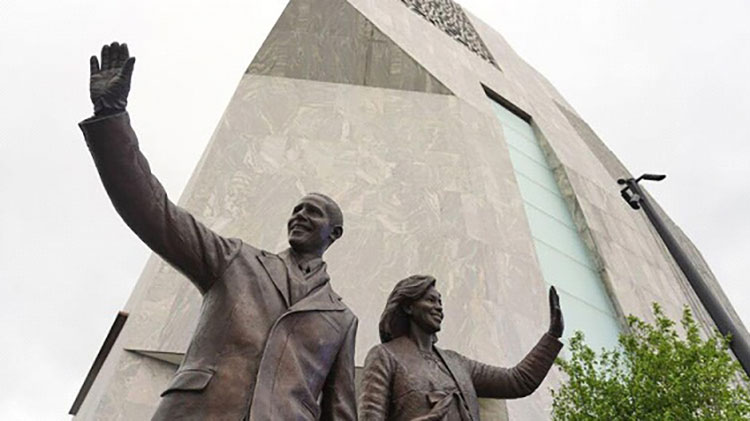
President Trump is constantly exceeding expectations about his ability to spread chaos in his country and around the world. To the chaos and destruction of the war against Iran that he began on February 28, he is now adding the chaos of peace. The 2026 World Cup has crashed into the chaotic world of both. In the midst of all of Trumps’ chaos, the US is anchoring the hosting of 2026 World Cup Football, flanked by Mexico to the south and Canada to the north. In the midst of it all, former President Obama held the opening ceremony for the Obama Presidential Centre in southside Chicago on Thursday, June 18.
It was a beautiful ceremony that was full of grace and elegance and a call for future action to stop America’s aberrational detour of the last 10 years and restore its historical march towards being a more perfect union as stipulated in the constitution. Trump was not mentioned but the contrast was clear. In attendance were all former US Presidents and world leaders of the Obama era, including Germany’s Angela Merkel and Canada’s Justin Trudeau. The Presidential Centre is a massive campus with a 225-foot behemoth tower, a museum, library and a basketball gym.
The project has been controversial with initial community backlash about its location in a public park and the threat of gentrification that may drive modest households in the area out of their homes. The actual implementation of the project and the choreographing of its opening ceremony would seem to have responded well to the early concerns. The City of Chicago has passed an ordinance to preserve affordable housing in the area, and a University of Chicago study has projected that the Centre would create 1,900 new permanent jobs and an annual $220 million economic spin-off for the City.
The timing of the opening could not have been politically more apt than being midway through Trump’s rapidly unravelling second terms in office. Local and national artists provided politically immersive entertainment, and the speeches were by President Obama and the former First Lady Michelle Obama, the two finest of speakers in contemporary America. Neither of them mentioned Trump, but both left no doubt of their concern with Trump’s America and “fierce urgency” of the moment to start undoing all of Trump’s misdoings in America and around the world. Obama insisted that Centre is not meant to be a monument to his presidency but a “vibrant, living celebration of community,” and hoped that it would inspire Americans now experiencing “anger and vision” to look “for fairness and common sense and mutual respect,” at the same time.
The Centre and its opening ceremony are a perfect foil to the Trump’s presidency and its grotesque ways. This year Trump is presiding over the 250th anniversary of American Independence. And he is doing it in his own way – inviting the King of England to mark the occasion and then hosting an evening of wrestling, of all places on one of the White House lawns, featuring only badass white male pugilists. The latter was also in celebration of his 80th birthday. A good majority of Americans including Republicans do not approve of Trump’s vulgarization of American culture.
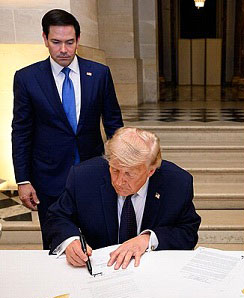
Trump signing the MOU at Chateâu de Versailles
Trump wants to transform Washington to entrench his name and image in perpetuity, to elevate him to the same status heights of presidential greats such as Lincoln and Kennedy, and to leave everywhere the maximalist mark of his obsession with gold and its colour. But the courts, certainly those below the Supreme Court, would have none of them. One after the other, the Courts have disallowed his bizarre efforts at narcissistic exhibitionism. A US District Court Judge in Washington has declared that Trump’s directive to change the name of the John F. Kennedy Center for the Performing Arts be known as the “Trump-Kennedy Center” is unconstitutional, and he ordered the restoration of the original name along with the removal of the name of Trump from all of the Centre’s venue names, websites, records and documents. The courts have also stopped Trump’s construction ball to build a new oversized ballroom devouring one of its historic lawns. The president went ahead without license or permit excavating a foundation cavern, and now his legacy after he leaves the White House could be a gaping hole in front of the main building. It will fall to his successor to bury Trump’s legacy and back-fill the hole.
World Cup Antidote
It turns out that after 18 months of Trump’s chaotic and traumatic second term, the World Cup is a welcome antidote to the convulsions that only the current US president is capable of causing for others. For sports fans in general, the World Cup is crashing into a crowded midyear sports agenda, that includes the French Open and the Wimbledon tournaments in tennis and majors in other sports. With technology enabling the simultaneous coverage of the global and the local, sports like other entertainments is catering to the local and global interests of fans.
Forty eight countries, including Iran, are in the bowl, and their supporters and flags are overflowing the streets and stadia of the 16 cities in the US (11), Mexico (three) and Canada (two), where the matches are being played. FIFA oligarchy could not have found a better free market host than Donlad Trump. Ticket prices have gone through the roof, for unlike in Europe and South America where there are limits on prices, there is none in the US but only limited restrictions in Canada and Mexico. FIFA is reaping the American free market and keeping the national football associations quiet against fandom pressure by sharing the ticket bounty proportionately with each national outpost.
On the other hand, it is also remarkable to see massive crowds filling up the stadia and other public venues to watch their favourite game. For all the talk and reality of inequality in wealth, there is also money in the pockets of many to splurge on tickets for a world cup football game, the modern opium of the masses. As with the old religion, there is a hierarchy among spectators and their seats, the latter rising from the close-up seats at the pitch level, where the price is at its highest, and reaching to the skies above from where one can steal a bird’s eye view of the action below at much lower but still high prices.
For American sports fans, the World Cup came crashing into the finals of the National Basketball Championship, which was especially remarkable this year because the New York Knicks whose home base is the storied Maddison Square Gardens, the Mecca of basketball, in the heart of New York, won the national championship after an interval of 53 years. For basketball aficionados, the victorious 1973 Knicks team included such national figures as Phil Jackson and Bill Bradely. Jackson would later coach Michael Jordon and Chicago Bulls, and Kobe Bryant and LA Lakers, guiding them to multiple championships. Bradley went on to become a long serving US Senator from New Jersey for the Democratic Party and was an unsuccessful presidential contender in 2020. Bradley was often compared to the similarly unsuccessful Adlai Stevenson whom President Kennedy appointed as his envoy to the UN, calling him “the most articulate statesman of our time.”
The Knicks’ long awaited victory may inspire hope among contenders at the World Cup. Only eight countries have won the World Cup so far – Argentina, Brazil, England, France, Germany, Italy, Spain and Uruguay. Netherlands has been to three finals but never won the cup. Italy that has won four World Cups has twice failed to qualify – in 2022 and again in 2026. Germany, another four-times winner is looking to return to its winning ways and end its dismal record since 2014. Mexico and Portugal are leading soccer countries but have never won the cup or been in the finals.
England who invented the game has won the cup only once – way back in 1966 – and is hoping to win again. “Coming home … football is coming home”, the 1996 song is now being sung everywhere England is playing in North America. First sung to mark England’s hosting of the Euro Cup in 1996, the song has become England’s veritable football anthem blending nostalgic joy for the 1966 win and pathos, with hope, for the country’s successive losses ever since. The English team this year parades an impressive array of young talent. Fans are both hopeful as well as resigned as has been their wont. They have reason for hope as pundits have short listed England among the top four contenders.
As the opening matches are being played out, the favoured teams are acquitting themselves well. Argentina, the reigning champions, has sent perhaps the strongest message with its 3-0 victory over Algeria. More than the scoreline, it is Lionel Messi’s masterclass of a hat trick that has electrified the fans and alerted the other teams. France is not far behind with its 4-1 win against Senegal. England registered a stirring 4-2 win against Croatia, the country that defeated it in the semifinals in the 2018 World Cup in Russia.
The most favoured country Spain was totally out of sorts in its opening game and was held to a goalless draw by Cabo (or Cape) Verde, the little West African island and part of the Dutch Kingdom. Other contenders, Brazil, Portugal and Netherlands were held to 1-1 draws respectively by Morocco, the Democratic Republic of Congo, and Japan. At the same time, Mexico, South Korea, USA, Australia, Germany, Sweden, Norway and Austria have scored impressive opening match victories. Iran played well against New Zealand in a 2-2 tie. No one is expecting any country that has never won the World Cup before to become champions now. The last time it happened was in 2010 when Spain won for the first time and only time so far. But that does not dampen fan enthusiasm over every match that will be played until the finals on Sunday, July 19, in New York City.
The paradox of Peace
American attention to world matters has never befitted the country’s superpower status. And the chasm have never been wider than under President Trump. The level of awareness ranges from total ignorance to absolute indifference. The attention to the war against Iran has been no different. The people, politicians and the media have almost singularly been focused on the price at the pump and the cost of groceries. These are fundamental concerns in politics, no doubt, but the economic havoc that the war is causing for the Middle East and the rest of the world has never been an equal concern in the US public discourse and media commentaries. Of course, American experts will lead the way analyzing and writing about the global effects of the war on Iran, but that will be a postmortem and it will not compensate for the real time failure of the Trump Administration to give due weight, as a superpower must, to the global effects of its war making decisions.
Trump admitted in France that he signed the MOU with Iran to avoid “economic catastrophe” in the US. That says it all even though he will likely never say it again. The MOU is officially called – Islamabad Memorandum of Understanding between the United States of America and the Islamic Republic of Iran. So, Pakistan gets its place in history and deservedly so. And Trump crafted his own history by signing a hard copy of the MOU at the Palace of Versailles, of all palaces, following his G7 summit attendance in the French Alps. Will the same hard copy be ever signed by an Iranian leader is an open question. That will be for future museums to explain, among many other leftovers of Trump. Trump may also use a certified copy of the document, if not the original itself, for the next application on his behalf for the Nobel Peace Prize.
This MOU has been signed by multiple times by both sides, but perhaps its strongest endorsement came with the approval of direct negotiation between Iran and the US given by Iran’s Supreme Leader Ayatollah Mujtaba Khamenei and read out on state television. The paradox of this peace is that while the MOU is universally welcome everywhere in the world, it is receiving the harshest scrutiny within the US. There is no palpable enthusiasm for it in the country. The war hawks are not at all pleased. Republicans are confused about Trump going to war for no reason and signing an MOU that gives Iran a control over the Strait of Hormuz that it never had before.
Democrats have no interest in welcoming the MOU, and they are focused on the overall failure of Trump in the Middle East. The powerful Israeli lobby has gone mute, fully realizing that their Prime Minister, Benjamin Netanyahu, has overreached himself with his war zealotry and made Israel unwelcome among a majority of Americans and a virtual pariah state in the world. Vice President Vance, who is doing damage control to save his own presidential plans for 2028, has warned that Israel must realize that President Trump is “the only head of state in the entire world who is sympathetic to the nation of Israel at this moment in time.”
The 14-point MOU is a finely worded and compact document, but it would have received universal support even in America had Trump achieved this without going to war and as an extension of the 2015 Joint Comprehensive Plan of Action (JCPOA) between Iran and the P5 + 1 (US, UK, France, Russia, China and Germany) that was facilitated by President Obama. Trump tore up that agreement and has been personally vindictive in criticizing Obama for allegedly reaching a deal that was only advantageous to Iran. It was not, and Trump’s irrational criticisms of the JCOPA are now coming back to haunt him as US critics are picking apart Trump’s MOU by comparing it to Obama’s JCPOA and taking into account the war-cost of the new MOU. Overseas, the G7 leaders who have been insulted by Trump all along, are welcoming the MOU as a “game changer,” perhaps hoping that flattery is the only way to keep Trump’s antics to be minimal for the rest of his presidency.
by Rajan Philips
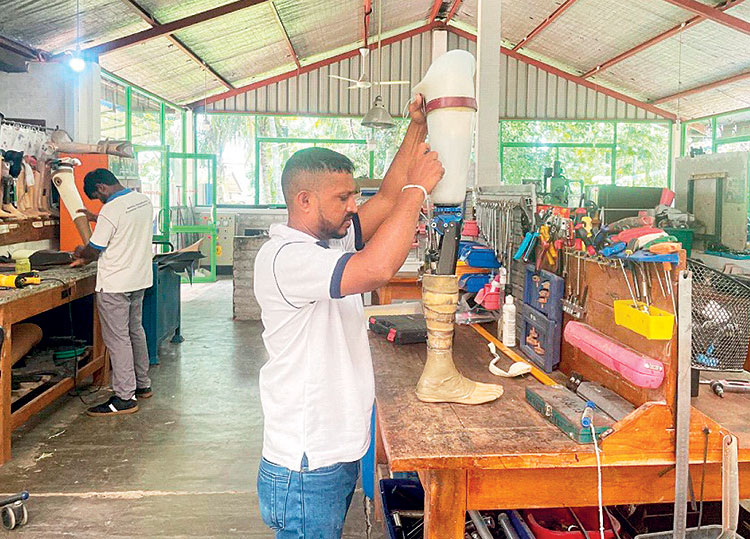
For thousands of Sri Lankans living with limb loss and physical disabilities, access to quality rehabilitation services remains a significant challenge. Yet, for more than three decades, our organisation has quietly transformed lives through innovation, compassion and community-based care. The Meththa Rehabilitation Foundation Guarantee Limited (MRFGL), supported by the Meththa Foundation-UK has emerged as one of Sri Lanka’s most effective voluntary rehabilitation service providers, restoring mobility, independence and dignity to some of the country’s most vulnerable citizens.
The Foundation’s roots stretch back to 1994, when a group of expatriate Sri Lankan professionals in the United Kingdom recognized the severe shortage of rehabilitation services available to disabled persons in Sri Lanka. Drawing upon their expertise in rehabilitation medicine and allied healthcare professions, they established the Meththa Foundation-UK with a simple but powerful vision: to provide affordable, high-quality prosthetic and rehabilitation services to those who needed them most.
What began as an effort to recycle and repurpose high-quality prosthetic components donated by the UK’s National Health Service has evolved into a comprehensive rehabilitation network serving communities across the island.
Clinical services commenced in Sri Lanka in 1995 through a mobile outreach programme that initially supported injured soldiers and later expanded to civilians affected by conflict and disability. The majority of them were victims of land mines. In 2010, the Sri Lankan arm of the organisation was formally registered as the Meththa Rehabilitation Foundation Guarantee Limited, strengthening its ability to deliver sustainable services nationwide.
Today, the Foundation operates four modern rehabilitation centres located in Mahawa, Mankulam, Balapitiya and Kilinochchi. These centres provide prosthetic and orthotic services, posture and mobility support, limb repairs, and rehabilitation assistance to patients from diverse social and economic backgrounds.
Recognising that many disabled individuals live in remote areas with limited access to healthcare, Meththa Foundation also established a mobile outreach service in 2011. Through a successful “Hub and Spoke” model, rehabilitation teams travel regularly to underserved communities, ensuring that patients are not denied care simply because of distance or financial hardship.
The scale of the Foundation’s work is impressive. During 2025 alone, the organization recorded approximately 2,000 patient contacts, including the provision of 350 new artificial limbs, 850 limb repairs and around 800 other rehabilitation devices. For many beneficiaries, these interventions represent far more than medical treatment; they offer a pathway back to employment, education and social participation.
Innovation has become a hallmark of the Foundation’s approach. Through an active research and development programme, MRFGL has developed affordable prosthetic technologies specifically suited to Sri Lankan conditions. Among its achievements is the development of a modular below-knee artificial limb system manufactured largely from locally sourced materials. The Foundation has also designed low-cost prosthetic knee components that significantly reduce the financial burden on patients while maintaining quality and functionality. These developments are funded by generous International Grants facilitated by affluent members of the Meththa Foundation-UK. Service users are encouraged to donate whatever they can but for those who cannot, which is a majority the services are entirely free.
These innovations not only make rehabilitation more affordable but also strengthen local manufacturing capabilities and reduce dependence on imported components.
Equally important is the Foundation’s commitment for building local expertise. Recognizing the shortage of trained rehabilitation professionals in Sri Lanka, Meththa Foundation established an apprentice-based vocational training programme that recruits and trains young people as prosthetists, orthotists and rehabilitation technicians. Several locally trained staff members are now employed across the Foundation’s centres, helping to create a sustainable workforce for the future.
The organisation’s work has attracted growing recognition within the healthcare sector. Discussions have already taken place with health authorities regarding the potential use of Meththa-designed prosthetic components within Government hospitals. Such collaboration could significantly expand access to affordable rehabilitation services throughout the country.
Beyond its clinical achievements, the Foundation’s impact is measured in restored confidence and renewed independence. Surveys conducted among beneficiaries indicate that many educated amputees successfully return to productive lives after receiving rehabilitation support. However, the Foundation also highlights an ongoing challenge among poorer and less educated amputees, many of whom struggle to access follow-up care due to transportation difficulties and financial constraints.
To address this issue, the organization hopes to expand its mobile services and community outreach programmes. Additional funding would allow rehabilitation teams to reach isolated communities more frequently, ensuring that vulnerable patients continue to receive the support they need.
Operating on an annual expenditure of approximately Rs. 30 million in Sri Lanka, supplemented by overseas fundraising and donations, the Foundation remains heavily reliant on the generosity of donors, charitable trusts and well-wishers. Every contribution directly supports the provision of artificial limbs, mobility devices, training programmes and outreach services for those who might otherwise be left behind.
As Sri Lanka continues to strengthen its healthcare and social welfare systems, organisations such as the Meththa Foundation demonstrate how innovation, volunteerism and dedication can create lasting social impact. By helping individuals regain mobility and independence, the Foundation is not merely providing artificial limbs—it is rebuilding lives and restoring hope.
For many beneficiaries, every step they take is a testament to the life-changing work of the Meththa Foundation.
www.meththafoundation-sl-uk.org
Chairman’s WhatsApp contact number +94 77 788 6119
Prof S P Lamabadusuriya, Chairman
Dr B Panagamuwa, First Trustee
Features
Sri Lanka’s Marine Frontline: Dr. Samantha Gunasekara’s Battle Against Plastic Pollution and Transboundary Waste
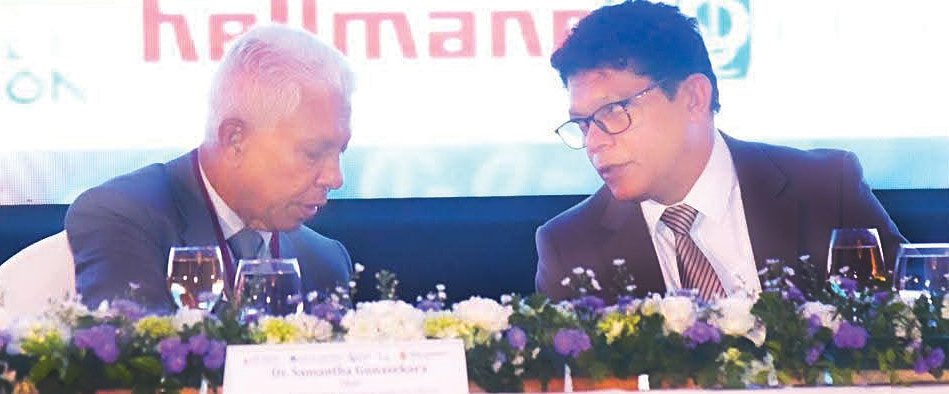
For decades, Sri Lanka’s coastline has been celebrated for its pristine beaches, rich marine biodiversity and vibrant fishing communities. Yet beneath the beauty lies an escalating environmental crisis that threatens ecosystems, fisheries, tourism and coastal livelihoods.
At the forefront of the battle against marine pollution is Dr. Samantha Gunasekara, Chairman of the Marine Environment Protection Authority (MEPA), who has spearheaded some of the country’s most ambitious coastal restoration and pollution mitigation programmes in recent years.
In an interview with The Island, Dr. Gunasekara outlined the scale of the challenge facing Sri Lanka’s marine environment, from locally generated plastic waste to transboundary pollution washing ashore from beyond the country’s borders.
He also spoke about the ongoing clean-up following the MV MSC Elsa 3 maritime incident and the urgent need for regional cooperation to tackle marine litter in the Indian Ocean.
“The issue is much bigger than what people see on a beach,” Dr. Gunasekara said. “When the public notices plastic bottles, polythene bags or other debris on the shoreline, they are only seeing the final stage of a problem that begins many kilometres inland.”
-
- Transboundary pollution
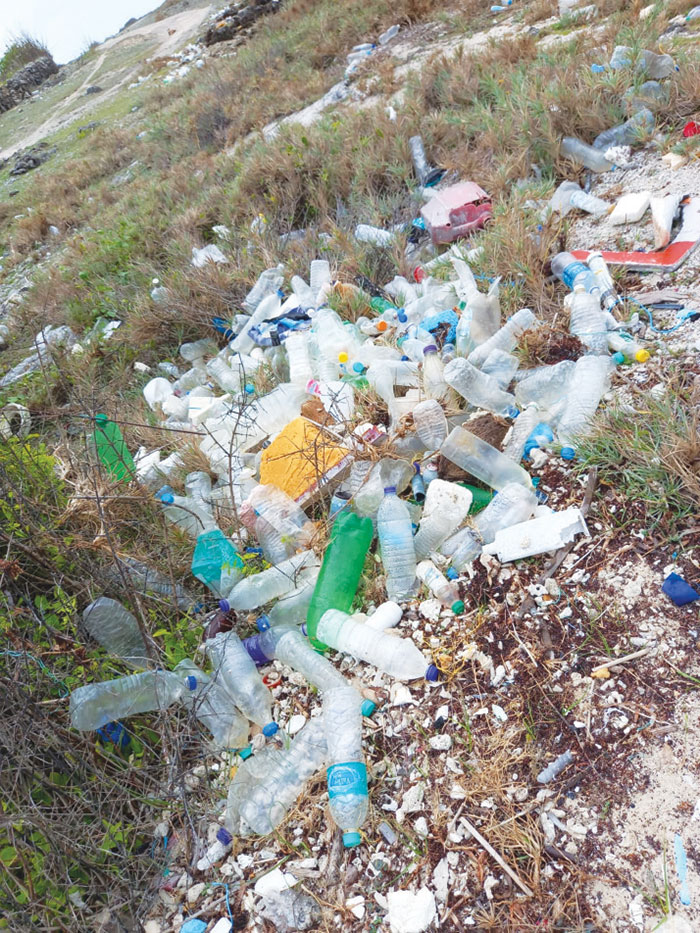
According to him, more than 80 percent of marine plastic pollution originates from land-based sources.
“What is found in the ocean is largely a reflection of what happens on land. Waste discarded into canals, streams and rivers eventually reaches the sea. Unless we address waste management within the country, marine pollution will continue regardless of how many clean-up programmes we conduct.”
He noted that household waste, industrial refuse, improperly managed dumpsites and littering remain major contributors to marine pollution.
Over the past year, MEPA has intensified its coastal clean-up operations, restoring numerous beaches that had been heavily contaminated by plastic and polythene waste.
The results have been dramatic.
Photographs documenting several restoration projects reveal coastlines once buried beneath layers of plastic debris transformed into clean and attractive public spaces.
“The President himself expressed concern after seeing the scale of pollution in some areas,” Dr. Gunasekara said. “That support has enabled us to move forward with several restoration initiatives.”
Yet, despite local efforts, Sri Lanka continues to face a challenge largely beyond its control—transboundary marine pollution.
Dr. Gunasekara was particularly concerned about the volume of waste washing ashore in the Northern Province and surrounding islands.
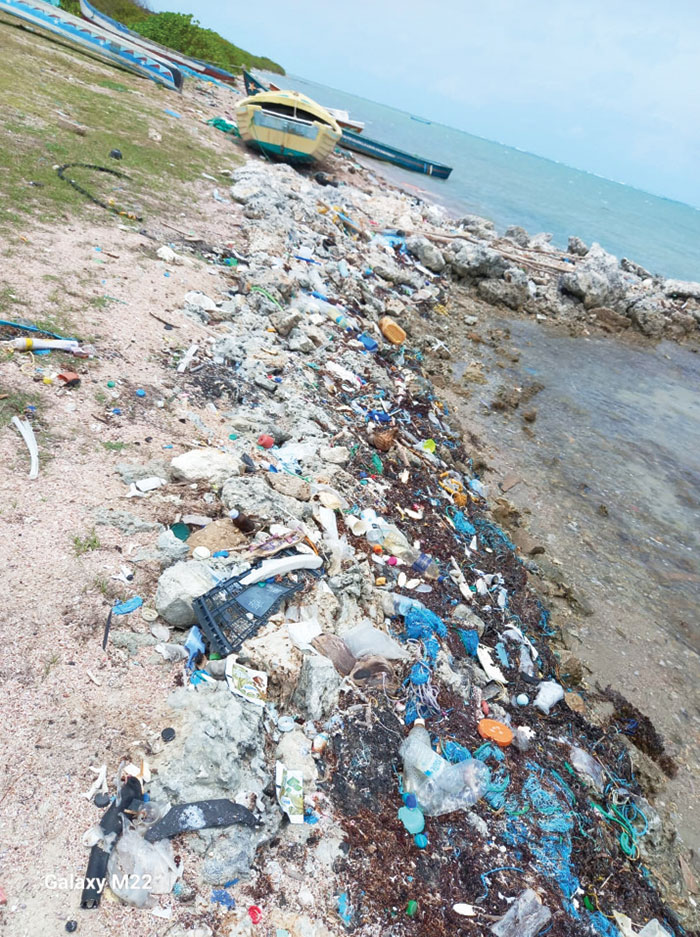
He said islands such as Delft, Nainativu, Punkudutivu and Eluvaitivu receive enormous quantities of foreign-origin debris every year.
“The quantities are unbelievable. If someone visits these locations after a rough sea period, they will immediately understand the magnitude of the problem,” he said.
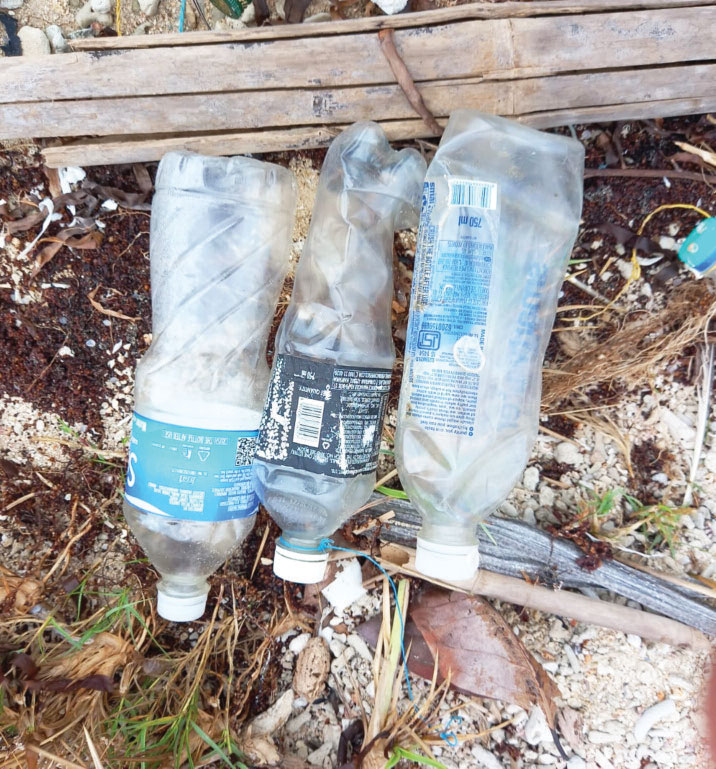
According to observations made during numerous clean-up operations, a significant proportion of the debris appears to originate from across the Palk Strait.
“Based on the labels, packaging, language markings and the nature of the waste, it is evident that much of the material comes from India. In some locations, nearly all the debris collected can be traced to Indian sources,” Dr. Gunasekara said.
He stressed that the issue should not be viewed as an attempt to assign blame but rather as a regional environmental challenge requiring regional solutions.
“The ocean does not recognise political boundaries. What enters the sea in one country can easily end up on the shores of another. This is why cooperation among neighbouring countries is essential.”
Nevertheless, he believes stronger action is required.
“Sri Lanka invests considerable resources in cleaning its coastlines. When foreign-origin waste continuously arrives on our shores, it places an additional burden on our economy and our institutions.”
Recognising the seriousness of the issue, MEPA has prepared policy proposals and submitted recommendations through the relevant ministry seeking higher-level government engagement.
A Cabinet paper addressing transboundary marine debris has also been prepared for consideration.
“The intention is to facilitate discussions at government-to-government level. We need practical mechanisms for prevention, monitoring and mitigation,” he said.
Dr. Gunasekara pointed out an apparent contradiction.
“Several coastal areas in India have received international recognition for beach cleanliness and environmental management. Therefore, there is no reason why similar standards cannot be maintained more broadly. The challenge is ensuring that waste generated inland does not eventually enter the marine environment.”
Another major challenge facing Sri Lanka has been the aftermath of the MV MSC Elsa 3 incident, which released large quantities of plastic nurdles into the marine environment.
Nurdles are tiny plastic pellets used as raw material in plastic manufacturing and are considered among the most difficult forms of marine pollution to remove because of their small size and tendency to disperse over vast distances.
Dr. Gunasekara recalled that the first signs of contamination emerged in Delft Island before spreading rapidly along the coastline.
“Initially there was little evidence of significant contamination. Then, within weeks, large quantities began washing ashore,” he said.
The pellets eventually spread across numerous northern islands and along extensive sections of the western coastline.
MEPA responded immediately, deploying personnel and mobilising local communities.
For the first three months, the authority led much of the clean-up effort directly.
However, the scale of contamination soon required additional resources.
Discussions were initiated with representatives of the shipping company and its insurers.
“The company agreed to support the clean-up operation under MEPA’s supervision and technical guidance,” Dr. Gunasekara said.
Today, thousands of workers continue to participate in the recovery effort.
At its peak, nearly 1,700 labourers were engaged daily in collecting nurdles and associated debris from affected coastal areas.
The operation remains one of the largest marine pollution response exercises undertaken in Sri Lanka.
Workers have been provided with protective equipment, water, welfare facilities and logistical support funded by the responsible parties.
“The objective is not simply to remove visible pollution but to minimise long-term environmental impacts,” Dr. Gunasekara said.
The task has proven far more complex than initially anticipated.
Changing ocean currents and rough weather have redistributed pollution into previously unaffected locations.
“Areas that were relatively clean months ago are now receiving fresh deposits. Therefore, the operation remains dynamic and requires constant monitoring.”
The volume of recovered material has been staggering.
According to MEPA estimates, approximately 47 shipping containers have already been filled with collected debris.
“These containers include nurdles, bottles, packaging material and other plastic waste recovered from beaches and coastal habitats,” he said.
The authority is now examining environmentally responsible disposal options.
Recycling remains difficult because prolonged exposure to seawater often contaminates plastic materials and reduces their suitability for conventional recycling processes.
Adding another mystery, MEPA recently detected coloured nurdles among the recovered pellets.
“We have found red, blue and green pellets. Traditionally, nurdles are colourless. We are investigating the source and significance of these findings,”
Dr. Gunasekara said.
Despite the immense challenges, he remains encouraged by the support received from local communities.
Fishing families, religious leaders, schools and volunteer groups have joined restoration efforts across the country.
In the North, villagers welcomed clean-up teams with garlands and handmade gifts as expressions of gratitude.
“These gestures demonstrated how much these communities value their environment,” he said.
Religious institutions have also become important partners.
“In several coastal regions, churches and temples helped coordinate volunteers and identify the most vulnerable communities requiring assistance.”
Looking ahead, Dr. Gunasekara believes Sri Lanka must adopt a broader vision of marine environmental protection.
He argues that marine pollution should no longer be regarded solely as an environmental issue.
“It affects fisheries, tourism, public health and national development. Every plastic bottle thrown into a canal ultimately becomes someone else’s problem.”
He also advocates stronger regional cooperation within South Asia to address marine pollution, improve waste management and establish joint monitoring mechanisms.
“The future of the Indian Ocean depends on collective action. No country can solve this problem alone.”
As Sri Lanka continues its struggle against mounting environmental pressures, Dr. Gunasekara’s message is both urgent and hopeful.
“The sea has sustained our civilisation for generations. Protecting it is not merely an environmental obligation; it is a responsibility we owe to future generations.”
For the chairman of MEPA, the mission extends beyond cleaning beaches. It is about safeguarding an entire marine heritage—one that remains central to Sri Lanka’s identity, economy and future prosperity.
By Ifham Nizam

Tunisia out of World Cup after 0-4 defeat by Japan

Vance arrives in Switzerland for US-Iran talks

FFSL renews National Team Head Coach Abdullah Almutairi under “The Next Chapter” program

Gakpo, Brobbey doubles give Dutch 5–1 World Cup win

Trump vows Iran will not charge Strait of Hormuz tolls, but says US might

Showers will occur in the Western, Sabaragamuwa and North-western provinces and in Galle, Matara, Kandy and Nuwara-Eliya districts

‘Dates have the highest sugar content to fight Coronavirus’

Sunday Island 27 December – Headlines

#SundayIsland 17th December – Headlines

Sunday Island – 28th March

Sunday Island Headlines – 21 March

Sunday Island – 21st February – Headlines
-

 News7 days ago
Release of 2025 O/L results likely to be delayed
-

 Sports7 days ago
Tharanga set for high-profile javelin clash in Ostrava
-

 News7 days ago
Theft of USD 2.5 mn from Treasury: CoPF accused of complicity in NPP cover-up
-

 News6 days ago
Beijing Capital Airlines to resume flights to Colombo signalling boost to tourism
-
 Features5 days ago
Killing of Colombo’s ancient trees — a warning on UN’s World Desertification Day – 17 June
-

 Opinion7 days ago
Decoding Trump’s 12.5% “Forced Labor Tariff” on Sri Lanka
-

 Opinion7 days ago
Palm leaf manuscripts of Sri Lanka – Part V
-

 News2 days ago
Creditor not yet paid