
Features
Peaceful and Unlawful Assembly

by Lalin Fernando
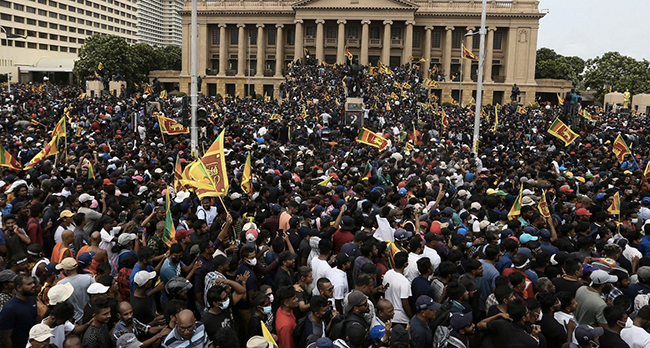
This is a response to the media, the BASL and foreigners who never give up preaching on how ‘peaceful protesters’ were attacked ‘brutally’ by the Security Forces, especially at Galle Face Green on July. 22. With hundreds of thousands of protesters (Sunday Times Aug . 7) including non-nationals living on charity,, who were the peaceful protesters?
There is a right to peaceful assembly but not to unlawful assembly..Under which law can protesters ‘peacefully’ block access to government buildings or interfere with other purposes the building was designed for? Can they obstruct vehicles or pedestrian traffic or cause a threat to public peace?.Did they not?
Interestingly in the UK the punishment for a public nuisance offence is life imprisonment under laws made eons ago. .So which law, ancient or modern, allowed protesters to occupy the Presidential Secretariat in SL? Was it the same law that allowed protesters to overrun the President’s official residence, the prime minister’s office, set fire to the prime minister’s home, murder persons on May 9 and incinerate 76- 91 homes of MPs etc? Were the people who did so ‘peaceful’, never mind the protests?
An unlawful or any assembly of five or more persons likely to cause a disturbance of the public peace may be ordered to disperse by a magistrate or police officer not below Inspector rank and it will be the duty of the of the members of such assembly to disperse (Code of Criminal Procedure Act (No 15 of 1979 Sect 95).Did the protesters do so? Peacefully or otherwise?
Unlawful assembly is one in which those involved behave in a violent, boisterous, disruptive or tumultuous manner. Who else except Ambassador Chung and the media remembers all these protesters being ‘peaceful’? The leaders and associated ruffians were blood thirsty..
Unlawful assemblies can be dispersed with the use military force by a commissioned officer of any of the three Forces acting alone in the absence of a magistrate or Inspector level police officer (Sect 96).The military has not used military force so far. Possibly because Ms. Chung thinks ‘the time is not right just now’. Will she signal the right time? Heaven help SL when she does, knowing how well she knows what ‘force’ is including ‘shredding’.
Public order – a definition
It is an offence to use threatening or abusive words or behaviour or disorderly behaviour or display in writing signs, a representation of which is threatening or abusive in the hearing or sight of a person that is likely to cause harassment, alarm or distress. Were we deaf and blind from April 22 that we did not see the behaviour of the mobs as ‘threatening’ or ‘abusive’ and in fact by some massive abberation thought they were actually ‘peaceful’?
Who decides which is which? The BASL,the media, Ms. Chung or the police? Why was a magistrate not asked to be present at barricades to decide? Did the sight of ‘ thousands upon thousands’ baying for blood prevent the legal system from functioning through fear and cowardice of those responsible for public security?
The same people who, did not hesitate to castigate, ridicule and insult the police soon after they took office? Who then weighed in profoundly to say the constitution was irrelevant and the government illegitimate helping to creating a state of anarchy? It actually became the popular thing to say so until an Emergency was declared and arrests were made.
Suddenly the Government that had been in a blue funk due to its guilt that made its promise of splendour and prosperity become one of nightmares and bankruptcy, had stood up.,following the example of the present President. Had the BASL taken the place of the judiciary to misdirect the country?
Yes, absolutely no force should be used against ‘peaceful’ protesters or a peaceful assembly in SL .However the time was not long past when mounted police in western capitals laid about with swords (Belgium, France?) to disperse unlawful or not, ‘assemblies’.The Jallianwalla Bagh Amritsar (India) massacre of peaceful protesters (it was a religious holiday) may be forgotten by some but not by Indians
Gen Dyer’s orders to the troops led to 1,200 killed and 1,500 wounded in 1919. Winston Churchill called it ‘intolerably monstrous”.In 2019 Britain ‘expressed regret’ but did not apologise to India..Lessons were not fully learned even 50 years on. .The British in Kenya were intolerable again.The Ohio State National Guard on 4 May 1970 shot and killed 4 Kent University undergrads and wounded nine with 69 rounds being fired by 28 Guardsmen in 13 secs when confronting an unarmed peaceful protests against US involvement in Cambodia.
Some of the dead were only observing the protests from 300 yards.Four million undergrads from universities all over the USA walked out in sympathy.. In 1974 the USA with 7,000 troops and press ganged support from six Caribbean countries invaded Grenada.Why? It had a leftist government supported by Cuba. It is 100 miles from Venezuela. Was this an anti left protest launched by the USA? It ended in a farce .
A mental asylum was bombed by the USAF. USA had 25 troops killed and 59 wounded.The inter force communications had not been tested. It ended with US Navy ships having to call back to their command HQ in USA to inform USAF pilots circling overhead in Grenada about opportunity targets. Grenada had 45 killed in action and 337 wounded inaction (not including Cubans)..
Grenada covers an area of 344 sq kms and had a population of 84,000 in 1993. The 7,000 US troops consisted of two Ranger battalions, the crack 82 Airborne Division and the Rapid Deployment Force! In 1919 the British declared martial law in Ceylon.They shot without judicial trial very many national leaders including William Pedris They panicked thinking it was an uprising against British rule. A Brit officer used to have his breakfast watching the executions. Is it not arrant arrogance and stupidity for the US or British envoys whose countries had enslaved Africans, taken native lands by force and attempted genocide of American Indians to preach to SL on how to deal with protesters?
The British action in dealing with ‘protesters’ in Wellawaya in the ‘Great Liberation war’ (1817-18) laid waste the fertile countryside and killed all males above 10 years of age.This was a catastrophy the effects of which were seen in the insurrection of 1971.The survivors swell the ranks of ‘protesters’ yet The SL Police style of operating by first establishing communications with the mobs is exemplary.Their monumental and enduring patience over the last four months is extraordinary.It has to be highly commended. However, except for the Colombo middle and upper middle class originals (generally) ,and the farmers, teachers, unionists etc were there not at Galle Face Green (GFG) peace hating protesters too? Have they been treated differently for being different?
Were they the followers of the terrorists of 1971?; who later together with the then President who had an entente with them, were responsible for 60,000 death in 13 months 1988/9? .Were they the new shock troops, well fed and generously looked after by the original ‘Aragalists with deep pockets, that attacked the police barriers almost daily in 2022 while the poor people were struggling to find food to feed their families among shortages of other bare essentials?
So what were they actually fighting for? (WHO says 6 million – nearly a quarter of the SL population, mainly children and women) are on the brink of starvation? At GFG who would have believed WHO? Food was in plenty and of all varieties, while drink flowed and dancers did the merry baila and other jigs. It looked so western fun, like a song/drug festival in the West whoever funded it.
The police always, repeat always, attempted at first to communicate with the ‘peaceful protesters’ and pacify them at every demo..They did not threaten.They ended up using water canon and firing tear gas when the barrier toppling thousands of ‘peaceniks’ breached their defences.Surely this last police response could not be correct if the protests were ‘peaceful’? Who did something wrong? The police or the ‘protesters’?
To say that only ‘some’ trouble makers have ‘infiltrated the current’ protesters’ as in one newspaper, is hypocrisy..Were the ‘some’ of those ‘peaceful’ thousands who with years of experience in terrorising especially freshers with savage ragging in all except the Northern and Eastern universities ,(they would not have dared) switched from site to site to challenge and overrun, outnumbered, neutered and emasculated police/military (POLMIL) that had their hands/batons/weapons tied?.When the Presidential Secretariat was taken back in July after illegal occupation, the numbers game was reversed. That took the obstinate ‘peaceful’ protesters completely by surprise.
The ‘some’ trouble makers knew the police would only use tear gas and water canon while the troops sadly acted like dummies. Few doubted that a state of near anarchy prevailed. It grew in intensity with every protest. The law was openly flouted (to the delight of many) by these ‘some’ trouble makers.Was it not their actions in 1988/89 that resulted in 60,000 deaths in 13 months? Does Ms Chung know?.
The killings were limited only to the Sinhalese while massive damage was done to govt. property, administrative machinery and national infrastructure. .The country was nearly shut down by the then ‘aragalists/terrorists’ distributing ‘chits’ and slaughtering anyone who disobeyed them even for keeping lights on in one’s home? Is this their third and final attempt?
However there are laws that protect the citizen’s body and his property and also public property.The police are there to see that these laws are enforced. Sadly they did little if nothing instead during these ‘peaceful’ protests due to poor leadership at national level including some of the top brass of the police.
Was this due to ignorance or fear and possibly due to Western interference and influence Or was it due to threats such as the visit to MOD by the western envoys? There was also the fear of a Geneva backlash.
Ironically it was the new elected by parliament President,hardly a Sando, (but much reviled by many of his former friends, sycophants and beneficiaries). who decided to invoke these laws, now called harsh.If these only knew the provisions of the US Patriot Act they would throw up.The new President during most of his over 40 years as a politician was the knight in shining western dress for the elite in Colombo, especially the middle aged women. Where are they now? Have they not done the SL thing? Desert and abandon when the going turns bad.
The former ex-military Prez disappeared. It may have been out of guilt for the horrible state of the nation under him or by being ill advised as usual..Did they all forget the Penal code? Who advised him on his course of action? Were they the same rotters of boastful academic (Viyathmaga) fame who are now deserting like rats?
The past president had a heroic choice when the final push came to overrun the near naked and ordered to be spastic, defenders of President’s 250 year old House (not ‘Palace’ as the western media likes to dub all non western leader’s houses) .Like General Gordon, vastly outnumbered , he could have faced the mobs alone. Gordon with his Egyptian and British troops near starvation after many months of encirclement, faced the Madhi of Sudan and his Dervish army at Khartoum.Gordon had often said that when God distributed fear he ran short of it when he came to Gordon.
Unfortunately for him the Dervish attackers had dodged God too.They were devilishly brave too They hacked off his head. Gota had probably not heard of Gordon who had a steamer on the Nile just behind his house (not Palace) to evacuate him.He refused. Ironically Gota had a SLN ship ready. He used it, fortunately.
It is now rumoured that Gota may come back to SL. Whenever he does, he may be compared by the fanciful SL media that likened him earlier to Hitler,(SL is a sucker for western imagery) to Napoleon coming back from Elba.Would the Western powers then contrive to send him to Guantanamo instead of St Helena even before a 100 days pass?
As for defending not only Presidents but all citizens Penal code Sec 25 para 89 clearly states that ‘nothing is an offence which is done in the exercise of private defence. Why then did the police not use force to defend the President’s life? Where does it say force cannot be used?. Self defence does not cease as long as the threat to life exists.
This important if not vital aspect of law is skillfully or cunningly not elaborated to the lay person by the countless BASL bulletins .The use of force causing even death is within the law in self defence. Six offences are specified.Who judges what is justifiable or proportionate? Is it the BASL, the media, western envoys ,or the individual (s) in danger?
The security forces (police) opened fire only at Rambukkana after a long, hot, whole day of protests that included stone throwing and attemped arson.The protesters hail from a long established JVP hotbed. Their activities included an abortive attempt at setting fire to the only petrol shed and a lone fuel tanker because there was no fuel!. If a person is killed or injured while the person is exercising his right of self defence he may still be arrested until the case is heard and extenuating circumstances if any are proved.This is not the law of the jungle or of asses .The police and others knew but were not convinced there was a level playing or fighting field. prevailing.
The ‘peaceful’ protesters destroyed 91 (MP Welgama in parliament in July 2022) houses of Govt MPs by arson on 9 May 22 and murdered nine(9) people including one MP whose naked body was dragged along the street .Did Mrs Chun see this? What would the BASL and media have stated if the law as given above was acted upon when the threat manifested itself? Would it be called an exhibition of brute force? Have they seen the very same activists displaying different slogans periodically attacking university students who disagree with them?
Para 90 states self defence covers ‘his own body or that of any other person against an offence affecting the human body.’….. and ‘property’. Any citizen, not only the police can act under that law .The police ordinance too provides legal cover.But the police it would appear were ordered to ignore the law.What was the IGP thinking and why?
Para 95 states the right to private defence ‘commences as soon as a reasonable apprehension of danger to the body arises from an attempt or threat and continues as long as apprehension of danger to the body continues’…So when does reasonable apprehension manifest itself and end? Is it after killing(s) and stripped bodies are dragged along streets or when a threat with paving stones, clubs and steel rods is apparent?
Para 96 covers mischief by fire or explosion … where ‘death or grievous hurt’ may result while para 99 covers Mobs.The same rights of defence applies.
Clearly the police are fully aware of all this as are the Forces when trained for duties in Aid of the Civil’ power .The principles followed are prevention,necessity, impartiality and minimum force..Impartiality is required when 2 mobs confront each other..Red shirts only cannot be the targets! Minimum force is the force applied immediately to stop danger to body or property and not after any bargaining as at the Presidential Secretariat in July 22..It normally starts after non lethal methods have failed. A single live round may be fired at a law breaker.If the danger continues 2 rounds may be fired.If the danger persists, heaven forbid but the aggressor may force the issue, a volley may be fired! The last has never happened in SL The worst example was at Amritsar during British rule in the late 1910s when machine guns were used under the orders of Gen Dyer Hundreds of Indians were killed.Dyer was killed in revenge much later in England.
The original protesters were organised, smartly dressed, well fed and wined, educated, witty, tech savvy They were the people who fashioned the ‘aragalaya’.No one else can claim to have done so . .They were the darlings of the media and an inspiration to the youth in particular. They were generous, helpful and kind to all who joined them. .They were not compromised and used for ulterior ends. People may recall their laudable efforts during the December 2004 tsunami and many candle light and other peaceful protests over the years.
Originally the cry was amusingly Go Gota Go which is a rallying cry at rugby.That was mistaken wit..This changed to ‘Gota Go Home’ even after he had been advised or forced to leave his home, and then ‘Ranil go home’ when Ranil wise cracked ‘I am at home’ .However those who confronted the police (and the military later) in many instances were dangerously violent.They were not representative of the original Aragalists.
The Mirihana protest, peaceful at first ,became violent and then certainly intimidating and threatening when a violent group infiltrated the original protesters, turned off the main road and onto the private road that led to the residence of the former President.Their intent was clearly unlawful and violent and could have included murder ,abduction and arson as subsequently happened with increasing frequency and boldness of the ‘protesters’ ..
What is the response of a house holder if a mob carrying poles, clubs and iron rods assembles by his perimeter wall, baying for his blood? Is he to wait until they scale his wall or should he act in self defence according to the law especially if it is at night? The former course appeared to be the response of, and temporary interpretation of the law by the police.It made the mobs lose fear of the law and its guardians and become reckless.
At the entrance to the Naval Dock Yard Trinco on 10 May 22, TV showed a young woman standing in front of a baying mob , surprisingly in a very mellifluous voice, singing out the refrain, ‘kapapang kapapang’ (cut cut ) and then ominously ‘kayli kayli (pieces pieces).A Sinhala Madame Defarge? The mob were not at a fish market looking to skin fish but were attempting to rush the gates of the Dock Yard, the premier base of the SL Navy and kill the former Prime Minister ..They knew it would have been a step too far had they challenged the Navy.Instead they taunted the Naval guards to entertain the easily cowed and cheap thrilled media instead. The mob attack to storm parliament did not appear to have a single peaceful intention. One JVP leader (not drunk and driving this time) did say they would surround parliament and not allow anyone who did not do what the JVP wanted done,to leave parliament. The stealing of 2 automatic rifles from badly battered troops showed that peace was furthest from their intentions..That was the turning point.The worm had turned. .Have the peaceful protesters now gone underground?Are they cutting off their beards and trimming their hair styles?Are they regrouping? Those 2 rifles must be found quickly. .
That woman in Trinco was not an exception but one of a kind of thousands of unemployable and unemployed rather elderly ‘students’ that launched attacks all over Colombo Fort and surrounding areas, transporting themselves almost magically over long distances while the rest queued 2-4 days for fuel.Who cared whether or how the people got petrol or food or cooking gas?
Why they are/ were called ‘peaceful protesters’ stuns the imagination .They are the same people who switched from one to another barricade encounter.Their leaders remained in the rear, as in 1988/9 when they attempted genocide of the Sinhalese .They have blood on their hands and their thinking is bloody but they masquerade as ‘peaceful’ protesters especially when western media is around. Local media laps them up in mortal fear 24 x 7.So did a western envoy, looking for a political stooge.There are many in SL, if dollars flow.
Were they not screaming obscenities and murderous threats while armed with iron bars and clubs well hidden? Did they at GFG not use force on the leader of the Opposition (9 May 22 – he subsequently dodged contesting the Presidency?!) and gave a former minister, who had produced 2 IRCs at a TV interview in 2019, a taste of the same on 9 July ?
RW correctly asked the US envoy,who declared her admiration if not undying affection for the JVP, whether force was not used by US security officials on the Trump supporters who stormed the Capitol building .He also asked where else in the world would attacks on a President’s office take place without a law enforcement response..He should have also asked what level of force was used on Sadr city protesters in Iraq who were confined in Abu Graib prison and what type of protest the villagers of Mai Lai were doing when Capt Calley (who was never incarcerated as a consequence) and his men murdered and raped the entire village.They killed all the dogs and cats too. South Korean troops were allied to the US forces then to fight the Vietnamese. Or he might have asked why tanks, helicopters and 2 battalions of Air Mobile troops were used to murder hundreds and wound thousands in Gwanju South Korea in 1980. Chung added a caveat.,She said the time was not right just now for strong arm tactics.So when will that correct time be and who will say so ? Is she trying to outdo Mr.Dixit?
Unsurprisingly no regional country criticized SL Thank you brothers and sisters.· The SL Police have acted with sufficient if not overwhelming restraint quoting law and doing their best to solve the continuing impasse, peacefully.They, after negotiating and pleading with the recalcitrant ‘protesters’ for 3 days, used only minimum if any force to execute a written order of the Fort magistrate to vacate the Presidential office which they had trespassed .That was their duty. Brutal force by police is most evident not in SL but where ‘Black Lives matter’ as the whole world knows.
Who set fire and destroyed RW’s house together with those of his brothers and his library and the dogs? Why were RWs brothers’ houses termed ‘neighbours’ houses by the media? Was the whole family a target . Were the attackers a foreign legion or the spearhead troops of the protesters?.Why does the JVP deny gleefully that it was they that did it? Are they pointing fingers at the FSP as everyone else does? Which lunatic calls the FSP ‘peaceful’? What was a leading opposition politician’s sister adding to the the baying by the mob?
How does one distinguish between ‘peaceful’ and violent’ in these circumstances? Has one to wait until foul deeds including murder and arson take place? The law clearly states that once a threat manifests itself, action according to the law, including use of force, is permissibleThe most important question is whether,after a corrupt, ineffective, weak, disgraced etc Govt fails, even as a global recession sets in,and the Ukraine war continues ,is it to be replaced, out of fear of retaliation, by local experts in terror ? Where is the cash coming from to steady SL? According to Sajith P in May 22, Saudi Arabia promised him oil.He has not repeated this very silly statement.The IMF is the only hope SL has. SL should ensure China chips in by restructuring her loans and with out right grants in addition to what India has unhesitatingly and generously given. SL has a very delicate balancing act to perform to ensure our historical Asian benefactors continue to help.She has to be sincere in all she does She should never try to play one against the other.That would be suicide . It will however be difficult for the West not to try to exploit SL at this time.
Pray for SL less the politicians, media, BASL and western imperialists who think they are the reincarnation of Gods.

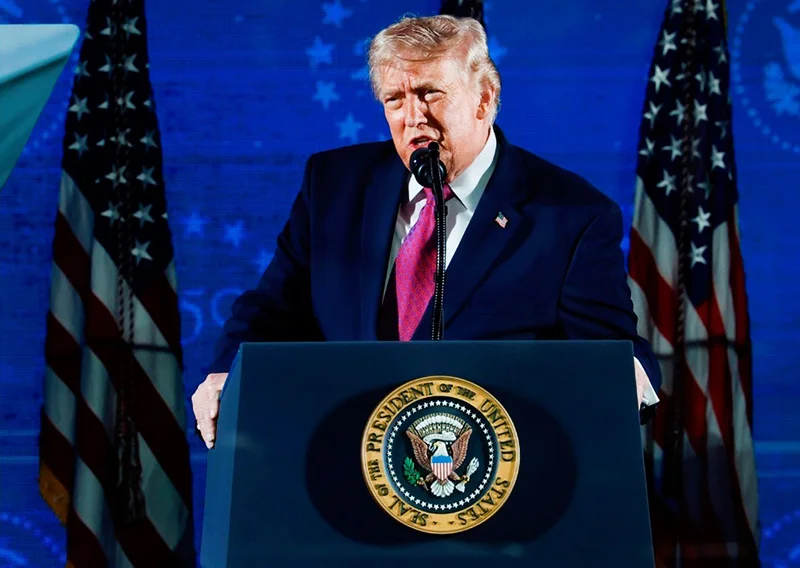
 Democratic and progressive opinion in the US and the world over would likely have been further jolted by the divisive rhetoric blared forth by US President Donald Trump on no less an occasion than the 250th anniversary of the US Declaration of Independence from Britain. The world has been placed on notice that what it would be having in the main is aggravated polarization on multiple fronts during what’s left of the Trump tenure.
If the world was expecting positive moves by the Trump administration to bridge divisions, heal rifts and usher in a more harmonious international political order, this is very unlikely to be. Instead, in all probability we would be left with a far more ‘dangerous place to live in’.
Some of the more thought-provoking recent ‘takes’ from President Trump are : ‘A generation after we fought and won the cold war against the menace of communism, there is now a resurgence of the communist menace in our land, including from newcomers to our country who embrace ideas totally opposed to our way of life and our great success.’ ‘We will send them (immigrants) quickly away, and we will continue to build our country bigger and better than ever before.’ ‘We are going to give our country its identity back.’ ‘You can be loyal to Karl Marx or you can be loyal to America. You can be a communist or you can be a patriot. You cannot be both.’
Accordingly, what the world would have in increasing measure going forward are stepped-up attempts to consolidate a white supremacist administration in the US accompanied by a suppression of ethnic, religious and cultural minorities at home along with renewed attempts to spread and consolidate US hegemonism world wide.
The latter project would mainly translate into US military interventions abroad of the Venezuelan type and a persistence if not a resurgence of identity based conflicts globally. Violent reactions internationally to what are seen as attempts by the US to bring recalcitrant sections in particularly the South under white supremacist control will provide the basis for the steadfast presence and spiking of identity politics globally.
Moreover, the path has been paved for stepped-up ethnic, religious and cultural disharmony within the US. A united state is far from possible, given this backdrop. Put simply, it would be a question of steeper political polarization at home and abroad.
The persistent, widespread support for the hard line Islamic regime in Iran locally and globally should serve as an eye-opener for the political decision-makers of the US. Huge crowds at the funerals of Iran’s political leaders could very well be state-orchestrated but they are a pointer to the fact that political Islam is far from on the decline. To the extent to which this is so, the phenomenon could be a hurdle in the path of a stridently expansionist US.
Looking back, it was the consolidation of the Islamic regime in Iran in the late seventies of the last century that, besides proving a major challenge to the unfettered global power expansion of the US and its Western allies, provided the motive force as it were for the proliferation of Islam-based identity politics in particularly the South. This continues to be so.
Going forward, the US would need to figure out how best it could manage the persistent presence of Islamic fundamentalism world wide, and for that matter other forms of identity politics, without drastically losing its global power and influence.
The recent successful challenge by Iran to the US’ efforts to exercise its diktat in West Asia should prove an ‘eye-opener’. In these confrontations both sides were bloodied but Iran proved that it could successfully take on the US militarily. The inference for the US ought to be that projecting its military might in the Middle East in a no-holds-barred fashion would not prove easy.
Arising from the foregoing a foremost policy challenge for the US would be to curb Iranian military power while avoiding another major military confrontation with the Islamic state that would cost the US and the world dearly in particularly economic and material terms. The US would have no choice but to persist with the often flagging West Asian peace effort and to render it fully workable.
Ukraine presents the US with another formidable challenge. As is known, Ukraine is proving no easy ‘push-over’ for Russia, but it is badly in need of more sophisticated Western arms, particularly effective air defense systems, to fully neutralize the Russian invasion. What would the US choose to do; go to Ukraine’s assistance fully or opt not to ruffle and antagonize the Putin regime, with which it is on some cordial terms?
A negotiated solution is best in Ukraine and the Trump administration would do well not to lose sight of this ideal but Russia too should see the need for a diplomatic solution if it is to salvage itself from its military stalemate in Ukraine. The US needs to try being a peace mediator in the latter theatre but if the Russian political leadership fails to opt for peace the US would have no choice but to join the rest of NATO and Europe in continuing to arm Ukraine.
The US would need to take the latter course if the ‘world’s mightiest democracy’ is to remain committed to its founding ideals. If President Trump fails to meet this challenge he would prove that he is nothing more than an ‘empty rhetorician’.
However, it should not come as a surprise to the world if Trump chooses not to strongly back the rest of the West on Ukraine. Domestic and foreign policy are closely intertwined. Since the Trump administration is committed to building a white supremacist state at home, democratic development worldwide has been of the least importance to it.
The Trump administration’s strong affinities to white jingoism would increasingly compel it to opt for a policy of international isolationism. As a result Ukraine could prove unimportant for the US going forward.
Consequently, US-Western Europe friction in particular is only likely to intensify in the days ahead. Coupled with the contentious issues growing out of the persistence of identity politics, the Trump administration’s far-sightedness in managing foreign policy issues would be tested to the fullest. Whether the world would have comparative peace or continued blood-letting would depend crucially on such judiciousness.
Features
Beyond concrete: Sunela Jayewardene urges Sri Lanka to rediscover an ancient wisdom for a planet in peril

It was more than a lecture on architecture. It was a challenge to rethink civilisation itself.
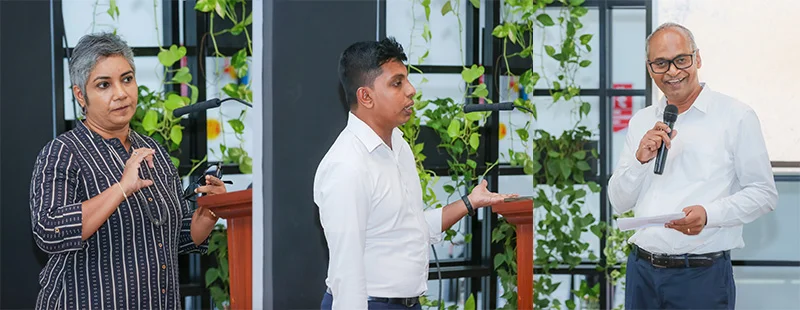
Standing before a packed audience at Dilmah by Genesis in Maligawatte, internationally acclaimed environmental architect, author and conservationist Sunela Jayewardene delivered a keynote that transcended blueprints, buildings and urban planning.
Instead, she invited her listeners on an intellectual journey into Sri Lanka’s ancient past, arguing that the answers to some of the world’s gravest environmental crises may already exist within the island’s forgotten ecological wisdom.
Her address, titled “Beyond Concrete: Architecture for the Coexistence of Species,” was at once philosophical, historical and deeply practical. It questioned humanity’s obsession with dominating nature and called for a return to a design ethic rooted in respect, restraint and coexistence.
“The road is actually very simple,” Jayewardene said. “We have simply forgotten it.”
That observation became the defining thread of an afternoon that challenged conventional thinking about architecture and development.
According to Jayewardene, modern society has inherited a worldview shaped largely by colonial values that placed human needs above those of every other living organism.
“Our value system was turned on its head,” she observed. “We accepted a Western way of looking at nature without questioning it. Today we can clearly see the consequences. The world is in crisis. Species are in crisis. Our lifestyles are in crisis.”
She was careful not to romanticise the past, nor was she dismissive of modern science. Instead, she argued that Sri Lanka’s pre-colonial civilisation possessed a sophisticated environmental philosophy that modern planners and architects have largely ignored.
For Jayewardene, environmental architecture is not about fashionable sustainability slogans or cosmetic landscaping.
It begins with humility.
It begins by recognising that humans are only one species among millions sharing the same landscape.
“The built environment should not exist in opposition to nature,” she said. “It should become part of nature.”
One of the most captivating moments of her presentation came when she introduced her own research into the island’s ancient sacred geography.
Using digital mapping and satellite imagery, Jayewardene demonstrated the remarkable alignment of Sri Lanka’s four original Saman Devalayas, whose axes converge on Sri Pada, historically known as Samanthakuta.
The extraordinary precision of these alignments, she argued, raises profound questions about the scientific and surveying capabilities of ancient Sri Lankan civilisation.
“What kind of technology enabled them to achieve this?” she asked the audience.
Her purpose was not to offer speculative answers but to challenge deeply ingrained assumptions that ancient societies lacked scientific sophistication.
“We often underestimate what our ancestors knew,” she said. “Yet the evidence around us tells a very different story.”
That forgotten knowledge, she argued, extended well beyond engineering.
It shaped an entire philosophy of living with the landscape rather than imposing human will upon it.
Displaying photographs from archaeological sites including Ritigala, ancient monasteries and rock pavilions hidden within Sri Lanka’s forests, Jayewardene illustrated how builders carved steps around natural boulders, integrated structures into existing rock formations and preserved the contours of the land.
Modern construction, she suggested, would almost certainly have bulldozed those landscapes into submission.
“Our ancestors honoured the land,” she said. “They accepted the landscape instead of trying to conquer it.”
For Jayewardene, that principle remains the foundation of every project she undertakes.
She described environmental architecture as an exercise in listening rather than commanding.
Every site, she explained, possesses its own identity, ecological history and natural rhythm.
The responsibility of the architect is to understand that identity before attempting to intervene.
“The land tells you what it wants to become,” she said.
Throughout the presentation, one word repeatedly surfaced—context.
Without understanding context, she argued, architecture becomes little more than sculpture.
Good design cannot be copied indiscriminately from one country to another or even from one district to another.
Climate differs.
Rainfall differs.
Vegetation differs.
Wildlife differs.
Culture differs.
Even the stories associated with landscapes differ.
All of these, Jayewardene insisted, must shape architecture.
“When I speak about inhabitants, I don’t mean only human beings,” she explained.
“The birds, insects, reptiles, mammals, trees and every living organism already occupying that land must become part of the design equation.”
This broader understanding forms the basis of what she describes as non-human-centred design—an approach that rejects the notion that cities exist exclusively for people.
Instead, landscapes should provide refuge for biodiversity while simultaneously serving human communities.
It is an idea that resonates strongly at a time when rapid urbanisation continues to erode habitats across Sri Lanka.
Jayewardene also challenged prevailing attitudes towards development itself.
Too often, she argued, “development” has become synonymous with replacing natural systems by concrete infrastructure.
She questioned whether flattening hillsides, redirecting streams and clearing vegetation can genuinely be described as progress.
In her view, genuine development should first ask what ecological value already exists before deciding what should be built.
One of the simplest yet most profound examples she offered concerned water.
“I always say it is acceptable to interrupt water,” she remarked. “But never disrupt it.”
That distinction reflects an ecological understanding often absent from conventional engineering.
Natural drainage systems, she warned, perform countless functions that remain invisible until they are damaged.
Floods, soil erosion, biodiversity decline and even changes in local climate frequently follow.
“We disrupt far more than water,” she said. “We disrupt entire ecological relationships.”
Equally significant was her distinction between degraded brownfield sites and relatively untouched greenfield landscapes.
Brownfield sites require ecological restoration, rehabilitation and renewal.
Greenfield sites demand restraint.
Minimal intervention, she argued, is often the highest form of environmental design.
The keynote found an appropriate setting within Dilmah Conservation’s own efforts to restore degraded urban landscapes.
Earlier in the programme, Rishan Sampath of Dilmah Conservation outlined the organisation’s transformation of an abandoned industrial property in Moratuwa into a flourishing urban forest containing over 300 tree species and more than 1,000 individual plants.
Scientific studies conducted within the restored forest have already demonstrated improvements in air quality compared with adjoining urban roads, providing measurable evidence that biodiversity restoration can improve city life.
For Jayewardene, such initiatives represent far more than beautification projects.
They demonstrate that ecological restoration can become a guiding philosophy for future urban planning.
Her address ultimately became a call to rethink humanity’s place within nature.
Architecture, she argued, should no longer celebrate domination over landscapes.
It should celebrate coexistence.
Every building should strengthen biodiversity.
Every development should restore ecological balance.
Every designer should ask not merely how a project serves people, but how it serves life itself.
As the audience left the hall, they carried with them more than architectural ideas.
They carried a challenge
To question inherited assumptions.
To rediscover indigenous ecological wisdom.
And to recognise that Sri Lanka’s greatest contribution to global sustainability may not lie in importing new environmental models, but in rediscovering the timeless principles embedded within its own civilisation.
For Sunela Jayewardene, the future will not be secured by building more impressive skylines.
It will be secured when humanity learns once again to build gently, intelligently and respectfully—allowing architecture to become not an act of conquest, but an expression of coexistence.
By Ifham Nizam

 Beyond modelling, Colombia’s Katherine Castaño, who captured the crown at the Top Model of the World 2026, in Egypt, is also a TV host, entrepreneur and social media influencer.
She’s based in Miami, Florida right now — a hub for fashion and influencer work — a city she calls home base, while representing Colombia on the world stage.
Her Miami base gives her access to fashion, entertainment, and business networks, while her title keeps Colombia front and centre in the global modelling conversation.
Off the runway, she says she enjoys singing, playing the piano, and tennis.
Katherine didn’t make the trip to Egypt as a newcomer. She’s built a strong international portfolio before winning the crown.
In fact, her résumé reads like a fashion passport: Colombia Moda, New York Fashion Week, Miami Swim Week, Miami Fashion Week, Nicaragua Diseña, IXEL Moda, and Mercedes-Benz San José.
On June 8, 2026, Katherine Castaño was crowned by outgoing winner Natalia Garizabal Vera, also of Colombia. That gave Colombia a historic back-to-back victory — the first time any country has done it in the competition’s history, and Colombia’s 4th win overall.
As Top Model of the World 2026, Katherine’s reign is centred on elevating her profile as a model, influencer, and entrepreneur.

She’s built a personal brand around beauty, ambition, style, and professionalism, with strong reach across fashion, social media, and business.
As titleholder, she’s now the face of the pageant’s international fashion platform, representing Colombia globally, while based out of Miami.
Ahead of the competition she was clear about the stakes: “This is bigger than me. This is for my country. This is for the story I’m here to write… And I’m not going quietly… we’re going for that back to back.”
As the reigning titleholder, Katherine Castaño’s role extends far beyond the sash. She’s using the platform to grow her brand as a model, influencer, and entrepreneur rooted in “beauty, ambition, style, and professionalism”.
She will also be doing runway shows, photoshoots, brand appearances, and fashion events.
Sri Lanka’s representative at this pageant was NetalieWithanage.

Cabinet Subcommittee on the Development of 25 Technical and Vocational Colleges meets under the Chairmanship of the Prime Minister

Representatives of the Organization of Professional Associations (OPA) of Sri Lanka meet the Prime Minister

District Secretaries’ Conference Chaired by the President

ICC contacts ECB over Stokes retirement video

Greater focus must be placed on strengthening primary healthcare

Morocco dealt huge blow as injured Saibari out of World Cup quarterfinal

‘Dates have the highest sugar content to fight Coronavirus’

Sunday Island 27 December – Headlines

#SundayIsland 17th December – Headlines

Sunday Island – 28th March

Sunday Island Headlines – 21 March

Sunday Island – 21st February – Headlines
-
 News5 days ago
Singapore-based Buddhist monk marks nearly four decades of humanitarian service
-
 News7 days ago
CIABOC to question Harak Kata on Rs. 200 mn bribery allegation
-
 News6 days ago
Freedom 250: US Embassy celebrates America’s 250th Independence Day through magic of American cinema
-

 Business7 days ago
‘Dialog Air Fibre powers a new era of Ultra Fast Home WiFi’
-
 News7 days ago
SLAF conducts successful rescue mission under UN command in Central African Republic
-

 News4 days ago
AI concerned over proposed SL military deployment in Haiti
-
 News7 days ago
UNEP support pledged to strengthen Sri Lanka’s Environmental Priorities
-

 Midweek Review2 days ago
Unexpected focus on ‘pieces of tin’ worn by military men