
News
AI claims govt. cracks down on dissent


The Amnesty International yesterday claimed that the Lankan government continued its crackdown on dissent, targeting multiple groups while impunity continued in a number of emblematic cases in 2021.
Al’s annual report on the state of the world’s human rights in 2021, released on Wednesday shows that in Sri Lanka excessive use of force and brutality by law enforcement officers were widely reported, and there were deaths in custody.
The report says: The UN Human Rights Council set up a mechanism to consolidate evidence of serious human rights violations for future prosecutions after the Sri Lankan government withdrew its support for transitional justice. Existing transitional justice mechanisms did not progress. The Prevention of Terrorism Act continued to be used to target critics from minority communities through arbitrary arrests and prolonged detention without judicial oversight. New regulations issued under the Act would effectively deny suspects a judicial hearing and force them to attend mandatory “rehabilitation”. Discrimination and marginalization of the Muslim community increased because of government policies specifically targeting them. The government failed to prioritize health workers, older populations, people with comorbidities or marginalized groups during its Covid-19 response.
The crackdown on dissent continued. The government targeted human rights defenders, journalists, lawyers, members of the opposition and criminal investigators and expanded its scope to include university students, academics, trade unionists and social media commentators. In May, the Secretary to the Ministry of Health issued an order threatening disciplinary action against health sector employees who spoke to the media about difficulties in tackling the Covid-19 pandemic.
There were protests over long-standing salary issues for teachers and principals. Demonstrators also called for the withdrawal of a controversial education bill; some activists were arrested, in some cases spending more than 75 days in detention.
In an online meeting organized by the Sri Lanka Judges Institute in August, judicial officers were given instructions by non-judicial officers on controlling public gatherings during the Covid-19 pandemic. The instructions followed widespread protests by trade unions, and the judicial officers reportedly felt pressured to deliver court orders preventing such protests.
The government announced law reform initiatives to regulate the work of NGOs, potentially hindering the right to freedom of association.
In emblematic cases which implicated members of the military or government supporters, either the suspects were acquitted or the cases were withdrawn by the Attorney General. Other cases failed to progress. The trial relating to the enforced disappearance in 2010 of journalist Prageeth Eknaligoda was postponed multiple times, owing in part to Covid-19 restrictions. Suspects in the 2005 assassination of Tamil MP Joseph Pararajasingham, including those from a government-aligned political party, were acquitted and the Attorney General’s Office did not indicate any interest in re-opening the investigation. Without publicly providing reasons for its decision, the Attorney General’s Office decided not to proceed with charges against Wasantha Karannagoda, a former Navy commander, over his alleged role in the enforced disappearance of 11 Tamils in 2008 and 2009. The Sri Lankan Navy is alleged to have been responsible for the forcible disappearance of the so-called “Navy 11”.
The UN Human Rights Council passed resolution 46/1 with a view to advancing accountability in Sri Lanka. The resolution established an international mechanism for OHCHR to collect, consolidate, analyse and preserve information and evidence and to develop strategies for future accountability processes for gross violations of human rights or serious violations of international humanitarian law.
Under the leadership of the controversial former Supreme Court judge Upali Abeyratne, the Office on Missing Persons (OMP) opened a new office in the North and announced plans to “verify” the 21,374 cases collated by its former members. By the end of the year, the OMP’s official caseload stood at 14,988, with no clear explanation for having dropped more than 6,000 missing persons cases. New members were appointed; there was lack of clarity over whether the leadership changed.



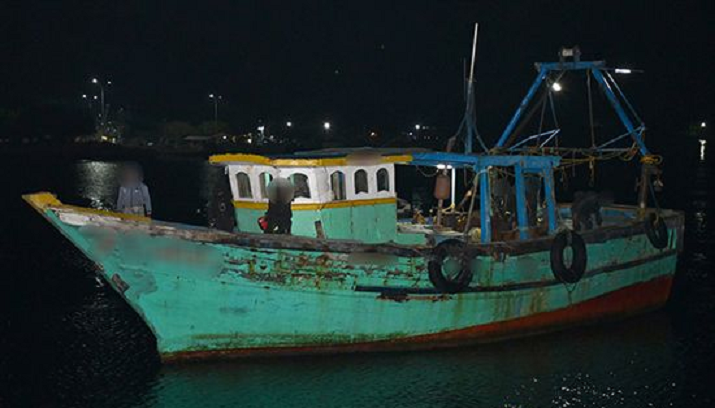
The Sri Lanka Navy seized three Indian fishing boats and apprehended 10 Indian fishermen while they were poaching in Sri Lankan waters, during a special operation conducted in the sea area north of Mannar and off the Delft Island in the dark hours of 19 Feb 25.
The Indian fishing boat, together with 04 fishermen aboard, held by the North Central Naval Command was brought to the Talaimannar Pier and they will be handed over to the Fisheries Inspector of Mannar for legal action. Meanwhile the 02 Indian fishing boats and 06 fishermen held by the Northern Naval Command were brought to the Kankesanthurai Harbour and they will be handed over to the Mailadi Fisheries Inspector for legal proceedings.
Including the recent operation, the Navy has held 13 Indian fishing boats and apprehended 99 Indian fishermen for poaching in Sri Lankan waters, thus far in 2025.


By Rathindra Kuruwita
The Cabinet of Ministers has approved a proposal submitted by the Minister of Energy Kumara Jayakody to proceed with the establishment of two solar power plants capable of producing 50 megawatts and 70 megawatts at Sampur, Trincomalee, as a joint venture between Sri Lanka and India.
Cabinet Spokesman, Minister Nalinda Jayatissa, said yesterday (20) that an agreement had been reached between the governments of Sri Lanka and India to set up those solar power plants in two phases—50 megawatts in the first stage and 70 megawatts in the second stage. The project will be undertaken as a joint venture between the Ceylon Electricity Board (CEB) and India’s National Thermal Power Corporation (NTPC) under a construction, ownership, and operation model.
He noted that the proposed 50 MW solar power project would be implemented by Trincomalee Power Company Ltd, a partnership between the CEB and NTPC to develop the previously planned coal power project at Sampur.
Accordingly, the Cabinet of Ministers has approved the proposal to take the necessary steps to advance the project’s implementation, the Cabinet Spokesman said.
by Sujeewa Thathsara
The Health Professionals’ Association has announced plans to take strong professional action unless the recent government decision to reduce overtime and leave entitlements for full-time and part-time medical and nursing staff.
This ultimatum came during a meeting held in Colombo on Feb 19, where several health workers’ unions gathered to discuss the implications of the budgetary changes.
Ravi Kumudesh, President of the Health Professionals’ Association, said that if the authorities failed to provide fair solutions soon, they would be compelled to launch a strike.
“We have given the Health Minister seven days to engage in meaningful discussions and resolve these issues,” Kumudesh said, highlighting the sacrifices health professionals made, working around the clock to deliver essential services.
The Joint Council of Professions Supplementary to Medicine (JCPSM) also expressed concern over the budget’s impact on health sector employees.
Meanwhile, other professional unions have also voiced their dissatisfaction with the budget. Ven. Ulapane Sumangala Thera, President of the Association of Education Professionals, pointed out that the expected salary increases for schoolteachers and principals had not been granted.


Three buses explode in Israel in suspected terror attack, police say

Navy seize three Indian fishing boats poaching in Sri Lankan waters

Gill ton helps India ace tricky chase after Shami five-for


-
 Sports6 days ago
Remarkable turnaround for Sri Lanka’s ODI team
-
 Features6 days ago
Scammed and Stranded: The Dark Side of Sri Lanka’s Migration Industry
-
 Business6 days ago
UN Global Compact Network Sri Lanka: Empowering Businesses to Lead Sustainability in 2025 & Beyond
-
 News7 days ago
Speaker agrees to probe allegations of ‘unethical funding’ by USAID
-
 Features5 days ago
Don’t betray baiyas who voted you into power for lack of better alternative: a helpful warning to NPP – II
-
 Features5 days ago
Two films and comments
-

 News3 days ago
Commercial High Court orders AASSL to pay Rs 176 mn for unilateral termination of contract
-

 Editorial7 days ago
Coal giant awakes, but uncertainty prevails