
Features
Two films and comments

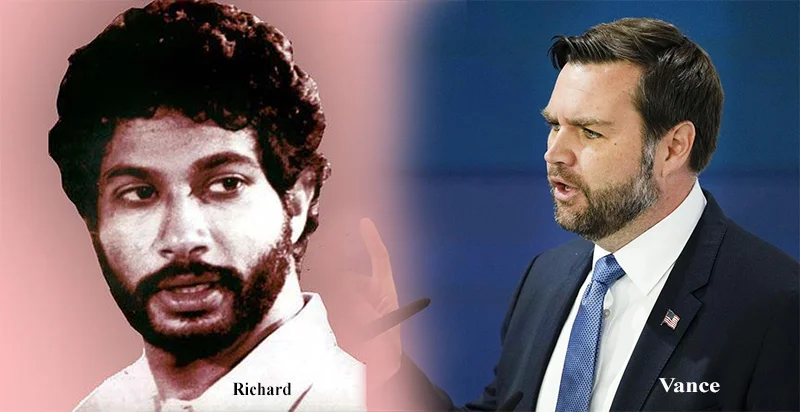
 is pleased to comment on two films, one Sri Lankan in Sinhala and the other American. She admits she is still to see the local film which is running in several cinemas to full audiences. It has been reviewed as outstanding; raved over by many; and already grossed the highest amount in Sri Lankan cinema history – Rs 100 million from date of release January 30 to February 14. This last: testimony to its popular appeal and acceptance as an outstanding cinema achievement. Director is Asoka Handagama and producer Subaskaran Allirajah for Lyca Productions. Swarna Mallawarachchi is said to give a stellar performance as Dr Manorani Saravanamuttu with an exceptional supporting cast including Sanath Gunatihilake, Sajitha Anthony, Rehan Amaratunge and others.
Titled Rani, the film concentrates on Manorani Saravanamuttu, mother of Richard de Zoysa, who was made to undergo the devastating trauma of seeing her son taken away, and then to identify the battered, tortured body washed ashore in Lunawa. Her commitment first was to identify the abductors or at least the leader of the group that came late at night to her home as media persons, and, on the pretext of speaking to the then sleeping Richard, took him away to murder him and drop him in the sea so his disappearance was complete.
Those times of fear
Cass was very much into following the trajectory of the political situation in the country as it was at that time. It was hot and turbulent with Ranasinghe Premadasa President and D B Wijetunge PM – admittedly ineffective against Premadasa. The country was gripped by fear; fear of an enemy and his cohorts who struck any outstanding person as being a threat to the Prez. And the LTTE, too, were active with raids south of the Vanni controlled by the Tigers.
Cass was working in the British Council when the news flashed that Richard had been tortured and killed and his body washed ashore. We cried as he had been much with BC; had performed in a Greek tragedy in the front garden of the BC. We knew instinctively who the perpetrator of the murder was and who executed through others the expressed displeasure that Richard de Zoysa was an irritant. The film, too, does not directly point a finger, merely indicates who he was. And thus the fear increased with frustration and deep sorrow at the loss of this brilliant young man brutally scythed at the age of 31.
We heard that Manorani identified the leader of the gang who came to her house that night, while watching TV on April 30. He was a security officer of the Prez. He was blown to bits with President Premadasa and others as the May Day rallies were commencing.
Another incident remembered with a shiver of apprehension passing down the spine was just prior to May Day. Prez Premadasa spoke at a public meeting in a near demented, almost strangled voice that people were pointing fingers of accusation at him for the murder of Lalith Athulathmudali.
Cass’ comment is to congratulate all involved in the film Rani for two reasons: exposition of a crime and a woman’s desperate sorrow that evolves to inner strength to help other women who had lost sons tragically. The second reason is that crimes have to be punished and that such crimes should not be forgotten. Reminders are good to keep people on their toes: on watch-out.
US movie
The other is the film of U S Vice President, J D Vance’s life story up to adulthood. He was born James Donald Bowman in 1984 but his parents divorced while he was a toddler and his name was changed to James David Vance after his mother – Beverly or Bev’s third marriage. He is first seen as a young boy living with his mother and sister in Middleton, Ohio, with loving grandparents close by. In swift flashbacks and forwards, his childhood life is juxtaposed with him as a graduate at Yale Law School and romance with Indian co-student Usha Bala Chilukuri.
Vance wrote his memoir in 2016 and titled it Hillbilly Elegy. The film was directed by Ron Howard with Vanessa Taylors writing the screen play. Amy Adams and Glen Close act as mother and grandmother; Gabriel Basso and Haley Bennett as boy and man Vance; and Freida Pinto as a very alike Usha.
Cass watched the film on Netflix and was stunned at how much the young boy had suffered, his mother being a druggie and moving from one man to another. In the car the young chap of around 10 years mentions: “Your latest boyfriend.” Bev gets mad and accelerates almost killing the two of them. He jumps out when she slows down and runs to a house for protection. The woman of the house phones the police but JD lies to them that nothing happened. Emotionally searing scenes show Bev’s addiction and trouble she causes her son. The film ends with his sister taking charge of Bev after her rehabilitation of many before, and Vance going back to New Haven, greeted by Usha and presenting himself for his first job interview.
An epilogue in the film reveals that JD and Usha married and have three children, moving to Ohio to be near his family. Bev was sober for six years. She was present at his swearing in as VP.
Comments
Much admired and applauded is Vice Prez JD Vance’s honesty in his memoir of his mother’s scandalous behaviour and drug addiction. That is, Cass presumes to say, Western honesty about personal history.
Now for a prediction. After all is said and done, Cassandra must live up to her Trojan ancestor Cassandra and call out an augury. She kept calling out: “I see blood!” True enough. Blood flowed as Agamemnon was murdered by his brother Menelaus and his wife Clytemnestra.
The present-day Cassandra’s cry is so different from her cries during many previous regimes in this Island. Now, she cries with contentment: “Peace it is. Peace be”, as she sees turmoil and wars all over the world and peace here. Also, the ability to look forward to rogues being caught, corruption slowly washed away and Sri Lanka restored to its resplendency.


 With no military quick-fix in sight to the ongoing, convoluted West Asian conflict it ought to be clear to the rationally inclined that there is no other way to a solution to the blood-letting other than through a negotiated one. Unfortunately, there are not many takers the world over for such an approach.
Consequently the war rages on incurring the gravest human costs to all relevant sides. Whereas it should be obvious to the Trump administration that Iran wouldn’t be backing down any time soon from its position of taking on the US frontally and with the required military competence in the Hormuz Strait and adjacent regions, the US demonstrates a stubbornness to persist with war strategies that are showing no quick, positive results on the ground.
Clearly, the virtual ‘lock down within a lock down’ situation in the Strait is not proving beneficial for either party. Instead, the spilling of civilian blood in particular continues with unsettling regularity along with an all-encompassing economic crisis that carries a staggering material toll for ordinary people all over the world.
From this viewpoint it is commendable for Pakistan to offer itself as a peace mediator and go ‘the extra mile’ to keep the principal parties engaged in some sort of negotiatory process. But its efforts need to win greater support from the world community. It is a time for peace-makers the world over to stand up and be counted.
It is also a time for straight-talking. To his glowing credit Pope Leo XIV is doing just that and he is the only religious head worldwide to do so. Very rightly he has called on President Trump to end the war through negotiations and described it as ‘unjust’ and ‘a scandal to humanity’.
May this crucial cause be taken up by more and more world leaders, is this columnist’s wish. Instead of speaking fatalistically about a ‘Third World War’, decision and policy makers and commentators, and these are found in plenty in Sri Lanka as well, would do better to help in drumming-up support for a peaceful solution and the latter is within the realms of the possible.
Incidentally, the commonplace definition of the phrase ‘World War’ is quite contentious and it would be premature to speak forebodingly about one right now. The fissures within the West on the Middle East conflict alone rule out the possibility of a ‘World War’ occurring any time soon.
Instead, it would be preferable for the international community, under the aegis of the UN, to take the ‘straight and narrow’ path to a peaceful solution. As implied, this path is no easy avenue; it is cluttered with obstacles that only doughty peace makers could take on and clear.
However, the path to a negotiated peace is worth taking and no less a power than the US should know this. After all, the US ‘bled white’ in Vietnam and had to bow out of the conflict, realizing the futility of pursuing a military solution. A similar lesson should have been learned by Russia which bled futilely in Afghanistan. It too is in an unwinnable situation in Ukraine.
The Pope’s observations to President Trump on negotiating peace have earned for him some snarls and growls of criticism but with time these critics would realize that peace could come only by peaceful means and not through ‘the barrel of a gun.’
For far too long the ‘silent majority’ of the world has allowed politicians to take the sole initiative on working towards peaceful solutions to conflicts and wars. As could be seen, the results have been disastrous. The majority of politicians speak the language of Realpolitik only and this tendency runs contrary to the ways of the selfless peace maker.
Power, which is the essence of Realpolitik, and peace are generally at loggerheads in the real world. Power and self-aggrandizement have to be shelved in the pursuit of durable peace anywhere and it is a pity that the likes of Donald Trump and his team are yet to realize this.
At this juncture the ‘peace constituency’ or the silent majority would need to take centre stage and play their rightful role as the ‘Conscience of the World’. If the latter begins to take on the cause of peace in earnest everywhere, the politicians would have no choice but to pay heed to their cause and take it up, since a contrary course would earn for them public displeasure and votes.
An immediate challenge would be for the ‘peace constituency’ to come together and act as one. Right now, such a coordinating role could be played effectively by only the UN and its agencies. Practical problems are likely to get in the way but these need to be managed insightfully and resourcefully by all stakeholders to peace.
In fact the time couldn’t be more appropriate for the backers of peace to come together and work as one. Right now, economic pressures are increasing worldwide and no less a public than that in the US is beginning to feel them in a major, crushing way.
Going ahead the US public, along with other polities, would find the economic consequences of war to be intolerable. There would be no choice but for governments and peoples to champion peace. Peace makers would need to ‘strike while the iron is hot.’
The success of the above endeavours hinges on the importance humans attach to their consciences. The danger about prolonged wars is that they deaden consciences; particularly those of politicians. The latter deaden their consciences to the extent that they prove impervious to the pain and suffering wars incur.
Thus, the ‘peace constituency’ has its work cut out; it cannot rest assured that politicians would prove sensitive to their demands. The latter would need to be constantly dinned into the hearts and minds of politicians and decision-makers if peaceful solutions to conflicts are to be arrived at.
Likewise, the publics of war-torn countries would need to demand the activation and sustaining of accountability processes with regard to those sections that are suspected of committing war crimes and like atrocities. Those publics that cease to demand accountability from powerful sections among them which are faced with war-time atrocity charges are as good as condemning themselves to lives of permanent dis-empowerment and enslavement.

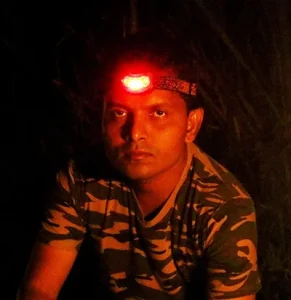
Chaminda Jayasekara
There is a particular stillness in Sri Lanka’s forests, after dusk — a kind of hushed expectancy where shadows lengthen, cicadas soften their chorus, and the night begins to breathe in its own rhythm. It is a world that does not reveal itself easily. You have to wait for it. You have to listen.
And then, suddenly, you see them — a pair of luminous, unblinking eyes suspended in the dark.
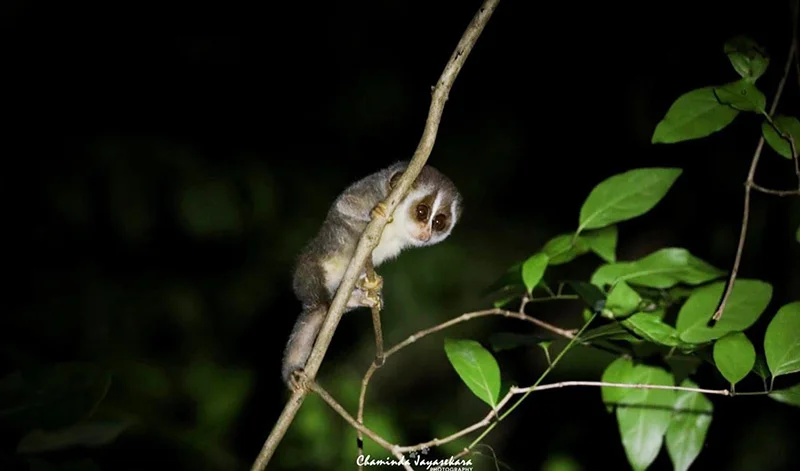
The Grey Slender Loris, or unahapuluwa, emerges, not with drama, but with quiet precision. Small, slow-moving, and almost impossibly delicate, it is one of Sri Lanka’s most enigmatic nocturnal primates — a creature that has survived millennia by mastering the art of stillness.
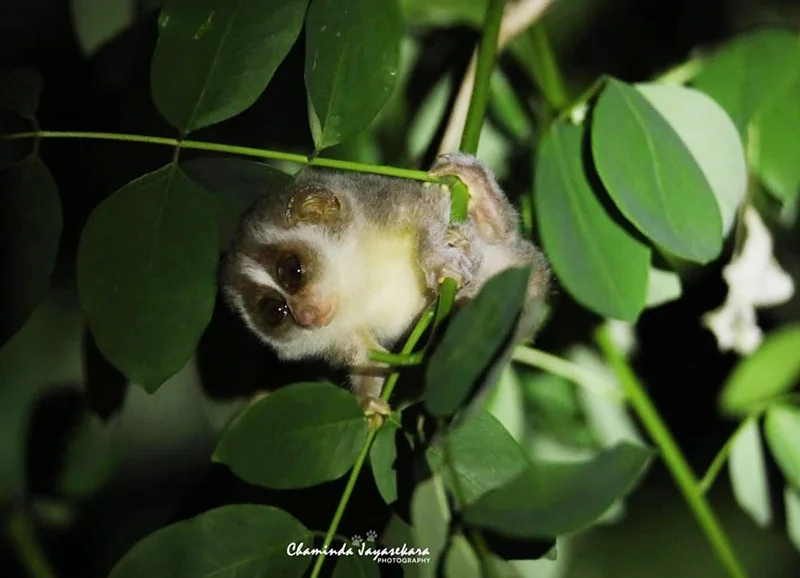
Yet, during these months — from late March through July — the forests hold a more tender story. It is the breeding season of the slender loris, and with it comes a scene that is often misunderstood by those who encounter it for the first time: a tiny infant, alone on a branch, barely three inches long, its fragile body silhouetted against the night.
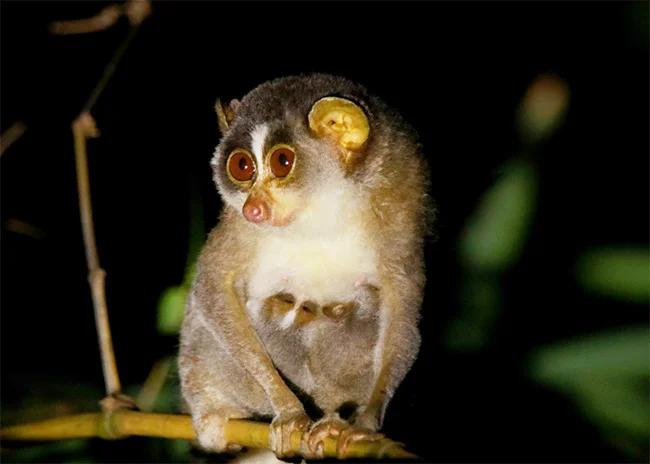
Grey Slender Loris with twin babies
To many, it appears to be a moment of abandonment.
To nature, it is a moment of trust.
“People often act out of compassion, but without understanding what they are seeing,” explains Chaminda Jayasekara of the University of Hertfordshire. “A baby loris left alone is not necessarily in danger. In fact, it is part of a natural process that is critical for its survival.”
According to Jayasekara, when a baby loris is about a month old, the mother begins a remarkable routine. As darkness settles, she gently places her infant on a secure branch and moves off into the forest to forage. Her journey can take her hundreds of metres away — sometimes close to 800 metres — as she searches for insects and other small prey.
In those hours of solitude, the infant is not abandoned. It is learning.
Clinging to the branch, it begins to explore its immediate surroundings. Tentatively, almost hesitantly, it reaches out — testing balance, grip, and instinct. It may attempt to catch tiny insects, mimicking behaviours it will one day rely on entirely. This is its first classroom, and the forest its only teacher.
“Those early nights are crucial,” Jayasekara says. “The baby is developing motor skills, coordination, and the ability to interact with its environment. These are things that cannot be replicated in captivity.”
And yet, this is precisely where human intervention often disrupts the process.
Across rural and even semi-urban Sri Lanka, stories circulate of well-meaning individuals who come across a lone baby loris and assume the worst. Driven by concern, they pick it up, take it home, or attempt to hand-rear it — believing they are saving a life.

Grey Slender Loris
But the reality is far more complex — and far more tragic.
“When a baby is removed unnecessarily, it loses something fundamental,” Jayasekara emphasises. “It loses the chance to learn how to survive in the wild. Without that, even if it survives in the short term, its long-term prospects are extremely poor.”
The forest, after all, is not just a habitat. It is a living, evolving system of lessons — how to detect predators, how to navigate branches, how to hunt silently, how to recognise territory. These are not instincts alone; they are behaviours refined through experience.
And the mother, contrary to assumption, is rarely far away.
“If people simply waited — even for several hours — they would often see the mother return,” Jayasekara explains. “She knows exactly where she left her baby. Her absence is temporary, purposeful.”
The advice from conservationists is clear and consistent: observe, but do not interfere.
If you encounter a baby loris, watch quietly from a distance. Avoid using bright lights or making noise. Give it time — at least 10 to 12 hours — before drawing conclusions. In most cases, the situation will resolve itself, just as nature intended.
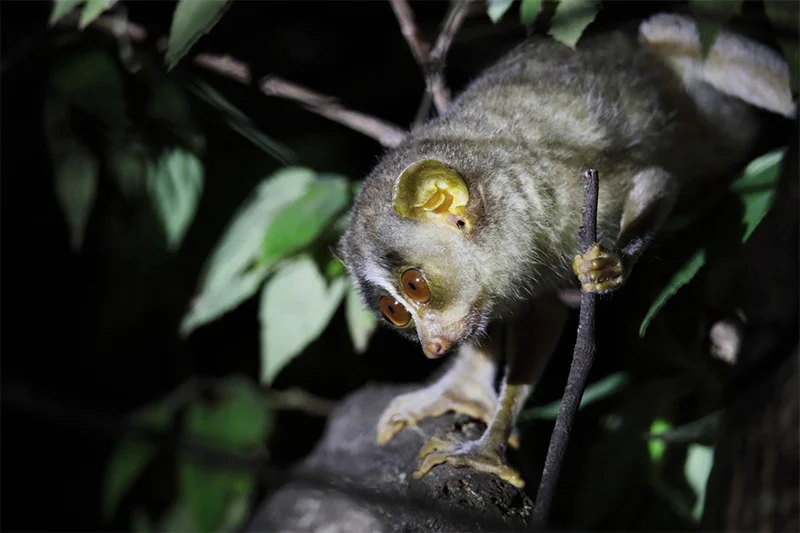
35 days old Grey Slender Loris
Only if the animal is clearly injured, or if there is strong evidence of abandonment after prolonged observation, should intervention be considered — and even then, it must be done through the proper channels, particularly the Department of Wildlife Conservation.
Attempting to care for such a delicate animal at home is not only ineffective but often fatal.
Sri Lanka is home to two species of slender loris — the Grey Slender Loris and the Red Slender Loris — each adapted to specific ecological zones across the island. Both are protected under national legislation and recognised internationally as species requiring urgent conservation attention.
Their threats are many: habitat loss, road mortality, illegal pet trade, and, increasingly, human misunderstanding.
Yet, in the midst of these challenges, there are also signs of hope.
In recent years, the slender loris has become the focus of a unique form of wildlife tourism — one that values patience over spectacle. Night walks, conducted with trained naturalists and strict ethical guidelines, offer visitors a chance to witness the loris in its natural environment without disturbing its behaviour.
At places like Jetwing Vil Uyana, this approach has been refined into a model of responsible eco-tourism. Over more than a decade, the property has developed a dedicated Loris Conservation Project, recording thousands of sightings while educating visitors and supporting local communities.
Here, the loris is not handled, chased, or exploited. It is simply observed — a quiet presence in a carefully protected landscape.
“The success of such initiatives shows that conservation and tourism do not have to be at odds,” Jayasekara reflects. “When done responsibly, tourism can actually support conservation by creating awareness and value for these species.”
There is something profoundly moving about encountering a loris in the wild. It does not roar or charge. It does not demand attention. Instead, it exists — quietly, deliberately — as it has for millions of years.
And perhaps that is why it is so easily misunderstood.
In a world that often equates visibility with importance, the loris reminds us that some of the most extraordinary lives unfold beyond the spotlight.
It also reminds us of something else — something simpler, yet harder to practice.
Restraint.
Because conservation is not always about stepping in. Sometimes, it is about stepping back. About recognising when nature does not need our help, but our patience.
So if, on some future night, you find yourself walking beneath the trees, and your light catches a tiny figure sitting alone on a branch — do not rush forward.
Pause.
Watch.
Let the moment unfold.
Because somewhere, moving silently through the darkness, guided by instinct and memory, a mother is already on her way back.
And by morning, the forest will be whole again.
By Ifham Nizam
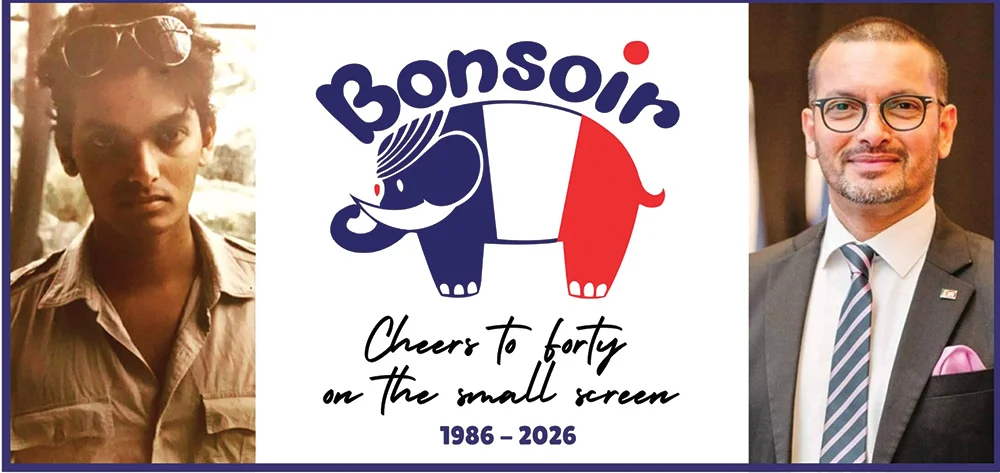
 We first saw him on the small screen in January 1986 – a relatively raw, totally untrained and a very nervous 24-year-old presenting ‘Bonsoir’ on ITN.
And now, 40 years later, and as one looks back, one realises what a multi-dimensional journey Kumar de Silva has navigated across the small screen yes, from your television screens to your laptops, and iPads, tabs, and mobile phones.
Says Kumar: “It is the French language I speak that opened the world of television to me, 40 years ago. It was ‘Bonsoir’ alone, and so to my French teacher at Wesley College, Mrs. BA Fernando, to ‘Bonsoir’, and to the Embassy of France in Sri Lanka, I am eternally grateful”.

Promoting the French language, and culture, in Sri Lanka, in a big way
Kumar went on to say that on the heels of ‘Bonsoir” came ‘Fanclub’, on ITN, describing it as yet another resounding success story which saw him as a music DJ on TV.
His inherent talent saw him handle a range of contrasting programmes across ITN, TNL, Prime TV and SLRC with consummate ease – from News Reading, Business Talk Shows, Celebrity Chats, to Dhamma discussions, on Poya Days, to name a few.

Kumar – the 1986 look
Trained in Paris in television production and presentation, the Government of France, in 2012, conferred on him the title of ‘Chevalier dans l’Ordre des Arts et Lettres’ (Chevalier in the Order of Arts and Letters) in recognition of his contribution to promoting the French language, and culture, in Sri Lanka.
In celebration of his four decades on the small screen, Kumar recently launched ‘Bonsoir Katha’, the Sinhala translation (by Ciara Mendis) of his English book ‘Bonsoir Diaries’ (2013), at a gala soiree. at the Alliance Francaise de Colombo, under the distinguished patronage of the French Ambassador in Sri Lanka, Remi Lambert, and francophone President Chandrika Kumaratunga.
He’s now excited about launching the French version of this book, ‘Les Coulisses de Bonsoir’, in Paris, in autumn this year. It is currently being translated by Guilhem Beugnon, a former Deputy Director of the Alliance Francaise de Colombo. This will, co-incidentally, also be Kumar’s 30th visit to Paris.

Chief Guest French Ambassador in Sri
Lanka Remi Lambert
Says Kumar: “The word GRATITUDE means a lot to me and so I always make it a point to spend time with two very special French people every time I go to France. One is Madame Josiane Thureau, formerly of the French Foreign Ministry, who began ‘Bonsoir’ in Sri Lanka. way back in the mid-1980s. The other is Madame Aline Berengier, the lady who designed the ‘Bonsoir’ logo – the Sri Lankan elephant in the colours of the French national flag”.
Kumar is also a much-sought-after Personal Development and Corporate Etiquette Coach in Colombo’s corporate world. Over the past 15 years, tens of thousands of corporates, have been through the different modules of his interactive training sessions. There have also been thousands of school leavers and undergraduates from national and private universities, many of whom will constitute the corporates of tomorrow.
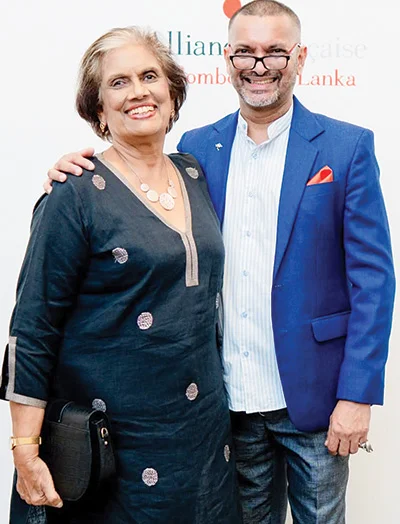
Guest of Honour francophone President Chandrika Kumaratunga at the gala soiree
at the Alliance Francaise de Colombo
The multi-talented Kumar turns 65 next year, and his journey on the small screen still continues – you see him on the (monthly) ‘Rendez-Vous with Yasmin and Kumar’ on the French Embassy’s YouTube Channel, and (every Friday) on ‘Fame Game with Rozanne and Kumar’ on Daily Mirror Online, Hi Online and The Sun Online.
There’s yet another podcast in the pipeline, he indicated, but diplomatically declined to give us details. All he said, with a glint in his eye, was, “It will hit your screens soon.”
Whatever he has in mind, one can be certain that the new programme will continue to showcase Kumar de Silva’s enduring presence in Sri Lanka’s entertainment scene.

Landslide Early Warnings issued to the Districts of Kurunegala and Ratnapura

US boards ship carrying Iranian oil, as Iran MP says first Strait of Hormuz toll paid

Advisory for Severe Lightning issued for the Western, Sabaragamuwa, Central, North-western, North-central, Southern, Uva provinces, and Ampara and Batticaloa districts

Will another film star be able to sway the election in India’s Tamil Nadu?

‘Team audit’ done, Kirsten hopes Sri Lanka keep ‘progressing and improving’

Nuwan Thusara withdraws lawsuit against Sri Lanka Cricket

‘Dates have the highest sugar content to fight Coronavirus’

Sunday Island 27 December – Headlines

#SundayIsland 17th December – Headlines

Sunday Island – 28th March

Sunday Island Headlines – 21 March

Sunday Island – 21st February – Headlines
-

 News3 days ago
Rs 13 bn NDB fraud: Int’l forensic audit ordered
-

 Business6 days ago
Harnessing nature’s wisdom: Experts highlight “Resist–Align” path to resilience
-

 Opinion4 days ago
Shutting roof top solar panels – a crime
-

 News6 days ago
Gratiaen Trust announces longlist for the 33rd Annual Gratiaen Prize
-

 News5 days ago
From Nuwara Eliya to Dubai: Isha Holdings markets Agri products abroad
-

 News6 days ago
Heroin haul transported on 50-million-rupee contract
-

 News4 days ago
Church calls for Deputy Defence Minister’s removal, establishment of Independent Prosecutor’s Office
-

 News5 days ago
‘Agents of the devil’ seeking to block Easter probe, Cardinal warns