
Opinion
SL Volunteer Air Force in counter-insurgency ops in 1971


This article was written by the late Sqn. Ldr. J.T. Rex Fernando (S. L.A.F.Retd.), First Commanding Officer Sri Lanka Volunteer Air Force, four years ago.
The contribution made by the Sri Lanka Air Force throughout five and a half decades, to safeguarding the country’s airspace and thereby the territorial integrity, has been given wide coverage in the print and electronic media. Recounting its illustrious history, it can look back with pride and satisfaction at its enviable record of operational successes, its reputation and also its contribution towards the development of the country’s non-military fields.
While recounting the vital role it played in crushing the abortive armed insurrection of 1971, it is only appropriate to recall the supportive role of the Sri Lanka Volunteer Air Force.
Armed insurrection
The armed insurrection of April 1971, to overthrow the lawfully constituted United Front Government, demonstrated clearly the tragic unpreparedness of the Government’s security forces at the time to deal promptly with a major, bloody uprising as the one the insurgents launched. On the one hand, there were not enough arms and ammunition. On the other hand the strength of the security forces was far below that which was required to sustain a major operation. The Air Force in particular had to perform a number of tasks in the first difficult days of the campaign with the Regular Force and found the need to supplement the relatively small Regular Force.
On April 24 Prime Minister Sirimavo Bandaranaike said, “On the 5th of April we found that we had inadequate weapons, ammunition and aircraft to meet a sustained threat over a long period of time by the terrorist insurgents.” The Prime Minister made this point again in July when she told the parliament that, “The week immediately following the 5th of April was an extremely vital week and the armed forces and the police had to struggle against many odds during this period.” The Air Force had to expand and expand fast. Likewise, other sections of the security forces had to be put in a state of preparedness to deal with any future threat to the country’s security. The need of the hour, when the country was facing a considerable threat from terrorists, was to strengthen the Armed Forces and the Police. It was this pressing need that led to the formation of the Sri Lanka Volunteer Air Force.
Establishment
To Air Vice Marshal Paddy Mendis, the establishment of the volunteer Air Force was the realisation of a cherished dream. For over 20 years, since inauguration of the Volunteer Force had never been given serious consideration. With the pressing requirement to supplement the regular strength, the formation of the Volunteer Air Force was formally authorised by a proclamation by the President on 14 April, 1971.
Appointed the first Commanding Officer, I was directed by A.V.M. Mendis to proceed with the setting up of the infrastructure, recruitment, training and deployment as a matter of utmost priority. The task itself was challenging and unenviable. However, with the guidance of the Commander and the continuous support of the Air Force Board of Management and with the exemplary dedication and admirable commitment of my adjutant Flt. Lt Mani Seneviratne, the task was pursued and successfully accomplished.
Role
The role of the Volunteer Force was essentially to assist the Regular Force in its primary and internal security duties. With more volunteers employed on internal security duties the skilled regular tradesmen were able to concentrate on their specialist technical and other skilled duties.
Organisation
On the basis of their functional role the Volunteer Force was organised broadly into Ground Operational Squadrons, Work Services Squadrons and Air Operational Squadrons. Despite the relatively short period of training and the limited ‘on the job training’ Volunteer personnel contributed considerably to the Air Force tasks. Apart from internal security duties and general operational tasks Volunteer personnel were employed in almost every field of Air Force activity, on flying duties, airfield construction, mechanical transport operations and maintenance, engineering duties, logistics and catering duties and administrative, clerical, medical and other miscellaneous service duties. The Air Field Construction Regiment was organised to undertake major construction projects and maintenance commitments. The Volunteers working side by side with the regulars assimilated the service form and gained confidence. The ‘esprit de corps’, the cordiality and friendship that prevailed contributed greatly to the success it achieved.
Recruitment and training
Recruitment commenced almost immediately. After the promulgation, the first batch of Volunteer Officers and Airmen commenced their initial Ground Combat training at Diyatalawa on April 23, while the Volunteer pilots at the same time commenced flight training at the No. 1 Flying Training School, China Bay. The task of the Instructors was not an unenviable one. They had to train personnel recruited from various walks of life as combatants capable of operating their intricate flying machines and coping with various operational and non combatant duties within a short period. The full, authorised cadre was recruited and training completed by the end of May.
The initial training courses were so designed to mould the trainees into alert, efficient and well disciplined members of the Air Force; proficient in all basic aspects of ground combat and other general responsibilities; capable of working with confidence, side by side with their regular counterparts in a supporting role. All Volunteer trainees, within the short training period, were trained adequately in varied service aspects, among which were drill, weapons training, field-craft and tactics, map reading, jungle training and watermanship, Air Force Law, and afforded an adequate knowledge of the organisation of the Air Force, along with first aid and fire fighting. Special emphasis was placed on physical fitness and the standard of physical fitness gradually raised, training them to take on the role of combatants irrespective of their specialised trades. Subsequent to initial combat training, trainees were afforded ‘on the job training’ on their particular trade duties.
Among the officers, specialists recruited were General Duties Pilots who were required to supplement the meagre number of Regular Pilots who were continuously flying day and night on operational and Air Transportation commitments, since the outbreak of the terrorist offensive. The Volunteer Pilots were intended to provide some relief though it was not possible to immediately employ most of them on operational duties. While very few were experienced pilots, most of the selected pilots had previous experience in light trainee aircraft only. After a rapid training course on the basic Chipmunk, then converting to the Dove and Heron aircraft, they were able to be of assistance to the Regular Pilots.
Spontaneous response
With the formation of the Volunteer Air Force there was an encouraging and unprecedented response from persons of all walks of life to join the Force. Reputed professionals of various disciplines as well as highly skilled and semi killed persons were all driven by a sense of patriotism and yearning to contribute their skills to preserve sovereignty and national integrity. While a great number of professionals volunteered and served with distinction, it is appropriate to mention the names of some in appreciation and expression of gratitude for their service, and also to highlight the multiplicity of disciplines and professions that made up the Volunteer Air Force. Medical professionals, Senior Consultant Late Dr. T.H. Amarasinghe, Consultant Surgeon Dr. S. Maheshwaran, Dental Surgeon Dr. S. Rajapakse, experienced and reputed pilots Susantha Jayasekara and David Peiris, Consultant and Chartered Cost Accountants late Dayalan Tharmaratnam and S. Balakur, Registered Auditor R. Ramachandra and Chartered Management Consultant, Kuda Liyanage, Banker Nimal Gunatunge, Chartered Civil Engineers Mervyn Wijesinghe and Ben Navaratne, Chartered Architect Mano Kumarasingham, Attorney at Law and Human Resources Consultant Tilak Liyanage and Lucky Moonamale, Civil Servant Mervyn Koch, Management Specialist Mahes Goonathilake, Business entrepreneurs late Ed Nathanielz, late Bevis De Silva, Upali Gunesekera and late Harold Pilapiya, reputed entertainer Desmond De Silva and National Cricketers Brian Obeysekera, Tony Opatha and Nihal De Zoysa are a few noteworthy examples.
All these gentlemen with a great number of others served the force with distinction. Most of them did so despite personal inconvenience, disruption of their regular employment, business and domestic life since most of them were stationed in remote and uncongenial locations such as Ridiyagama, Weerawila, Weeraketiya and Hambantota.
Entry of women
The entry of women into the Volunteer Force can be considered a unique feature of the formulation of the Volunteer Force. Armed Services, an exclusive preserve of the men, opened its doors to the women. The four pioneering women on graduating on 4 October, 1972 were engaged in secretarial duties and duties associated with tourist flying.
Continued mobilisation
It must be accepted that when personnel initially enlisted in the Volunteer Force, they did not anticipate to be mobilised for prolonged periods of time. Especially those with permanent employment and holding responsible positions and those in the government sector encountered hardships as a result of continued mobilisation and deployment in remote areas. Some of them were gradually absorbed into the Regular Force, and some left after fulfilling an obligation on cessation of hostilities.
Contribution
In 1973 just two years after the formation of the Volunteer Force, the Commander of the Air Force AVMP. H. Mendis, with a sense of great satisfaction, referring to the Volunteer Force asserted, “As a result of hard work and dedication to duty of the highest order, the Volunteer Force has distinguished itself in combat, security, administrative, operational and constructional duties. Your units are based in many locations within the country and you have carried out your duties exceptionally well.”
Every Volunteer was conscious that he or she had a vital role to play in the defence of the country. The sense of dedication and devotion to duty inculcated by the Regular counterparts was indeed the most encouraging feature of the Volunteer Organisation.
These gentlemen who spontaneously responded to a call to serve the country in her hour of peril, maintained their enthusiasm and displayed remarkable dedication to duty. Their service was of help to the Air Force at a time the country was plunged into bloody chaos. It is only appropriate to recall their contribution and express our appreciation of their services.


In recent months, President Anura Kumara Dissanayake has repeatedly expressed a concern that the government does not have the accurate data it needs to make good decisions.
At meetings with senior officials from ministries ranging from health and agriculture to education and infrastructure, the President has reportedly lamented that the government often lacks reliable information on what its projects are achieving, how funds are being spent, and whether public investments are producing results. The meeting on December 6th at the Matale District Secretariat was a case in point. The President emphasised the need for most accurate data to award compensation for damaged agricultural lands before the month’s end. He recalled that the Department of Agriculture’s data showed an excess of rice in the country, but the nation has faced a rice shortage.
For a country attempting economic recovery after the most severe crisis in its post-independence history, absence of accurate data is a dangerous position to be in.
Without data, decisions become guesswork. Without evidence, policy becomes speculation.
Ironically, Sri Lanka already possesses the policy architecture required to solve this problem. The National Evaluation Policy (2018) and the National Evaluation Policy Implementation Framework (2023) were created precisely to ensure that public spending is guided by evidence, results, and accountability. Yet today, despite these policies and the presence of a dedicated government agency tasked with monitoring development projects, the country still lacks the integrated digital monitoring and evaluation system needed to turn policy into practice. Until that gap is closed, Sri Lanka will continue to struggle with inefficient public investment, delayed projects, and policy decisions made without reliable evidence.
The scale of the problem
The Department of Project Management and Monitoring (DPMM), operating under the Ministry of Finance, is the central institution responsible for overseeing development projects implemented by government ministries. According to its 2024 Annual Performance Report, the department monitored 226 large-scale development projects across various ministries during the year. These projects collectively had an allocated budget of LKR 705 billion, but the actual expenditure amounted to only LKR 401.96 billion, representing about 56.9% utilization of the allocated funds.
In other words, nearly half of the planned development spending did not materialize.
While fiscal constraints and external factors contributed to this outcome, the data nevertheless highlights a deeper systemic issue: weak monitoring and decision-making structures that fail to identify and resolve implementation problems early.
The report also indicates that many projects face delays due to procurement issues, coordination failures, cost escalations, and operational bottlenecks. What makes the situation more troubling is that information about these problems is often fragmented and slow to reach decision-makers.
The government does monitor projects through reports and field visits, but the information flow remains largely manual and scattered across ministries. In the digital age, such a system is simply inadequate.
A policy that already foresaw the solution
Sri Lanka’s National Evaluation Policy (NEP), approved by the Cabinet in 2018, recognised this problem years ago. The policy aims to ensure that public investment decisions are guided by reliable evidence, efficiency, and measurable development results.
The NEP outlines several key goals:
· strengthening evidence-based decision making,
· improving efficiency in resource utilisation,
· ensuring transparency and accountability in public expenditure,
· promoting learning from successes and failures of past projects, and
· creating a national culture of evaluation.
To operationalise the policy, the government introduced the National Evaluation Policy Implementation Framework (NEPIF) in 2023. This framework explicitly calls for the creation of integrated information systems capable of gathering and analyzing data across the project cycle—from planning and budgeting to implementation and evaluation. In fact, NEPIF specifically proposes the establishment of a web-based integrated public investment management and evaluation information system to store project data and evaluation reports.
Such a system would allow decision-makers to access reliable information quickly, improving accountability and policy planning. Unfortunately, despite the clarity of this vision, the digital infrastructure necessary to implement it at a national scale is still largely absent.
A revealing moment at a Colombo seminar
The urgency of this gap became strikingly clear at a recent seminar in Colombo organized by a national NGO. The organization demonstrated its cloud-based monitoring and evaluation system which was comprehensive and updated by multiple layers of personnel, to a group of university students. On a large screen, a dashboard displayed real-time information on the organization’s twenty development projects across the country. Each project appeared as a branch of a digital tree, connected to activities, budgets, locations, and beneficiaries. With a few clicks, staff could generate reports showing the status of any project at national, district, or local levels, both of data and graphics. Updated data was available up to the previous day.
What would normally take weeks of manual compilation could be done in less than a minute.
Among the audience was a university academic who observed something obvious but powerful. ‘If a small NGO can run a system like this,’ he asked, ‘why can’t the Government?’ Another participant responded and told that the non-introduction of a digitalized Monitoring and Evaluation mechanism was due to some bureaucrats’ resistance. ‘I heard the Evaluation Reports of several projects of the government was not published because the respective Project Managers had opposed, fearing their failure would be exposed’, another academic commented. Those comments deserve serious reflection on the situation, I believe.
The digital revolution in monitoring and evaluation
Around the world, governments are increasingly adopting digital monitoring and evaluation platforms to track public investments in real time. These systems combine several elements:
· project databases
· geospatial mapping
· financial monitoring tools
· citizen feedback mechanisms
· performance dashboards for decision-makers.
Countries such as Estonia, South Korea, Rwanda, and Chile have integrated such systems into national governance structures. In these systems, ministers and senior officials can see instantly:
· which projects are progressing
· which projects are delayed
· how funds are being spent
· whether outputs and outcomes are being achieved.
More importantly, such platforms enable early intervention. Problems can be identified before they become crises. For Sri Lanka, which must now manage scarce fiscal resources with extreme care, such tools are no longer optional luxuries.
They are necessities.
The cost of not knowing
The absence of integrated data systems carries real economic consequences. Public investment decisions affect everything from roads and irrigation schemes to hospitals and schools. When these investments fail or underperform, the cost is not merely financial. It affects the daily lives of citizens.
A hospital without doctors. An irrigation scheme without water. A school building without teachers.
These are not simply implementation failures; they are information failures.
Without reliable monitoring systems, governments often learn about problems too late. By the time corrective action is taken, budgets have been spent and opportunities lost.
The NEPIF recognises precisely this challenge. It emphasises that evaluation should be an integral part of the entire development cycle—from project design to implementation and feedback for future planning.
But such evaluation cannot occur without reliable data systems.
Building an evaluation culture
Another important goal of the National Evaluation Policy is to create a culture of evaluation within the public sector. This requires a shift in mindset. Evaluation should not be seen as a fault-finding exercise. Instead, it should function as a learning mechanism that helps improve policy design and implementation.
The NEPIF stresses that evaluation findings should inform planning, budgeting, and future project selection. However, without systematic information systems, evaluation results often remain scattered across reports that few decision-makers read. Digital platforms can transform this situation by making information visible, accessible, and actionable. They turn data into knowledge. And knowledge into better decisions.
What a national digital system could look like
Sri Lanka does not need to start from scratch. The institutional building blocks already exist:
· the Department of Project Management and Monitoring (DPPM)
· the National Evaluation Policy
· the National Evaluation Policy Implementation Framework
· various sector-specific monitoring systems across ministries.
What is missing is integration.
A national digital monitoring and evaluation platform could include:
1. A centralised project database:
All government development projects recorded with budgets, timelines, outputs, and implementing agencies.
2. Real-time progress dashboards:
Accessible to the President, Cabinet, ministry secretaries, and provincial administrators.
3. Geographic mapping:
Showing where projects are located and how they benefit communities.
4. Automated reporting:
Reducing paperwork and enabling faster decision-making.
5. Citizen transparency portals:
Allowing the public to see how public funds are used.
Such a system would dramatically strengthen transparency, accountability, and efficiency.
The opportunity before Sri Lanka
Sri Lanka today has a rare opportunity. Economic crises often force governments to rethink outdated systems. The country cannot afford inefficient public investments any longer. Every rupee spent must produce measurable results. The National Evaluation Policy and its implementation framework already provide the intellectual foundation for this transformation. What remains is political commitment. A bold decision to build the digital infrastructure of evidence-based governance.
A call to action
The President’s concern about the lack of reliable data in government is both accurate and urgent. But the solution does not require new policies. The policies already exist. What Sri Lanka needs now is implementation. A national digital monitoring and evaluation system would give policymakers something they currently lack: a clear, real-time picture of the country’s development efforts. Such a system would empower leaders to identify problems early, allocate resources wisely, save billions of rupees from wasting and ensure that development projects truly benefit citizens.
In short, it would give Sri Lanka what every modern state needs: a digital nervous system connecting policy, data, and decision-making. The question is no longer whether the country needs such a system.
The question is simply this: how soon Sri Lanka is willing to build it.
by Tilak W. Karunaratne

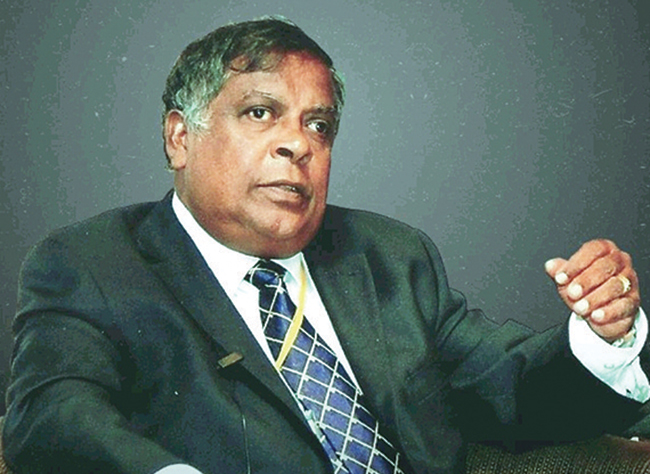
Mr. Tuli Cooray, former Deputy Director General of the Board of Investment of Sri Lanka (BOI) and former Secretary General of the Joint Apparel Association Forum (JAAF), passed away three months ago, leaving a distinguished legacy of public service and dedication to national economic development.
An alumnus of the University of Colombo, Mr. Cooray graduated with a Special Degree in Economics. He began his career as a Planning Officer at the Ministry of Plan Implementation and later served as an Assistant Director in the Ministry of Finance (Planning Division).
He subsequently joined the Greater Colombo Economic Commission (GCEC), where he rose from Manager to Senior Manager and later Director. During this period, he also served at the Treasury as an Assistant Director. With the transformation of the GCEC into the BOI, he was appointed Executive Director of the Investment Department and later elevated to the position of Deputy Director General.
In recognition of his vast experience and expertise, he was appointed Director General of the Budget Implementation and Policy Coordination Division at the Ministry of Finance and Planning. Following his retirement from government service, he continued to contribute to the national economy through his work with JAAF.
Mr. Cooray was widely respected as a seasoned professional with exceptional expertise in attracting foreign direct investment (FDI) and facilitating investor relations. His commitment, leadership, and humane qualities earned him the admiration and affection of colleagues across institutions.
He was also one of the pioneers of the BOI Past Officers’ Association, and his passing is deeply felt by its members. His demise has created a void that is difficult to fill, particularly within the BOI, where his contributions remain invaluable.
Mr. Cooray will be remembered not only for his professional excellence but also for his integrity, humility, and the lasting impact he made on those who had the privilege of working with him.
The BOI Past Officers’ Association
jagathcds@gmail.com
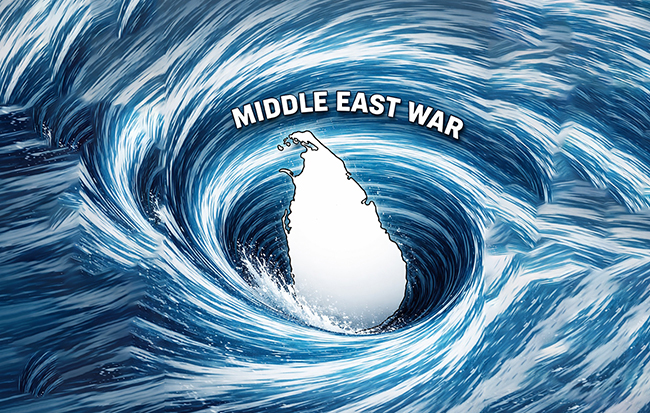
“As a small and open country, Singapore will always be vulnerable to what happens around us. As Lee Kuan Yew used to say: “when elephants fight, the grass suffers, but when elephants make love, the grass also suffers“. Therefore, we must be aware of what is happening around us, and prepare ourselves for changes and surprises.” – Prime Minister Lee Hsien Loong, during the debate on the President’s Address in Singapore Parliament on 16 May, 2018, commenting on the uncertain external environment during the first Trump Administration.
“When elephants fight, it is the grass that suffers”
is a well-known African proverb commonly used in geopolitics to describe smaller nations caught in the crossfire of conflicts between major powers. At the 1981 Commonwealth conference, when Tanzanian President Julius Nyerere quoted this Swahili proverb, the Prime Minister Lee Kuan Yew famously retorted, “When elephants make love, the grass suffers, too”. In other words, not only when big powers (such as the US, Russia, EU, China or India) clash, the surrounding “grass” (smaller nations) get “trampled” or suffer collateral damage but even when big powers collaborate or enter into friendly agreements, small nations can still be disadvantaged through unintended consequences of those deals. Since then, Singaporean leaders have often quoted this proverb to highlight the broader reality for smaller states, during great power rivalry and from their alliances. They did this to underline the need to prepare Singapore for challenges stemming from the uncertain external environment and to maintain high resilience against global crises.
Like Singapore, as a small and open country, Sri Lanka too is always vulnerable to what happens around us. Hence, we must be alert to what is happening around us, and be ready not only to face challenges but to explore opportunities.
When Elephants Fight
To begin with, President Trump’s “Operation Epic Fury”.
Did we prepare adequately for changes and surprises that could arise from the deteriorating situation in the Gulf region? For example, the impact the conflict has on the safety and welfare of Sri Lankans living in West Asia or on our petroleum and LNG imports. The situation in the Gulf remains fluid with potential for further escalation, with the possibility of a long-term conflict.
The region, which is the GCC, Iraq, Iran, Israel, Jordan, Syria and Azerbaijan (I believe exports to Azerbaijan are through Iran), accounts for slightly over $1 billion of our exports. The region is one of the most important markets for tea (US$546 million out of US$1,408 million in 2024. According to some estimates, this could even be higher). As we export mostly low-grown teas to these countries, the impact of the conflict on low-grown tea producers, who are mainly smallholders, would be extremely strong. Then there are other sectors like fruits and vegetables where the impact would be immediate, unless of course exporters manage to divert these perishable products to other markets. If the conflict continues for a few more weeks or months, managing these challenges will be a difficult task for the nation, not simply for the government. It is also necessary to remember the Russia – Ukraine war, now on to its fifth year, and its impact on Sri Lanka’s economy.
Mother of all bad timing
What is more unfortunate is that the Gulf conflict is occurring on top of an already intensifying global trade war. One observer called it the “mother of all bad timing”. The combination is deadly.
Early last year, when President Trump announced his intention to weaponise tariffs and use them as bargaining tools for his geopolitical goals, most observers anticipated that he would mainly use tariffs to limit imports from the countries with which the United States had large trade deficits: China, Mexico, Vietnam, the European Union, Japan and Canada. The main elephants, who export to the United States. But when reciprocal tariffs were declared on 2nd April, some of the highest reciprocal tariffs were on Saint Pierre and Miquelon (50%), a French territory off Canada with a population of 6000 people, and Lesotho (50%), one of the poorest countries in Southern Africa. Sri Lanka was hit with a 44% reciprocal tariff. In dollar terms, Sri Lanka’s goods trade deficit with the United States was very small (US$ 2.9 billion in 2025) when compared to those of China (US$ 295 billion in 2024) or Vietnam (US$ 123 billion in 2024).
Though the adverse impact of US additional ad valorem duty has substantially reduced due to the recent US Supreme Court decision on reciprocal tariffs, the turbulence in the US market would continue for the foreseeable future. The United States of America is the largest market for Sri Lanka and accounts for nearly 25% of our exports. Yet, Sri Lanka’s exports to the United States had remained almost stagnant (around the US $ 3 billion range) during the last ten years, due to the dilution of the competitive advantage of some of our main export products in that market. The continued instability in our largest market, where Sri Lanka is not very competitive, doesn’t bode well for Sri Lanka’s economy.
When Elephants Make Love
In rapidly shifting geopolitical environments, countries use proactive anticipatory diplomacy to minimise the adverse implications from possible disruptions and conflicts. Recently concluded Free Trade Agreement (FTA) negotiations between India and the EU (January 2026) and India and the UK (May 2025) are very good examples for such proactive diplomacy. These negotiations were formally launched in June 2007 and were on the back burner for many years. These were expedited as strategic responses to growing U.S. protectionism. Implementation of these agreements would commence during this year.
When negotiations for a free trade agreement between India and the European Union (which included the United Kingdom) were formally launched, anticipating far-reaching consequences of such an agreement on other developing countries, the Commonwealth Secretariat requested the University of Sussex to undertake a study on a possible implication of such an agreement on other low-income developing countries. The authors of that study had considered the impact of an EU–India Free Trade Agreement on the trade of excluded countries and had underlined, “The SAARC countries are, by a long way, the most vulnerable to negative impacts from the FTA. Their exports are more similar to India’s…. Bangladesh is most exposed in the EU market, followed by Pakistan and Sri Lanka.”
So, now these agreements are finalised; what will be the implications of these FTAs between India and the UK and the EU on Sri Lanka? According to available information, the FTA will be a game-changer for the Indian apparel exporters, as it would provide a nearly ten per cent tariff advantage to them. That would level the playing field for India, vis-à-vis their regional competitors. As a result, apparel exports from India to the UK and the EU are projected to increase significantly by 2030. As the sizes of the EU’s and the UK’s apparel markets are not going to expand proportionately, these growths need to come from the market shares of other main exporters like Sri Lanka.
So, “also, when elephants make love, the grass suffers.”
Impact on Sri Lanka
As a small, export dependent country with limited product and market diversification, Sri Lanka will always be vulnerable to what happens in our main markets. Therefore, we must be aware of what is happening in those markets, and prepare ourselves to face the challenges proactively. Today, amid intense geopolitical conflicts, tensions and tariff shifts, countries adopt high agility and strategic planning. If we look at what our neighbours have been doing in London, Brussels and Tokyo, we can learn some lessons on how to navigate through these turbulences.
(The writer is a retired public servant and can be reached at senadhiragomi@gmail.com)
by Gomi Senadhira

Showers may occur at a few places in the Western and Sabaragamuwa provinces and in Galle and Matara districts after 2.00 pm

Burning of low-grade coal at N’cholai plant increases pollution: Parliament

Tariff shock from 01 April as power costs climb across the board

CDL under new management completes major Norwegian ship order

Govt. making arrangements for 3,500 SL Hajj pilgrims

NGO activists warn of ‘democratic dangers’ as PSTA draft bill looms over Parliament

‘Dates have the highest sugar content to fight Coronavirus’

Sunday Island 27 December – Headlines

#SundayIsland 17th December – Headlines

Sunday Island – 28th March

Sunday Island Headlines – 21 March

Sunday Island – 21st February – Headlines
-

 News6 days ago
Senior citizens above 70 years to receive March allowances on Thursday (26)
-

 Features3 days ago
A World Order in Crisis: War, Power, and Resistance
-

 News4 days ago
Energy Minister indicted on corruption charges ahead of no-faith motion against him
-

 News5 days ago
US dodges question on AKD’s claim SL denied permission for military aircraft to land
-

 Business5 days ago
Dialog Unveils Dialog Play Mini with Netflix and Apple TV
-

 News6 days ago
CEB Engineers warn public to be prepared for power cuts after New Year
-

 Sports4 days ago
SLC to hold EGM in April
-
 Latest News5 days ago
A strong Technical and Vocational Education and Training (TVET) system equips individuals with practical, relevant, and future-oriented skills helping to innovate responsibly towards a greener and sustainable future – PM