
News
Poll monitors believe SLPP should abide by AG’s advice

MP-elect on death row
By Shamindra Ferdinando
Polls Monitoring groups-PAFFREL (People’s Action for Free and Fair Election) and CMEV (Centre for Monitoring Election Violence) yesterday (2) said that the government would have to abide by the instructions issued by Attorney General Dappula de Livera in respect of MP elect Premalal Jayasekera sentenced to death over a killing in Kahawatte, Ratnapura, in January 2015.
The AG has informed the Secretary to the Justice Ministry and the Secretary General of Parliament of Jayasekera being disqualified to serve as a member of parliament and also to exercise his franchise.
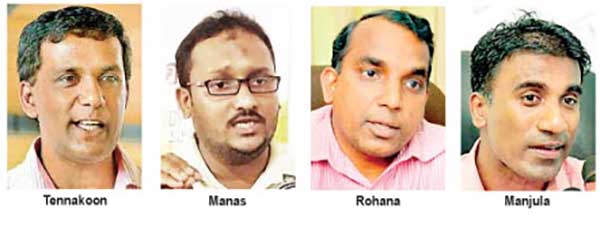
Acknowledging that the SLPP Ratnapura candidate had received the second highest number of preferences at the August general election, PAFFREL Executive Director Rohana Hettiarachchi and CMEV National Coordinator and Researcher Manjula Gajanayake pointed out that the Attorney General expressed his opinion after the Secretary to the Justice Ministry sought his advice.
Premalal Jayasekera polled over 140,000 preference votes. Pavitradevi Vanniarachchi obtained over 200,000 votes the highest preference there by a candidate representing any contesting party.
Both Hettiarachchi and Gajanayake emphasized that it was no longer a political issue
Secretary to the Justice Ministry sought the AG’s advice in the wake of the Commissioner General of Prisons seeking advice regarding Jayasekera being allowed to attend the inauguration of parliament on August 20.
Hettiarachchi said that the authorities quite rightly refrained from taking Jayasekera to parliament on August 20 though the convict’s family received an invitation to attend the inauguration from the Office of the Secretary General of Parliament.
Responding to another query, Hettiarachchi, who is also the Convenor of March 12 Movement said that he couldn’t comment on behalf the civil society groups though the PAFFREL strongly opposed any political party or a lawmaker challenging the AG’s stand. There couldn’t be any dispute over the AG’s advice, Hettiarachchi stressed, urging all those responsible to review the situation.
According to the AG’s Department as a result of Jayasekera appealing against the Ratnapura High Court ruling, only the death sentence had been suspended pending the Court of Appeal case.
Hettiarachchi pointed out that in the wake Minister Vasudeva Nanayakkara challenging the AG’s competence, the government sought the AG’s opinion on the 20th Amendment to the Constitution.
Addressing the media on Monday (31), veteran lawyer Nanayakkara said that the AG couldn’t decide on Jayasekera’s fate as it was the responsibility of the parliament.
Manjula Gajanayake said that Minister Vasudeva Nanayakkara’s dismissal of the AG’s opinion as regards Jayasekera’ eligibility sent a wrong signal to other members of the SLPP parliamentary group as well as the public. Gajanayake said that Nanayakkara couldn’t have been unaware of the constitutional provision as regards convicted persons.
Responding to another query, Gajanayake alleged that during the general election campaign in Ratnapura Vasudeva Nanayakkara repeatedly assured the electorate that he would stand by Premalal Jayasekera. Gajanayake said that the CMEV and other monitoring groups observed Nanayakkara’s campaign throughout that period.
Nanayakkara of the Democratic Left Front (DLF) contested on the SLPP ticket.
Former CAFFE (Campaign for Free and Fair Election) Executive Director Rajith Keerthi Tennakoon told The Island that there were three previous examples regarding convicted persons being denied the opportunity to attend Provincial Council and Parliamentary sessions. Tennakoon said that former Sabaragamuwa Provincial Council member Hasitha Muhandiramge’s convicted over 1999 double murder case and General Sarath Fonseka were prevented from attending Sabaragamuwa PC and parliament, respectively.
Tennakoon said that the ruling SLPP would have to pick Sunny Rohana or Ranjith Bandara who polled 53,261 each in place of Premalal Jayasekera. As both SLPPers had polled equal number of preferential votes, the Election Commission (EC) would have to decide the replacement on toss of a coin.
Tennakoon said that a decision would have to be made before Parliament meets again on Sept 8. So far, the 9th parliament met twice on Aug 20 and 21.
Authoritative sources told The Island that the three-member EC hadn’t discussed the issue formally though it came up. The EC consists of Mahinda Deshapriya (Chairman), Prof. Ratnajeevan Hoole and Nalin Abeysekera PC. Sources said that the EC was scheduled to meet him on coming Friday and Saturday. “We have not met as a Commission on this although it came up informally. We meet next on the 4th evening and 5th”, an EC member said.
Asked whether this could cause a dispute between the government and the AG’s department, sources said that the law was clear in this regard. Perhaps the parliament could intervene only by enacting new laws and backdating them, sources said.
CAFFE Executive Director Ahamed Manas Makeen faulted the Ratnapura electorate for voting for Premalal Jayasekera in spite of knowing he was convicted for the Kahawatte killing. Makeen also questioned the SLPP accommodating the former Deputy Minister on its Ratnapura nominations list regardless of the pending verdict.


The Cabinet of Ministers approved the resolution furnished by the Minister of Agriculture, Livestock, Lands and Irrigation to appoint Ms. P. M. Jayadeera (Engineer) in the Special Grade of Sri Lanka Engineering Service serving at present as the Additional Secretary (Water Resources Development) of the Ministry of Agriculture, Livestock, Lands and Irrigation to the post of Director General which will be vacant from 06.10.2026.
Approval has been granted at the meeting of the Cabinet of Ministers held on 08.06.2026 to prepare a draft bill for restructuring Sri Lanka Cricket.
Accordingly, the Legal Draftsman has formulated Sri Lanka draft bill providing legal provisions for the administration of Sri
Lanka Cricket, control, regulation, promotion, establishment of Sri Lanka Cricket for the development and administration, through the concepts of better governance, integrity, transparency, accountability, inclusiveness and providing equal opportunities for the betterment of the cricket sport, establishment of Sri Lanka Cricket for securing the wellbeing of all participants and securing cricket from corruption and other mal practices.
Clearance of the Attorney General has been received for the said draft bill. Approval of the Cabinet of Ministers has been received for the resolution furnished by the Minister of
Youth Affairs and Sports to publish the said draft bill in the government gazette notification and thereby forward the same to the Parliament for its concurrence.
The Sri Lanka Land Development Corporation performs vitally important functions such as minimizing the risk of inundation in urban and lowland areas, maintaining drainage systems efficiently, carrying out urgent operations during inundation events, and maintaining canals.
The need to strengthen the capacity of the corporation’s internal
operations has been identified by the corporation to perform the aforementioned functions efficiently and expeditiously.
The corporation has planned to purchase small -scale machinery that can be used to clean small canals, which significantly contribute to urban inundation.
The General Treasury has agreed to grant 625 million rupees as an equity contribution for purchasing the relevant machinery.
Accordingly, the Cabinet of Ministers has approved the resolution submitted by the Minister of Transport, Highways, and Urban Development to purchase the relevant machinery by the Sri Lanka Land Development Corporation, following formal procurement procedures at an estimated cost of Rs. 1,233
million, utilizing the aforementioned amount granted by the General Treasury and the funds of the Sri Lanka Land Development Corporation.

Ms. P. M. Jayadeera (Engineer) appointed Director General of Irrigation
Sri Lanka Cricket Draft Bill to be gazetted
Cabinet approves purchase of machinery for the Sri Lanka Land Development Corporation
Cabinet approval for Project to Build Secure, Skilled, and Empowered Community for families resettled at the at Kalinga Mawatha, housing scheme
Appointment of Cabinet Sub-Committee for the Organization of 79th Independence Day Commemoration
Establishment of New Management Framework for the Dr. Nevil Fernando Hospital

‘Dates have the highest sugar content to fight Coronavirus’

Sunday Island 27 December – Headlines

#SundayIsland 17th December – Headlines

Sunday Island – 28th March

Sunday Island Headlines – 21 March

Sunday Island – 21st February – Headlines
-

 News6 days ago
US embassy won’t comment on IGP’s probe into joint drug raid
-

 News4 days ago
Shanakiyan urges urgent action over reported death sentence for Lankan in Saudi Arabia
-

 News5 days ago
Bid for Basil’s extradition nears final stage: Police
-

 News3 days ago
Namal Rajapaksa Buddhist gambit fails, bail denied
-

 Business6 days ago
All-new Bolero MaXX unveiled in Sri Lanka
-

 Features3 days ago
Why the spelling Sri Lankan names in English vary
-
 Opinion6 days ago
A journalist who wrote across the divide
-

 Features3 days ago
Three bands, a new identity: Sri Lankan wolf snake recognised as distinct species