
News
Dispute over transfer boards: Keheliya’s word final – Prime Minister

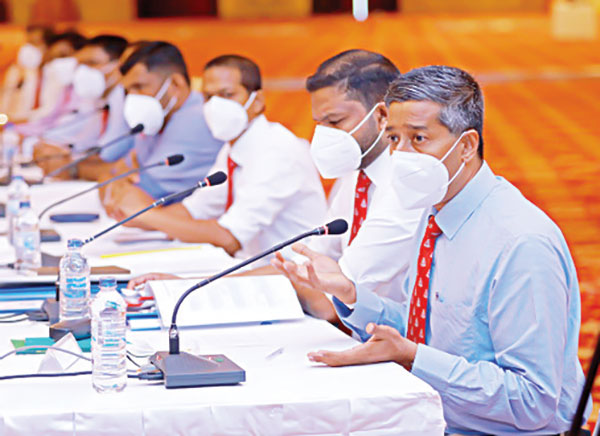
Contradictory statements over Temple Trees talks
By Shamindra Ferdinando
A simmering battle between the health ministry and the Government Medical Officers’ Association (GMOA) over the recent controversial change of the system that had been in place with regard to post-intern appointments has taken a new turn with Premier Mahinda Rajapaksa declaring that the final decision on such matters should be taken by Health Minister Keheliya Rambukwella.
PM Rajapaksa said so at the end of a meeting at Temple Trees on Tuesday morning (04) attended by Minister Rambukwella and GMOA President Dr. Anuruddha Padeniya.
PM Rajapaksa’s Office yesterday (05) morning quoted him as having told the meeting that the final decision was the prerogative of the Health Minister. According to the statement issued under the hand of PM’s Media Secretary Rohan Weliwita, Minister Rambukwella has told Premier Rajapaksa that the newly introduced system couldn’t be changed. Having ruled out further talks meant to restore the discarded system, Minister Rambukwella has said that he was prepared to discuss issues at hand pertaining to the newly introduced system. The Minister was reacting to the GMOA requesting the restoration of the discarded system.
Minister Rambukwella challenged the GMOA over the latter’s accusations regarding him interfering in administrative decisions.
Yesterday’s press release further quoted Premier Rajapaksa as having said that some issues couldn’t be resolved through discussions.
Top GMOA spokesperson Dr. Samantha Ananda yesterday told The Island that the Premier’s Office called the meeting on a request made by them. The meeting that commenced at 10 am ended close to noon with the health ministry and the GMOA unable to reach consensus on the issue at hand.
Yesterday’s press release issued by the PM’s Office following strong interventions by the health ministry was the third that dealt with the Temple Trees meeting.
On Tuesday, the PM’s Office released two statements also under the hand of Rohan Weliwita.
Premier Mahinda Rajapaksa has asserted that the change of the system that had been in place with regard to post-intern appointments will cause disputes.
The Premier has advised all stakeholders to reach a consensus whether to retain the same system inclusive of medical transfer boards.
Prime Minister’s Office on Tuesday night (4) quoted him as having instructed Director General of Health Services (DGHS) Dr. Asela Gunawardena to settle differences through consultations.
In the first statement, Premier Rajapaksa was quoted as having reproached health ministry officials over the unilateral change of the system. Premier Rajapaksa has told health ministry officials not to pursue political agenda at the expense of the government but to deal with trade unions in terms of the establishment of code.
Among those who had been present at the meeting were health minister Keheliya Rambukwella, Health Secretary Maj. Gen. Dr. S.H. Munasinghe, Secretary to the National Salaries Commission Chandrani Senaratne, DGHS Dr. Asela Gunawardena and President of the Government Medical Officers’ Association (GMOA) Dr. Anuruddha Padeniya.
Dr. Padeniya has requested the ministry to treat Administrative Medical Officers (Medical Administrative Grade) equally without them being divided into two sections namely Senior Medical Administrative Grade and Junior Medical Administrative Grade. Asked for clarification, Dr. Chamil Wijesinghe also of the GMOA said that the GMOA believed the two sections should be combined.
The GMOA has sought the intervention of Premier Rajapaksa after having accused the health ministry of failing to address the grievances of doctors. In a statement issued on Dec 28, 2021, the GMOA explained the difficulties experienced by three categories of doctors in service, namely (1) Grade Medical Officers (2) Specialist Medical Officers and (3) Administrative Medical Officers.
The GMOA resorted to trade union action from Dec 21 to 24 demanding that the government address seven major issues.
The GMOA, in a statement that dealt with the Temple Trees meeting said that the outfit was compelled to strike due to unilateral actions of Deputy Director General of Health Services Dr. G. Wijesuriya. According to the GMOA statement issued by its Secretary Dr. Senal Fernando, Premier Rajapaksa has directed DGHS Dr. Gunawardena to restore the abolished system in which transfer boards played a significant role.
The GMOA said that Premier Rajapaksa also directed the DGHS to establish an independent committee that would be tasked to inquire into the irregularities caused by the changes made to the Medical Administrative Grade at the behest of the then health Minister Rajitha Senaratne and his wife, Dr. Sujatha Senaratne. The GMOA used the opportunity to explain how Dr. Seneratne’s unilateral interventions caused problems for the Medical Administrative Grade and resulted in overall deterioration of the services and working conditions.





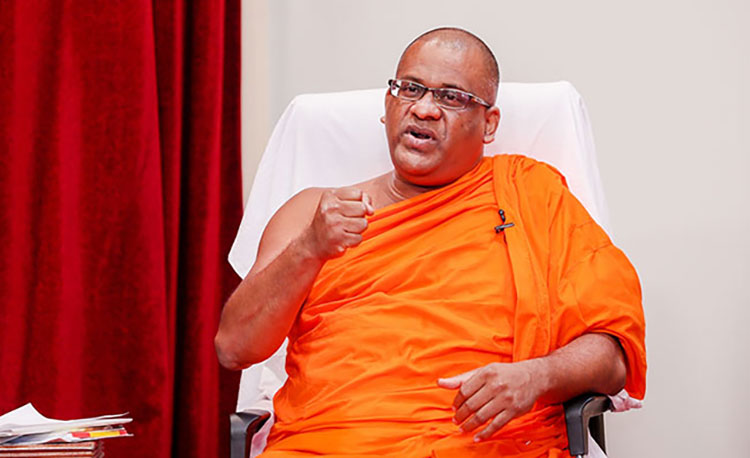
The Mahanayaka Theras of all Nikayas have protested against Bodu Bala Sena (BBS) General Secretary Ven. Galagodaaththe Gnanasara Thera, who is serving a prison sentence for contempt of court, being produced before court in civilian attire.
In a letter to the Commissioner General of Prisons, the Mahanayaka Theras have said they were surprised and concerned by the decision to remove the monk’s robes.
The letter has been signed by Most Ven. Thibbotuwawe Sri Siddhartha Sumangala Thera of the Malwatu Chapter, Most Ven. Warakagoda Sri Gnanarathana Thera of the Asgiri Chapter, Most Ven. Karagoda-Uyangoda Maithri Murthi Thera of the Amarapura Maha Nikaya and Most Ven. Makulawe Sri Wimala Thera of the Ramanna Maha Nikaya.
The Mahanayaka Theras have said they respect the Constitution and the judicial process, but maintained that removing a monk’s robes or ending his status as a member of the Buddhist Order is a matter that should be decided by the Maha Sangha.
They have said the relevant Sangha Council has not determined that Ven. Gnanasara Thera committed a Parajika offence or any other offence warranting his removal from the Buddhist Order.
The Mahanayaka Theras have also referred to Regulation 550 of the Prison Standing Orders, which they say stipulates that convicted prisoners should not be taken to court in prison uniform and should be allowed to wear the type of clothing they normally wore before their conviction. In the case of a Buddhist monk, they have said, this means his monastic robes.
They also referred to the United Nations Standard Minimum Rules for the Treatment of Prisoners, which provide for prisoners taken outside prison to be allowed to wear their own clothing or other unobtrusive clothing.
The Mahanayaka Theras have requested the Commissioner General of Prisons to allow Ven. Gnanasara Thera to wear his robes when appearing in court and to maintain his status as a monk while he remains in prison.
Prisons authorities have said that the clothing decision was made under prison regulations, and the Prisons Department has stated that prisoners serving sentences of more than three years are required to wear prison-issued clothing when produced before court.
The Committee on Public Finance has said that the actual losses suffered by the NDB bank are much more than what was initially reported. When compared with the initial disclosure made by NDB on 6 April 2026, the reported amount of the fraud had increased by Rs. 0.4 billion, from Rs. 13.2 billion to Rs. 13.6 billion, the committee said.
When compared with the amount disclosed by NDB on 26 June 2026, based on the interim report dated 22 June 2026, the additional amount of fraud is Rs. 60 million.
The has committee issued the following statement: The Committee on Public Finance recently summoned officials of the Central Bank of Sri Lanka to Parliament to inquire into the financial irregularities identified at NDB Bank and the final audit report relating to the matter.
The Committee meeting, chaired by Member of Parliament Dr. Harsha de Silva, discussed irregularities identified in NDB Bank’s financial statements, shortcomings in the audit process, and the relevant audit reports.
The meeting was attended by Deputy Ministers Chathuranga Abeysinghe, Dr. Kaushalya Ariyaratne, and Nishantha Jayaweera, as well as Members of Parliament Attorney-at-Law Rauff Hakeem, Ravi Karunanayake, Ajith Agalakada, Nimal Palihena, Wijesiri Basnayake, M.K.M. Aslam, Champika Hettiarachchi, and Attorney-at-Law Lakmali Hemachandra.
The Committee also focused on the findings of the investigation conducted by the Sri Lanka Accounting and Auditing Standards Monitoring Board (SLAAMB), as well as the findings revealed through the investigation conducted by Deloitte Touche Tohmatsu India LLP. In particular, the Committee inquired into the failure of the external auditors to identify irregularities in NDB Bank’s financial statements.
The accountability of senior management with regard to corporate governance and risk management in relation to the financial irregularities was also discussed.
As a significant proportion of NDB Bank’s shares are held by institutions representing public and state funds, the Committee also considered the potential impact of such financial irregularities on public funds and the general public.
The Committee also discussed the progress made by LankaPay in establishing a centralized fraud monitoring system to prevent fraud within the financial system. The need to strengthen fraud monitoring systems at the individual bank level to monitor transactions carried out within each bank was also emphasized.
Accordingly, the following observations are included in the final audit report concerning the financial irregularities at NDB Bank:
1. The audit covers the period from 1 April 2016 to 31 March 2026. The audit report specifically identifies the financial impact arising from fraudulent transactions amounting to Rs. 13,639,664,684 (Rs. 13.6 billion).
2. According to the disclosure made on 29 September 2026, the financial impact arising from the fraudulent transactions is as follows:
· Rs. 1.5 billion for the period prior to 1 January 2025;
· Rs. 9.6 billion during 2025; and
· Rs. 2.5 billion for the quarter ended 31 March 2026.
3. Compared with the initial disclosure made by NDB on 6 April 2026, the reported amount of the fraud has increased by Rs. 0.4 billion, from Rs. 13.2 billion to Rs. 13.6 billion. Compared with the amount disclosed by NDB on 26 June 2026, based on the interim report dated 22 June 2026, the additional amount of fraud is Rs. 60 million.
4. The final audit report has also confirmed the previous disclosures that no customer accounts were affected as a result of the fraud incident.
5. The report has identified several governance failures at NDB relating to the processing of CEFT transactions, user-level activities within the Core Banking System, and the management of user credentials and access information. In addition, shortcomings have been identified in several operational areas, including transaction monitoring, daily account reconciliation, financial compliance, internal audit, branch network management, and operational risk management.
The audit report has made comprehensive recommendations to strengthen the control mechanisms, governance structures, and processes relating to the above-mentioned activities of the bank.
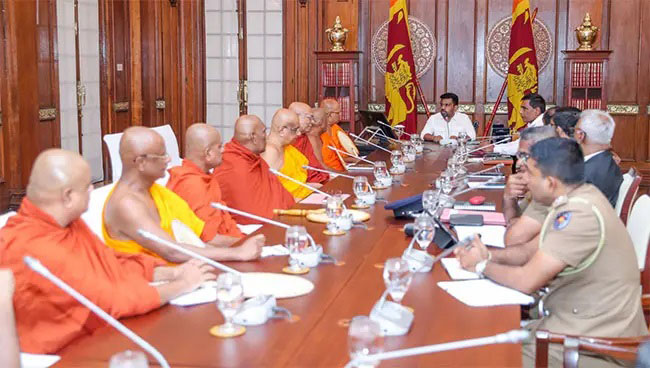
President Anura Kumara Dissanayake has ordered the formation of a committee to review the laws and regulations on how Buddhist monks serving prison sentences are treated, including the procedures that apply when they are taken out of prison.
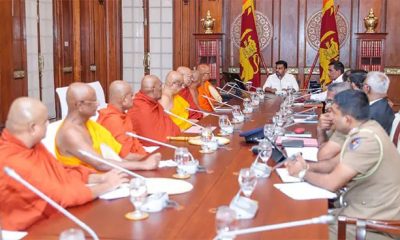
He revealed this at a special meeting with Maha Sangha representatives held yesterday (8) at the Presidential Secretariat. The meeting was called after concerns were raised over how Ven. Galagoda Aththe Gnanasara Thera was treated when he was taken from prison to court.
The committee will recommend amendments to existing laws and, where needed, new prison standing orders and regulations. Its members will be drawn from the Attorney General’s Department, the Ministries of Justice, Public Administration, and Buddha Sasana, Religious and Cultural Affairs, and the Department of Prisons, including the Commissioner General of Prisons. It has been given two weeks to review the current legal provisions and submit its recommendations. The President added that any changes specific to Buddhist monks would be made in consultation with the Maha Sangha.
Outlining the legal background, the President said prison administration was governed by the Prisons Ordinance of 1877, along with the regulations and standing orders issued under it. That framework mostly addressed prisoners in general, he said, and had few provisions dealing specifically with Buddhist monks.
The meeting was attended by senior Maha Sangha members representing the Siyam, Amarapura and Ramanna Nikayas, along with Minister of Buddhasasana, Religious and Cultural Affairs Hiniduma Sunil Senevi and Minister of Justice Harshana Nanayakkara.

Trump says US will not strike Iran before midterm elections

2026 Nobel Peace Prize awarded to Navi Pillay

Showers or thundershowers will occur in most part of the island after 1.00 p.m.

Removing monk’s robes matter for Sangha to decide: Mahanayake Theras

NDB fraud Rs 60mn more than reported

President orders review of laws on treatment of imprisoned monks

‘Dates have the highest sugar content to fight Coronavirus’

Sunday Island 27 December – Headlines

#SundayIsland 17th December – Headlines

Sunday Island – 28th March

Sunday Island Headlines – 21 March

Sunday Island – 21st February – Headlines
-

 Features5 days ago
The first woman in the foreign service or Ceylon Overseas Service it was then called
-

 News4 days ago
Geneva takes up Sallay’s case and govt. ignores opportunity to answer accusations
-

 Editorial6 days ago
Fuelling discontent and protest
-

 Foreign News6 days ago
Ten injured after car crashes into rugby supporters in Australia
-

 Latest News6 days ago
Tharindu Rathnayake, bowlers secure Asian Games Bronze for Sri Lanka
-

 News5 days ago
Nearly 20 Iranian tankers stranded off Lanka amid US sanctions
-

 Features4 days ago
Sri Lanka Cricket Bill: Governance reform is not yet a cricket strategy
-

 Features3 days ago
Preventing grievances from becoming communal