
Opinion
An Economic Round Table – a farce in a fallen economy?

It is indeed amusing to read this debate published in The Island about an “economic roundtable towards a consensus”, presumably to help Sri Lanka’s politicians to get the country out of the abyss it has fallen into. Could these writers be practising a genre of writing bordering on farce, and understated amusement?
They realise that what is needed in the first instance is a tribunal and a guillotine set up in the Galle Face Green, to execute the crooks who have amassed personal fortunes by various scams and “jaavaram”? Scams could be at the august level of a Prime Minister and a Governor of the Central Bank working in collusion, with a Minister who did not know who paid the rent for his luxury flat, or at the ignominious level of a secretary to the President who exchanged sacks of money in a dark parking lot, or in the shadow of changing the price of sugar or of nano-nitrogen to fill desired pockets.
However, once the crooks are got rid of, and their ill-gotten wealth nationalised and repatriated, the economists could be called in to give consensual advice?
Hema Senanayake, who thinks that a round table of economists will square the circle, may have heard of Bernard Shaw’s remark that if you ask 10 economists to point to the North, they will point in 11 different directions and yet miss the North!
Hema Senanayake says, perhaps with unstated irony that “In chemistry, there is no middle path, just known truth prevails. So is physics. In brief all subjects of natural sciences there are scientific truths. Why not in economics?” The simple answer is that Economics is NOT a science. According to Dr. Nalin de Silva, even science is a chronic Western lie – only revealed truth is “truth”.
Senanayake may be secretly thinking of the address given by von Hayek on receiving the Nobel Prize for Economics, entitled “On pretence of knowledge”. https://www.nobelprize.org/prizes/economic-sciences/1974/hayek/lecture/
Von Hayek says that most economic advice is just pretence to knowledge, when no such knowledge exists. In regard to the analogy with the physical sciences, he says:
“Economic Science marks a significant step in the process by which, in the opinion of the general public, economics has conceded some of the dignity and prestige of the physical sciences. On the other hand, the economists are at this moment called upon to say how to extricate the free world from the serious threat of accelerating inflation which, it must be admitted, has been brought about by policies which the majority of economists recommended and even urged governments to pursue. We have indeed at the moment little cause for pride: as a profession we have made a mess of things.
It seems to me that this failure of the economists to guide policy more successfully is closely connected with their propensity to imitate as closely as possible the procedures of the brilliantly successful physical sciences – an attempt which in our field may lead to outright error.”
Senanayake is carrying his irony too far when he says “Therefore, I would unite with Dr. Dayan Jayatilleke to call for an Economic Round table and let’s begin with economic axioms. Our people would be relieved from economic suffering within months.”
In Months, WOW! After all, we have heard of Euclid’s axioms, or the axioms set down by Whitehead and Russell in their abortive bid to unify logic and mathematics. But what are these axioms of Economics? The pretence that there are such axioms has been expunged long ago by von Hayek in his Nobel-prize speech.
So what about Sri Lanka’s economy? Surely, if the old soldier had not shot himself in the foot by listening to the likes of Venerable Rathana, Dr. Padeniya, or Dr. Jayasumana to clean the country of toxins, he would not have banned agrochemicals last April. There would have been less of a crisis.
AGRICULTURE- the leading leg of the nation.
What we need now are not economic axioms, but rapid-result agriculture.
Mrs. Bandaranaike, having destroyed Dudley Senanayake’s gains in agriculture, realised in 1971-72 that a possible recourse was to grow Manioc, Millet etc., i.e., crops that need very little agrochemicals! Manioc leaves contain a form of cyanide, and even caterpillars or cattle avoid it. However, if the leaves are pounded and left for an hour, the cyanide is released and makes an excellent “Maellum” (cooked salad) rich in protein.
The government has not only shot one foot (agriculture), but also its other foot (energy sector), and is unable to stand erect. It is on its four limbs; its only capacity is to beg. But DISASTER CAPITALISM is here. The main question for the round-table economists is, who should buy up the disaster – the US, Chinese or Indian capitalists? But, even if the economists come to some agreement, they cannot achieve much, unless they can invite the likes of Goldman Sachs, Mukesh Ambani or Ma Huateng to the talks. That is the only valid axiom!
If the agricultural catastrophe can be weathered for a year by resorting to Manioc and other fallback foods (while the upper classes eat their organic food and drink Evian water), at least one leg of the economy becomes viable. How about the other leg – the power sector?
THE POWER SECTOR- the left leg of the nation
: Already, the local populace has re-discovered firewood. This is bio-energy. Quick growing plants requiring little or no fertiliser and resistant to pests, fit the bill. While exploiting quick-growing plants like Giricidia, my choice for a high-payoff plant for the power sector is Castor, “Erandu” in swabhasha. The oil can be used in a diesel engine without further treatment! It grows fast on the poorest of soils, untouched by even a very hungry goat or gnat. The whole plant, seeds, shells can be burnt to produce high-pressure steam and electric power.
Ipil Ipil, used in coconut plantations as it is a nitrogen-fixing plant, grows to 20-30 feet in a couple of years, and can also be used for firewood or for power generation.
Ifham Nizam’s report in The Island (1st January 2022) says that “Hydro Power capacity has dropped to 70 percent from nearly 95 percent during the recent rains.” When the rains stop, the water levels in the reservoirs fall as the water flows down the sluices, turbines and into irrigation canals. But what is not appreciated is that one third of this water (that could generate 95% during rains) gets lost by EVAPORATION occurring day and night, especially from water areas covered by Salvinia and other aquatic plants.
One might imagine that aquatic plants cover the water and prevent evaporation. Far from it. They act like wicks, and bring up water through their underwater roots and to the air more efficiently. So, REMOVE the aquatic plants, and put floating covers on the windswept part of the water. You immediately get 1/3 MORE electricity by extending the effect of the rains.
Putting floats on water surfaces to partially cover them is a locally available, rapidly deployable technology. However, these floats can carry solar panels. Then, a good additional amount of solar energy, besides the 1/3 extra electricity obtained by cutting evaporation, can be obtained. This solar electricity can be used during the day; a corresponding amount of water can be saved by shutting off a few turbines.
Deploying floating covers to prevent evaporation (with or without solar panels) cleans up the aquatic surfaces. The Salvinia, “Japan Jabara” (water hyacinth) etc., suck up the dissolved oxygen in the water and asphyxiate aquatic organisms, and create unhealthy aquatic bodies. The aquatic weeds thrive in excess phosphates carried down to reservoirs from agricultural areas. So, clearing up these aquatic surfaces, and covering them partially using solar panels will IMPROVE the aquatic ecosystem beyond measure.
In summary, falling back to fast-growing primordial diets based on manioc, millets and yams to weather over the immediate shock of the collapse of the conventional agriculture sector, can steady one leg of the economy. The other leg, i. e., the power sector, may have to fall back on fire wood, Gliricidia, Castor and such bio-energy sources, while taking steps to prevent loss of hydro-power due to water evaporation.
However, an efficient organisational structure is needed to achieve these objectives. The Ministry of Agriculture has had five secretaries in a short length of time. It is like a demoralised army languishing under a succession of mad men, who ordered firing even into its own ranks.
CHANDRE
DHARMAWARDANA
chandre.dharma@yahoo.ca

Contrary to the current government’s election promise to lower the electricity bill by 33%, electricity tariffs have been further increased by 18%, with effect from 11 May, 2026. A cosmetic concession has been given to the consumers with a consumption less than 180 units per month. However, they are already subject to the 10% increase already granted on 01 April, 2026. The subsidy of Rs 15 billion granted by the Treasury to enable this concession is highly questionable; it is a clear case of misleading the public. The subsidy of Rs. 15 billion is not a gift from Heaven, but is from public funds, which could have been used for other sectors which deserve assistance.
This was also the case prior to the IMF insisting that the electricity tariff should be cost-reflective. The then CEB wasted nearly a trillion rupees of treasury funds (read funds belonging to the people) over the past decade by adopting wasteful and ill-conceived generation options and other activities in the name of generating low-cost electricity.
Unfortunately, the IMF did not impose the essential condition that CEB should follow the concept of Least Economic Cost of Generation in selecting the generation mix.
The CEB’s persistent refusal to accept this principle and act thereon has been the main reason for the spate of increases in electricity tariff for the last several years as shown. (See Table 1)
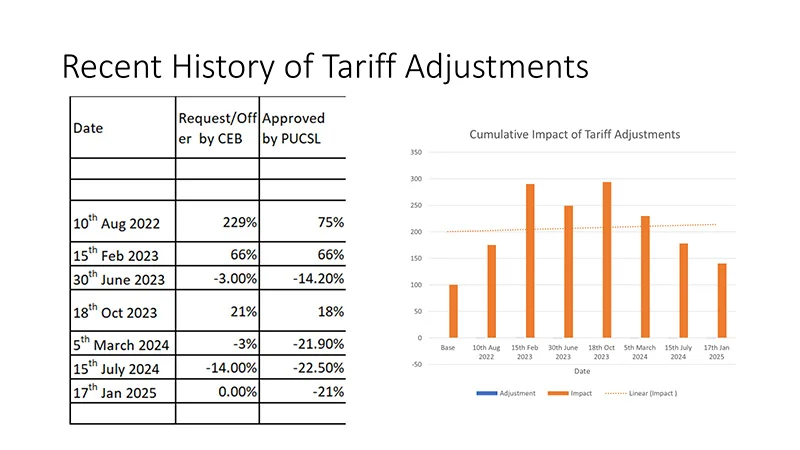
This does not include the increases in April and May
The Public Utilities Commission of Sri Lanka (PUCSL) has sought to lower tariffs in some instances, but it has failed to reverse the trend.
There were vehement protests by all concerned during the public hearing held on 6 May 2026 against any kind of tariff increase, which naturally would have grave negative ramifications on peoples cost of living and all other sectors of the economy. The numbers presented by the National System Operator (NSO), successor to the now defunct CEB were highly criticized as inaccurate and designed to deceive the public and presented only to say support their claim for the tariff increase.
Most critically, the question of the required supply of coal, especially the substandard variety currently being used, was questioned. Given the onset of monsoons, it is doubtful whether even the emergency supplier can deliver 330,000 MT of coal to meet the supply shortfall at higher prices. The original supplier failed to deliver the last five shipments.
As such, it is now very likely that there will be a shortage in the electricity supply in the coming months. In addition, the NSO in its submission has predicted an increase in demand of 118 GWh during the next quarter. What is the plan of NSO to meet this demand? Will it try to meet the shortfall by increased use of oil, resorting to the much-dreaded Emergency Purchases as done previously? If that is the case, there will be another demand for a tariff increase in September 2026 to cover the additional costs.
Hobson’s Choice for PUCSL
However, the writer, taking a pragmatic view that the PUCSL, is faced with the difficult position of ensuring that the NSO is able to function and to maintain the national electricity supply, the breakdown of which is unfathomable, proposed that some increase in tariff in the present instance was inevitable, however, distasteful and unpopular that would be. This is in light of the massive increase in the price of all forms of oil used for the power generation and the loss of generation capacity caused by the coal scam. It is not possible to accept a complete loss of the supply nor prolonged power cuts as happened in 2022. Neither the CEB nor its successor, the NSO, has been proactive in anticipating the current crisis in spite of many years of warnings of the danger of over dependence on imported fossil fuels which Sri Lanka has absolutely no control over where either price or supply is concerned. It is imperative that even at this late stage the NSO reverse this situation by reducing such dependence, as Sri Lanka now enjoys the means of filling that gap using economical and abundantly available indigenous sources of renewable energy such as Solar Wind and Biomass.
Therefore, I proposed that whatever tariff increase was granted be made strictly conditional to NSO acting swiftly to formulate plans fast to eliminate the use of any kind of oil for power generation.
Pragmatic approach of PUCSL
It is of great relief to the consumers and the county that the PUCSL has accepted this proposal and imposed the following conditions in granting the 18% tariff Increase to consumers over 180 units per month.
Conditions of PUCSL
1. NSO shall review its generation plan to eliminate the oil dependency of Sri Lanka energy mix by 2030 and to achieve the renewable energy targets, the generation plan to be ready by end 2026.
Several other measures have also been adopted to ensure that all licensees comply. It is imperative that President Anura Kumara Dissanayake realise that abiding by these conditions is the only way he can hope to deliver on his promise of reducing the consumer tariff.
Even though achieving the 33% tariff reduction will take some time, given that the baseline has shifted considerably upwards due the past tariff increases, the implementation of these conditions imposed immediately can arrest the dangerous trend of ever increasing consumer tariff. The President should be vigilant to prevent any attempts by interested parties to perpetuate the use of oil for power generation by sabotaging this much-delayed change, and perhaps by hiding behind some clause in the recently enacted Electricity Act. It will be in his interest to monitor the events closely, perhaps via the newly-appointed Secretary to the Ministry of Power and Energy.
PUCSL’s proactive role
The PUCSL has been proactive in this regard by foreseeing the need for
accelerated development and integration of solar PV as the fastest means of filling the gap created by the gradual elimination of oil use. It has already published a stagewise plan to achieve this goal by 2030
Furthermore, recognising that the change can be achieved by attracting private investment, the PUCSL is currently planning to publish Feed in Tariff (FIT) applicable for the integration of storage batteries to overcome the often repeated issue of variability and thereby the potential instability of the grid . It’s even more important that the correct size of these batteries will enable the ” Prosumers” to export the much-needed power to the grid during the peak hours.
The excessive use of the excessive diesel and other oils is needed mostly during the peak hours. It is feasible for this need to be filled by exporting solar and wind via battery storage. It is to be noted that a substantial amount of solar and wind energy is currently curtailed during the weekend daylight hours without compensation to the developers, claiming the supply is in excess of the demand. Moreover, the payments due to these developers have been delayed over several months now amounting to over Rs 10 billion. In the meantime, we have been paying for the use of oil imported with scarce foreign exchange.
We solicit the vigilance of the respective authorities,including the Presidential Secretariat, to ensure that no barriers are created by interested parties for the implementation of the PUCSL proposals.
In this regard, the issue of delayed payments to the Renewable Energy Developers should be resolved urgently as these are the very same developers who can contribute most speedily to implement the strategy proposed by the PUCSL.
The low hanging fruit
Taking a pragmatic view of the situation, one will see that even in a situation where all parties willingly and readily accept this strategy as the only way forward, there is much work to be done before the energy stored in batteries could be exported to the grid.
The fastest option is to permit the emerging new rooftop solar systems to
be developed coupled with batteries in the off-grid mode, which does not require the traditional grid integration.
They shall be permitted to join the system when smart meters are in place to enable such energy to be exported during the peak hours and also to implement the time of use (TOU) tariff system to pay only for the energy exported during this time slot only.
It is imperative that very urgent action be taken to effect these changes, with the installation of smart meters to consumers who require them. The current increase of 18% of the tariff to this class of consumers who are able to fund the solar PV plus batteries will enhance the financial feasibility of this move and therefore should be considered an incentive to do so although unintentionally. This is illustrated to be compared with the same analysis published in my previous article. (See table 2)
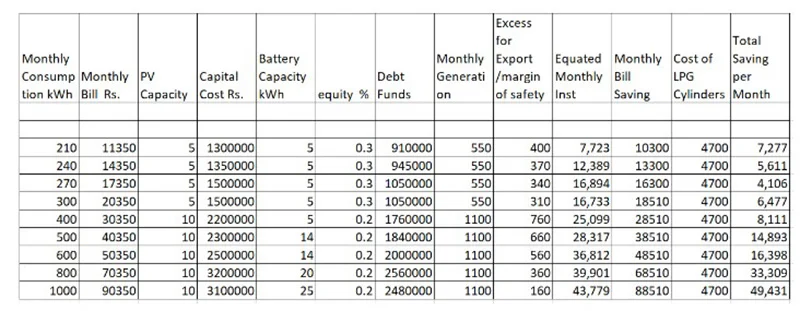
When the FIT for exports to the grid off the batteries are announced the saving would be much greater as there is a possible excess generation that can be exported to the grid during peak hours, further assisting the reduction of the need for diesel generation.
The NSO should also recognise the value of the contribution by this group of consumers as the energy consumed by them during the peak hours will no longer be drawn from the grid thus in effect reducing the need for use of diesel during this period.
Using the data submitted with the claim, it can be seen that Rs 6,287 million will be required to generate 51 GWh of electricity using diesel, presumably at the current price of Rs. 382 per litre. This relates to a cost of generation of Rs 122.60 per kWh accepted without contest. The income they would get per unit even after the 18% increase from this class of consumers would be Rs 100 per unit. As such, even if the cost of diesel remains at the present level which is most doubtful, the NSO will be able to save at least Rs 22.60 per unit of energy that is not supplied to these “Prosumers”
The PUCSL’s proposed plan to eliminate the use of oil stipulates that the use of diesel for power generation should be done only during the peak hours and should be eliminated in 2026. The installation of smart meters and implementation of the TOU tariff system will have to be completed fast to achieve this goal
However, the process of Prosumers installing systems in the off-grid mode will help as they would not use the grid during the peak hours. They may use the grid during the off-peak hours. But since at this stage the system is not grid-integrated there is no impact on grid stability and thus prior approval is not required. They are in a position to install these systems in anticipation of the proposed system of exports, and save on their monthly electricity bills while helping reduce the peak load. They will also be protected from any power cuts, which are looming.
As such, we expect the PUCSL as well the NSO to pressure Sri Lanka
Customs to allow the duty and other concessions granted by them at the point of imports large scale batteries of 1 MWh capacity to be granted to the smaller scale batteries of kWh scale which at present are subject to levies up to 47%, and this should be corrected forthwith to attract more “Prosumers”.
The condition imposed by the PUCSL on the recent tariff increase is fair and very pragmatic. It is time for the NSO to recognize its national duty and obligation to the people of Sri Lanka to think positively and overcome two decades of negative stance the CEB adopted much to the detriment of Sri Lanka’s interest.
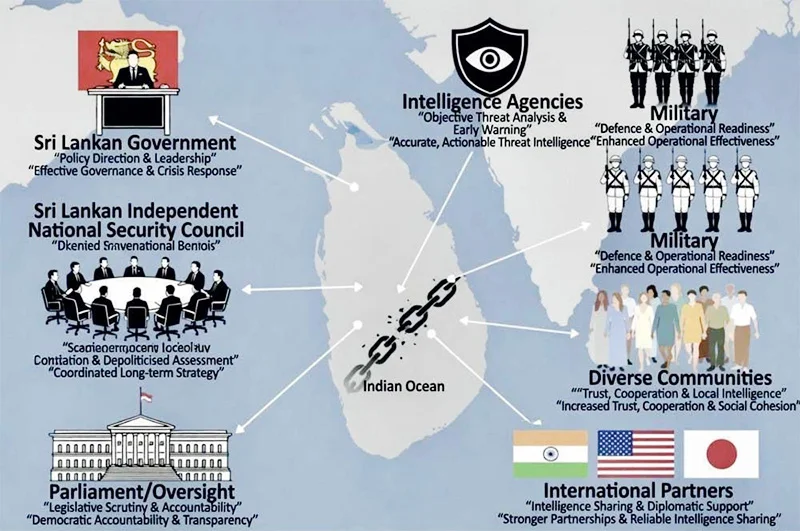
Sri Lanka in 2026 finds itself at a dangerous crossroads. Its commanding position in the Indian Ocean should be a strategic asset, yet it remains a vulnerability. The civil war ended in 2009 and the economy has begun recovering from the 2022 crisis, but the island faces intensifying great-power rivalry, internal divisions, and new threats ranging from cyber attacks to climate disasters. The deepest problem, however, is home-grown: the chronic politicisation of intelligence and security institutions.
This deliberate distortion weakens threat assessment, destroys public trust, and leaves Sri Lanka ill-equipped to handle a turbulent region. The most practical remedy lies in establishing a robust, independent National Security Council (NSC) with real statutory power. India’s post-Kargil reforms offer compelling lessons on how institutional redesign can professionalise intelligence and strengthen sovereignty.
Geopolitically, Sri Lanka is trapped in the crosshairs of India-China-US competition. Debt legacies such as Hambantota, competing port and infrastructure offers, and constant demands for maritime domain awareness force Colombo into a perpetual tightrope walk. Naval incidents near Sri Lankan waters remind us how easily the island could become a theatre for proxy rivalries. In such an environment, objective intelligence is not a luxury, it is survival. Yet when agencies are politicised, accurate analysis becomes impossible.
Reports are shaped to please the government of the day rather than reflect reality. Appointments go to loyalists, not professionals. Surveillance targets opposition figures, journalists, activists, and minority communities instead of terrorists, drug lords, or foreign agents. This is not a bureaucratic accident; it is deliberate design repeated across successive governments.
The 2019 Easter Sunday attacks remain the bloodiest proof. Credible warnings about Islamist extremism were ignored or poorly coordinated because of political rivalries and interference. Two hundred and sixty-nine people died in an atrocity that could have been prevented. In the North and East, continued intimidation of Tamils, Muslims, human rights defenders and war victims’ families has poisoned community relations and created dangerous intelligence black holes.
Resources are wasted watching critics while organised crime, gun violence, human trafficking, drug smuggling and hybrid disinformation flourish. The new Protection of the State from Terrorism Act (PSTA) risks becoming another tool of abuse unless accompanied by genuine safeguards.
Cyber vulnerabilities, climate-driven unrest and economic fragility only multiply these risks. Politicised intelligence does not protect the state, it hollows it out.
The National Security Council as Institutional Firewall
Sri Lanka’s 2026 National Security Strategy draft finally recognises the need for an empowered NSC. This must not become another decorative body. It should be established by law with the following core features:
• Statutory independence and fixed-term, merit-based appointments for key leadership, insulated from electoral cycles.
• A clear legal distinction between the permanent State and the temporary Government.
• A professional secretariat for real-time coordination across intelligence, military, police, foreign affairs and cyber agencies.
• Parliamentary oversight committees that include opposition members and require regular redacted public reporting.
• Strong protections for officers who deliver objective analysis, even when it is politically inconvenient.
Such an NSC would integrate political direction with professional assessment, end fragmented decision-making, and prevent partisan capture. It would allow Sri Lanka to craft long-term strategy rather than lurch from crisis to crisis.
Learning from India’s Post-Kargil Reforms
India’s experience is directly relevant. Before 1999, India suffered from the same fragmentation and coordination failures Sri Lanka faces today.
The Kargil Review Committee exposed glaring intelligence and structural weaknesses after the border conflict with Pakistan. In response, India created a permanent National Security Council headed by the Prime Minister. At its heart is a powerful National Security Advisor (NSA) supported by the National Security Council Secretariat (NSCS) and the Joint Intelligence Committee (JIC). The system coordinates inputs from the Intelligence Bureau (internal security), RAW (external intelligence), military intelligence and other agencies.
The Strategic Policy Group brings senior officials together for integrated advice, while the National Security Advisory Board draws independent experts for long-term thinking. These reforms did not eliminate all political influence; no large democracy is immune but they dramatically improved coordination, professionalised assessment, and enabled more assertive and coherent diplomacy. India’s ability to handle complex Indian Ocean challenges, respond to crises, and balance major powers has visibly strengthened since the reforms.
Sri Lanka, being smaller and more compact, can adapt this model even more effectively. A well-designed NSC here would be easier to manage than India’s vast apparatus, yet it could deliver the same benefits: continuity, centralised coordination, merit-based leadership, and reduced politicisation.
The key difference is political will. India acted decisively after a major shock. Sri Lanka has had multiple shocks, the Easter attacks being the most painful yet structural reform remains elusive.
Countries that succeed, such as Singapore and Israel, maintain strict firewalls between intelligence and partisan politics. They recruit and protect competent professionals who serve the nation, not the ruling party. Their agencies earn both domestic trust and international respect. Politicised systems, by contrast, breed repression, repeated failures and eroded sovereignty.
The Path Forward
Implementing genuine NSC reform will require courage from the highest levels of leadership. Superficial changes designed only to satisfy donors will achieve nothing. Sri Lanka must enshrine merit, oversight and professional culture in law. This will rebuild trust with minority communities, restore credibility with international partners (India, the US, Japan and others), and allow balanced diplomacy in a contested ocean. It will also free resources to tackle real threats terrorism, organised crime, cyber attacks and climate-induced instability instead of chasing political opponents.
The cost of continued inaction is painfully clear: more intelligence failures, deeper ethnic divisions, investor flight, and a permanent loss of strategic autonomy. The reward is equally clear a professional security apparatus that converts Sri Lanka’s geographic gift into genuine national strength, economic confidence and regional respect.
In 2026, Sri Lanka’s most important battle is not against an external enemy but against the internal politicisation that turns protectors into political instruments. Establishing a strong, independent National Security Council is not institutional tinkering; it is a patriotic necessity.
By learning from India’s proven reforms and committing to merit, coordination and accountability, Sri Lanka can finally build intelligence services worthy of its people and its strategic location. The draft National Security Strategy must now become binding law and practice. Half-measures will only mortgage the future. Professional, depoliticised institutions are the foundation on which Sri Lanka’s security, stability and prosperity must rest.
“Sri Lanka’s future will not be decided in the Indian Ocean, but in Colombo’s willingness to build institutions that place the State above the Government of the day. A strong, independent National Security Council is not merely a reform, it is the decisive step towards turning strategic vulnerability into enduring national strength. The time for excuses is over. The time for action is now.”
Writer
Mahil Dole, SSP (Retired), is the former Head of the Counter-Terrorism Division of the State Intelligence Service of Sri Lanka, and has served as Head of the Sri Lankan Delegation at three BIMSTEC Security Conferences. With over 40 years of experience in policing and intelligence, he writes on regional security, interfaith relations, and geopolitical strategy.
By Mahil Dole ssp rtd.
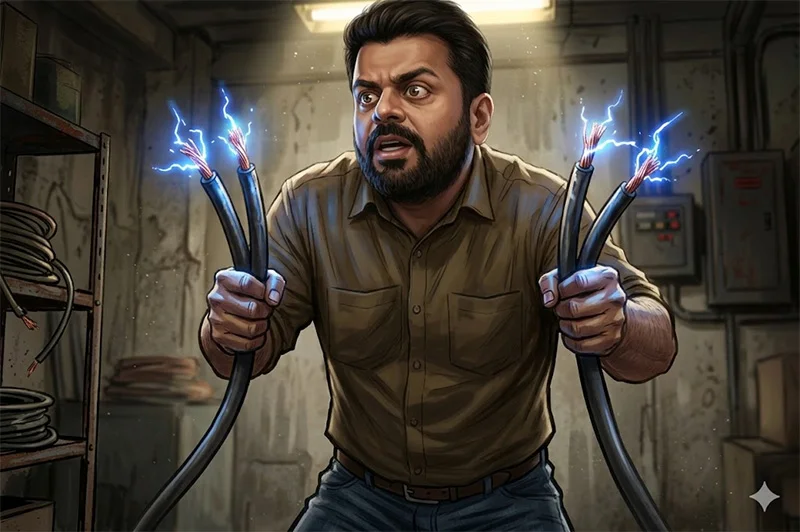
Tariff Increase: Visible and Real Impact
The recent increase in electricity tariffs in Sri Lanka has created serious social and economic concerns. The increase applies especially to consumers who use more than 180 units of electricity. Their bills may rise by more than 18%.
At first, this may look like a decision that affects only “high electricity users.” But in reality, the impact is much wider. It affects households, businesses, industries, services, inflation, investment, and national competitiveness.
Sri Lanka is now facing a situation where electricity bills continue to rise again and again. This should not be seen as a one-time tariff revision. If the price of one unit of electricity keeps increasing, the deeper problem is not only household consumption. The real problem is the high cost of electricity generation. Therefore, the unit price of electricity cannot be reduced in a sustainable way unless the cost of generation is reduced first.
The main concern is that Sri Lanka still does not seem to have a clear, practical, and measurable long-term plan to reduce generation costs. What we often hear are political explanations, temporary promises, and hopeful statements. But hope alone cannot reduce electricity tariffs. What the country needs is a realistic national plan. It must focus on low-cost power generation, efficient management, renewable energy investment, and serious reforms in the electricity sector.
Electricity is a basic foundation of a modern economy. When its price increases, it affects the cost of living, business costs, production, and national competitiveness. According to the Public Utilities Commission of Sri Lanka (PUCSL) announcements, the May 2026 revision applies especially to domestic consumers above 180 units, government institutions, large industries, and several GP2 and GP3 categories.
Direct Impact: Pressure on the Middle Class
The tariff increase directly affects middle-class and upper-middle-class families that use more than 180 units of electricity. In urban and semi-urban life, many electrical appliances are now part of daily life. These include refrigerators, water pumps, computers, internet devices, washing machines, fans, rice cookers, and other household equipment.
Many families exceed 180 units not because they live luxuriously, but because modern life requires electricity. Therefore, it is not realistic to say that this decision affects only the rich. Children’s education, online learning, work from home, small home-based businesses, water supply, communication, and basic household safety all depend on electricity.
According to PUCSL examples, a household using 210 units may see its bill increase from Rs. 9,570 to Rs. 11,330. This is an increase of about Rs. 1,760 per month, or nearly Rs. 21,000 per year. For families whose incomes are not rising at the same pace, this is a serious burden. It reduces savings. It affects education, health, food, and daily consumption. When electricity bills, food prices, fuel prices, and loan costs rise together, middle-class confidence falls. Families begin to cut non-essential spending. This also reduces market demand. Therefore, the electricity tariff increase is not just another monthly bill. It is a deeper pressure on living standards, savings, and economic security.
Impact on the Business Sector
The wider impact of electricity tariff increases is seen most clearly in the business sector. Factories, hotels, restaurants, supermarkets, cold storage facilities, bakeries, printing businesses, IT firms, and small and medium enterprises all depend heavily on electricity.
When electricity costs rise, production and service costs also rise.
In 2024, the industrial sector alone used 4,622 GWh of electricity. This was 30.4% of total electricity sales. The General Purpose category used 3,472 GWh, or 22.9%. This shows that a large share of electricity consumption takes place in the production and service economy.
For large industries, electricity is essential for machinery, refrigeration, lighting, packaging, water pumping, and quality control. When the unit price of electricity rises, the cost of producing each item also rises. Businesses then have only a few choices. They can pass the cost to consumers. They can reduce their profit margins. Or they can reduce production.
For small and medium businesses, the pressure is even greater. Large companies may be able to invest in solar power, energy-efficient machinery, or special credit facilities. But small businesses have limited options. For a bakery, salon, grocery shop, or small restaurant, a higher electricity bill directly affects daily cash flow. In the end, these costs enter the prices of goods and services. The price of food at a restaurant, goods at a shop, products from a factory, and services at a hotel can all rise because of electricity costs.
In the long run, this can also affect employment, wage increases, business expansion, and overall economic activity.
Inflation and the Cost of Living
Higher electricity tariffs can create a risk of rising inflation. Electricity is not only a household bill. It is also a key cost in food production, storage, transport, industry, hotels, hospitals, schools, and many services.
When electricity costs rise, that cost gradually enters the prices of goods and services.
Sri Lanka’s recent experience shows how dangerous this can be. In September 2022, annual inflation based on the Colombo Consumer Price Index reached 69.8%. Food inflation reached 94.9%, while non-food inflation reached 57.6%. This shows how quickly living costs can rise when fuel, electricity, transport, and exchange rate pressures come together. In April 2026, CCPI-based annual inflation also increased from 2.2% in March to 5.4%. Non-food inflation rose from 2.9% to 6.8%. This is an important warning.
Under the CCPI base year 2021=100, the category “Housing, Water, Electricity, Gas and Other Fuels” carries a weight of about 31.6% in the consumer price index. Therefore, higher electricity and fuel costs can have a direct impact on inflation. The risk is that an electricity bill increase does not stop with the electricity bill. It can later spread into food prices, medicine prices, school services, hospital services, restaurant prices, and transport costs. This is known as a second-round effect.
When inflation remains high, real household income falls. Even if salaries remain the same in numbers, people can buy less with that salary. There is another danger. If people and businesses expect prices to keep rising, businesses may raise prices early. Workers may demand higher wages. Suppliers may sign contracts at higher prices. This can create a wage-price spiral. Therefore, the inflationary impact of electricity tariff increases should not be treated lightly. The country needs more than tariff increases to cover institutional losses. It needs a long-term plan to reduce the cost of electricity generation, diversify the energy mix, and protect the cost of living.
Coal, Oil, and the Cost of Power Generation
One major reason for rising electricity tariffs is the way electricity is generated. Consumers see only the final bill. But behind that bill are fuel choices, power plant efficiency, import costs, exchange rates, and weaknesses in energy planning.
A major part of Sri Lanka’s electricity generation still depends on coal and fuel oil. In 2024, total electricity generation was 16,802 GWh. Coal accounted for 32.6%. CEB oil-based generation accounted for 9.3%. IPP oil-based generation accounted for 4.6%. Together, coal and oil-based generation made up nearly 46% of total generation. This is very important for tariff decisions.
Coal power plants such as Norochcholai provide relatively low-cost base power. But when such plants face maintenance problems, technical failures, or unexpected shutdowns, the country loses low-cost electricity. It then has to use more expensive oil-based power plants.
According to CEB 2024 data, the fuel cost of one unit of electricity from Lakvijaya coal power was Rs. 17.96 per kWh. But some diesel and LAD power plants cost more than Rs. 40 to Rs. 100 per kWh. This clearly shows how the generation mix affects the unit price of electricity.
Coal and oil are also imported fuels. They depend on foreign exchange. When global fuel prices rise, when the rupee weakens, or when geopolitical risks increase, electricity generation costs also rise. Therefore, a real discussion on reducing electricity tariffs must begin with reducing generation costs. Sri Lanka needs a practical plan to move towards lower-cost, reliable, and locally available energy sources.
Inefficiency and Policy Weaknesses
Another major reason for repeated tariff increases is long-term inefficiency in the electricity sector. Old transmission systems, power losses, delayed projects, inefficient procurement, political interference, and the absence of a stable energy policy have weakened electricity planning.
An efficient electricity system needs timely investment in low-cost power plants. Existing plants must be properly maintained. Transmission and distribution systems must be modernized. Renewable energy projects must be connected to the grid without unnecessary delay. When these steps are not taken on time, the country becomes dependent on expensive emergency solutions. Sri Lanka has natural advantages in solar, wind, and small hydro power. But delays in approvals, limited grid capacity, legal uncertainty for investors, and frequent policy changes have prevented the country from using this potential fully. This is a lost economic opportunity.
Another weakness is that decisions in the electricity sector are often driven more by politics than by technical and economic logic. Tariff decisions, power plant selection, project approvals, and institutional reforms should be based on professional judgment. When decisions are made for short-term popularity, the long-term cost is paid by the public.
Therefore, a plan to reduce electricity tariffs cannot be only a tariff announcement. It must be a full reform programme. It must reduce generation costs, reduce dependence on imported fuel, strengthen the grid, speed up renewable energy, and reduce institutional inefficiency. Without such a plan, electricity bills will continue to remain a burden on the people.
Impact on National Competitiveness
High electricity costs do not affect households alone. They also affect production costs, export prices, investment decisions, tourism costs, and the service economy. Therefore, electricity tariffs are a key factor in national competitiveness.
When electricity costs rise, it becomes harder for exporters to compete on price. Sectors such as apparel, food processing, rubber, plastics, packaging, printing, and light manufacturing all depend on electricity. International buyers are highly price-sensitive. If Sri Lanka’s production costs rise, its export competitiveness weakens.
Tourism is also affected. Hotels, restaurants, guest houses, and villas need electricity for air conditioning, lighting, laundry, kitchens, water heating, and digital systems. When electricity bills rise, room rates and service charges may also rise. This can make Sri Lanka less attractive compared to regional competitors. The IT, BPO, software, and digital service sectors also need reliable and affordable electricity. Higher power costs and uncertainty about supply can reduce the confidence of foreign clients and investors.
Foreign investors consider energy costs when choosing a country. They also look at labour costs, tax policy, legal stability, market access, and infrastructure. If electricity is expensive, the system is inefficient, and policy is unstable, investors see the country as risky. In the long run, this can affect new investment, jobs, wage growth, and economic growth. Therefore, electricity tariff increases must also be seen as a national competitiveness issue. If Sri Lanka wants to expand exports, strengthen tourism, attract investment, and create jobs, it needs a reliable electricity system at a reasonable cost.
A Positive Side: An Opportunity for Energy Efficiency
This situation should not be seen only negatively. Higher electricity prices can also encourage people to think more seriously about energy efficiency.
According to CEB 2024 data, electricity exported to the grid through rooftop solar increased from 632 GWh in 2023 to 867 GWh in 2024. This is a 37% increase. The number of rooftop solar accounts increased from 39,827 to 73,050, an 83% increase. This is a positive sign. It shows that people are looking for energy alternatives. But this alone is not enough. Individual solar adoption is useful, but the country still needs a reliable, coordinated, and long-term national energy plan to reduce overall generation costs.
What Should Be Done?
Sri Lanka cannot depend only on short-term solutions. The country needs a national policy that builds long-term energy security and economic stability.
Renewable energy must be accelerated. Sri Lanka has strong natural advantages in solar, wind, and hydro power. But delays in projects, policy instability, and investment barriers have prevented the country from using this potential fully. Households and businesses should be encouraged to use solar power. This can be done through affordable loans, tax relief, and a clear legal framework. If people can produce part of their own electricity, pressure on the national grid will also reduce.
Efficiency, Transparency, and Public Responsibility
To solve this problem, inefficiency and waste in the electricity sector must be reduced. Transmission losses, delayed projects, weak management, and political interference must be addressed. Financial transparency and professional management in institutions such as the Ceylon Electricity Board are also essential. This can help rebuild public trust.
The public also has a role. People should use electricity responsibly. They should use energy-efficient appliances, reduce waste, and change consumption habits where possible. But public responsibility alone cannot solve the problem. Even if people save electricity, the unit price cannot fall if national generation costs remain high. Therefore, responsible consumption by the public and a serious government plan to reduce generation costs must go together.
Rising electricity tariffs are not only about a higher electricity bill. They affect the entire economy. They influence household living costs, business costs, inflation, investment, and national competitiveness. The long-term solution is not repeated tariff increases. It is an efficient, diversified, and sustainable energy policy. The price of one unit of electricity can be reduced only when the cost of producing that unit is reduced. Political hope is not enough. Sri Lanka needs a practical national programme with clear targets, a timeline, investment support, faster renewable energy development, and reforms to reduce inefficiency in the electricity sector. Without such a programme, promises to reduce electricity bills will sound to the public like another political explanation and another hopeful statement.
by Prof. Ranjith Bandara

Vaibhav Sooryavanshi picked in India ‘A’ squad for one-day tri-series in Sri Lanka

Saudi Arabia set to host Dunes League T20 from October

The guidance of Religious Leaders is essential to strengthen coexistence among communities. — Prime Minister

‘Watermelon deaths’ in Mumbai puzzle investigators

Mass sex abuse allegations force closure of boarding school in Indonesia

Gunshots fired in Philippine Senate where lawmaker wanted by ICC is holed up

‘Dates have the highest sugar content to fight Coronavirus’

Sunday Island 27 December – Headlines

#SundayIsland 17th December – Headlines

Sunday Island – 28th March

Sunday Island Headlines – 21 March

Sunday Island – 21st February – Headlines
-

 News5 days ago
Lanka Port City officials to meet investors in Dubai
-
 News2 days ago
Ex-SriLankan CEO’s death: Controversy surrounds execution of bail bond
-

 News6 days ago
SLPP expresses concern over death of former SriLankan CEO
-

 Editorial7 days ago
The Vijay factor
-

 News6 days ago
Police inform Fort Magistrate’s Court of finding ex-CEO of SriLankan dead under suspicious circumstances
-

 Features3 days ago
When University systems fail:Supreme Court’s landmark intervention in sexual harassment case
-
Features3 days ago
High Stakes in Pursuing corruption cases
-

 Features7 days ago
Palm leaf manuscripts of Sri Lanka – 1