
News
BR says only Prez, PM and Cabinet can make him reverse move


Only listed companies targeted to raise Rs 114 bn
By Shamindra Ferdinando
Finance Minister Basil Rajapaksa has declared that his proposals to impose 25 percent retrospective tax surcharge on listed persons or companies that earned over Rs 2 bn 2020/2021 and increase VAT (Value Added Tax) to 18 percent from the current 15 percent wouldn’t be abandoned.
Appearing on ‘Salakuna,’ a weekly political programme telecast Monday night live on ‘Hiru’ FM Rajapaksa emphasised that he wouldn’t succumb to pressure from those affected by his proposals. Responding to ‘Hiru’ anchor Chamuditha Samarawickrema, the FM said only President Gotabaya Rajapaksa and Preme Minister Mahinda Rajapaksa and the Cabinet could intervene.
FM Rajapaksa said that he discussed the issue at hand with the chambers and didn’t object to the imposition of the surcharge for a year or two in view of the devastation caused by the pandemic, though they opposed haphazard changes in taxes.
However, those companies that hadn’t been listed in the Colombo Stock Exchange were left out of the tax net in spite of them, too, being cash rich, much to the surprise of the business sector.
Rajapaksa urged the media not to engage in a campaign to pressure the government to do away with the proposals.
Presenting the Budget for 2022, Minister Rajapaksa proposed (a) one-time tax surcharge of 25 percent on persons or companies with taxable income over Rupees 2,000 million for the year of assessment 2020/2021. The government expected to recover Rs 100 bn through this tax and (b) VAT on banks and financial service providers to be increased to 18 percent from 15 percent. Minister Rajapaksa stressed that this tax should be paid monthly from 01 January 2022 to 31 December 2022 and not passed onto customers. The government expected to raise Rs 14 bn through the tax.
When some Opposition members interrupted Minister Rajapaksa immediately after he announced the 25 percent surcharge on a selected group of companies, the FM said that he would like to see who represented the interests of the targeted companies.
The Inland Revenue Department says the following companies are likely to be levied proposed one-off tax surcharge: LOLC Holdings (Rs.23,075 mn), Commercial Bank (Rs 16,940 mn ), Ceylon Tobacco (Rs. 15,578 mn ), ExpoLanka Holdings (Rs. 14,830 mn), HNB (Rs 14,096 mn), Dialog Axiata (Rs. 12.034 mn), Ceylinco Insurance (Rs.8,880 mn), Sampath Bank (Rs.8,442 mn), Vallibel One (Rs. 8,117 mn), Sri Lanka Telecom (Rs.7,880), Hayleys (Rs.7,637 mn), Distilleries Company of Sri Lanka (Rs. 6,962 mn), LB Finnace (Rs. 6,807 mn), Royal Ceramics Lanka (Rs. 6,135 mn), Central Finance Company (Rs. 5,544 mn), Tokyo Cement Company (Lanka) (Rs.5,425 mn), People’s Leasing and Finance (Rs. 5,295 mn), Dipped Products (Rs.5,140 mn), National Development Bank (Rs. 5,117 mn), John Keells Holdings (Rs.5,026), Carson Cumberbatch (Rs.4,804 mn), Richard Pieris and Company (Rs. 4,680 mn), Melstacorp (Rs. 4,425 mn), LOLC Finnace (Rs.4,365 mn), Nations Trust Bank (Rs. 4,055 mn), Hemas Holdings (Rs. 3,621 mn), Bukit Darah (Rs. 3,541 mn), Cargills (Ceylon) (Rs.3,481 mn), CIC Holdings (Rs.3,132 mn), Haycarb (Rs. 3,047), SeylanBank (Rs. 3,039 mn), Lanka Walltiles (Rs. 2,960 mn), Nestle Lanka ( Rs.2,947 mn), DFCC Bank (Rs. 2,745), Ceylon Guardian Investment Trust (Rs. 2,721 mn), Citizens Development Business Finance (Rs.2,554), Lanka Tiles (Rs. 2,475 mn), Lion Brewery Ceylon (Rs.2,471 mn), Singer Sri Lanka (Rs.2,452 mn), Ceylon Cold Stores (Rs.2,334 mn), CT Holdings (Rs.2,288 mn), Chevron Lubricants Lanka (Rs.2,225 mn), Commercial Leasing and Finance (Rs. 2,216 mn), Access Engineering (Rs. 2,173 mn), Teejay Lanka (Rs.2,139 mn), Pan Asia Banking Corporation (Rs.2,048) and Commercial Credit and Finance (Rs, 2,005).
Former banker and Samagi Jana Balavegaya lawmaker Eran Wickremaratne strongly opposes the budget proposal. Asked for his stand on FM Basil Rajapaksa’s move and whether the latest proposal is similar to the tax imposed by the UNP but not implemented, MP Wickremaratne told The Island: “The private sector is not averse to paying taxes. They want a predictable tax environment so that they can plan and execute business plans. A one-off tax is arbitrary and unpredictable. It destroys business confidence. It weakens planning as well as foreign investors’ confidence in the country.”
Referring to the doing away with one-off super gains tax declared in 2015 but never implemented, SJB lawmaker Dr. Harsha de Silva stressed that two wrongs did not make a right.
Sources said that the cash strapped government could have targeted unlisted companies too. However, the decision makers had conveniently restricted the targeted group from among the listed group.
Responding to ‘Salakuna’ queries, Minister Rajapaksha strongly defended sharp tax cuts imposed immediately after the change of government in 2019. The minister said that sharp reduction of taxes saved many private companies, including the one that employed the ‘Salakuna’ team of journalists. The minister said so when Chamuditha Samarawickrema asserted that the government caused unnecessary revenue issues by reducing a range of taxes amounting to well over Rs. 500 bn.



Opp. lashes out at Justice Minister for disparaging remarks about CLA
By Shamindra Ferdinando
The Joint Opposition yesterday (09) tore into Justice and National Integration Minister Harsha Nanayakkara over some disparaging remarks about the Commonwealth Lawyers Association (CLA) in Parliament on Tuesday (08).
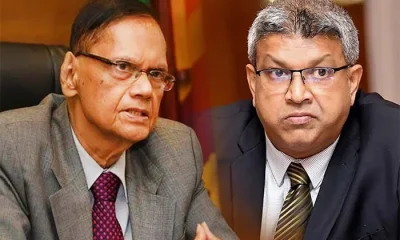
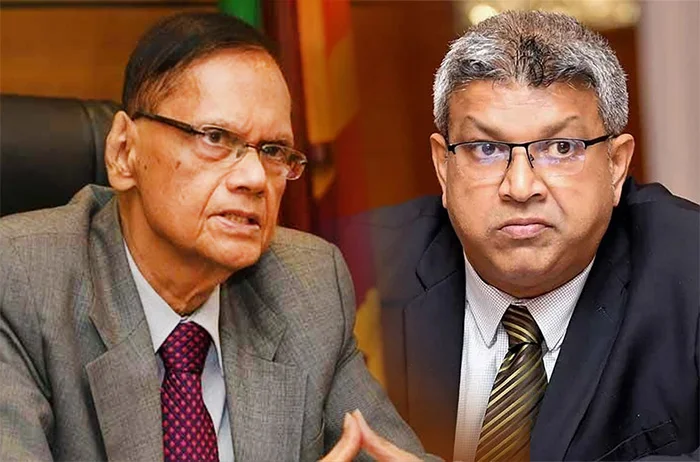
The Convenor of the Opposition grouping, former Law Professor Peiris questioned Minister Nanayakkara’s declaration that the CLA was a private club that granted membership on payments received. Emphasising that the CLA consisted of those in the legal profession in Commonwealth countries, Prof. Peiris told the weekly media briefing at the Flower Road Office of former President Ranil Wickremesinghe that the views expressed by the organisation couldn’t be discarded under any circumstances.
Prof. Peiris dealt with Nanayakkara’s response to the CLA’S concerns about several issues, including the composition of the five-member panel of judges. “How could Minister Nanayakkara dismiss concerns raised by CLA on the basis of the paid-membership of the organisation?” Prof. Peiris asked. If membership became an issue, the government would have to reconsider Sri Lanka’s UN membership, the ex-External Affairs Minister said, pointing out that the country had to make regular payments to retain membership of other UN agencies, as well.
Prof. Peiris said that indefensible attacks on international organisations could cause irreparable damage to the country. Appreciating the CLA’s report on the Supreme Court proceedings on the 01 and 02 September, Prof. Peiris stressed the importance of what he called total transparency in the judicial process. He said that whatever the outcome of a particular legal process, it couldn’t be done behind the backs of the public.
Referring to legal processes regarding the 6th Amendment and 13th Amendment, in 1983 and 1987, respectively, Prof. Peiris said, on both occasions the then Chief Justices Neville Samarakoon and S. Sharvananda constituted benches consisting of all Supreme Court judges.
But, the incumbent CJ Preethi Padman Surasena, in spite of the majority of petitioners demanding all available 13 justices to hear the case, decided to leave out those on the seniority list from second position to fourth position.
The government got offended because the CLA pointed that out for the whole world to take notice, Prof. Peiris said. The former parliamentarian noted that the CJ hadn’t even give a reason for declining the widespread call to involve all available 13 judges. According to him, there had been instances where CJ’s appointed seven justices to hear a particular case. Prof. Peiris cited the 2018 bench of seven judges that heard the petitions against President Maithripala Sirisena over the dissolution of Parliament and a panel constituted in 2023 to hear the 2019 Easter Sunday carnage that claimed the lives of 270 people.
The issue at hand is that the five-member panel of judges hadn’t been selected on the basis of seniority, Prof. Peiris said, once the SC determination was sent and released through the Speaker, they would meticulously examine that to make their position known to the people. Prof. Peiris said that what they really wanted to know was that if seniority hadn’t been the basis for selection what the criterion was.
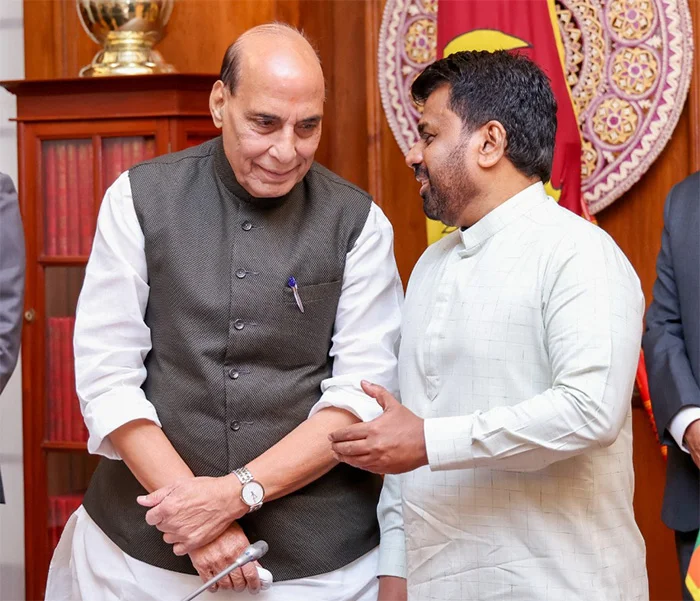
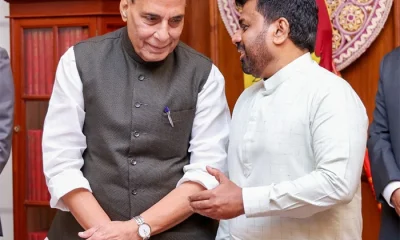
The Indian Defence Ministry in a statement issued yesterday (09) quoted President Anura Kumara Dissanayake as having assured visiting Defence Minister Rajnath Singh that Sri Lanka would never allow its territory to be used for activities inimical to India’s security interests.
The text of the Indian press release: “Visiting Indian Defence Minister Rajnath Singh called on President Anura Kumara Dissanayake in Colombo on September 09, 2026. The two leaders held substantive discussions on issues covering the entire spectrum of the multi-faceted partnership between the two nations, characterised by traditionally warm relations and mutual trust.
The two sides reaffirmed that as civilisational twins, close neighbours and maritime partners, India and Sri Lanka would continue to work together for their development and welfare of the people while working jointly to ensure the safety, security, peace and prosperity of the region. The senior Indian Minister conveyed greetings on behalf of Prime Minister Narendra Modi and underlined that the citizens of the two countries share deep friendship based on strong historical & civilisational links and people-to-people exchanges.
Extending a warm welcome to Mr. Singh, President Dissanayake recalled his interactions with PM Modi and reiterated that Sri Lanka would never allow its territory to be used for any activities inimical to India’s security interests.
President Dissanayake expressed his gratitude for the relief assistance provided by India as part of Operation Sagar Bandhu during Cyclone Ditwah and the comprehensive rehabilitation package extended by New Delhi to facilitate reconstruction and rehabilitation work across different parts of the island. The powerful Indian Defence Minister emphasised that as a closest friend and neighbour of Sri Lanka, India considered it not a favour, but a responsibility to provide assistance as the first responder and would continue to do so in the future as well.
Both leaders virtually inaugurated three Bailey Bridges constructed by the Indian Defence Forces. The two sides also exchanged MoUs on upgradation of L70 Guns for the Sri Lankan Air Force, and cooperation between National Cadet Corps (NCC) & National Defence Colleges (NDC) of both the countries. The MoU on Upgradation of six L70 guns for the Sri Lankan Air Force falls under a Government of India grant. The upgradation of these air defence guns will significantly strengthen the air defence architecture of critical assets in Sri Lanka. These air defence guns were earlier provided to the Sri Lanka Air Force by India.
The MoU on academic cooperation between NDC, India and NDC, Sri Lanka will facilitate knowledge sharing which will be a significant step in further strengthening the academic bonds between both the sister institutes. The MoU on NCC cooperation will formalise the NCC youth exchange programme between India and Sri Lanka. This exchange programme provides a valuable opportunity for NCC cadets from multiple countries across the world to come to New Delhi every year and participate in NCC events.”
News
UK-led Core Group calls Jaffna mass graves a ‘stark reminder’ but stops short of calling for international accountability
Mass grave excavations in Sri Lanka are a stark reminder that thousands of cases of enforced disappearance remain unresolved, the Sri Lanka Core Group has told the UN Human Rights Council, urging Colombo to translate its stated commitment to reform into concrete progress, while again stopping short of calling for the international accountability that Tamils have long demanded.
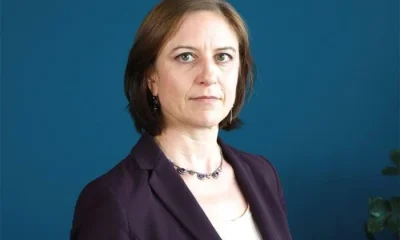
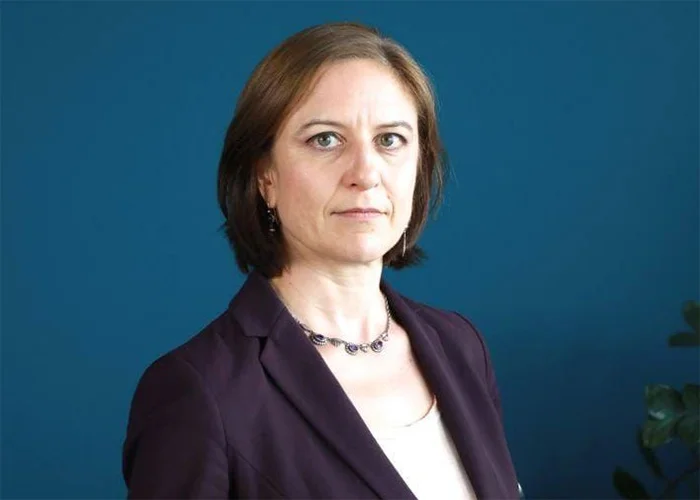
The statement, delivered in Geneva, on Tuesday (08), during the Council’s 63rd session by the United Kingdom’s Human Rights Ambassador Eleanor Sanders on behalf of Canada, Malawi, Montenegro, North Macedonia and the UK, welcomed, what it called, the High Commissioner’s balanced assessment of the human rights situation on the island.
The group acknowledged that Sri Lanka had faced considerable challenges recently, including severe weather events and global energy shocks, and welcomed positive developments, including the ratification of the ILO Convention 190 and engagement on the Convention on the Rights of Persons with Disabilities.
“However, much further action is needed to build confidence in accountability and reconciliation efforts,” Sanders said. “Progress in several emblematic cases has not yet been accompanied by a comprehensive,
victim-centred accountability process to address past violations. Mass grave excavations are a stark reminder that thousands of cases of enforced disappearances remain unresolved. And reports of intimidation, harassment, and restrictions affecting civil society, journalists and victims’ groups, including in the North and East, still raise concerns.”
The group urged progress on democratic governance, including advancing legal and institutional reforms, resolving land-related issues, ensuring respect for human rights in detention institutions and strengthening independent institutions.
The statement follows a familiar pattern. In June, the group acknowledged “developments in certain mass grave investigations” and urged that excavations meet international standards, and in March it called for the repeal of the Prevention of Terrorism Act. At the 58th session it welcomed a series of measures Tamils regarded as superficial. Neither this statement, nor its predecessors, names Chemmani, calls for international oversight of the excavation, or addresses the demand for a referral to the International Criminal Court.

Showers will occur in the Western and Sabaragamuwa provinces and in Kandy, Nuwara-Eliya, Galle and Matara districts.


Sri Lanka reiterates its territory won’t be used against India

UK-led Core Group calls Jaffna mass graves a ‘stark reminder’ but stops short of calling for international accountability

India underscores security and defence in overall partnership with SL

If Sri Lanka wants ‘real’ stability, only one way to achieve it, in a short time

‘Dates have the highest sugar content to fight Coronavirus’

Sunday Island 27 December – Headlines

#SundayIsland 17th December – Headlines

Sunday Island – 28th March

Sunday Island Headlines – 21 March

Sunday Island – 21st February – Headlines
-

 News5 days ago
Namal remanded until Sept. 18 over Airbus deal investigation
-

 Latest News4 days ago
Tharanga creates history with Diamond League crown in Brussels
-

 News4 days ago
Dispute which triggered listed company director being detained at BIA resolved
-

 Features3 days ago
After the parade: What a traffic OIC’s walk-out tells us
-
 Opinion6 days ago
In Memory of Dr Upatissa Pethiyagoda
-

 Editorial5 days ago
Power vs Equality
-
 Latest News6 days ago
SLPP MP Namal Rajapaksa arrested by CIABOC
-
Editorial3 days ago
Arrests as theatre