
Features
Pandemic profiteering and constitutional distractions


Ah, take the cash, and let the virus spread!
by Rajan Philips
“Some for the Glories of This World; and some Sigh for the Prophet’s Paradise to come; Ah, take the Cash, and let the Credit go, Nor heed the rumble of a distant Drum!”
― Omar Khayyam
Covid-19 is getting too close to home for too many. Last week it was Suresh Perera at the Sunday Island. This week it was Mangala Samaraweera, the veteran politician, who passed way after contracting Covid-19. He was a political stalwart behind the victories of Chandrika Kumaratunga, Mahinda Rajapaksa and Maithripala Sirisena in presidential elections. He was also a faithful lieutenant to former Prime Minister Ranil Wickremesinghe. A frontline cabinet minister in multiple portfolios since 1994, Mangala surpassed his father and political figure Mahanama Samaraweera in profile and in popularity.
Mangala Samaraweera will be remembered as a sincere and outspoken champion of pluralism, tolerance and national reconciliation even though his public pronouncements often created more controversy than consensus among his compatriots. As Foreign Minister, he tried to forge a new relationship with western countries predicated on respect for and observance of human rights. Shortly before his illness, he successfully interceded to obtain Covid-19 vaccine supplies for Sri Lanka from the US. Mangala Samaraweera’s death is widely mourned even as Covid-19 victims are getting more numerous and increasingly personal.
The 10-day lockdown imposed on Friday August 20 has not been able to reduce the daily totals of infections and deaths. Without a lockdown the totals would have been way higher. If the current trend continues, it would be a matter of weeks before total infections pass the half a million landmark and the number of deaths exceed 10,000. For the longest time after the onset of Covid-19, Sri Lanka’s totals were few hundreds of infections and hardly two dozen deaths. A political victory was declared prematurely, and public health was ignored almost permanently. Now there is no obvious end in sight, to plan for victory celebrations, even with the optimistic expectation of a fully vaccinated nation. Before looking for the end of the tunnel, look at what next steps are in sight.
The known unknown, at the time of writing, is whether the current lockdown will be ended or extended, come Monday. The decision apparently will be made on Friday August 27, according to news reports citing Dr. Asela Gunawardane, Director General of Health Services. By the time this column appears, you will already know whether or not the lockdown is continuing. The known known from Dr. Gunawardane’s statement is that the good doctor is at least open to continuing the lockdown. The unknown unknown, in Rumsfeld parlance, is the mind or the mindlessness of the President.
Friday last week, after months of resisting medical opinion, the President used the plea from the country’s highest prelates as reason for relenting and agreeing to a lockdown. Whose pleas are going to tip the scales a second time? What planetary signals are flashing in the national clairvoyant’s crystal ball? There are many other knowns and unknowns.
Unclaimed Bodies and Overclaimed Profits
The big known about the current lockdown is the confusion that shrouded its multiple announcements. As a result, people have been left to wonder whether they are in a lockdown, or a quarantine curfew; what is open and what is closed; and what activities are allowed and what are not. The administrative confusion is confounded by political infighting in the government. The SLPP is again taking to task its miniscule partners in the governing alliance for showing disloyalty to the President – this time writing to him and asking for a lockdown in deference to the medical opinion that has been calling for one for months on end.
It really requires extraordinary imagination to accuse the likes of Wimal Weerawansa, Udaya Gammanpila and Vasudeva Nanayakkara that they are of part of an international plot to bring about a regime change in Sri Lanka. Plot with whom – North Korea? But that apparently is the current pre-occupation of the SLPP – to safeguard the President, and not fighting Covid-19 to save the country. It has also been reported that at SLPP’s behest senior government officials are releasing communications and statements opposing the current lockdown and/or curfew measures. And this at a time when the police are arresting people on the street in record daily numbers for alleged curfew violations.
Besides the confusion at large in the country and paranoia within the government there is also the tragically known unknown about the last rites for people who are dying and are going to their graves or are turning into ashes – unseen and unwept and even unclaimed by their bereaving families. Lynn Ockersz has versified the insensitive crassness with which the (Covid-19) dead are being officially treated. His poem “The Unclaimed Body” (The Island, August 18) also calls out the Republic’s preference and religiosity: “Such treatment of the dead is no surprise,” the poem hits the nail on the coffin, “In a republic that’s preferred to be in chains … and in a land where religiosity pompously parades …”
Even elephants are protesting at parades, perhaps unlocking what DH Lawrence poetically saw while on a visit to the island during the 1922 “Pera-hera, at midnight, under the tropical stars,” as “the mystery of the dark mountain of blood, reeking in homage, in lust, in rage, and passive with everlasting patience.” Prudent rulers, whether kings or presidents, would never take patience to be everlasting either among elephants or among citizens.
While it is too much to expect poetic sensitivity to be observed in government operations, it is fair and reasonable to expect that a government that is boastful of its vistas and splendour, would show some respect for the nation’s dead and compassion for those that are left to mourn. Just as healthcare workers are expected to have good bedside manners, it is not too much to ask that the government directs its deathcare workers to show proper mortuary manners, graveside manners and pyre-side manners.
From deaths to profits is a tortuous leap, but not with a pandemic around and with this government at the helm. There are plausible allegations that profits and commissions are being garnered from selling vaccines, performing tests, disposing dead bodies and designating quarantine hotels. A retired Chief Epidemiologist has publicly stated that the President’s directive to conduct weekly Rapid Antigen Tests (RATs) on people over 60 years of age with pre-existing medical conditions will not contribute to saving lives but only to generating profits for companies importing RAT test kits.
It known that test kits are imported at USD 4 (Rs. 800) per kit with 10 testing samples, or a cost of Rs. 80 per sample. Private hospitals apparently charge patients Rs. 2,500 per sample, for a profit of Rs. 2,420 on each sample with the bulk of it going to the importer. The cost of a RAT test kit in India is INR 150, and in many countries the kits are distributed free. It is bad enough to have a government that is ill-equipped and incompetent, but do people deserve a government that presides over such a rip off in the middle of a pandemic? Ah, take the cash, and let the virus spread. That seems to have become the unwritten motto.
Constitutional Distractions
As for the virus spread, Sri Lanka has all the experts needed in Epidemiology and Public Health to advise the government and lead a programmatic path to containing the spread of the virus. But the government has failed to assemble them to perform this task. The government’s failure to give medical experts an organizational forum to provide leadership has led them to literally freelance in the media instead of directly advising the government.
Practically in most countries governments are following the advice of medical experts. In some western countries governments conveniently abdicate their responsibilities to scientists and experts. India and Sri Lanka are notable exceptions. The results on the Covid-19 front are unmistakable. The Indian situation is different from Sri Lanka’s. In India, the BJP and Prime Minister Modi do not trust any Indian expert, professional, or academic who is not a BJPer. They are suspected to be secularists or Nehru loyalists and are excluded as far as possible from decision making in state institutions. All important decisions have to be made by the Prime Minister himself. Similar to the Trump presidency. This approach blew up in the face for Modi and the BJP, jus as it did for Trump.
In Sri Lanka, until recently, almost everyone of consequence wanted to be associated with President Gotabaya Rajapaksa and the SLPP. There are no Senanayake or Bandaranaike loyalists lurking in state institutions and agencies to undermine the Rajapaksas. President Rajapaksa did not have to suspect anyone or exclude anyone especially in the matter of Covid-19. He could have summoned and consistently obtained the best expert advice and recommendations possible and presided over their implementation through the state machinery including the army. When things go right, he could take political credit for them, and if they go wrong he could damn the experts. Why was this approach not taken? That has already become the defining question for the prematurely tottering GR presidency.
As explanatory factors go – there is inexperience and incompetence. But one year of Covid-19 experience is worth a lifetime of normal experience, and you can always compensate for incompetence by picking and relying on people who are competent. Sinhala nationalism is more a convenient ruse than a defining political cause for the Rajapaksas. Of course, for those who want to manipulate Rajapaksas as weapons of history, they can be a pretty authentic bunch. In any event, nationalism is neither a vaccine nor therapy against Covid-19. Even ‘vaccine nationalism’ never found much traction, and for Sri Lanka it has no meaning.
What seems to have pushed the GR presidency off track on Covid-19 is the administration’s, and the family’s, hunger for project distractions. They would rather allocate national resources and incur debt for financially profiteering but economically dead end development projects than spend time and resources in purposefully fighting Covid-19. The government and the family have never shied away from their distractive priorities: the Port City in Colombo, a millionaire Yacht Club in Hambantota, 500 gyms throughout the country, transport and highway projects based Ponzi funding sources – the list will keep going on. And where there is a choice involved between public interest and commercial interests, the scales are always tilted in favour of the latter. No government has so comprehensively alienated and outraged every working segment of Sri Lanka’s population – farmers, teachers, fishers, workers and professionals.
A qualitatively different distraction is the constitutional project. Covid-19 may have put on hold the work of the Expert Committee set up to guide the writing of a new constitution – the fourth in 74 years. The Committee’s report was expected in July, there has not been any new news on its current status. This is hardly the time for preparing a new constitution. More importantly, the present government and parliament are by far the least constitutionally literate government or parliament in 90 years of constitutional government. Without Covid-19 the government may have ploughed through to producing a new constitution.
In the current situation and alternating between lockdowns, the government will be pilloried by the public if it takes up the constitutional project as a priority. The project should ideally be allowed to stay quiet and wither away. However, the government would likely welcome any opportunity to restart the project if the suggestion were to come from outside the government. It would be unfortunate and politically ill-advised if a request were to be extended to the government at this time, to write a new constitution to address the problems of the Tamils. It is irresponsible to think that “Covid-19 is a temporary situation and a new constitution is more important.” No one wants a permanent Covid-19 situation, but until Covid-19 is significantly controlled, nothing else can be a priority. More importantly, Covid-19 has turned upside down the credibility of the Rajapaksa government. The government must be pushed and persuaded to focus on Covid-19, even if leads to restoring its credibility. It should not be given the excuse to be distracted from Covid-19 to write a new constitution.


Prof. Ranjith Senaratne,
Emeritus Professor in Crop Science and former Vice-Chancellor,
University of Ruhuna and General President of the Sri Lanka Association for the Advancement of Science (2023) and
Prof. Prasad Jayaweera,
Dean, Faculty of Computing, University of Sri Jayawardenapura
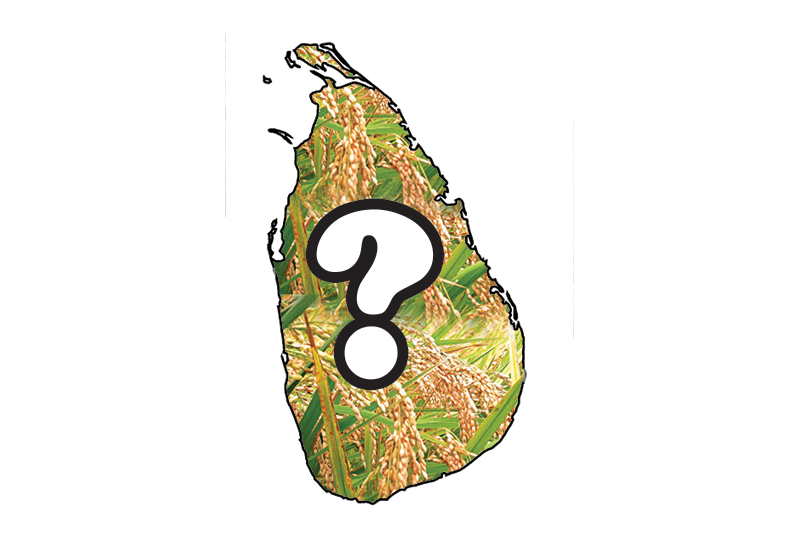
Rice is not merely another crop in Sri Lanka. It is our staple food, an integral part of our history and culture, and a foundation of the civilisation that flourished around our ancient hydraulic systems. Revered as Buddha Bhogaya, the Buddha’s crop, rice has sustained our people for more than two millennia. Yet, remarkably, a country with such a profound relationship with rice continues to lurch from one rice crisis to another.
At one time, we have a surplus. At another, we face shortages. Prices rise sharply, consumers complain, farmers struggle to obtain remunerative prices, millers and traders become the focus of public attention, imports are hurriedly arranged, and governments announce yet another set of measures to contain the crisis. Then, after the immediate problem subsides, the matter recedes from the national agenda, until the next crisis arrives.
Why does this keep happening despite decades of agricultural research, policy interventions, expert committees and public debate?
Perhaps because we have been asking the wrong question. The fundamental problem is not simply how to produce more rice. Nor is it merely a question of prices, imports, fertiliser, farmers, millers or markets. The rice conundrum is a complex national systems problem.
We cannot solve a system by fixing its parts in isolation
Sri Lanka’s rice sector is an intricate web of interconnected systems involving agriculture, land, water, climate, technology, finance, energy, transport, markets, trade, governance, institutions and consumer behaviour. A decision made in one part of this system can have consequences, sometimes unintended, in another.
A change in fertiliser policy, for example, can affect productivity and production costs, which in turn influence farmer profitability, market prices and the need for imports. Irrigation decisions affect not only production, but also water availability, energy use and environmental sustainability. Guaranteed prices influence farmers’ cropping decisions, while import policies can simultaneously protect consumers and weaken incentives for domestic production. Likewise, market concentration can affect both the price received by farmers and the price paid by consumers. This is precisely why isolated interventions so often produce disappointing results. We keep treating symptoms while leaving the underlying system largely untouched.
For decades, we have generated valuable scientific knowledge on individual aspects of rice production and marketing. But knowledge generated within disciplinary and institutional silos does not automatically translate into solutions to complex real-world problems. What is needed now is a fundamentally different way of thinking.
From a “rice crop” to a “rice system”
The first step is to stop looking at rice simply as something that is grown in a paddy field.
The rice system begins with land, water, seed, inputs, technology and finance. It extends through cultivation, harvesting, drying, milling, storage, transport, wholesale and retail marketing, and finally to the consumer’s table. At every stage, there are different interests, incentives, constraints and actors: farmers, farmer organisations, input suppliers, machinery operators, millers, traders, wholesalers, retailers, financial institutions, government agencies, researchers and consumers.
And hovering over the entire system are climate change, changing consumer preferences, technological transformation and national economic conditions. A weakness anywhere in this chain can compromise the performance of the whole system.
Consider post-harvest losses. If significant quantities of rice are lost because of inadequate drying, storage or processing facilities, increasing production alone cannot solve the problem. Similarly, if farmers produce efficiently but face weak markets and poor bargaining power, productivity gains may not translate into improved livelihoods.
The question, therefore, should not be “How much rice can we produce?” but “How can we make the entire rice system work better?”
That requires us to see the connections.
The missing ingredient: reliable, real-time information
There is another fundamental weakness that deserves urgent attention: we still lack a comprehensive, integrated, interoperable and reliable national information system for rice. Information is scattered among different institutions, often collected using different methodologies and not necessarily available when decisions need to be made.
How much rice will actually be produced? How much is in storage? What is the likely demand? Where are the emerging production shortfalls? What are the stocks held by different actors? How are prices moving along the value chain? What are the likely consequences of climate conditions? Without timely and reliable answers to such questions, policymakers are forced to make critical decisions with incomplete information. This is not merely an administrative inconvenience. It is a national food-security vulnerability.
Sri Lanka should therefore seriously consider establishing a National Rice Intelligence and Decision Support System (NRIDSS), an integrated digital platform that brings together relevant real-time information from agriculture, meteorology, irrigation, markets, trade, statistics and other institutions. Such a system could support production forecasting, market monitoring, import decisions, early warning and evidence-based policy formulation. In an increasingly uncertain climate and volatile global economy, this should no longer be regarded as a luxury. It is becoming an essential component of national food-system governance.
The deeper problems cannot be ignored
A systems approach would also force us to confront some uncomfortable structural realities. Why does productivity remain relatively low despite decades of research? Why are so many holdings too small to achieve economies of scale? Why are modern technologies and precision agriculture not being adopted more rapidly? Why do farmers often have limited bargaining power? Why do substantial losses occur after harvesting? Why can market power become concentrated in a relatively small number of actors? Why are guaranteed prices sometimes announced too late to influence farmers’ production decisions? Why are policy interventions so often reactive rather than proactive? And how will droughts, floods, temperature extremes, changing rainfall patterns and emerging pests affect the stability of rice production in the years ahead? These are not separate questions. They are parts of the same system.
From crisis management to systems governance
Sri Lanka does not need another isolated discussion about rice. What is needed is a national policy dialogue and action forum that brings all relevant actors together, not merely to exchange speeches, but to develop a shared understanding of the system and agree on what needs to be done. Such collaboration must go beyond consultation or the exchange of views. The different parties need to work together from problem definition through to implementation, bringing their diverse knowledge, perspectives, interests and practical experience into a common process.
Farmers bring contextual and experiential knowledge; industry actors understand market realities and operational constraints; scientists contribute evidence and analytical capabilities; policymakers bring institutional and regulatory perspectives; while technology and data specialists can provide new tools for understanding and managing the system. When these different perspectives are brought together systematically, they can reveal interdependencies, challenge assumptions, identify feasible interventions and generate solutions that are evidence-based, practically implementable and socially acceptable.
This is the essence of a transdisciplinary systems approach: not simply working across disciplines, but bringing together multiple stakeholders and multiple forms of knowledge to co-create solutions and share responsibility for outcomes. The process should therefore go beyond presentations and speeches. It should involve systems mapping, causal analysis, stakeholder dialogue, scenario planning and the participatory identification of the critical bottlenecks and leverage points in the rice system. Most importantly, it should distinguish between what is urgent and what is important, and between interventions that merely alleviate symptoms and those capable of changing the underlying behaviour of the system itself.
We need an implementation roadmap, not another report
There is, however, one important caveat. Sri Lanka has no shortage of reports, recommendations and policy documents. What we often lack is sustained implementation. Any national initiative on the rice conundrum must therefore end not with another set of broad recommendations but with a prioritised national action roadmap. It should identify short-, medium- and long-term actions, assign institutional responsibilities, establish timelines and define measurable indicators of progress. The ultimate objective should be to move Sri Lanka from reactive crisis management to proactive systems governance.
A national opportunity
The rice conundrum may, in fact, provide Sri Lanka with an opportunity that extends well beyond rice to deal with other important crops. If we can demonstrate that a complex national problem can be addressed by bringing together science, policy, stakeholder knowledge, real-time information and systems thinking, the approach could become a model for addressing other persistent challenges, from climate resilience and water security to energy, food systems and disaster risk.
The choice before us is therefore quite stark. We can continue responding to each rice crisis as it emerges, adjusting prices, arranging imports, appealing to millers, reassuring consumers and supporting farmers, only to repeat the cycle later. Or we can step back and ask a more fundamental question:
What is it about the way our rice system is structured and governed that continually produces these crises?
That is the question that needs to be answered. Sri Lanka has the scientific expertise, institutional capacity and stakeholder knowledge required to do so. What is needed now is the willingness to bring these fragmented sources of knowledge together and examine the rice sector as one interconnected system.
Our ancient civilisation understood the importance of interconnectedness: land, water, agriculture and society were organised as parts of a larger whole. Perhaps, in confronting the modern rice conundrum, we need to rediscover that systems wisdom, this time supported by modern science, technology, real-time data and transdisciplinary thinking. The time has come to stop merely managing the rice crisis. It is time to fix the system that keeps producing it.
It is against this backdrop that the Sri Lanka Association for the Advancement of Science (SLAAS) proposes to convene shortly a “National Policy Dialogue and Action Forum on the Rice Conundrum in Sri Lanka”, bringing together the key stakeholders across the rice system. The Forum is intended to provide a platform for moving beyond piecemeal and reactive interventions towards a coordinated, evidence-based and transdisciplinary systems approach, one capable of generating lasting and pragmatic solutions to what has become an “island-shaking national issue”.
78 Years of Demagoguery, Not Democracy
by Brigadier Ranjan de Silva
rpcdesilva@gmail.com
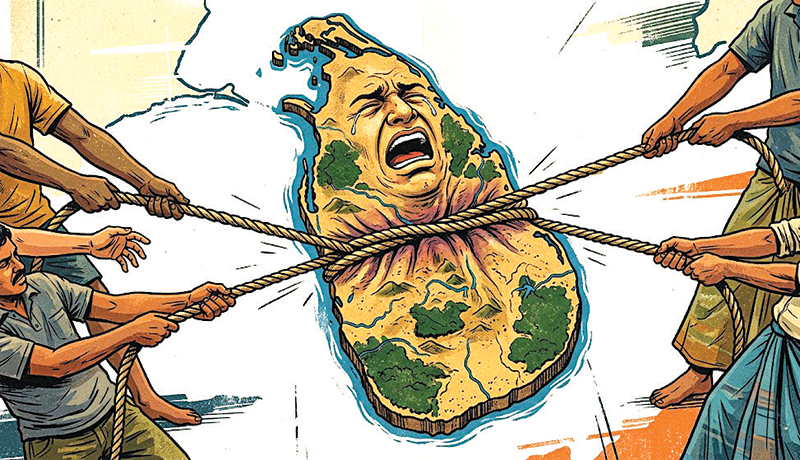
On the 4th of February every year, we raise the lion flag and speak of democracy. We speak of 78 years of “self-rule.” But honesty demands we ask: what kind of rule have we actually had? It was not democracy. Democracy is government for the common good, constrained by law, informed by reason, and accountable to truth.
What Sri Lanka has had for 78 years is demagoguery — government by manipulation, by party, and by passion.
Defining the Curse:
The dictionary defines demagoguery as “political activity that seeks support by appealing to the desires and prejudices of ordinary people rather than by rational argument.” Its tools are simple: divide the people, promise the impossible, demonize the opponent, and govern for the next election, not the next generation. That is the political culture we inherited in 1948 and perfected since.
78 Years of Evidence:
The record is not ambiguous. Policy by Pendulum – 1948–2024. Instead of a national development plan, we got a partisan wrecking ball. 1956: The “Sinhala Only Act” was passed not after linguistic study, but as an election mobilization tool. 1970-77: The SLFP nationalized private enterprise and imposed import controls. 1977: The UNP reversed course with an open economy overnight. 2005-2014: Mega infrastructure was built on Chinese loans with no feasibility transparency. 2015-2019: Those same projects were called “white elephants” and stalled. 2020-2021: The organic fertilizer ban was announced as a populist “green” policy, reversed 6 months later after it collapsed agriculture and food prices. The Colombo Port City, Hambantota Port, and the Central Expressway all followed the same pattern: started, stopped, rebranded. The country pays twice. The party takes credit once. Economics as Election Candy. Demagoguery is expensive. 1960s: Subsidized rice to win rural votes, leading to the 1971 food crisis.
2005-2014:
Fuel subsidies and public sector hiring sprees that doubled the wage bill. 2019:
Unfunded tax cuts that removed Rs. 500 billion in annual revenue with no offset. By April 2022, external debt hit $51 Billion and we defaulted for the first time. The party that cut taxes was not in power to manage the IMF program. The party that inherited it was blamed for the austerity. This is the cycle. Institutions captured. A democracy needs referees. We turned them into party cadres. The 17th Amendment 2001 created independent commissions. The 18th Amendment 2010 abolished them. The 19th 2015 restored them. The 20th 2020 gutted them again. Police transfers, university vice-chancellors, and state bank chairmen have all been decided by party headquarters, not merit.
When the institution serves the party, the citizen gets leftovers.
Identity over Ideas: From 1956 to 1983 to 2009 to 2022, our elections have been won on fear, not spreadsheets. “They will erase your language.” “They will sell the country.” “Only we can protect Buddhism/the minorities/the nation.”
Rational debate on debt, productivity, or climate adaptation never wins a rally. Prejudice does. That is demagoguery by definition.
Party Interest subverted the National Interest. The core damage of 78 years of partisan politics is this: the nation became secondary to the party. Need power sector reform? Impossible, because our unions will strike. Need to cut 300,000 ghost employees? Impossible, because our voters will defect. Need a 20-year education and export plan? Impossible, because it won’t show results before the next election. So, we borrowed. We patched. We lied. The result: a railway system that still runs on 1950s engines, hospitals without paracetamol in 2022, and a brain drain of 300,000+ skilled workers since the crisis. The parties rotated. The country declined.
The Opposition’s Original Sin and here, all parties share guilt equally. In opposition, the job is not to govern. It is to destroy. The UNP in the 60s called the SLFP “communist.” The SLFP in the 70s called the UNP “imperialist.” The JVP called both “traitors.” The SJB, SLPP, and NPP today use the same script with new logos. Every tax is “anti-people.” Every reform is “a sell-out.” Every crisis is proof the other side is evil and must be removed at any cost. Then they win. And implement 80% of what they opposed. Because demagoguery has no principles, only positions. 78 years of unmerciful, bad-faith criticism has not produced accountability. It has produced cynicism. The public now believes all politicians are the same — because for 78 years, they have behaved the same.
Breaking the Curse:
Changing the party in power will not end this. We must change the incentives that reward demagoguery. Three reforms are non-negotiable: Bind future Parliaments to national policy. Pass 10-year frameworks for energy, education, and public debt with 2/3 majority protection. Infrastructure and fiscal rules should outlast one government, as they do in Chile and New Zealand. Depoliticize the state. Independent commissions for police, elections, public service, and bribery must have constitutional budgets and appointment panels that exclude MPs. No more 18th/20th Amendment style rollbacks. Demand better from voters We must stop rewarding the best slogan and start demanding the best spreadsheet. Town halls over rallies. Costings over promises. A 5-year plan over a 5-minute speech.
In 1948, we did not inherit democracy. We inherited an election. For 78 years we have used that election to choose our favourite demagogue. The prize has been debt, division, and decay. The curse of partisan politics will only end when citizens and leaders agree on one principle: Party second. Country first. Until then, February 4th will remain a ceremony, not a celebration.
Export diversification – Missing the wood for the trees – Part II
by Gomi Senadhira
Sri Lanka established its diplomatic presence in the Gulf region only in the early 1980s. First, a small embassy was opened in Abu Dhabi, covering the UAE. Then in 1982, embassies were opened in Jeddah and Kuwait. The embassy in Jeddah covered Saudi Arabia while Kuwait was responsible for Kuwait, Oman, Qatar and Bahrain. Commercial Diplomats were also assigned to these two embassies. A senior private sector executive, with experience in marketing, was posted to Jedda as the commercial counsellor. I was posted to Kuwait as a second secretary (Commercial). Our instructions were very clear. Focus not only on traditional exports. Product diversification was a priority.
Developing Markets for Agricultural Products
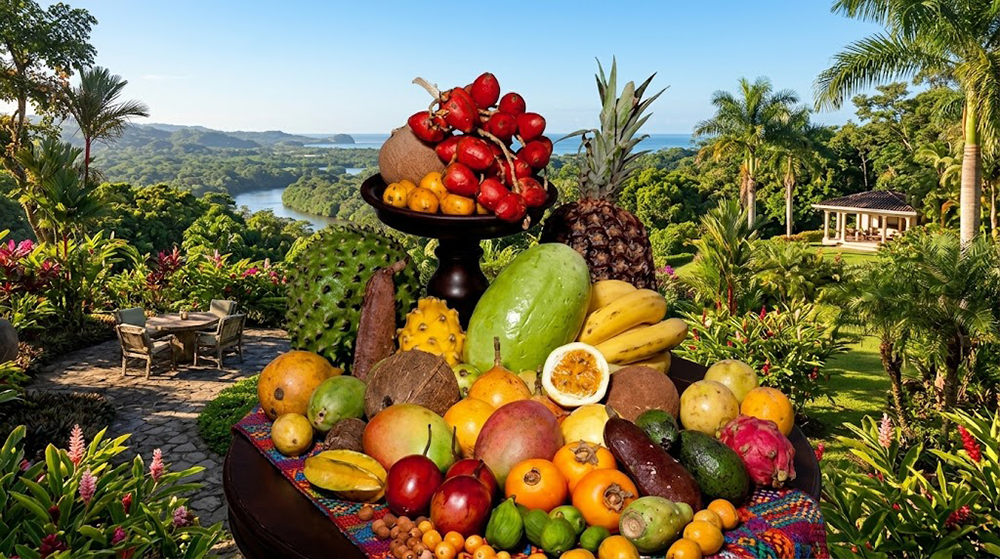
At that time, Minister Lalith Athulathmudali had just launched his Export Production Villages (EPV) programme. He believed that the EPVs working closely with the exporters would provide an ideal opportunity for rural households to directly benefit from the government’s new open trade policy. Agricultural products, particularly fruits and vegetables, were a key component of this approach and the ministry thought that the Gulf countries, with large Sri Lankan communities, would have a ready-made market for these items. Thus, from day one we were compelled to explore the market for nontraditional exports; fruits and vegetables (F&Vs) were on the top of our priority list.
From cane baskets to cardboard boxes
Fortunately, the market for the F&Vs products in the region was at a very early stage of development. That provided an opportunity for Sri Lankan exporters, who were also inexperienced, to work with the importers and grow together. For example, in Kuwait, one of our first customers for F&Vs was a small supermarket where the manager was a Sri Lankan. After the first shipment arrived, he invited me to inspect the shipment. I visited the supermarket and was shocked by what I saw. While produce from other countries was packed nicely in cardboard boxes, our packaging mirrored transport to Manning market, cane baskets! As a result, fresh produce had suffered significant damage. A long report, with photographs, to the trade ministry produced an immediate response. After all, this was a pet project of the Minister. Within weeks, shipments were packed in cardboard boxes. Immediately afterwards, an expert on packaging from the Commonwealth Secretariat was sent to Kuwait with an official from the EDB to study the problem.
By then, we had also managed to develop a friendship with the management of the Salmiya supermarket, a large upmarket supermarket patronised by wealthy Kuwaitis and expats. It was a cooperative and the chairman was a Kuwaiti public servant. I could only meet him after 6 PM when his large office functioned as a diwaniya, a cherished cultural space in Kuwaiti society. Guests moved in and out the room. I had to spend time with them sipping many cups of tea. Though that meant at least two hours on each visit, it helped greatly to develop a close relationship. The general manager was an efficient and friendly Palestinian. After many visits we had succeeded in getting an order for F&Vs. The day after the first shipment arrived, I got an urgent call from the GM to come and inspect it. Once again, I was in for a surprise. Inside the cold room, the consignments from other countries were stacked neatly on top of each other, while vegetable boxes from Sri Lanka had collapsed once placed on top of each other, crushing the produce within.
Fortunately, our packaging experts arrived in Kuwait soon after this incident. They spent two days in the Salmiya Supermarket, studying the packaging from other origins. We were also successful in assuring the GM our packaging would improve. After that, packaging improved and exports moved smoothly. With that, Sri Lanka emerged as a small but reliable supplier to the mainstream market, not just the ethnic segment of the market.
Export of Fresh Vegetables by Sea
Towards the end of my tour, a Sri Lankan businessman requested me to find a buyer for cabbages, which he was prepared to export in large quantities by sea. I introduced him to the largest fruit and vegetable importer in Kuwait. Their regular suppliers of similar vegetables were Jordan, Lebanon and Syria. Luckily, the company was keen to diversify the supply sources. A few weeks later, the first container load of cabbages from Sri Lanka arrived in Kuwait. Immediately after the arrival of the container, I visited the company. They were pleased with the quality and the price and were looking forward to importing more fruits and vegetables. Unfortunately, that turned out to be a one-off event. Later on, when I was back in Sri Lanka, the exporter informed me that he couldn’t continue with it due to the problems with the local supply chains.
Floriculture
During the period I was asked by the EDB to explore the market for floricultural products, more particularly for cut flowers. At that time Kuwait was a relatively large importer of cut flowers and live plants. The main suppliers were the Netherlands and Colombia. Importers were also reluctant to move out of the established supply chain, particularly due to “snob value” associated with the product from Europe. However, after some difficulties, one importer agreed to place a pre-paid trial order. After the arrival of that shipment, he was impressed by the quality of the product and the orders expanded rapidly. As a result, by the end of 1985 Kuwait had become a major buyer of Sri Lanka’s floricultural products.
From village to global markets
As a result of the proactive promotional work undertaken by the EDB and the embassies in the region, by 1985, Sri Lanka had managed to acquire a small but significant share of the F&V and floriculture markets in the GCC countries. We had also identified domestic supply chain issues that hindered exports. All that was done, long before Southeast Asian or African countries even entered into that market. In fact, my Southeast Asian colleagues used to contact me often to reserve “durian” for them at the “Sri Lankan supermarket”.
Most importantly, a substantially large share of produce from Sri Lanka in Kuwaiti supermarkets originated in the EPVs. Of course, that didn’t just happen. The ministry (or the minister) using the carrot and stick approach “encouraged” exporters to buy the produce directly from the newly established EPVs. (The writer can be reached at senadhiragomi@gmail.com)

Prime Minister of Sri Lanka holds a bilateral meeting with Minister for Education and Skills Development of Bhutan

Prime Minister Meets His Majesty the King of Bhutan

Kusal Mendis, Binura Fernando ruled out of T20I series in England

SLPP MP Namal Rajapaksa arrested by CIABOC

Devapathiraja clinch U15 Division I title with 33-run win over Royal

Mandhana’s record ton powers India into semi-finals

‘Dates have the highest sugar content to fight Coronavirus’

Sunday Island 27 December – Headlines

#SundayIsland 17th December – Headlines

Sunday Island – 28th March

Sunday Island Headlines – 21 March

Sunday Island – 21st February – Headlines
-

 Features6 days ago
“Wrap Me Up in My Blazer”— A Gentlemanly Bradby Reminiscence
-

 Features5 days ago
When Sri Lankan stories find their own voice
-
 Features6 days ago
JVP/NPP government as seen from outside by Lionel Bopage now domiciled in Australia
-
 News5 days ago
BASL takes exception to Justice Ganepola being denied a place in SC
-

 Editorial7 days ago
Govt. trying to dupe UN Rapporteur?
-
 Features6 days ago
Prof. Savitri Goonesekere: What has she done?
-

 News2 days ago
Denied of promotion to SC despite vacancies, justice Gurusinghe retires
-

 Latest News2 days ago
Grade 5 scholarship exam results released