
Features
From Villain to Unsung Hero

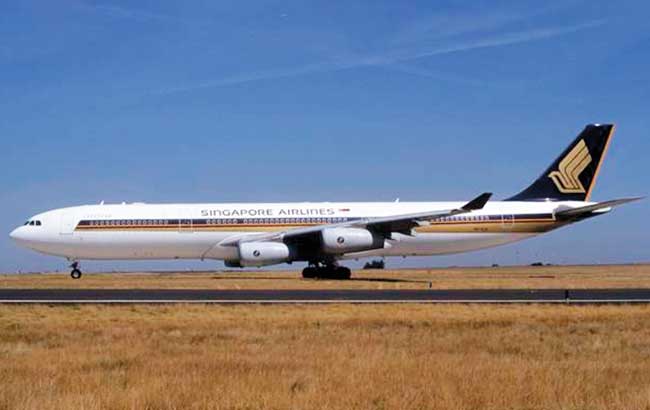
One winter morning in 1998, as a part of the SIA crew while planning a departure from Kimpo (Gimpo) International Airport Seoul South Korea, in our Airbus A 340 aircraft, we realised that it had snowed all night and the runway surface was ‘contaminated’ with melting snow (Slush). We had been told time and time again by the performance experts that a depth of snow, slush or standing water more than 3mm (1/8th of an inch), the proverbial SriLankan Baas’s ‘Noola’, on more than 25% of the Runway, it is considered to be contaminated. The Kimpo Airport Authorities hadn’t cleaned the runway surface like in most other airports.
A contaminated runway poses a whole host of problems for pilots attempting to take-off. Because of the natural resistance of the water, snow or both on the runway in varying degrees and depths, the acceleration to the take-off speed becomes slow as the wheels have to displace the contaminants using up a greater amount of runway length than on an uncontaminated (dry) runway. This leaves less runway length available for the aircraft to stop, if for some unforeseen reason the pilots need to abandon the take-off. Then stopping becomes a problem as the tyres may skid or aquaplane, making the wheel brakes ineffective with a good chance of over running the runway length available.
 In this day and age, to reduce the thermal and mechanical stresses to the jet aircraft engines it was recommended by the manufacturer that pilots use a reduced thrust setting on uncontaminated (dry) runways, for take-off. Therefore, it was mandated that on a contaminated runway, full thrust is used to enable the aircraft to accelerate quicker to the speed (V1) at which the Captain will have to decide whether he will stop or go. Every type of aircraft is tested in snow, slush or standing water, the spray patterns studied and a set of lower V1 speeds for slush operations are available for different take-off weights in graphs or in tabulated form for quick reference. At V1 speed, if the Captain decides to continue the take-off it becomes a ‘non-event’. However, if he decides to stop for any reason, it becomes regimented and exiting as he has got to announce to the First Officer that he is discontinuing the take-off, apply brakes, close the engine Throttles, keep the aircraft straight on the centre line (that may not be visible), deploy spoilers and Reverse Thrust bringing the aircraft to a stop and cancelling Reverse and spoilers at the appropriate time. The non-flying pilot notes the air speed at which the Captain rejected and announces to the Control Tower that they have abandoned the take-off and then monitors the deceleration, providing a back up to the Captain’s actions. These are standard Operating Procedures (SOP’S) evolve through the years. Noting the speed at which they rejected the take-off is necessary when it comes to brake cooling time after rejecting a take-off. The brakes in the old days became white hot with its use at high speed. With the use of Carbon brakes and integral cooling fans the problem is resolved to a large extent.
In the present day in all the modern airliners braking is done automatically using ‘Auto Brakes’ with anti- skid devices operating and this exercise (Rejected Take off) is practiced in the Simulator every six months as a team exercise under the supervision of a Flight Instructor. As a further consideration, the manufacturer Boeing’s analysis of all the past rejected take-off accidents have also shown that if the Captain was two seconds too slow in rejecting the take-off at the decision speed of V1, the aircraft will exit the runway at the other end at 60kt! So, their recommendation was to be ‘go minded’ at V1 and not attempt to stop. The reader will agree that a lot of things happening and judgemental considerations going through the Captain’s mind simultaneously while on the take-off run.(what if)
Usually on take-off on an uncontaminated runway it was a legal requirement to be at a height of 35 feet over the end of the runway. On a contaminated runway the aircraft is allowed to clear the end at 15 feet to accommodate the loss of performance. In addition to all this, in jet aircraft, it is recommended to have the continuous ignition ‘on’ to ensure that the engines do not flameout (fail) due to slush ingestion by the engine intakes. Fortunately, it wasn’t snowing that day in Kimpo and therefore did not pose a problem with ice on the wings which would have created another problem for us as the wings are meant to be clean on take-off. These Standard Operating Procedures (SOPs) are all contained in the Flight Manual of any particular type of aircraft and expected to be read and understood by its Crew.
 That morning the take-off at Kimpo went off like clockwork. As everything appeared to be normal there was no need to abandon the take-off and after getting airborne, we had to concentrate on other important things like a sharp turn left before reaching the DMZ (De Militarised Zone) and avoiding overflying the South Korean President’s Palace which was a known prohibited area. They would fire two tracer shells. If no action was taken to change course and avoid, they will attempt to shoot you out of the skies, passengers or no passengers!
All in all, tackling a contaminated runway in modern times became a ‘piece of cake’ if one knew what to do. These procedures were not promulgated overnight. They were the result of ‘blood sweat and tears’ through the years. The story below is a good example.
In 1949 there was an accidental overrun of the runway of a Trans Canada Airlines (TCA) aircraft in Vancouver, Canada. The Investigators declared that the probable cause was the presence of slush (melting snow) on the runway preventing acceleration to the required speed for take-off. This observation was intimated to many airlines including British European Airlines (BEA) authorities who had not taken any cognizance and duly filed the letter without advising their operating crews of such possibilities.
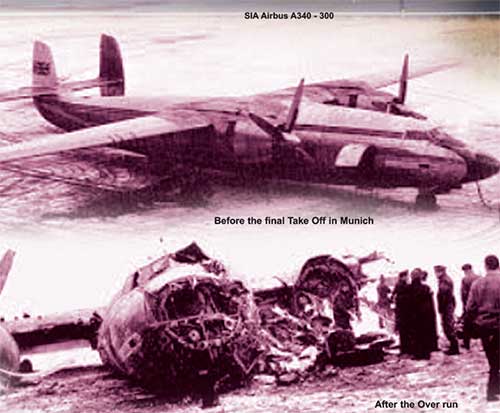
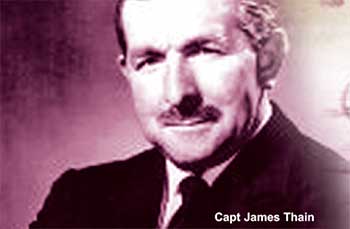
Nine years later, on 6th Feb 1958, Capt James Thain and Capt Kenneth Rayment were operating a BEA charter flight from Belgrade Yugoslavia to London with the Manchester United Football Team and some well-known sports writers as their passengers. Both pilots were good friends and had served in the RAF together during WWII. Usually there would have been a regular First officer but since both captains had common interests like poultry farming, they had requested to operate together. The young Manchester United team known as ‘Busby Babes’ were well on their way to be European Cup Champions. Since the Airspeed Ambassador ‘Elizabethan’ aircraft did not have sufficient range to fly direct to London, they needed to do a Technical (refuelling) stop in Munich, Germany. The flight was uneventful till they reached Munich.
The Runway was contaminated with melting snow in Munich. Light snow was falling on the wings. Due to the fact that anti-ice heaters were used on the descent into Munich Airport, Capt. Thain decided not to get the wings cleaned. It was a judgment call.
After refuelling the crew attempted to take-off twice, but had to discontinue due to an engine malfunction. Then they taxied back to the ramp for a consultation with the Ground Engineer, after which the two captains decided to open power slowly to fix the engine problem which was known to occur in Munich which was over 1700 feet above mean sea level. On the third attempt the power was opened slowly and that involved a longer take off run which took the aircraft to a more contaminated unused part of the runway which actually made the aircraft lose speed from 117 knots to 105 knots and never accelerated to flying speed. Capt Thain was looking inside the cockpit and carefully ‘nursing’ the engines and monitoring the speed while Captain Rayment was handling the controls. When he looked outside the runway end was closing in quickly and it was too late. He opened throttles to the maximum. The wheels never left the ground because it didn’t have flying speed. The aircraft over ran and crashed through a fence, hit a tree and a house and burst into flames. The crash killed 23 out of the 44 passengers and crew on board, critically injuring Capt Kenneth Rayment, He passed away a few days later, leaving Capt Thain to carry the blame alone. With that, destroying the chances of Manchester United being European champions.
The German Accident investigator Capt. Hans J Reichel and his team arrived from Brunswick, West Germany, ill-equipped, about six hours later. By this time the weather had worsened and it was night time. He had to borrow lighting equipment from the BBC photo crew present at the site, He had been a pilot both in the Luftwaffe and Lufthansa the German Airline. The first thing he did was to check for wing ice and found a six-hour build-up of snow and declared that there was ice on the wings before take-off. No proper measurements of the depth of the slush were done on the runway at Munich. A parallel UK investigation was also launched. The formal accident inquiry commenced on 29th Apri’58 and was protracted and didn’t consider the effect of slush at all. The ‘Brits’ virtually fell in line with their German counterparts. The Final Accident Report came out on 9th March 1959, (More than a year after the crash), blaming the ice build-up on the wings and Capt Thain’s failure to de-ice.
It saidL:
 “Apart from the ice, we couldn’t find any other reason which could have contributed to the air crash “
Capt Thain’s licence was suspended and he reverted to full time poultry farming while relentlessly working with the British Air Line Pilots Association (BALPA) to obtain more research data on the effects of slush on Take-off performance.
In 1961 Capt. Thain was fired from his job of BEA for allowing Capt Rayment to sit in the Left hand seat while he as designated Captain on the roster sat on the Right hand seat. The Captain on the roster should have sat on the Left hand seat and thus it was purported that he had violated the existing BEA Flight Crew Standing Orders which in itself a relatively minor matter. Looking back, it probably was just an excuse to shed him as this WWII veteran and BEA Captain ended up being an embarrassment to the Airline. There was no doubt about his ‘unquestionable ability’ up to that time of the accident. In the eyes of the general public and Football fans he was considered a villain.
If the German Accident Investigators blamed the Slush on the Runway for the overrun then the Munich Airport Authorities would have to take the rap for not cleaning the runway surface. It was rather obvious that like in most accidents it is convenient and emotionally satisfying to blame an individual and not the system that gave rise to the unsafe situation. Capt. Thain did not give up trying to clear his name. He was determined to find out the real cause of the accident. He appealed.
Seven months after the crash in September 1958 the FAA started conducting practical tests on the impact of slush on aircraft acceleration for take-off. Although there was new scientific evidence available, the Germans were not keen on reopening the case and Capt. Thain was languishing in guilt. Capt. Thain kept the pressure on. Eventually in 1967 Prime Minister Harold Wilson mentioned publicly, that Capt. Thain was a “victim of injustices.” Soon after (1968) the British were also conducting experiments with slush on the runway at Royal Aircraft Establishment (RAE) in Bedford in shallow ponds of standing water, using Canberra, Viscount and Ambassador Aircraft. The significant adverse effects of slush on the Runway were confirmed.
Finally, Capt. Thain’s persistence paid off and his plight was mentioned in Parliament and the British Authorities agreed to review the investigation and found that the German investigation was incomplete. The Investigators had not interviewed many witnesses including the Air Traffic Controllers and those who reached the wreck first and could have given evidence to say that there was no ice on the wings immediately before the crash. It seemed that witnesses had been selectively interviewed to fit the ‘probable cause’.
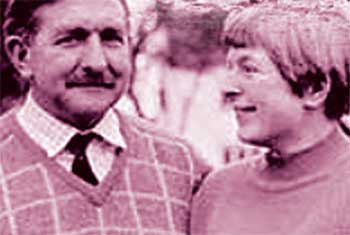 Eleven long years after the crash in March 1969 Capt. James Thain was finally exonerated, but died soon afterwards of a heart attack at a relatively young age of 54, due to trauma and stress. This prompted one of the ‘wags’ in the BALPA to declare that “If the crash doesn’t kill you, the inquiry will”
Capt. James Thain with his determination to find the real culprit of the Munich accident made taking off in slush safer for airline pilots, by triggering off research on both sides of the Atlantic that evolved into SOP’s which allowed us to take off safely from Kimpo that wintry morning.
In his own words, to his daughter, “The difference between the possible and impossible is merely a measure of man’s determination”
To me, Capt. James Thain was an unsung hero whose great determination to prove his innocence made flying safer for the future air travellers.






Tales of Mystery and Suspense 2
A very different sort of murder mystery today, one of the few intended to provide laughter too. Written in the thirties, it deals with a murder during a ballet, its title being A Bullet at the Ballet. It was a collaborative effort by Caryl Brahms and S J Simon, to whom I was introduced nearly half a century ago by Robert Scoble, the friend with whom I have discussed and shared books more than with anyone else.
Brahms was a ballet critic whose parents were Jews who had emigrated to Britain from Turkey while Simon was born in Manchuria in 1904 to a White Russian Jewish family, and then ended up in England, where he was renowned as an expert on bridge.
Having been fellow lodgers in London, they wrote together for newspapers and then tried out a novel. A Bullet in the Ballet, published in 1937, was an instant success, and over the next few years they published a couple of sequels, involving the Ballet Stroganoff, and the detective Adam Quill, who was tasked with investigating the first murder.
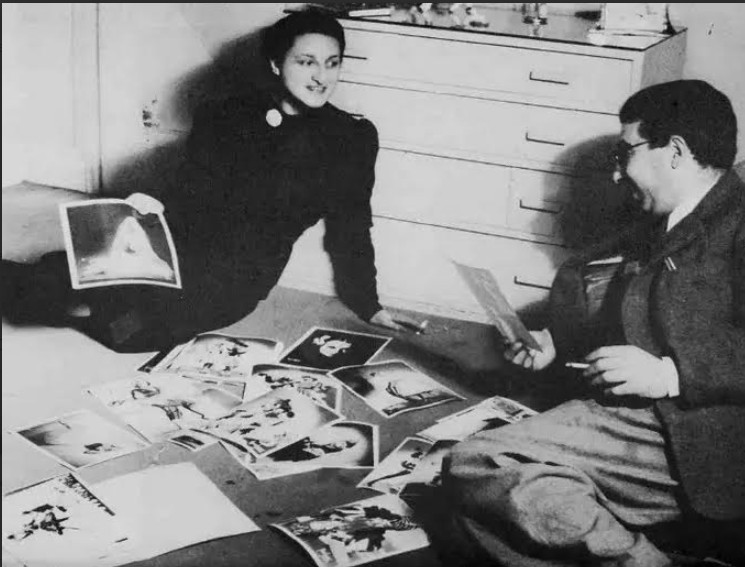
Brahms and Simon
In Robert’s Books and other reading around the world, published by Godage & Bros a few years back, I mentioned the first of these and also what then entertained me most, when I read these books in his luxurious flat in Chidlom Place in Bangkok, No Bed for Bacon, a romp through the days of Queen Elizabeth. Historical absurdities were their other forte, but in this series, I will confine myself to the three books that feature Quill, and the gloriously dotty Ballet Stroganoff.
It is owned by the impresario Vladimir Stroganoff, whose motley crew includes the once renowned ballerina Arenskaya, who is now his trainer, and the avant garde composer Nicolas Nevajno, who wants anyone, as he meets them, ‘to schange me small scheque’. The dancers are less memorable, except that two of them are the murder victims, both when dancing the title role in ‘Petroushka’. Neither Anton Palook nor Pavel Bunia was especially popular, and Quill was on the point of arresting the latter for the murder of the former when, having put it off at Stroganoff’s request so that he could dance the title role, the suspect was killed in the course of the ballet.
Both before and after the second murder, Quill is confronted with multiple motives, multiple means and multiple opportunities, to cite the formula in the Detective’s Handbook he has studied. Palook for instance had affairs with lots of girls but had recently taken up with the homosexual Pavel, whose lover, his dresser Serge Appelsinne, was profoundly jealous. The young dancers who performed brilliantly in the final performance of Petroushka, with which the novel ends, were also involved, in that Palook had been friendly towards Kasha Ranevsky, making Pavel jealous; and the ballerina Rubinska, involved with Palook, had tried to wean him away from Pavel, an appeal Pavel may have heard, after which she met Palook again just before he died, and he had said he was sick of being chased since his affairs were never lasting.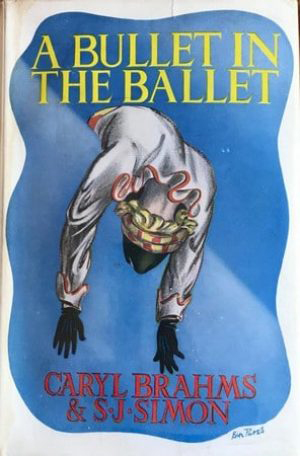
Preposterous intricacies one might have thought, had I not come across similar exchanges when we hosted the London City Ballet in Sri Lanka in 1985 on a British Council tour. Brahms and Simon simply push everything well over the top, with the characters pursuing their own obsessions without reference to the predilections, let alone the obsessions, of the others, all of which makes for high drama at a cracking pace.
But in dwelling at length on the plot of this first Brahms and Simon novel, I have omitted what perhaps provides the most zest to the plot, the constant bickering between Stroganoff and his orchestra, his efforts to avoid his relentlessly talkative Secretary, the endless stream of catch phrases, such as the Wiskyansoda Stroganoff offers his visitors, only to find there is none, just Russian tea, or the vigilant mothers determined to bag the best roles for their daughters.
Then there is Arenskaya, who flirts with the incredibly handsome Quill, and turns out to have had an affair years back with his boss, the usually grumpy Snarl, who softens surprisingly when he comes to a performance. And her husband, Puthyk, who was not at all jealous it seemed of her having had an affair with Palook, reminisces endlessly of his own wonderful performances in the past, though now at most he can only be used in crowd scenes.
Quill – and the ubiquitous press – meanwhile discover that a third Petroushka had died while playing the role, in Paris, before the two deaths in London. He had been found dead in his dressing room, and suicide had been the verdict, but now it was assumed that he too had been murdered, and there was thought to be a jinx on anyone dancing the title role. But Stroganoff was determined to go ahead with the gala performance he had planned, for which he hoped Benois, who had been involved in the original production with Njinsky, would come.
Though it was increasingly clear Benois would not appear, with tickets selling like hot cakes, in anticipation of a death, there was no way Stroganoff would cancel the performance. And his great rival Lord Buttonhooke, the newspaper proprietor, who it was rumoured wanted to start a ballet and had persuaded Palook to come over to him, had headlines about another murder all ready as the curtain rose.
Rubinskaya had earlier begged Quill to arrest Ranevsky, who was to dance the roll, as the only way of saving him, but there is no reason to do this, and so the performance does happen, with inspired performances by both of them. And, so, the murderer, who could not bear to have the role traduced, refrains from killing Ranevsky, and confesses to the earlier crimes. ‘Lord Buttonhooke strode from the theatre, a disappointed man’.
But that is not the end, for there is an epilogue in which Stroganoff writes to Quill to plead for kindness to ‘not an assassin, but an artist, that you have put in that pretty home in Sussex’. The letter has other elements that take up themes from the book, such as a new ballet by Nevajno, with ‘a scene where the corps de ballet is shot with a machine-gun. London will be shaken.’ And he will not tell Kasha and Rubinska that they dance better every day ‘lest their mother ask for bigger contracts’.
It was no wonder that the book was a triumph. The ballet scenes, if brilliantly exaggerated, did create a sense of how such spectacles were created, the murder mystery was full of suspense with the two deaths – and the discovery of another, treated earlier as suicide – well paced, and the climax when the ballet ends without another murder was gripping.
LEST WE FORGET – IV
Dag Hjalmar Agne Carl Hammarskjöld
(‘DH’ for short) was appointed Secretary-General of the United Nations in April 1953, when he was 47 years old. He was a member of an aristocratic Swedish family, a diplomat and reformer, in whom the Western world and United States of America had faith to do the ‘right’ thing. His mission was to prevent minor skirmishes among countries from escalating into a third World War. In short, his role was to implement the UN Charter (Peace, Security, Development and Human Rights).
The Korean War was just ending, and the Cuban situation (1956 to 1958) occurred during his watch. The Vietnam North/South conflict had also commenced in 1955. So did the Suez crisis in 1956. By 1960 another crisis had occurred in the Congo. He applied himself with religious zeal, sometimes trusting his conscience, judgement and personal commitment to maintain the UN’s integrity during the Cold War. As a result, he was not too popular with the US, the UK and Russia, which at one point wanted him to resign. By now DH was serving a second term as Secretary-General.
In the Congo, mineral-rich Katanga province wanted self-rule with Moïse Tshombe as its head, while highly paid white mercenaries (dogs of war?) ran his military. Thus, with this situation creating a civil war, things were going from bad to worse. By now UN troops were fully involved in ‘peace keeping’ in the Congo. DH had made three trips to Congo before, and his fourth trip, on September 13, 1961, was to include a visit to Katanga for a meeting with Tshombe in the hope of negotiating for peace. His first destination was Leopoldville, now known as Kinshasa, the capital of the Democratic Republic of Congo (DRC). There, he spent about four days before flying to Ndola in Northern Rhodesia, the country now known as Zambia. Ndola was situated at the Katanga border.
The flight took off from Leopoldville shortly after 3 pm on September 17. For security reasons, the flight was initially planned for another destination, then diverted to Ndola. The aircraft was a four-engine Douglas DC-6B, with ‘Aramco’ markings, Swedish registration SE-BDY, and named Albertina. With DH there were 15 other passengers and crew on board.
It was midnight when the aircraft overflew the Ndola airport, tracking towards a ground-based Non-Directional radio beacon (NDB) in the vicinity. To observers on the ground, everything about the aircraft looked ‘normal’. This was 1961, and it was still not mandatory to have a Flight Data Recorder (FDR) and Cockpit Voice Recorder (CVR) – collectively known as the ‘Black Box’ – installed onboard. The air traffic control tower had neither radar nor voice-recording facilities.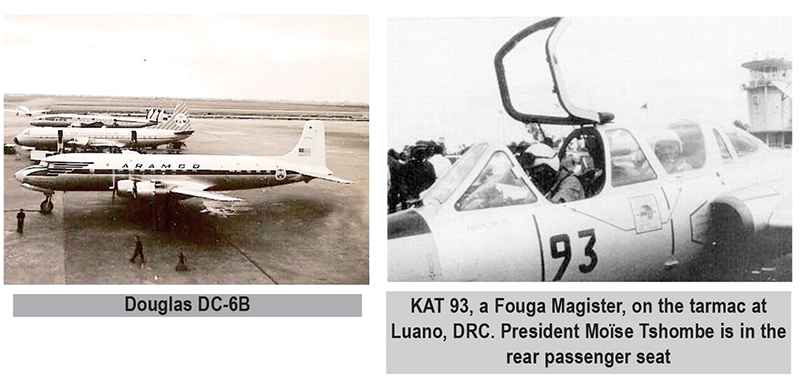
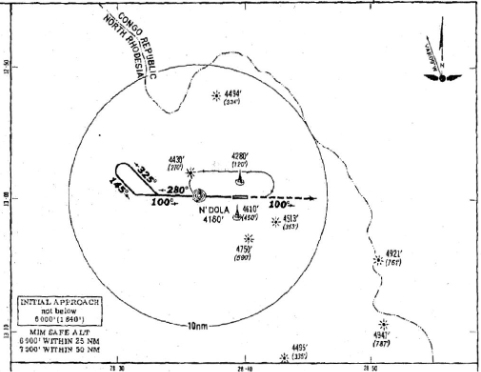
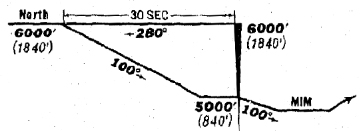
The navigational equipment on the DC-6 was primitive by today’s standards. A needle over a compass dial in the Automatic Direction Finder (ADF) pointed to the beacon which was located close to the final approach. The ‘modus operandi’ was to fly past the beacon (which is at a known position relative to the airport). Pilots know they have flown past the beacon when the ADF needle swings around from pointing toward the nose of the aircraft to the tail. From overhead that Ndola NDB the aircraft is expected to fly on a heading of 280 degrees for 30 seconds, then carry out a course reversal, known as a ‘procedure turn’, offset to the right at 45 degrees (heading of 325 degrees) and flown for precisely 60 seconds, after which another turn is made to the reciprocal direction, in this case 145 degrees, back to intercept the extended centreline of the runway, with a bearing of 100 degrees to the NDB and the runway beyond. All this while descending to a minimum altitude of 5,000ft, as dictated by a landing chart for the airfield approved by the operating airline and local civil aviation authority. (See Chart 1 and 2)
In Chart 1, the significant high ground is only indicated to the north and south of the runway. There is no significant high ground to the west. Because pilots don’t know the exact distance from the airport, an acceptable technique used was ‘dive and drive’. Consequently, Albertina flew over Ndola at 6,000 ft or lower, and when turning ‘beacon inbound’ the pilots asked for a lower altitude of 5,000 ft to descend and maintain. While on descent, the DC-6 impacted unmarked high ground at 13 minutes past midnight, when only 9 miles from the airport.
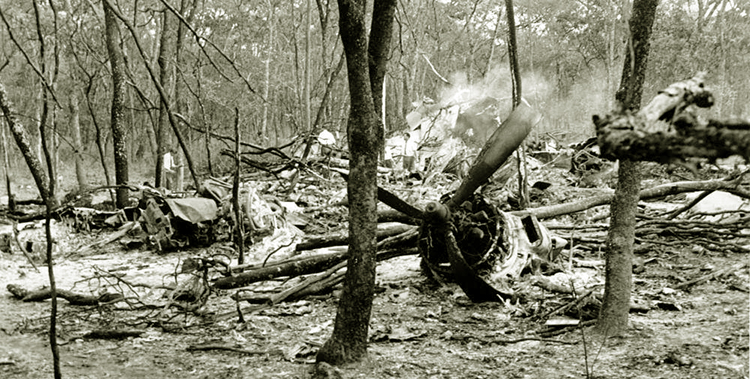
Meanwhile in Ndola, a welcoming party awaited, consisting of Lord Alport, British High Commissioner to the Federation of Rhodesia and Nyasaland, Moïse Tshombe, the Katangese separatist leader, who had been brought in from Congo for talks with DH, and many others. They waited at the airport until shortly after 3 am, when the runway was closed and landing lights were turned off. Strangely, the air traffic control staff in the tower did not observe fire or noise of the crash and assumed that the aircraft had diverted to another airport. (See Image Wreckage)
The impact with trees occurred at a height of 4,357 ft above sea level, slightly left of the extended centreline of the runway. The aircraft should have been at least at 5,000 ft above sea level, as required by the approved landing chart. Significant high ground west of the airfield was not indicated in that chart.
The wreckage was found later in the afternoon of September 18, in the jungle, with over 80% of the airplane destroyed by fire. Although 14 passengers and crew were burnt beyond recognition, one bodyguard, Sergeant Harold Julien, survived for six days before dying in hospital. DH’s unburnt dead body was discovered with grass on his hands, propped up by an anthill and a playing card, the Ace of Spades, under his collar! The first UN officer to arrive at the crash site, Major General Bjørn Egge, a Norwegian, observed that there was a clean bullet hole in DH’s head that was covered up during the postmortem. So, did DH survive the crash to be killed afterward?
In the 24 hours preceding the crash, two of the three crew members had been on duty continuously for 17 hours, while the handling pilot’s duty time was within limits. The Rhodesian accident investigation team that conducted the inquiry declared it was ‘pilot error’. The following day, former US President Harry Truman, who was a confidant of incumbent President John F. Kennedy said that “Hammarskjöld had been killed”. Of course, pilot error was the most convenient explanation, because dead men cannot defend themselves. Therefore, those findings were disputed as there can be reasons why the pilots were forced to fly low. In other words, the cause behind the cause needed to be found.
In one of two UN-authorised inquiries, the UN’s Deputy Spokesperson, Farhan Haq, said that “significant new information” had been submitted to the inquiry for this latest update. This included probable intercepts by the UN member states, of communications related to the crash; the capacity of Katanga’s armed forces, or others, to mount an attack on the DC-6, SE-BDY; and the involvement of foreign paramilitary or intelligence personnel in the area at the time. It also included additional new information relevant to the context and surrounding events of 1961.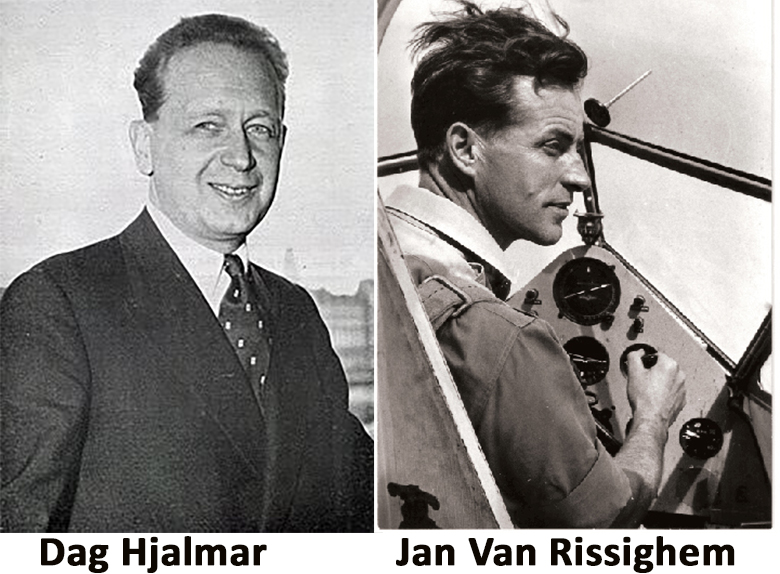
Additionally, in 1998 Archbishop Desmond Tutu, Chairman of South Africa’s Truth and Reconciliation Commission (TRC), stated that with regards to DH’s death in 1961, Britain’s MI5 (Military Intelligence, Section 5), the USA’s Central Intelligence Agency (CIA) and South African Intelligence were implicated in letters where information was withheld before by member nations of the UN.
One possibility was the planting of plastic explosives in the wheel bay of the DC-6 when it was on the ground in Leopoldville. Pieces of wreckage were not spread out over the jungle. The aircraft crashed in one piece, creating a swathe in the treeline. So, it could not have been an explosion.
Many Congolese natives, including ‘charcoal burners’ in the jungle, said that there was more than one aircraft in the sky that night. These reports were dismissed as unreliable by the original accident inquiry. It was possibly because in 1961 the Rhodesian authorities only accepted ‘white’ witnesses’ evidence. So, was the DC-6 shot down, and if so by whom?
A High Frequency (HF) radio listening station in Cyprus monitored a transmission of a highly decorated, ex-Royal Air Force World War II pilot, operating in the Congo as a mercenary with the nickname ‘Lone Ranger’, giving a running commentary while shooting a large passenger aircraft from his modified Fouga CM.170 Magister two-seat jet trainer airplane. The pilot, Jan Van Risseghem (from a Belgian father and English mother), may not have known whose aircraft he was shooting at. He was only told of the mission he needed to accomplish. Besides, he had a strong alibi set up by the Belgian State Security Service (VSSE), saying that he was nowhere in the vicinity. Documents released later confirmed that the alibi was pure fabrication. It is also said that the American Ambassador to the Congo sent a secret cable saying that Van Risseghem was the possible ‘attacker’! (See Images Jan Van and KAT 93)
Harold Julien, the sole survivor of the crash, stated from his hospital bed that the aircraft caught fire before it crashed. But his evidence was disregarded on the grounds that he was seriously ill and delirious before he succumbed to his injuries.
Then, Land Rovers being driven to and fro were observed by natives in the early morning of September 18. This led to speculation that the occupants were suspected French mercenaries attempting to reach the crash site and destroy any evidence of foul play before the official party arrived. Questions were also asked as to how the Ace of Spades (or Six of Spades) playing card ended up under DH’s collar?
Further reports mentioned a de Havilland Dove aircraft flying in the vicinity of the crash. Was it part of an attempt to bomb the DC-6 from a high altitude?
On the other hand, the DC-6 was making a very difficult approach and landing at night, with the possibility for pilots to be distracted by optical illusions. These have been identified and labeled as potential killers by scientists and aviation accident investigators in subsequent crashes. With no lights in the foreground, they would have lost sight of the natural horizon in the dark. Years later, this phenomenon was called a ‘Black Hole’. Did the captain attempt to do a visual approach into uncharted territory, while disregarding the radio navigational beacon landing aid, and collide into high ground, a type of accident described as a Controlled Flight into Terrain (CFIT)?
The verdict is still open
Today’s airliners, equipped with Inertial Navigation Systems (INS) and satellite-aided Global Positioning Systems (GPS), can be set up by the pilots to fly an Artificial Intelligence (AI) generated approach angle, independent of ground navigational facilities, to prevent this type of CFIT accident. Besides that, all turbine-powered aircraft carrying more than nine passengers must be equipped with a Ground Proximity Warning System (GPWS) as mandated by law.
Going even one better, there are enhanced radar displays to show the presence of high ground. Unfortunately, the DC-6 that the Secretary-General of the UN travelled in was powered by four piston engines.
It was said of Dag Hammarskjöld that he served as Secretary-General of the UN with the utmost courage and integrity from 1953 until his death in 1961, setting standards against which his successors continue to be measured.
He is the only Nobel Peace Prize Laureate to have been awarded the distinction posthumously.
God bless all secret service agencies of the world and no one else!
by GUWAN SEEYA

 Should Sri Lanka consider an 18th IMF programme? Some academicians exploring Sri Lanka’s development prospects in depth are raising this issue. It is yet to emerge as a hot topic among policy and decision-making circles in this country but common sense would sooner rather than later dictate that it be taken up for discussion by the wider public and a decision arrived at.
The issue of an 18th IMF programme was raised with some urgency locally by none other than Dr. Ganeshan Wignaraja,Visiting Senior Fellow, ODI Global London, one of whose presentations, made at the Regional Centre for Strategic Studies (RCSS), Colombo, was highlighted in this column last week, May 7th. An IMF programme is far from the ideal way out for a bankrupt country such as Sri Lanka but a policy of economic pragmatism would indicate that there is no other way out for Sri Lanka. Such a programme is the proverbial ‘Bird in the hand’ for Sri Lanka and it may be compelled to avail of it to get itself out of the morass of economic failures it is bogged down in currently.
While local economic growth possibilities are far from encouraging at present, such prospects globally are far from bright as well. Some of the more thought-provoking data in the latter regard were disclosed by Dr. Wignaraja. For example, ‘The IMF’s April 2026 World Economic Outlook projects global growth slowing to 3.1 percent in 2026; with downside risks dominating: prolonged conflict, geopolitical fragmentation, renewed trade tensions, bearing down hardest on emergent and developing economies.’
However, as is known, an ‘IMF bailout’ is fraught with huge risks for the people of a developing country. ‘The Silver Bullet’ brings hardships for the people usually and they would be required by their governments to increasingly ‘tighten their belts’ and brace for perhaps indefinite material hardships and discontent. For Sri Lanka, the cost of living is unsettlingly high and 20 percent of the population is languishing below the poverty line of $ 3.65 per day.
These statistics should help put the spotlight on the people of a country, who are theoretically the subjects and beneficiaries of development, and one of the main reasons, in so far as democracies are concerned, for the existence of governments. Placing people at the centre of the development process is urgently needed in the global South and shifting the focus to other considerations would be tantamount to governments dabbling in misplaced priorities.
Technocrats are needed for the propelling of economic growth but a Southern country’s main approach to development cannot be entirely technocratic in nature. The well being of the people and how it is affected by such growth strategies need to be prime focuses in discussions on development. Accordingly, discourses on how poverty alleviation could be facilitated need urgent initiation and perpetuation. There is no getting away from people’s empowerment.
In the South over the decades, the above themes have been, more or less, allowed to lapse in discussions on development. With economic liberalization and ‘market economics’ being allowed to eclipse development, correctly understood, people’s well being could be said to have been downplayed by Southern governments.
The development issues of Southern publics could be also said to have been compounded over the years as a result of the hemisphere lacking a single and effective ‘voice’ that could consistently and forcefully take up its questions with the global powers and institutions that matter. That is, the South lacks an all-embracing, umbrella organization that could bring together and muster the collective will of the South and work towards the realization of its best interests.
This columnist has time and again brought up the need for concerned Southern sections to explore the potential within the now virtually moribund Non-Aligned Movement to reactivate itself and fill the above lacuna in the South’s organizational and mobilization capability. In its heyday NAM not only possessed this institutional capability but had ample ‘voice power’ in the form of its founding fathers, with Jawaharlal Nehru of India, for example, proving a power to reckon with in this regard. The lack of such leaders at present needs to be factored in as well as accounting for the South’s lack of power and presence in the deliberative forums of the world that have a bearing on the hemisphere’s well being.
The Executive Director of the RCSS, Ambassador (Retd) Ravinatha Aryasinha, articulated some interesting thoughts on the above and related questions at a forum a couple of months back. Speaking at the launching of the book authored by Prof. Gamini Keerewella titled, ‘Reimagining International Relations from a Global South Perspective’, at the Bandaranaike Centre for International Studies, Colombo, Amb. Aryasinha said, among other things: ‘Historically, there is a precedent that has been realized by the Non-Aligned group of countries – unfortunately, rather than being reformed and modified at the end of the Cold War, it has been tossed away.’
The inability of the nominally existent NAM to come out of its state of veritable paralysis and voice and act in the name of the South in the current international crises lends credence to the view that the organization has allowed itself to be ‘tossed away.’ The challenge before NAM is to prove that it is by no means a spent force.
As indicated, NAM needs vibrant voices that could advocate value-based advancement for the global South. Moral principles need to triumph over Realpolitik. Such transformative changes could come to pass if there is a fresh meeting of enlightened minds within the South. Pakistan by offering to mediate in the ongoing conflict between the US and Iran, for instance, proved that there are still states within the South that could look beyond narrow self-interest and work towards some collective goals. Hopefully, Pakistan’s example will be emulated.
Along with Pakistan some Gulf states have shown willingness to work towards a de-escalation of the present hostilities in West Asia. This could be a beginning for the undertaking of more ambitious, collective projects by the South that have as their goals political solutions to current international crises. These developments prove that the South is not bereft of visionary thinking that could lay the basis for a measure of world peace. That is, there are grounds to be hopeful.
NAM needs to see it as its responsibility to make good use of these hopeful signs to bring the South together once again and work towards the realization of its founding principles, such as initiating value-based international politics and laying the basis for the collective economic betterment of Southern people.

Britain’s Health Secretary Streeting resigns as pressure on Starmer grows

National SME Strategy Framework 2026 is critical because it brings policy consistency and stability to the sector – PM

Giant new dinosaur identified from fossils in Thailand

Cuba says CIA chief visited Havana as energy crisis worsens

Showers about 150mm are likely at some places in the Western, Sabaragamuwa and North-western provinces and showers above 100mm are likely at some places in Galle and Matara districts

Tilak Varma, Shardul Thakur hand Punjab Kings fifth successive defeat

‘Dates have the highest sugar content to fight Coronavirus’

Sunday Island 27 December – Headlines

#SundayIsland 17th December – Headlines

Sunday Island – 28th March

Sunday Island Headlines – 21 March

Sunday Island – 21st February – Headlines
-

 News5 days ago
Lanka Port City officials to meet investors in Dubai
-

 News2 days ago
Ex-SriLankan CEO’s death: Controversy surrounds execution of bail bond
-

 News6 days ago
SLPP expresses concern over death of former SriLankan CEO
-
 News6 days ago
Police inform Fort Magistrate’s Court of finding ex-CEO of SriLankan dead under suspicious circumstances
-
 Features3 days ago
When University systems fail:Supreme Court’s landmark intervention in sexual harassment case
-
Features3 days ago
High Stakes in Pursuing corruption cases
-
 Midweek Review2 days ago
A victory that can never be forgotten
-

 News6 days ago
President of Vietnam and delegation departs Sri Lanka