
News
GMOA takes strong stand, urges Defence Consultative Committee to re-examine project

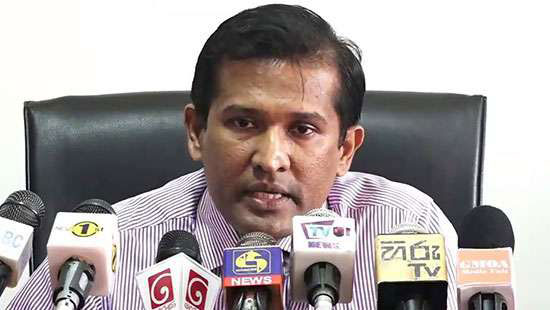
National Defence University Bill:
‘Uni outside purview of UGC, SLMC, etc., inimical to education system’
By Shamindra Ferdinando
Top Government Medical Officers’ Association (GMOA) spokesperson Dr. Prasad Colambage says the enactment of the General Sir John Kotelawela National Defence University Bill will create an institution outside the purview of the University Grants Commission (UGC) as well as the Sri Lanka Medical Council (SLMC). The proposed University wouldn’t be subject to regulatory bodies of engineering, law and public administration, Dr. Colambage asserts.
In a brief interview with The Island the GMOA official said that the controversial move was contrary to much touted assurances given by the Joint Opposition (JO)/Sri Lanka Podujana Peramuna (SLPP) in the run-up to the 2019 presidential and 2020 parliament elections. Referring to the failed bid to enact the Bill during the previous yahapalana administration, Dr. Colombage said that they were quite disappointed at the way the incumbent dispensation handled the issue at hand.
He strongly denied accusations that the GMOA was pursuing an agenda inimical to government efforts to expand higher education opportunities.
Responding to another query, Dr. Colambage attributed a last minute decision not to present the Bill in Parliament on July 08 to an obvious split in the ruling party. The Consultative Committee on Defence at a meeting chaired by State Minister of National Security and Disaster Management and State Minister of Home Affairs Chamal Rajapaksa was earlier scheduled to table the Bill in Parliament, Dr. Colambage said. Appreciating the decision not to present the Bill for the second reading , Dr. Colombage said that under the leadership of Vice President of the GMOA Dr. Chandika Epitakaduwa a committee was examining the Bill as well as the one prepared by the previous administration.
When The Island questioned the rationale in the GMOA’s opposition to the Bill against the backdrop of it being sanctioned by the Legal Draftsman and the Attorney General, Dr. Colambage said that the whole process in the enactment of laws was dubious. The GMOA official alleged that various interested parties had been pursuing agendas in that regard under the very noses of those who were supposed to ensure national interest. The possibility of some lawmakers being aparty to projects disadvantageous to the country couldn’t be ruled out, Dr. Colambage said.
“Yes, it is certainly a very unfortunate situation. A key issue is whether the Parliament can be exploited by those pursuing agendas for personal benefit,” Dr. Colombage said.
The GMOA official emphasised that the Bill in its present form was not acceptable under any circumstances. How could those in authority seek to establish an institution through parliamentary Act contrary to the Universities Act No 16 of 1978? Dr. Colombage asked.
The Communications Department of the Parliament on July 7 quoted Defence Secretary Gen. Kamal Gunaratne as having told Consultative Committee on Defence chaired by State Minister Chamal Rajapaksa the then President Maithripala Sirisena, in his capacity as the Defence Minister made an attempt to enact the Bill. SLFP leader and Polonnaruwa District MP Sirisena according to the Communications Department had been present at the meeting along with Anura Priyadarshana Yapa, Tiran Alles and Jayantha Weerasinghe, PC.
Dr. Colambage urged all political parties represented in Parliament to state their stand on the proposed Bill. The Parliament comprises 15 political parties with the SLPP being the largest with 145 seats followed by the SJB 54 and the TNA 10. Of the political parties in Parliament, nine are represented by one MP each.
Asked whether the GMOA intended to discuss the issue at hand with political parties, Dr. Colambage said that once Dr. Epitakaduwa made his report available within the next few days, stakeholders could be briefed. Parliament couldn’t absolve itself of the responsibility to thwart calculated attempts to deteriorate higher education sector, Dr Colambage alleged. The official stressed that their objections to the proposed Bill was not political. The primary issues here were that the Bill would result in the creation of a University managed by the military and selection of students outside the Z score, the GMOA spokesperson said.
Dr. Colambage was of the opinion that an independent University would cause deterioration of the entire higher education system and open the country for all sorts of external interventions. It could be a long term objective of interested parties to weaken the once proud University system at a time other countries were bent on tightening laws.
Outspoken GMOA Secretary Dr. Senal Fernando in a statement issued on Monday (12) speculated that the proposed Bill would pave the way for militarisation of the higher education system.
Dr. Colambage said that the GMOA received the backing of student groups and trade unions though the government sought to discourage ongoing protests against the Bill. According to him, a major fault in the proposed Bill was that it would allow admission of students without minimum qualifications. The Bill should be examined against the backdrop of reports that those without basic qualifications had been accommodated in Universities over the years, Dr. Colambage said.
“Our systems are fallible. There is no point in denying that fact,” Dr. Colambage said, alleging unscrupulous elements had proved over and over again systems at any level could be manipulated regardless of catastrophic consequences. “The ongoing high profile project to provide special status to KDU is case in point,” Dr. Colambage said, underscoring how influential persons sustained the operation in spite of the change of government in 2019. The role played by the Consultative Committee on Defence and the stand taken by different political parties on the KDU issue reflected the present crisis, Dr. Colombage said.
According to Dr. Colambage the KDU project could easily secure the support of those willing to exploit an opportunity to make gains at the expense of the national interest. The GMOA official said that the media should seriously cover the developments regarding the KDU matter.
Referring to the controversial circumstances under which Sri Lanka entered into Singapore-Sri Lanka Free Trade Agreement (2018), Access and Cross Servicing Agreement (ACSA) (2017), Geneva Resolution (2015) and the way attempts were made to finalize Millennium Challenge Corporation (MCC) Compact as well as Status of Forces Agreement (SOFA), Dr. Colambage said that the country lacked overall strategy in that regard. Those in authority seemed to be disinterested in working out a common agenda, Dr. Colambage said, urging the government to review contentious KDU Bill.
The GMOA official asserted that the decision to hold back the Bill which was to be presented for the second reading was certainly a victory. They wouldn’t have done that lightly therefore it would be the responsibility of the Consultative Committee on Defence to consult all relevant parties in that regard. The incumbent government wouldn’t want to go down in history as the dispensation responsible for the ruination of the University system. The powerful doctors’ union said that deterioration of higher education standards couldn’t be permitted for the benefit of corrupt elements whose success largely depended on the failure of the political party system.
Dr. Colambage said that the crisis could be easily resolved by accommodating the KDU with 11 faculties within the University system. The controversial Bill had been there for 12 years and first major attempt to operationalise it was made in 2018.

News
The government is implementing a comprehensive programme to restore the livelihoods of fishermen and businesses affected by Cyclone Ditwah – PM

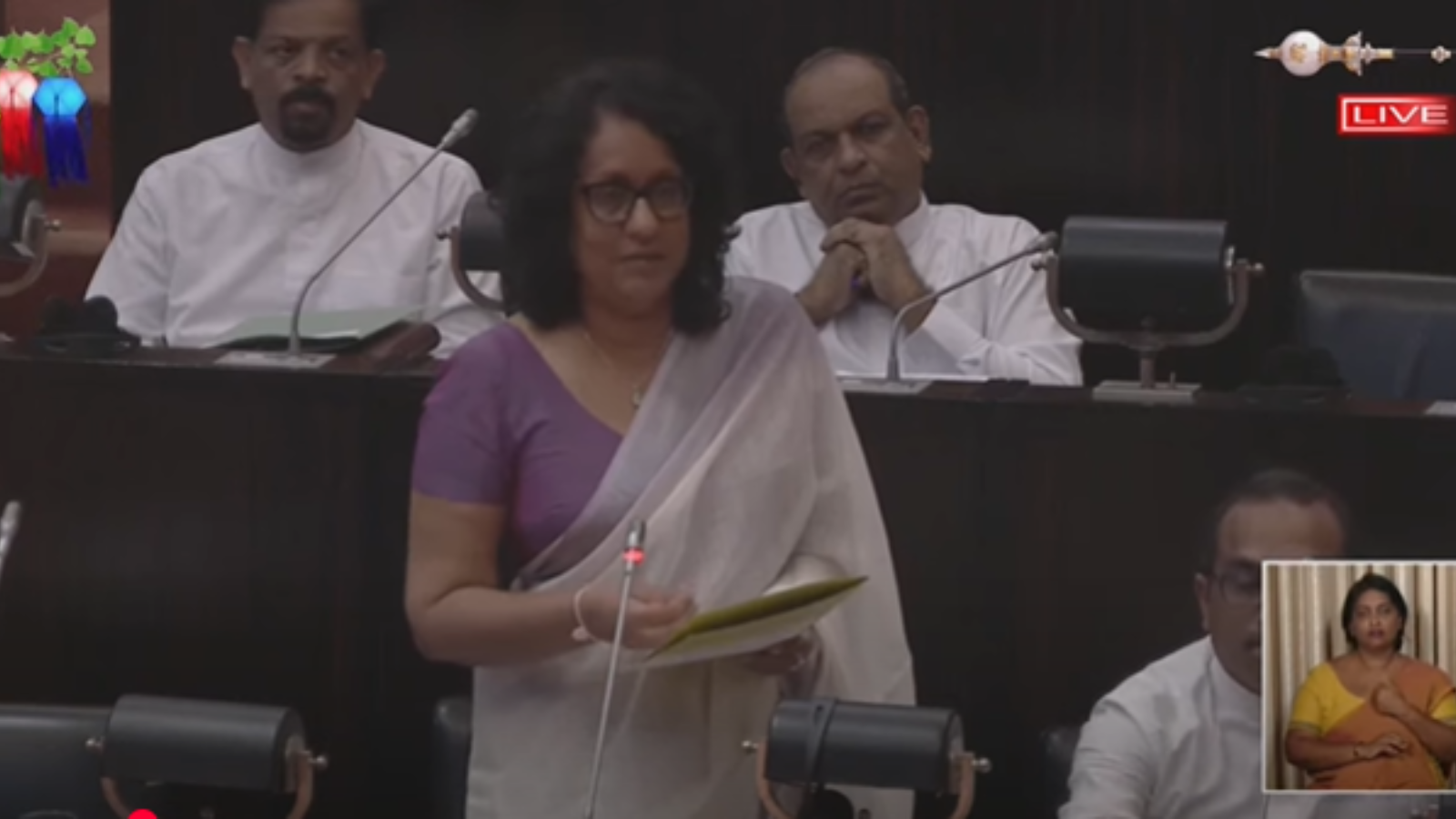
Prime Minister Dr. Harini Amarasuriya stated that the Government has implemented a comprehensive programme to assist the fishing community and micro, small, medium, and large-scale entrepreneurs affected by Cyclone Ditwah in rebuilding their livelihoods.
The Prime Minister made these remarks while responding to questions in Parliament on Tuesday (09) regarding the relief measures introduced for those affected by the disaster.
Prime Minister Dr. Harini Amarasuriya stated:
“The Ministry of Fisheries, Aquatic and Ocean Resources has initiated a special assistance programme for both marine and inland fishermen affected by Cyclone Ditwah. Under this programme, new fishing vessels will be provided to replace those that were completely destroyed, while partially damaged vessels will be repaired. The distribution of fishing nets to eligible fishermen has also commenced.
To support the recovery of businesses damaged by the cyclone, the Government has introduced a concessional loan scheme carrying an annual interest rate of 3 per cent. The programme, with a total allocation of Rs. 10,000 million, is being implemented through 15 banks. As at 28 April 2026, loans amounting to Rs. 3,812 million had been disbursed to 2,800 entrepreneurs. The scheme offers a repayment period of up to three years, including a six-month grace period, with the objective of enabling businesses to resume operations without delay. Applicants are required to obtain recommendations from the Grama Niladhari and the Divisional Secretary certifying that the business was operational before the cyclone and that it was affected by the disaster.
The Prime Minister further stated that, on the instructions of the Central Bank of Sri Lanka, licensed banks have granted a moratorium on loan repayments and waived penalty interest until 31 January 2026. The Prime Minister also emphasized that compensation payments to affected entrepreneurs are continuing in accordance with the relevant ministerial circulars and disaster relief guidelines.
[Prime Minister’s Media Division]
News
Formulation of a Draft Economic Development Bill to expedite the process of Digital Transformation and Digital Economic Development

It is essential to establish an institutional framework with legal powers to ensure the effective implementation of national digital policy and guidelines.
Quality human capital should be attracted to this institutional framework for the compilation of policies, implementation of policies, regulation, and empowerment of operations. The continuous participation of the private sector should also be considered in establishing a strong institutional framework.
It has been further identified that attention should also be
drawn to new fields of digital innovation, including support for artificial intelligence and related activities.
Taking into consideration the aforementioned matters, a concept paper has been formulated to prepare a Draft Economic Development Bill for the establishment of a new institutional framework.
Accordingly, the Cabinet of Ministers has approved the resolution furnished by the President in his capacity as the Minister of Digital Economy to instruct legal draftsman to formulate a Draft Economic Development Bill based on the aforementioned concept paper.
The Sri Lanka Community and Health Survey is the main data source for obtaining necessary information for reviewing progress toward achieving the national health development goals, as well as the expected sustainable development goals by 2030.
The last survey was conducted in the year 2016, and the Sri Lanka Community and Health Survey should be conducted to obtain updated data to enable the collection of related data and indicators concerning the health and well-being targets of the Global Sustainable Development Objectives.
Accordingly, the Cabinet of Ministers has approved the resolution furnished by the President in his capacity as the Minister of Finance, Planning, and Economic Development to take necessary steps to conduct the aforementioned survey.

India’s Sri Lanka Test tour set to begin in Galle on August 15

US strikes Iran in response to downing of military helicopter

The government is implementing a comprehensive programme to restore the livelihoods of fishermen and businesses affected by Cyclone Ditwah – PM

Air Canada pilot accused of flying for 17 years without proper licence

Rana and Mosaddek star as Bangladesh end 21-year wait with crushing win

Formulation of a Draft Economic Development Bill to expedite the process of Digital Transformation and Digital Economic Development

‘Dates have the highest sugar content to fight Coronavirus’

Sunday Island 27 December – Headlines

#SundayIsland 17th December – Headlines

Sunday Island – 28th March

Sunday Island Headlines – 21 March

Sunday Island – 21st February – Headlines
-
 Latest News7 days ago
Kusal Mendis, Pathum Nissanka, bowlers put Sri Lanka 1-0 up
-
 News7 days ago
New US tariffs proposed on 60 countries, including Sri Lanka
-
 Features6 days ago
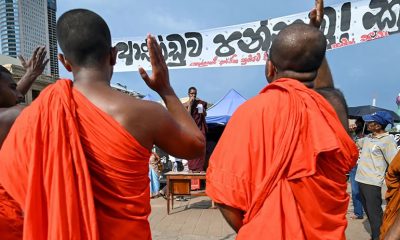
Power crept into the Sangha and is now tearing it apart
-

 Features6 days ago
Kondachchi wind farm and battery storage project to boost energy security, says Power Ministry Secretary
-
 News3 days ago
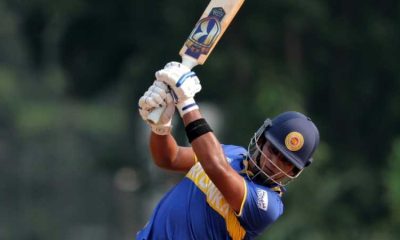
Women’s T20 World Cup 2026 warm-up: Chamari Athapaththu’s 94 helps Sri Lanka beat Pakistan
-
 Features6 days ago
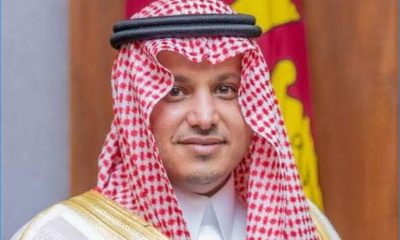
Saudi Arabia sets new benchmark in Hajj management as 1.7 million pilgrims complete sacred journey
-

 News5 days ago
Asst. Manager, security officer arrested over Rs 30 mn snatch at Horana PB branch
-

 Editorial3 days ago
Probe Sallay’s complaint