
News
Climate Action for People and Planet: The Time is Now – UN Secretary-General

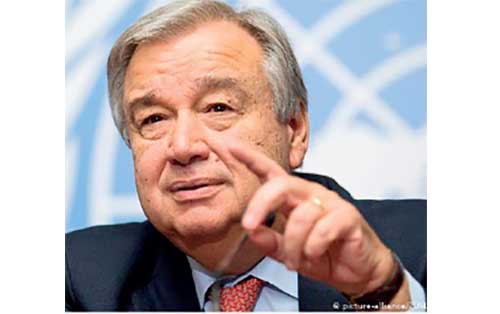
In this pivotal year for humanity, now is the time for bold climate action. The science is irrefutable and globally agreed: to stop the climate crisis from becoming a permanent catastrophe, we must limit global heating to 1.5 degrees Celsius, UN Secretary-General António Guterres said in a message to mark Earth Day on April 22 and the US convened Leaders’ Summit on Climate.
“To do this, we must get to net zero emissions of greenhouse gases by mid-century. Countries making up about two-thirds of the global economy have committed to do so. This is encouraging, but we urgently need every country, city, business and financial institution to join this coalition and adopt concrete plans for transitioning to net zero”, he said.
Even more urgent is for governments to match this long-term ambition with concrete actions now, as trillions of dollars are mobilized to overcome the COVID-19 pandemic. Revitalizing economies is our chance to re-engineer our future, the UN Secretary-General further said.
The world has a strong framework for action: the Paris Agreement, in which all countries committed to set their own national climate action plans and strengthen them every five years. Over five years later, and with damning proof that if we don’t act we will destroy our planet, it is time for decisive and effective action as the United Nations convenes all countries in Glasgow in November for COP26, he continued.
The new national plans must cut global greenhouse gas pollution by at least 45 per cent by 2030 compared to 2010 levels. Many have been presented already, and set out clearer policies to adapt to the impacts of climate change and boost access to renewable energy, he noted.
But so far, those plans achieve less than a one per cent cut in emissions. This is a true red alert for people and planet.
In the months ahead, beginning with the upcoming Leaders Summit hosted by the United States, governments must dramatically step up their ambitions – particularly the biggest-emitting countries that have caused the vast bulk of the crisis, he added.
The UN Secretary-General’s message further said: “Phasing out coal from the electricity sector is the single most important step to get in line with the 1.5-degree goal. Immediate action to remove the dirtiest, most polluting fossil fuel from power sectors offers our world a fighting chance.
“Global coal use in electricity generation must fall by 80 per cent below 2010 levels by 2030. This means that developed economies must commit to phase out coal by 2030; other countries must do this by 2040. There is simply no reason for any new coal plants to be built anywhere. One third of the global coal fleet is already more costly to operate than building new renewables and storage. COP26 must signal an end to coal.
“As the world moves towards clean air and renewable energy, it is essential that we ensure a just transition. Workers in impacted industries and the informal sector must be supported as they move jobs or re-skill. We must also unleash the vast power of women and girls to drive transformation, including as equal participants in governance and decision-making.
“The countries that contributed least to climate change are suffering many of the worst impacts. Many small island nations will simply cease to exist if we don’t step up the response. The developed countries must deliver on their commitments to provide and mobilize $100 billion annually by:
doubling current levels of climate finance;
devoting half of all climate finance to adaptation;
stopping the international funding of coal; and
shifting subsidies from fossil fuels to renewable energy.
“The G7 Summit in June offers the opportunity for the world’s wealthiest countries to step up and provide the necessary financial commitments that will ensure the success of COP26.
“While governments must lead, decision-makers everywhere have a vital role to play.
I ask all multilateral and national developments banks, by COP26, to have clear policies in place to fund the COVID recovery and the transition to resilient economies in developing countries, taking into account crippling debt levels and huge pressures on national budgets.
“Many local governments and private business have committed to net zero emissions by 2050, and have engaged in significant reviews of their business models. I urge all to set ambitious targets and policies.
“I encourage young people everywhere to continue to raise their voices for action to address climate change, protect biodiversity, stop humanity’s war on nature and accelerate efforts to achieve the Sustainable Development Goals.
“Time is running out, and there is much hard work ahead, but this no time to raise the white flag. The United Nations will keep flying our blue flag of solidarity and hope. This Earth Day and over the crucial months ahead, I urge all nations and all people to rise together to this moment”.



The Sri Lanka Navy successfully recovered its Fast Attack Craft P 4447 following a successful salvage operation, bringing a multi-stage emergency response to a close.
The craft, which ran into distress during a routine patrol on 15th August 2026 off Angulana, was brought to the surface on 11th September, from a depth of approximately 80 feet. It was
subsequently towed to the Colombo Dockyard premises.
The initial phase of the operation immediately following the incident focused on search and rescue. A joint effort involving the Navy, Air Force, Police, and local fishermen from Angulana
resulted in the rescue of 11 crew members. The search and rescue phase drew to a close with the recovery of the remains of the Second in Command of the craft, on 4th September.
Following the search and rescue phase, specialized Navy diving and salvage teams launched a dedicated recovery phase against rough sea conditions and underwater challenges, adhering to
strict safety protocols. The Navy’s marine, hull, electrical, and electronic engineering teams utilized specialized technical know-how and equipment to raise the vessel in stages.
Thus, the salvage operation marked an outstanding achievement attained through the professionalism, technical expertise of Navy divers, and coordinated contribution of all
engineering and technical branches of the Sri Lanka Navy. Technical support and specialized expertise were also extended by the Sri Lanka Ports Authority and Colombo Dockyard PLC.


By Shamindra Ferdinando
The Opposition should intensity its focus on the forthcoming selection of a member of the Commission to Investigate Allegations of Bribery or Corruption (CIABOC) and remain vigilant as Speaker Dr. Jagath Wickremaratne, MP, the head of the Constitutional Council (CC) tasked with making the relevant recommendation, is under investigation by the CIABOC, sources familiar with the ongoing inquiry told The Island.
Chethiya Goonasekara, PC, is expected to complete his three-year term on Dec 31, 2026. Sources pointed out that CIABOC Commissioners are appointed by the President on the recommendation made by the 10-member Constitutional Council.
The CIABOC initiated the investigation following a complaint lodged by suspended Chief of Staff and Deputy Secretary General of Parliament Chaminda Kularatne in early February this year. Sources said that as Goonasekera is scheduled to complete his term toward the end of 2026, the CC would have to call applications soon to choose the successor.
Goonasekara received his appointment from President Ranil Wickremesinghe in January 2024. A Justice W. M. N. P. Iddawala was appointed Chairman of the CIABOC. The other commissioner is K. Bernard Rajapakse.
Asked whether Iddawala and Rajapakse, too, would complete their terms soon, sources said that in terms of the Anti-Corruption Act No 09 of 2023, the Chairman of CIABOC would hold office for a period of five years, second commissioner (K. Bernard Rajapakse) for four years and the third commissioner (Chethiya Goonasekara) for a period of three years.
Sources said that the Opposition as well as civil society representatives in the CC should take up the issue of Speaker facing an investigation by the CIABOC taking part in the forthcoming selection process. Responding to queries, sources emphasized that the issue was whether in terms of Section 107 of the Anti-Corruption Act the participation of the Speaker in the selection process amounted to a violation of the Act itself.
The current members of the CC are Dr Jagath Wickramaratne, Speaker and Chairman of the Constitutional Council, Dr. Harini Amarasuriya, Prime Minister, Sajith Premadasa, Leader of the Opposition, Bimal Rathnayake, MP, Aboobucker Athambawa, MP, Ajith P. Perera, MP, Sivagnanam Shritharan, MP, Austin Fernando, Civil society representative, Prof. Wasantha Seneviratne, Civil society representative and Ranjith Ariyaratne, Civil society representative.
Sources pointed out that in spite of the sensitivity of the case, the CIABOC recorded Kularatne’s statement in the second week of August, six months after he lodged the complaint.
The CIABOC on 3, 8 and 10 Sept recorded the statements from the Transport Officer, Deputy Director, Administration and Assistant Director, Finance regarding the use of facilities by the Speaker, those assigned to his staff and other relevant matters.
The NPP named Dr. Wickramaratne as the Speaker after Asoka Ranwala resigned over controversy regarding his higher education qualifications.
SJB lawmaker Dayasiri Jayaskera has repeatedly raised the issues concerning the Speaker with the focus also on the Speaker using two government-managed residences, relevant staff in addition to expenditure on food, transport and fuel provided to the Speaker’s private secretary.
Political sources said that trouble erupted after the Parliamentary Staff Advisory Council in late January sacked Kularatne accusing him of providing false information to secure his appointment. Before being appointed as the Deputy Secretary-General of Parliament in 2023, Kularatne held several high-ranking positions, including Secretary to the Chief Government Whip, Additional Secretary to the President, Additional Secretary to the Prime Minister, and Additional Secretary to the Leader of the Opposition.
The SJB declared in Parliament that Ranwala should be brought back as the Speaker as they have no faith in Wickramaratne. MP Mujibur Rahuman jokingly told parliament that the Opposition wouldn’t raise Ranwala’s educational qualifications.

The Government Medical Officers’ Association (GMOA) has stressed the need to conduct a comprehensive countrywide cadre revision urgently.
GMOA spokesman Dr. Lasitha Dhammika told The Island that the failure on the part of successive governments to conduct cadre revision caused the deterioration of the public sector health services. Due to the absence of required statistics, they hadn’t been able to fully comprehend the situation on the ground and to ascertain the requirements of the public.
Dr. Dhammika pointed out the expansion of the services without supporting statistics and the need to initiate an immediate cadre revision. According to him, the GMOA had raised this issue with successive governments without success. The GMOA spokesman said that they also sought relevant information from the Health Ministry in terms of the Right to Information (RTI) Act two weeks ago but was yet to receive response.
(SF)

Fast Attack Craft P 4447 recovered in successful salvage operation

Showers above 100 mm are likely at some places in the Western, Central, Sabaragamuwa, Southern, North-central and North-western provinces

Shafali, Mandhana power India to eighth Asia Cup title

Tharanga wins Ultimate Javelin title

CIABOC member’s appointment: Controversy over Speaker under probe heading selection process

GMOA: Countrywide cadre revision not done since 2015

‘Dates have the highest sugar content to fight Coronavirus’

Sunday Island 27 December – Headlines

#SundayIsland 17th December – Headlines

Sunday Island – 28th March

Sunday Island Headlines – 21 March

Sunday Island – 21st February – Headlines
-

 Sports3 days ago
DDS set to lose Test captaincy
-

 News6 days ago
Thailand shuts door on undesirables from Sri Lanka
-

 News3 days ago
Sri Lanka faces new grid challenge as rooftop solar surges: former CEB GM
-

 Latest News3 days ago
Shafali, Deepti power India into sixth T20 Asia Cup final
-
 Business6 days ago
CEB successor company breaks into top three in competitive BESS tender
-

 Opinion5 days ago
Navigating Sri Lanka’s Israeli Dilemma
-

 Latest News3 days ago
Sri Lanka thwart Fatima Sana challenge to secure Asia Cup final spot
-

 Features4 days ago
Lost for 90 years: Rare Goby resurfaces in Jaffna