
News
Climate Action for People and Planet: The Time is Now – UN Secretary-General

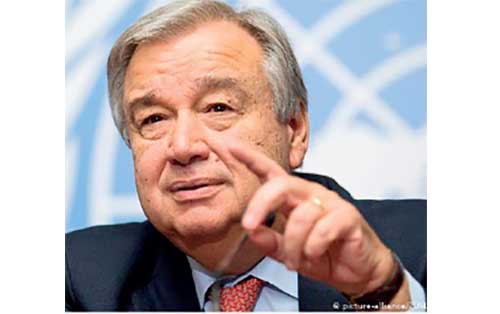
In this pivotal year for humanity, now is the time for bold climate action. The science is irrefutable and globally agreed: to stop the climate crisis from becoming a permanent catastrophe, we must limit global heating to 1.5 degrees Celsius, UN Secretary-General António Guterres said in a message to mark Earth Day on April 22 and the US convened Leaders’ Summit on Climate.
“To do this, we must get to net zero emissions of greenhouse gases by mid-century. Countries making up about two-thirds of the global economy have committed to do so. This is encouraging, but we urgently need every country, city, business and financial institution to join this coalition and adopt concrete plans for transitioning to net zero”, he said.
Even more urgent is for governments to match this long-term ambition with concrete actions now, as trillions of dollars are mobilized to overcome the COVID-19 pandemic. Revitalizing economies is our chance to re-engineer our future, the UN Secretary-General further said.
The world has a strong framework for action: the Paris Agreement, in which all countries committed to set their own national climate action plans and strengthen them every five years. Over five years later, and with damning proof that if we don’t act we will destroy our planet, it is time for decisive and effective action as the United Nations convenes all countries in Glasgow in November for COP26, he continued.
The new national plans must cut global greenhouse gas pollution by at least 45 per cent by 2030 compared to 2010 levels. Many have been presented already, and set out clearer policies to adapt to the impacts of climate change and boost access to renewable energy, he noted.
But so far, those plans achieve less than a one per cent cut in emissions. This is a true red alert for people and planet.
In the months ahead, beginning with the upcoming Leaders Summit hosted by the United States, governments must dramatically step up their ambitions – particularly the biggest-emitting countries that have caused the vast bulk of the crisis, he added.
The UN Secretary-General’s message further said: “Phasing out coal from the electricity sector is the single most important step to get in line with the 1.5-degree goal. Immediate action to remove the dirtiest, most polluting fossil fuel from power sectors offers our world a fighting chance.
“Global coal use in electricity generation must fall by 80 per cent below 2010 levels by 2030. This means that developed economies must commit to phase out coal by 2030; other countries must do this by 2040. There is simply no reason for any new coal plants to be built anywhere. One third of the global coal fleet is already more costly to operate than building new renewables and storage. COP26 must signal an end to coal.
“As the world moves towards clean air and renewable energy, it is essential that we ensure a just transition. Workers in impacted industries and the informal sector must be supported as they move jobs or re-skill. We must also unleash the vast power of women and girls to drive transformation, including as equal participants in governance and decision-making.
“The countries that contributed least to climate change are suffering many of the worst impacts. Many small island nations will simply cease to exist if we don’t step up the response. The developed countries must deliver on their commitments to provide and mobilize $100 billion annually by:
doubling current levels of climate finance;
devoting half of all climate finance to adaptation;
stopping the international funding of coal; and
shifting subsidies from fossil fuels to renewable energy.
“The G7 Summit in June offers the opportunity for the world’s wealthiest countries to step up and provide the necessary financial commitments that will ensure the success of COP26.
“While governments must lead, decision-makers everywhere have a vital role to play.
I ask all multilateral and national developments banks, by COP26, to have clear policies in place to fund the COVID recovery and the transition to resilient economies in developing countries, taking into account crippling debt levels and huge pressures on national budgets.
“Many local governments and private business have committed to net zero emissions by 2050, and have engaged in significant reviews of their business models. I urge all to set ambitious targets and policies.
“I encourage young people everywhere to continue to raise their voices for action to address climate change, protect biodiversity, stop humanity’s war on nature and accelerate efforts to achieve the Sustainable Development Goals.
“Time is running out, and there is much hard work ahead, but this no time to raise the white flag. The United Nations will keep flying our blue flag of solidarity and hope. This Earth Day and over the crucial months ahead, I urge all nations and all people to rise together to this moment”.


BY IfhAm NIzAm
Sri Lanka could soon face a new electricity-grid challenge—not from too little power, but from having too much solar generation in the wrong places and at the wrong times, a former Ceylon Electricity Board (CEB) General Manager told The Island.
The former CEB GM who insisted not to be named warned that the rapid growth of rooftop and utility-scale solar could place increasing pressure on CEB and LECO distribution feeders, substations and the national grid unless transmission, storage and grid-management systems are upgraded at the same pace.
“The issue is no longer simply how much solar we can install. The question is whether the grid can absorb those electrons when and where they are produced,” he told The Island.
He said Sri Lanka should learn from China and India, where the enormous expansion of renewable generation is now forcing policymakers to focus increasingly on storage, transmission capacity, intelligent dispatch and grid flexibility.
“China has already exceeded 1.28 TW of installed solar, while India’s grid-connected installed solar capacity stood at around 162.15 GW as of June 30, 2026. The difficult question now is what you actually do with so much solar when everyone is generating at almost the same time,” he said.
For Sri Lanka, he said, the warning is particularly relevant to the distribution network.
A feeder carrying a high concentration of rooftop solar can, during periods of strong sunshine and low local demand, move from the traditional one-way flow of electricity towards consumers to reverse power flow back towards the transformer and upstream network.
“That means the feeder is no longer simply a one-way road for electricity. At certain times of the day, it becomes a two-way road,” he said.
This can create voltage-rise, protection-coordination and transformer-loading issues and could eventually limit the amount of additional rooftop solar that can safely be connected to particular feeders.
“What matters is where those megawatts are connected,” he told The Island.
He said Sri Lanka therefore needs to begin looking at solar hosting capacity feeder by feeder and substation by substation, rather than treating the national grid as having unlimited capacity to absorb new distributed generation.
The problem is compounded by the evening transition, when solar generation falls rapidly just as electricity demand can increase.
“If the system has a lot of solar in the middle of the day and then loses that generation rapidly in the evening, something else has to respond. That is a flexibility problem,” he said.
This is where battery energy storage systems (BESS) are likely to become increasingly important—but the former CEB chief cautioned against allowing cheap imported battery hardware to drive the market.
“Sri Lanka could soon have huge BESS demand, very cheap battery hardware and everyone suddenly becoming a BESS pundit. What could possibly go wrong?” he said.
He cited fire safety, degradation, poor integration, weak energy-management systems, questionable warranties, incorrect sizing, inappropriate grid locations and poor thermal management as major risks.
“A system can look fantastic in Excel on Day One but perform very differently in Year Two,” he told The Island.
He said the future BESS market would therefore be determined less by who could supply the cheapest container and more by who understood the complete system.
“The future BESS business will not be about who can assemble the cheapest container. It will be about who understands battery, PCS, EMS, grid, safety, degradation and dispatch economics as one system,” he said.
For Sri Lanka, storage should also be considered as a distribution-grid asset, rather than solely as a large transmission-level installation.
Strategically located batteries could absorb excess rooftop solar on constrained feeders during the middle of the day and release electricity later when local demand rises, potentially reducing network congestion and improving the value of distributed generation.
“The question is not simply, ‘How many megawatt-hours of batteries do we need?’ The question is, ‘Where does the battery create the greatest system value?’” he said.
He said China’s and India’s experience could broadly be viewed as three stages: Phase One—build solar and wind; Phase Two—build storage; and Phase Three—redesign the grid around renewables.
Sri Lanka, he said, should learn from that progression before renewable penetration makes grid problems significantly more expensive to solve.
“Installing another large amount of solar is one thing. Absorbing those electrons when the sun is shining everywhere at once is quite another,” he said.
“Solar taught us how to generate cheap electrons. BESS and the grid will decide whether those cheap electrons are actually useful when they are needed.”
“That is perhaps the biggest lesson Sri Lanka should take from China and India’s energy transition right now,” he added.
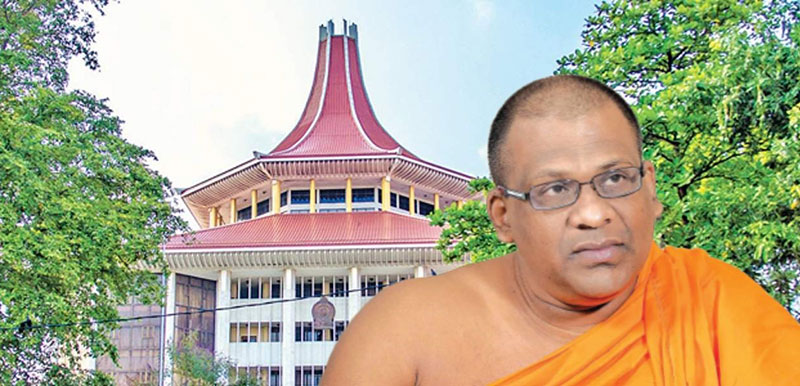
The Supreme Court yesterday ruled that former President Maithripala Sirisena’s decision to grant a presidential pardon to Bodu Bala Sena (BBS) General Secretary Ven. Galagoda Atte Gnanasara Thera was arbitrary and invalid in law.
A three-judge bench headed by Justice Janak de Silva delivered the judgment in response to fundamental rights petitions filed by the Centre for Policy Alternatives (CPA) and Sandhya Ekneligoda, challenging the former President’s decision to release the monk from prison.
Gnanasara Thera had been sentenced by the Court of Appeal in August 2018 to 19 years’ rigorous imprisonment, to run concurrently as six years, after being found guilty of contempt of court over his conduct inside the Homagama Magistrate’s Court on January 25, 2016, during proceedings related to the disappearance of Prageeth Ekneligoda.
The Supreme Court subsequently upheld the Court of Appeal’s finding of guilt on October 5, 2018.
However, Gnanasara Thera was released from Welikada Prison on May 23, 2019, after the then President Sirisena granted him a presidential pardon.
The petitioners challenged the legality of the pardon, prompting the Supreme Court to examine the exercise of the President’s constitutional power of clemency.
The Court’s ruling yesterday effectively nullifies the pardon granted to the BBS leader.
Viran Corea, PC, with Luwie Ganeshathasan and Khyati Wikramanayake appeared for the CPA, while Counsel Asthika Devendra, with Pulasthi Hewamanne, instructed by Manjula Balasuriya, appeared for Sandhya Ekneligoda.Counsel Thishya Weragoda, with Sanjaya Marambe and Iresh Senevirathne, appeared for Gnanasara Thera. Faiszer Musthapha, PC, with Pulasthi Rupesinghe, appeared for former President Sirisena.
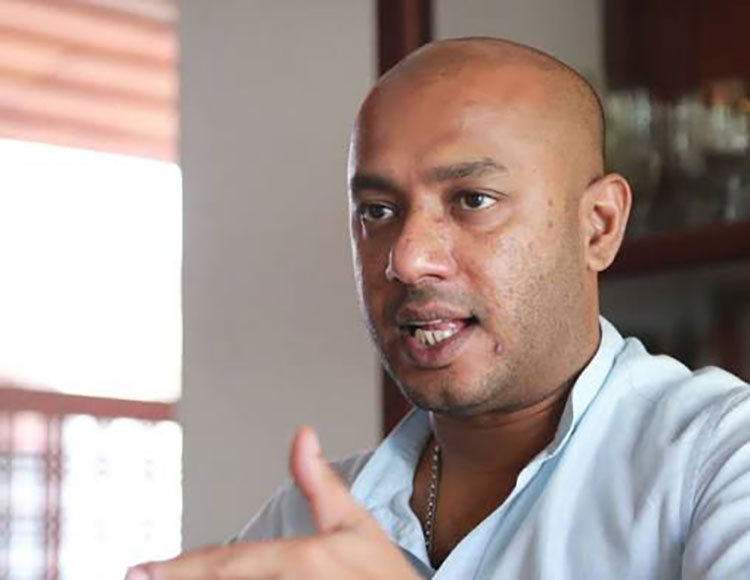
The Colombo High Court yesterday served indictments on former Minister Duminda Dissanayake and a woman in connection with the discovery of a gold-plated T-56 assault rifle at the Havelock City apartment complex in Wellawatte.
Following the indictments, the High Court Judge ordered that both accused be released on bail.
Court records indicate that indictments had also been filed against Dissanayake and the same co-accused on September 9, after which they were granted bail.
The case relates to the discovery of the gold-plated firearm at the apartment complex in May 2025.
Two women, aged 40 and 68, were initially arrested in connection with the possession of the weapon, before the investigation was handed over to the Terrorism Investigation Division (TID).
Subsequent investigations by the TID led to Dissanayake being arrested and produced before court. However, he was later released after the Attorney General’s Department informed court that there was insufficient evidence at the time to proceed with legal action against him.

Sri Lanka faces new grid challenge as rooftop solar surges: former CEB GM

SC rules President Sirisena’s pardon of Gnanasara thera invalid

Duminda, another indicted in gold-plated T-56 case

‘Commissions paid to aircraft buyers standard practice’: Ex-AASL Board Member

Catholic bishops call for impartial probe into Chemmani mass grave

Ex-‘VVIP’ astrologer makes statement to Bribery sleuths

‘Dates have the highest sugar content to fight Coronavirus’

Sunday Island 27 December – Headlines

#SundayIsland 17th December – Headlines

Sunday Island – 28th March

Sunday Island Headlines – 21 March

Sunday Island – 21st February – Headlines
-

 News6 days ago
Namal remanded until Sept. 18 over Airbus deal investigation
-

 Latest News5 days ago
Tharanga creates history with Diamond League crown in Brussels
-

 News5 days ago
Dispute which triggered listed company director being detained at BIA resolved
-

 Features4 days ago
After the parade: What a traffic OIC’s walk-out tells us
-

 Editorial6 days ago
Power vs Equality
-
Editorial4 days ago
Arrests as theatre
-

 Latest News4 days ago
Harshitha’s composed knock seals Sri Lanka’s semi-final berth
-

 Latest News7 days ago
SLPP MP Namal Rajapaksa arrested by CIABOC