
Business
Igniting global talent: Port City Colombo’s role in Sri Lanka’s next growth chapter


By Sal Laher
Every new market decision eventually becomes a test of confidence: can the country supply the talent, can the work scale, and can the rules hold long enough to matter. That is the lens through which we have looked at Sri Lanka, and across IFS and now IGT I, the answer to each of those questions has been the same.
For more than three decades, Sri Lanka has built a serious technology services industry with real depth, real clients and real global relevance. The Export Development Board identifies ICT services as the country’s second-largest export earner, supported by more than 500 companies and a workforce of around 146,000 people.
In 2025, ICT and BPM export earnings reached US$1.64 billion, overtaking tea as an export earner for the first time. That is worth pausing on. A knowledge industry has surpassed the country’s most iconic export, and it did so the hard way, with firms setting up where they could, growing as they could manage, and scaling within the limits of the space and infrastructure available in Colombo. If that was possible in a fragmented, piecemeal environment, the more useful question is what becomes possible when the physical, legal and financial architecture is built deliberately to support that kind of ambition. That is what Port City Colombo is for.
Most people in the industry will tell you the real figure runs higher still, because a great deal of the work is invoiced through offshore entities and never fully recorded here, and that tells you something important: the capability is world class and globally competitive, and what has been missing is an operating environment built to keep more of that value inside the country.
As someone with real skin in the game, I can say with confidence that Port City Colombo is that environment. IGT I moved early in March 2024 into the zone, and we had our first client shortly after. Since then we have grown to just over 500 people, with new clients and open offers that take us beyond our initial growth, serving international clients across the Americas, Europe, and Middle East, and we expect to pass our budgeted target for the year. I have opened operations in many countries over my career, and I have rarely seen one move at this speed.
The story did not begin from zero. It came from what we had already seen building IFS in Sri Lanka, where we experienced first-hand the quality of the talent here and the role this country could play inside a high-growth international technology company. The investors behind IFS then asked whether the same model could work for other companies in their portfolio. It was that question, on top of the experience we had built in Sri Lanka, that sparked IGT I: Ignite Global Talent. We understood that the capability already existed. It just needed the right commercial, flexible, and independent structure around it.
Port City Colombo is foundational to this in ways that are sometimes underestimated. Operating in a designated foreign currency environment removes layers of friction that global service businesses feel immediately, because payroll, client invoicing and procurement all become easier to manage when the currency framework is consistent. For a company serving global clients, that matters in ways that go beyond accounting tidiness, reducing hedging pressures and the small inefficiencies that accumulate across a business operating in two currencies at once.
The zone also empowers companies to think differently about talent. Where a role requires international expertise, the framework allows that conversation to happen more practically. At the same time, the pull for Sri Lankan professionals is real. Much of our hiring has come from professionals choosing to build their careers here, drawn by the scale of the work, direct exposure to international clients, and the chance to be part of something built from the ground up. That kind of pull is not something a financial model captures easily, but it is one of the strongest signals a new business district can send, particularly when it draws back talent that might otherwise have built its career overseas.
There is a wider point here. For years the best people have left for opportunities abroad, taking their skills and their earnings with them. Port City Colombo offers a way to keep more of that talent at home, in work that meets global standards and increasingly pays at a level that reflects it, with the contribution staying inside Sri Lanka’s economy.
None of this is guaranteed to continue on its own. The confidence that has brought companies like ours into the zone, and the talent that has followed, now needs protecting, and what it mostly comes down to is predictability. An investor can work with rules that are demanding and rules that are clear. What no one can plan around is a rule that keeps moving, and the sharpest example right now is how employees are taxed. The treatment of employee tax in the zone changed under the 2026 amendment to the Colombo Port City Economic Commission Act, moving from an open-ended exemption to a transitional period for existing entities and standard rates for new entrants. Whatever the merits of that specific change, the cost of leaving the position unsettled is higher than the cost of any particular rate, because uncertainty over employment costs is what stops an investor committing.
The same need for predictability runs through the everyday machinery of operating here. Port City Colombo is a world-class development still partly tethered to paper, physical signatures and processes that move more slowly than a global business expects, and that is not about any one institution but about the systems of the zone and the systems of the wider country learning to work together. A business environment built to attract international companies cannot ask them to run on manual processes where digital workflows should exist. Singapore launched TradeNet in 1989 and cut trade document turnaround from days to minutes. Dubai made its government fully paperless by 2021. That is the distance Sri Lanka still has to cover, and it is well within reach. I still spend a good part of my week on wet signatures, company seals and manual form entry, and closing that gap has to start somewhere. Digital signatures within Port City Colombo would be a logical first step.
I want to be fair about where things stand. The Cabinet approval of 77 Businesses of Strategic Importance in April 2026 is a meaningful public signal that the zone is moving from promise to activation. The foundations are real and the direction is right.
Which is why the question itself has changed. For years the doubt was whether a zone like this could work in Sri Lanka at all, and from where I sit, that question has begun to answer itself. The more important question now is how quickly the country makes it easy for the next ten companies to reach the same conclusion I have, and to find what we found when we looked properly: that the talent was always here, waiting for somewhere worthy of it, with the innovation, speed and digital ambition, including AI, to match, and that combination will set Port City Colombo apart in the years to come.
The author, Sal Laher, is Group CDIO and EVP at IFS, and Managing Director of IGT I Outsourcing Lanka.


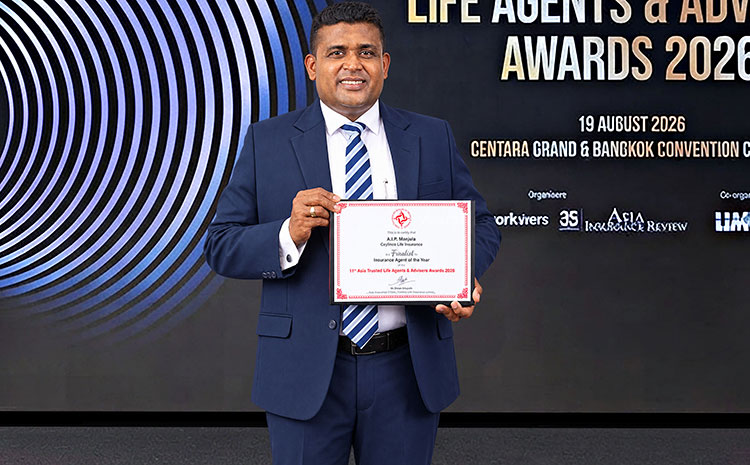
Ceylinco Life’s Ambalantota branch agent AIP Manjula has been named one of three global finalists for the prestigious Insurance Agent of the Year award at the 11th Asia Trusted Life Agents & Advisers Awards (ATLAA) 2026.
The recognition places a Sri Lankan insurance professional among the finalists in a regional field spanning South Asia, Southeast Asia, East Asia and the wider Asia-Pacific region.
Ceylinco Life said the achievement reflected the calibre and customer-focused approach of its agency force, while recognising Manjula’s professionalism and commitment to policyholders.
The award evaluates insurance agents on criteria extending beyond sales performance, including ethical conduct, client service, policy persistency, digital adoption, innovative practices and contributions to the insurance industry and community.
The awards are organised by Asia Advisers Network and Asia Insurance Review, with LIMRA as co-organiser. An independent judging and balloting process is monitored by KPMG as the official scrutineer. The judging panel comprises senior insurance executives, association presidents and industry experts from across the Asia-Pacific region.
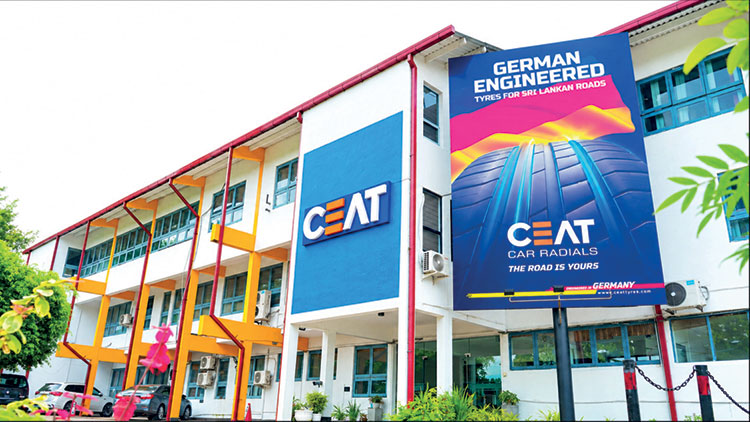
CEAT Kelani Holdings (CKH) has retained its National Long-Term Rating of ‘AA+(lka)’ with a Stable Outlook from Fitch Ratings for the sixth consecutive year, reflecting the company’s financial resilience and leading position in Sri Lanka’s pneumatic tyre market.
The ‘AA+(lka)’ rating, the second-highest on Fitch’s national scale, indicates a very strong capacity to meet financial commitments.
Fitch said CKH’s established market leadership and resilient financial profile remained key strengths, while noting its exposure to price-sensitive, cyclical and highly competitive markets.
The Stable Outlook reflects expectations that the company will maintain its market position despite rising input costs and increasing competition from imported tyres, while preserving adequate credit metrics during periods of weaker earnings and higher investment.
Fitch expects CKH’s established brand, extensive dealer network and adaptive pricing strategies to support its market position. Planned production facility upgrades are also expected to improve product quality, particularly in the radial tyre segment.
The rating agency expects near-term pressure on margins from higher raw material and energy costs but said the company’s low leverage and sound liquidity would provide a cushion.
CKH Chairman Chanaka De Silva said the rating reinforced the company’s focus on disciplined financial management, operational adaptability and long-term investment.
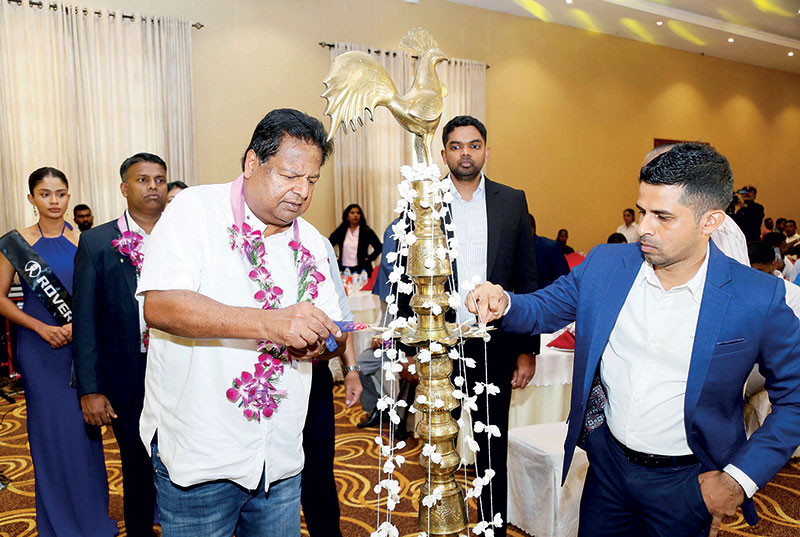
Rivon Agriglobe and Rivon Lanka, affiliated with Celogen Lanka, Assidua Technologies and Kelun Lifesciences, have introduced ZETOR and Agriglobe tractors, the Z-Tukoba power tiller and Rover electric motorcycles to the Sri Lankan market.
The new range was launched at a special event held on September 4 at the Sannasa Hotel in Dambulla, attended by more than 120 dealers from across the country.
The event was graced by Nalin Welgama as Chief Guest, together with Rishi Kumar, Managing Director; WH Roshan, Finance Director; Sadish Kumar, Director; Sumith Nandana, General Manager; Suresh Dhammika, Head of Sales; and Jayasuriya, Operations Manager.
The agricultural machinery range includes the 50-horsepower ZETOR HORTUS 50 and Agriglobe 50 tractors and the Z-Tukoba power tiller, offering what the company described as European-engineered technology for Sri Lankan farmers.
The launch also featured the recognition of Rover E-Bike dealers, highlighting the company’s efforts to expand its island-wide dealer network and promote electric mobility.
The companies said the new models would be available through their growing dealer network across Sri Lanka, providing customers with access to agricultural machinery and electric motorcycles.

Buttler out of Oval decider as Lawrence earns ODI call-up

Showers will occur in the Western, Eastern, Uva and Sabaragamuwa provinces and in Galle, Matara, Kandy and Nuwara-Eliya districts.

Nor’easter brings flooding as New York and New Jersey declare emergency 2 hours ago

Trump rejects Iran deal to reopen Strait of Hormuz in seven days

Govt plans to hire 121,000 state workers, redistribute tax revenue

Parliament clears 22A amid protests

‘Dates have the highest sugar content to fight Coronavirus’

Sunday Island 27 December – Headlines

#SundayIsland 17th December – Headlines

Sunday Island – 28th March

Sunday Island Headlines – 21 March

Sunday Island – 21st February – Headlines
-

 News6 days ago
Hatton youth protest against reported death sentence for Lankan in Saudi Arabia
-

 News4 days ago
Mastermind Naufer Moulavi among 15 found guilty
-
 News5 days ago
Protest against setting up of cement factory in highly populated area near BIA
-
 News6 days ago
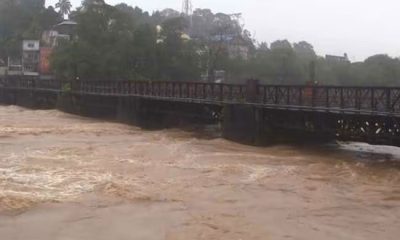
Mahaweli rises as heavy rain triggers flood, landslide fears
-

 Latest News7 days ago
Landslide Red Alerts issued to the districts of Kandy, Kegalle and Nuwara Eliya
-

 Midweek Review4 days ago
Thileepan’s fast unto death: An authentic narrative that many missed
-

 Editorial4 days ago
Big Bad Bills
-
Editorial5 days ago
Trouble beginning in earnest