
Business
Igniting global talent: Port City Colombo’s role in Sri Lanka’s next growth chapter


By Sal Laher
Every new market decision eventually becomes a test of confidence: can the country supply the talent, can the work scale, and can the rules hold long enough to matter. That is the lens through which we have looked at Sri Lanka, and across IFS and now IGT I, the answer to each of those questions has been the same.
For more than three decades, Sri Lanka has built a serious technology services industry with real depth, real clients and real global relevance. The Export Development Board identifies ICT services as the country’s second-largest export earner, supported by more than 500 companies and a workforce of around 146,000 people.
In 2025, ICT and BPM export earnings reached US$1.64 billion, overtaking tea as an export earner for the first time. That is worth pausing on. A knowledge industry has surpassed the country’s most iconic export, and it did so the hard way, with firms setting up where they could, growing as they could manage, and scaling within the limits of the space and infrastructure available in Colombo. If that was possible in a fragmented, piecemeal environment, the more useful question is what becomes possible when the physical, legal and financial architecture is built deliberately to support that kind of ambition. That is what Port City Colombo is for.
Most people in the industry will tell you the real figure runs higher still, because a great deal of the work is invoiced through offshore entities and never fully recorded here, and that tells you something important: the capability is world class and globally competitive, and what has been missing is an operating environment built to keep more of that value inside the country.
As someone with real skin in the game, I can say with confidence that Port City Colombo is that environment. IGT I moved early in March 2024 into the zone, and we had our first client shortly after. Since then we have grown to just over 500 people, with new clients and open offers that take us beyond our initial growth, serving international clients across the Americas, Europe, and Middle East, and we expect to pass our budgeted target for the year. I have opened operations in many countries over my career, and I have rarely seen one move at this speed.
The story did not begin from zero. It came from what we had already seen building IFS in Sri Lanka, where we experienced first-hand the quality of the talent here and the role this country could play inside a high-growth international technology company. The investors behind IFS then asked whether the same model could work for other companies in their portfolio. It was that question, on top of the experience we had built in Sri Lanka, that sparked IGT I: Ignite Global Talent. We understood that the capability already existed. It just needed the right commercial, flexible, and independent structure around it.
Port City Colombo is foundational to this in ways that are sometimes underestimated. Operating in a designated foreign currency environment removes layers of friction that global service businesses feel immediately, because payroll, client invoicing and procurement all become easier to manage when the currency framework is consistent. For a company serving global clients, that matters in ways that go beyond accounting tidiness, reducing hedging pressures and the small inefficiencies that accumulate across a business operating in two currencies at once.
The zone also empowers companies to think differently about talent. Where a role requires international expertise, the framework allows that conversation to happen more practically. At the same time, the pull for Sri Lankan professionals is real. Much of our hiring has come from professionals choosing to build their careers here, drawn by the scale of the work, direct exposure to international clients, and the chance to be part of something built from the ground up. That kind of pull is not something a financial model captures easily, but it is one of the strongest signals a new business district can send, particularly when it draws back talent that might otherwise have built its career overseas.
There is a wider point here. For years the best people have left for opportunities abroad, taking their skills and their earnings with them. Port City Colombo offers a way to keep more of that talent at home, in work that meets global standards and increasingly pays at a level that reflects it, with the contribution staying inside Sri Lanka’s economy.
None of this is guaranteed to continue on its own. The confidence that has brought companies like ours into the zone, and the talent that has followed, now needs protecting, and what it mostly comes down to is predictability. An investor can work with rules that are demanding and rules that are clear. What no one can plan around is a rule that keeps moving, and the sharpest example right now is how employees are taxed. The treatment of employee tax in the zone changed under the 2026 amendment to the Colombo Port City Economic Commission Act, moving from an open-ended exemption to a transitional period for existing entities and standard rates for new entrants. Whatever the merits of that specific change, the cost of leaving the position unsettled is higher than the cost of any particular rate, because uncertainty over employment costs is what stops an investor committing.
The same need for predictability runs through the everyday machinery of operating here. Port City Colombo is a world-class development still partly tethered to paper, physical signatures and processes that move more slowly than a global business expects, and that is not about any one institution but about the systems of the zone and the systems of the wider country learning to work together. A business environment built to attract international companies cannot ask them to run on manual processes where digital workflows should exist. Singapore launched TradeNet in 1989 and cut trade document turnaround from days to minutes. Dubai made its government fully paperless by 2021. That is the distance Sri Lanka still has to cover, and it is well within reach. I still spend a good part of my week on wet signatures, company seals and manual form entry, and closing that gap has to start somewhere. Digital signatures within Port City Colombo would be a logical first step.
I want to be fair about where things stand. The Cabinet approval of 77 Businesses of Strategic Importance in April 2026 is a meaningful public signal that the zone is moving from promise to activation. The foundations are real and the direction is right.
Which is why the question itself has changed. For years the doubt was whether a zone like this could work in Sri Lanka at all, and from where I sit, that question has begun to answer itself. The more important question now is how quickly the country makes it easy for the next ten companies to reach the same conclusion I have, and to find what we found when we looked properly: that the talent was always here, waiting for somewhere worthy of it, with the innovation, speed and digital ambition, including AI, to match, and that combination will set Port City Colombo apart in the years to come.
The author, Sal Laher, is Group CDIO and EVP at IFS, and Managing Director of IGT I Outsourcing Lanka.



CIF, the globally recognized multi-surface cleaning brand, has officially entered the Sri Lankan market, expanding the range of international home-care solutions available to local consumers.
CIF products are now available at Cargills, Keells, Glomark and Celeste, as well as online through Daraz and uStore, at a retail price of Rs. 900 for 500ml. Shop CIF online at https://ustore.lk/collections/cif
Used by households around the world, CIF is known for its powerful cleaning performance and ability to tackle everyday dirt and some of the toughest cleaning challenges around the home.
Its introduction to Sri Lanka comes as consumers increasingly seek cleaning products that combine performance, convenience and versatility, particularly solutions that can be used across multiple areas and surfaces within the home.
One cleaner. So many possibilities.
From stubborn kitchen grease and grime to limescale around sinks and dirt that builds up on frequently used surfaces, CIF is designed to provide powerful cleaning performance while helping make every day cleaning simpler.
The brand’s multi-surface proposition allows consumers to address a range of household cleaning needs with one versatile solution, bringing greater convenience to modern cleaning routines.
CIF’s entry into Sri Lanka also brings the brand’s global philosophy closer to local consumers eventually helping people restore and rediscover the beauty of the places and things around them through effective everyday cleaning.
With its combination of global recognition, multi-surface versatility and powerful cleaning performance, CIF’s arrival provides Sri Lankan consumers with a new international option in the household cleaning category.
The world’s favorite multi-surface cleaning brand is finally here in Sri Lanka.
Just CIF it!
Business
A sustained wave of Indian assistance to Sri Lanka showcases defining shift in developmental diplomacy
By Sanath Nanayakkare
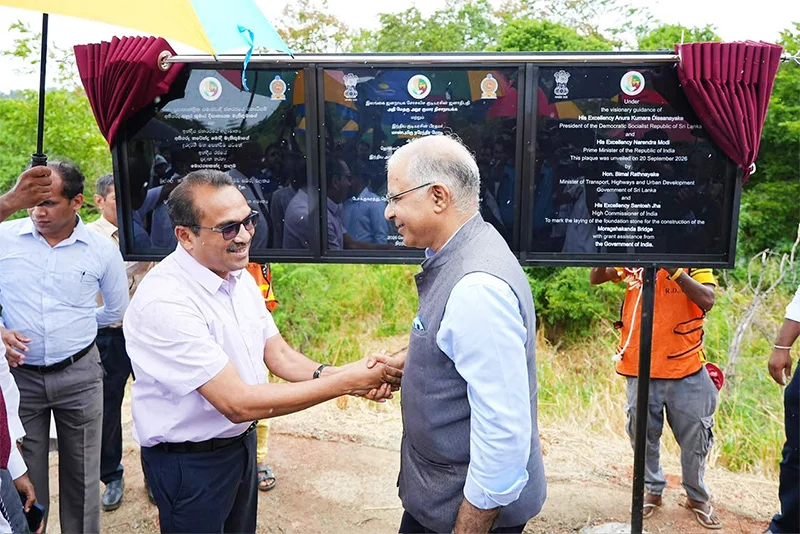
An evolving approach to regional diplomacy was brought into sharp focus with the recent foundation-laying ceremony for the Moragahakanda Bridge in Matale.
Jointly launched by Indian High Commissioner Santosh Jha and Minister of Transport, Highways and Urban Development Bimal Rathnayake, this 175-metre span is far more than a routine civil engineering project. It serves as the physical manifestation of a broader USD 450 million reconstruction package deployed by India in the wake of Cyclone Ditwah, which severely fractured the island’s transport arteries.
Foreign aid is too often discussed in cold, macroeconomic abstractions. Yet, every so often, a consistent pattern of targeted assistance alters the landscape of bilateral relations, offering a clear window into how regional partnerships evolve out of necessity and goodwill.
Across the country today, a remarkable narrative of multi-layered cooperation is unfolding.
From critical post-disaster infrastructure and maritime routes to grassroots agricultural uplift and institutional capacity-building, India’s developmental footprint is shifting unmistakably toward an organic, people-centric model of shared resilience.
What distinguishes this latest wave of assistance is its deliberate pivot from emergency support to permanent, climate-resilient transformation. When Cyclone Ditwah initially paralysed regional connectivity, India’s immediate response was marked by the rapid deployment of temporary Bailey bridges.
Today, that swift humanitarian intervention has matured into a structural blueprint: the Moragahakanda project stands as the vanguard of 13 permanent bridges being built across Sri Lanka’s provinces by IRCON International Limited, complemented by upcoming railway upgrades and modern signaling systems backed by a USD 250 million Line of Credit.
The true signature of this diplomatic shift lies in its breadth, operating simultaneously across multiple tiers of society:
Institutional Governance: Delegations of Sri Lankan parliamentarians and senior administrative officers regularly travel to India to study public policy frameworks, legislative systems, and administrative practices.
Economic Lifelines: Financial mechanisms, such as viability gap funding for the Nagapattinam-to-Kankesanthurai passenger ferry service, continue to shrink geographical distances, reviving coastal commerce and tourism.
Grassroots Empowerment: Specialised capacity-building programmes tailored for local stakeholders – ranging from state officials to rural dairy farmers -ensure that development reaches deep into the island’s hinterlands.
By aligning immediate disaster relief with long-term infrastructure, institutional capacity, and human capital, India and Sri Lanka are demonstrating how neighbours can build safer, more connected futures together, grounded firmly in mutual respect and tangible progress.

By Ifham Nizam
The Central Environmental Authority (CEA) yesterday urged visitors to the Colombo International Book Fair to bring reusable bags to carry their purchases, as part of a drive to reduce single-use plastic waste at the event.
CEA Director General R. S. P. Kapila Rajapaksha said large quantities of plastic, particularly “sili sili” bags, had been used to carry books at previous book fairs.
“We urge visitors to bring an environmentally friendly, reusable bag when they come to buy books. This simple step can help reduce the use of single-use plastic and protect the environment,” Rajapaksha said.
The book fair opens on September 25, with the CEA and the Sri Lanka Book Publishers’ Association launching an awareness programme targeting book sellers, food vendors and visitors.
The programme will be conducted under the theme “Read Smart, Carry Smart”, focusing on reducing polythene and plastic use throughout the exhibition.
The CEA said the use of plastic bags is also subject to regulations issued under the Consumer Affairs Authority Act. Gazette Extraordinary No. 2456/41, dated October 1, 2025, prohibits the free distribution of handled “sili sili” bags to consumers. Where such bags are sold, the charge must be included in the customer’s bill.
The CEA said food outlets at the book fair would also be required to comply with regulations prohibiting a range of single-use plastic products.
These include plastic straws and stirrers, disposable plastic plates, cups, spoons, forks and knives, as well as polythene-based food wrappers commonly known as lunch sheets.
The CEA said it had discussed the requirements with relevant stakeholders and reached agreement to ensure that prohibited products are not used at food outlets within the exhibition premises.
The authority urged both traders and visitors to cooperate with the initiative and help make this year’s book fair a more environmentally responsible event.

Niroshan Dickwella in Sri Lanka’s T20I squad for the first time since 2021

ICC’s agenda for 2027-31: more T20Is, fewer bilateral ODIs

CIF, the world’s favorite multi-surface cleaning brand, arrives in Sri Lanka

A Joint Regional Initiative to Ensure the Digital Safety of Children

PM meets with IMF delegation

Ms. P. M. Jayadeera (Engineer) appointed Director General of Irrigation

‘Dates have the highest sugar content to fight Coronavirus’

Sunday Island 27 December – Headlines

#SundayIsland 17th December – Headlines

Sunday Island – 28th March

Sunday Island Headlines – 21 March

Sunday Island – 21st February – Headlines
-

 News7 days ago
US embassy won’t comment on IGP’s probe into joint drug raid
-

 News5 days ago
Shanakiyan urges urgent action over reported death sentence for Lankan in Saudi Arabia
-

 News6 days ago
Bid for Basil’s extradition nears final stage: Police
-

 News4 days ago
Namal Rajapaksa Buddhist gambit fails, bail denied
-

 Business7 days ago
All-new Bolero MaXX unveiled in Sri Lanka
-

 Opinion7 days ago
A journalist who wrote across the divide
-

 Features4 days ago
Why the spelling Sri Lankan names in English vary
-

 Features4 days ago
Three bands, a new identity: Sri Lankan wolf snake recognised as distinct species