
News
Country faces triple burden of child malnutrition

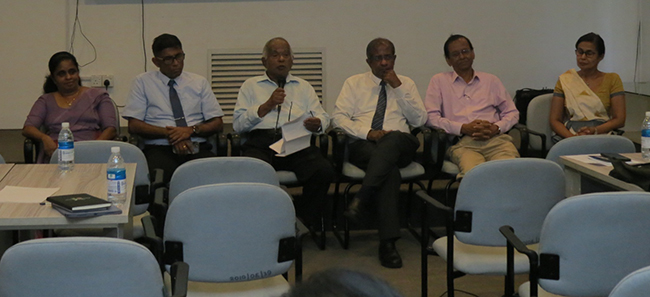
Sri Lanka is facing a growing “triple burden” of child malnutrition that demands urgent, science-driven intervention, a senior health official said at a recent forum organised by the National Science Foundation in Colombo.
Dr. Hiranya S. Jayawickrama, Consultant Community Physician attached to the Family Health Bureau (FHB) of the Ministry of Health, said that the country continued to grapple with undernutrition, micronutrient deficiencies and rising overweight among children, despite decades of maternal and child health interventions.
Addressing the Science Forum on Food Security held at the NSF auditorium recently, Dr. Jayawickrama said malnutrition in Sri Lanka was no longer limited to hunger or food scarcity, but had become a multidimensional public health challenge affecting children across all social strata.
She explained that undernutrition continued to manifest in the form of stunting, wasting and underweight among children. Stunting refers to chronic undernutrition over a long period, usually resulting in low length or height for age. Wasting, by contrast, indicates acute undernutrition and is characterised by low weight for length/height, often caused by sudden food shortages or illness. Underweight is a broader indicator reflecting low weight for age and may result from either chronic or acute undernutrition.
Dr. Jayawickrama said that micronutrient deficiencies, particularly Iron deficiency, remained widespread among children and mothers, while overweight and obesity were emerging as growing concerns due to changing dietary habits and increased consumption of foods high in sugar/starch, and fat including ultra-processed foods.
She identified several key drivers behind the crisis, with inappropriate infant and young child feeding practices as the leading underlying reason, with several other contributors such as recurrent infections, low birth weight, poverty, food insecurity and poor sanitation . Persistent myths and misconceptions surrounding child feeding, as well as parenting challenges, had also hampered progress, she said.
“Authentic sources of information is essential to obtain a clear understanding in addressing this issue,” Dr. Jayawickrama stressed, adding that national nutrition interventions must be guided by routine maternal and child health data collected by the FHB, research conducted by the Medical Research Institute (MRI), and national level surveys conducted by the Department of Census and Statistics.
Outlining the government’s response, she said the Ministry of Health was implementing an integrated Maternal and Child Health (MCH) package of evidence based interventions aimed at addressing malnutrition at multiple levels.
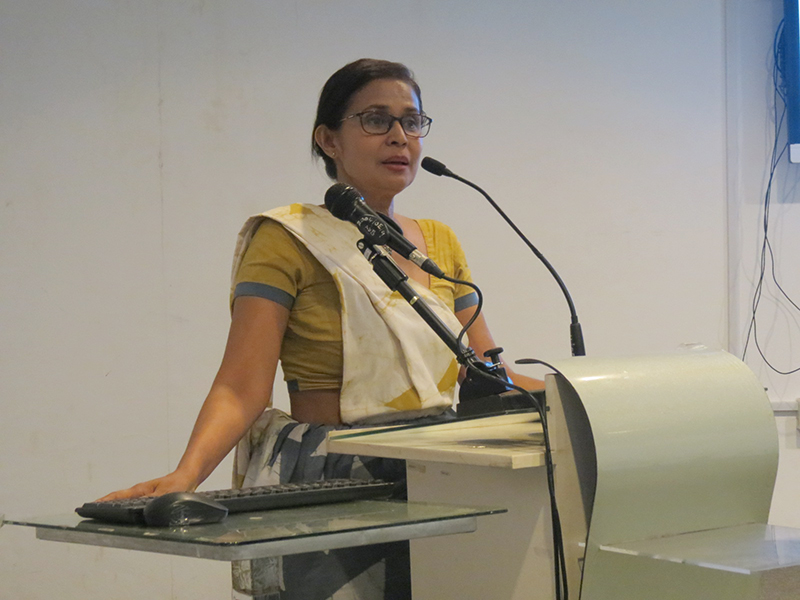
Dr. Hiranya S. Jayawickrama addressing the forum
Among the interventions highlighted were regular growth monitoring at clinics and field weighing posts, promotion of breastfeeding and appropriate complementary feeding practices which promote healthy, natural and home based food consumption, and micronutrient supplementation programmes.
Children receive Vitamin A mega-doses through the MCH programme, while multiple micronutrient powders are also distributed for home fortification of complementary food, she said.
Specialised nutritional support programmes have also been implemented. Thriposha is provided for children suffering from Moderate Acute Malnutrition (MAM), while BP-100 therapeutic food is provided to children diagnosed with Severe Acute Malnutrition (SAM) in hospital settings.
Dr. Jayawickrama said Public Health Midwives (PHMs) continued to play a frontline role through home visits, conducting field weighing posts, nutrition counselling sessions and awareness programmes targeting caregivers.
The interventions are being implemented under the framework of the National Nutrition Policy 2021–2030 and the Maternal and Child Health Policy 2012.
A significant focus of the presentation was the implementation of the Labelling and Advertising Regulations of 2022, which are expected to strengthen legal safeguards for children against misleading food marketing practices.
According to Dr. Jayawickrama, the regulations prohibit the advertising of infant formula intended for children aged below one year and milk-based products marketed for children aged between one and three years.
The regulations also ban the use of images featuring pregnant and lactating mothers, infants and children below the age of 12 years in food advertisements across television, print, digital and social media platforms.
In addition, promoting any food products to children under the age of 12 years is prohibited unless approval is obtained from the Chief Food Authority.
She warned that aggressive commercial promotion of ultra-processed foods including milk based commercial products for children undermines breastfeeding practices and healthy dietary behaviours among children.
Dr. Jayawickrama further explained that child nutrition services in Sri Lanka are monitored through a comprehensive electronic health management information system operated by the Family Health Bureau. Children are regularly assessed for weight, length/height and growth patterns at maternal and child health clinics and field weighing centres, while standard growth charts are used to identify early signs of growth problems and malnutrition.
The forum also featured presentations by Prof Buddhi Marambe, Emeritus Prof KKDS Ranaweera and Prof Ranuka Silva. NSF Chairman Dr Sudath Samaraweera and Director General Prof Shiromi Perera were also present.


A specialists committee has been appointed by the Secretary to the Ministry of Agriculture, Livestock, Lands and Irrigation adhering to the decision of the Cabinet of Ministers dated 29.12.2025 for submitting appropriate recommendations analyzing the provisions of the draft bill formulation in regard to Animal Welfare.
Based on the recommendations of the said Committee, the Legal Draftsman has been instructed at the meeting of the Cabinet of Ministers held on 18.05.2026 to prepare the final bill on the animal welfare.
Wherefore, the Legal Draftsman has formulated the draft bill and the clearance of the Attorney General has been received in the connection.
Accordingly, the Cabinet of Ministers granted approval to the resolution furnished by the Minister of Agriculture, Livestock, Lands and Irrigation to publish the said draft bill in the
Government Gazette Notification and subsequently forward the same to the Parliament for its concurrence.
Under the legal provisions for elections in this country since 2004, it is mandatory for voters who come to mark their votes to verify their identity through a valid identity card, and it is also mandatory for all such voters to be marked with an appropriate mark using indelible ink. The dual purpose of these two functions is to prevent a voter from voting more than once in a single election.
It has been observed that having to follow two different
methods at the same time to achieve the same objective hinders the efficiency of the duties performed at the polling stations and also incurs additional costs to the government.
Therefore, it has been deemed appropriate to remove the legal provisions regarding the use of indelible ink and marking the voter with the appropriate mark from all election acts.
Accordingly, the development activities of the province, as well as national security, will benefit. Therefore, the Cabinet of Ministers has approved the resolution furnished by the
President to take necessary steps to remove the legal provisions
• Section 36 of the presidential Election Act, No 15 of 1981
• Section 38 of the Parliamentary Election Act, No 01 of 1981
• Section 36 of the Provincial Council Election Act, No 02 of 1988
• Section 53 A of the Local Government Elections Ordinance (262 Authority)
• Section 21 of the Referendum Act No 7 of 1981
News
Showers will occur in the Western, Sabaragamuwa and North-western provinces and in Galle, Matara, Kandy and Nuwara-Eliya districts


WEATHER FORECAST FOR 24 JUNE 2026
Issued at 05.30 a.m. on 24 June 2026 by the Department of Meteorology
Several spells of showers will occur in the Western, Sabaragamuwa and North-western provinces and in Galle, Matara, Kandy and Nuwara-Eliya districts. Showers or thundershowers may occur at a few places in the Uva province and in Ampara and Batticaloa districts after 2.00 p.m.
Fairly strong winds about (30-40) kmph can be expectedat times over the Western slopes of the central hills, the Northern, North-central, North-western and Southern provinces and in Trincomalee district.
The general public is kindly requested to take adequate precautions to minimize damage caused by temporary localized strong winds and lightning during thundershowers.

Animal Welfare Draft Bill to be Gazetted
Legal provisions on marking voters using indelible ink during elections removed

Showers will occur in the Western, Sabaragamuwa and North-western provinces and in Galle, Matara, Kandy and Nuwara-Eliya districts

Court vacancy row throws Parliament into turmoil; sittings disrupted

Climate, pollution, forest loss now hitting economy: BASL chief

GSP+ in jeopardy: GL

‘Dates have the highest sugar content to fight Coronavirus’

Sunday Island 27 December – Headlines

#SundayIsland 17th December – Headlines

Sunday Island – 28th March

Sunday Island Headlines – 21 March

Sunday Island – 21st February – Headlines
-

 News5 days ago
Creditor receives USD 2.5 mn as Lankan public bears loss from theft of Treasury funds
-

 News4 days ago
Creditor not yet paid
-

 News4 days ago
Consumers bearing 22% tax burden despite 18% VAT claim: Dr. Harsha de Silva
-

 Opinion6 days ago
Beyond diagnosis: A strategic design for 7% growth by 2029 (Part I)
-

 Opinion5 days ago
SriLankan Airbus struck by lightning
-

 Features3 days ago
Nanda Pethiyagoda Wanasundara as three generations of family saw her
-

 Latest News3 days ago
Sooryavanshi thumps fastest List A fifty as India A win tri-series
-

 Editorial3 days ago
Fuel crisis: Beyond price debate