
News
Korea, UNDP launch $4.7 M Waste Management & Climate Resilience project

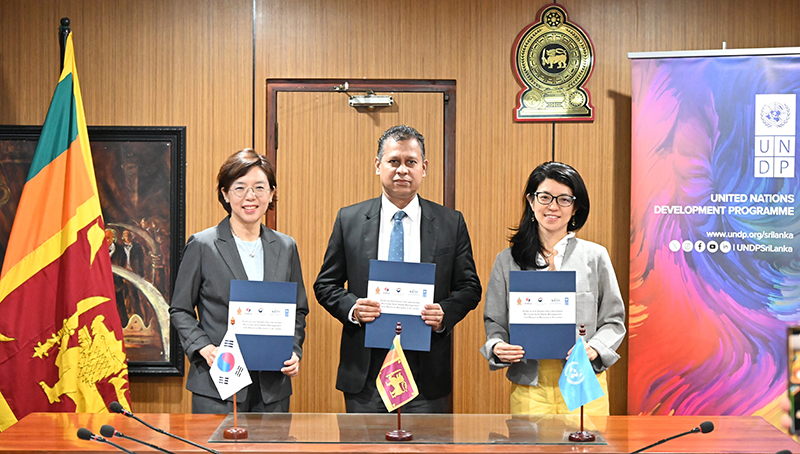
With support from Ministry of Climate, Energy and Environment of the Republic of Korea, UNDP Sri Lanka advances low-carbon and inclusive waste management solutions
The Ministry of Climate, Energy and Environment, Republic of Korea, through the Korea Environmental Industry and Technology Institute (KEITI), will provide USD 4.7 million for a new initiative, entitled ‘Scale-up and Sustain the Low-Carbon Municipal Solid Waste Management and Resource Recovery in Sri Lanka’ which will be implemented by the United Nations Development Programme (UNDP) in Sri Lanka together with the Ministry of Public Administration, Provincial Councils and Local Government. The three-year project will promote sustainable, low-carbon and locally appropriate solutions to transform municipal solid waste management in two selected Local Authorities within the Central and Sabaragamuwa provinces.
A symbolic signing ceremony took place yesterday with the participation of S. Aloka Bandara, Secretary to the Ministry of Public Administration, Provincial Councils & Local Government; Miyon LEE, Ambassador of the Republic of Korea to Sri Lanka; and Azusa Kubota, Resident Representative, UNDP in Sri Lanka, along with representatives from the partner organisations.
Sri Lanka generates more than 10,000 tons of municipal solid waste daily, of which only half is collected, and a small fraction is properly treated. The remainder is commonly dumped or burned in open sites, creating significant environmental, health and social risks. Previous interventions faced persistent challenges, including mismatched technologies, financial and institutional constraints and limited community participation. In addition, the waste sector is often among the sectors most severely impacted by climate change and natural disasters, as witnessed during the recent Ditwah cyclone and floods, which severely overwhelmed the existing capacities of local authorities and exposed vulnerable communities engaged in waste management activities.
Highlighting the importance of advancing sustainable waste management, S. Alokabandara, Secretary, Ministry of Public Administration, Provincial Councils and Local Government, said, “Strengthening municipal solid waste management is a national priority, and this project marks a significant step forward. By working closely with UNDP and our partners, we are translating policy into action, building systems that are locally grounded, environmentally responsible, and capable of delivering long-term benefits to our communities. This initiative is a vital investment in public health, environmental protection and the resilience of future generations”.
This new project seeks to address these barriers by strengthening decentralised waste management systems within the jurisdiction of local authorities, thus avoiding the logistical and social difficulties, as well as the higher costs, associated with cross-boundary waste transport. UNDP Sri Lanka will lead implementation in close collaboration with the Government of Sri Lanka at provincial and local levels, together with the Ministry of Public Administration, Provincial Councils and Local Government, local authorities, private sector partners and Korean technical agencies.
Addressing Korea’s keen interest in assisting Sri Lanka for sustainable development and climate change initiatives, Miyon Lee, the Ambassador of the Republic of Korea, welcomed the launch of this project and wished its successful implementation. She reaffirmed Korea’s commitment to sharing its advanced technology, experience and resources with Sri Lanka in building an effective solid waste management system that will accommodate sustainable solutions across four provinces in the country.
Emphasising the need for integrated and inclusive solutions to Sri Lanka’s waste challenges, Azusa Kubota, Resident Representative, UNDP in Sri Lanka, noted, “This project comes at a critical time for Sri Lanka. With KEITI’s support, we are investing in solutions that are not only environmentally sound, climate-proofed and disaster-resilient but also economically viable and socially inclusive. Our objective is to support communities to manage waste more effectively, reduce greenhouse gas emissions and create green jobs, while strengthening the resilience of local systems and institutions.”
Adding to this, Rhyunmin Park, (Environment Adviser), UNDP Bangkok Regional Hub, also expressed his commitment to collaborating through this project to lay the foundations for sustainable waste management across the Asia-Pacific region.
Strategic waste management plans will be developed in four provinces, namely, the Northwestern, Central, Sabaragamuwa and Southern provinces, while comprehensive demonstration projects will be implemented in the Gampola and Balangoda Urban Councils. In Gampola, an anaerobic digestion plant and pyrolysis technology will be introduced, targeting a reduction of 168,630 metric tons of carbon dioxide equivalent emissions over 10 years, while vermicomposting and pyrolysis will be applied in Balangoda, with an expected reduction of 100,740 metric tons.
Further highlighting the priority of the Government of Korea’s support in this area, Ms. Eunhae Jung, Director General for International Cooperation Bureau, Ministry of Climate, Energy and Environment, Republic of Korea, stated, “This project with UNDP Sri Lanka demonstrates our commitment to advancing global climate action through practical and scalable solutions. Beyond emission reductions, it is meaningful as it empowers local governments and communities to take the lead in sustainable waste management. By sharing our expertise and innovative technologies, we hope the progress made here will serve as a model for other countries.”
Beyond infrastructure, the initiative will foster behavioural change and innovation. It will promote waste minimisation through ‘refuse, reduce and reuse’ practices, improve segregation at source, and pilot smart waste collection systems using digital applications. Knowledge-sharing and capacity development will be central to ensuring that the interventions are replicable and scalable.
The project is structured around four key components: strengthening policy and institutional frameworks; demonstrating best-fit waste management technologies; developing green financing models and public-private partnerships; and establishing robust monitoring and evaluation systems. Gender-responsive approaches will be integrated throughout, ensuring women’s meaningful participation in decision-making and addressing the disproportionate burdens they face in waste-related labour.
This initiative represents a significant step towards achieving Sri Lanka’s climate commitments under the Paris Agreement, including its five waste sector Nationally Determined Contributions (NDCs). By reducing emissions, enhancing resource recovery and fostering inclusive green growth, the project will contribute directly to the country’s progress towards multiple Sustainable Development Goals, including good health and well-being, sustainable cities and communities, climate action and decent work and economic growth.


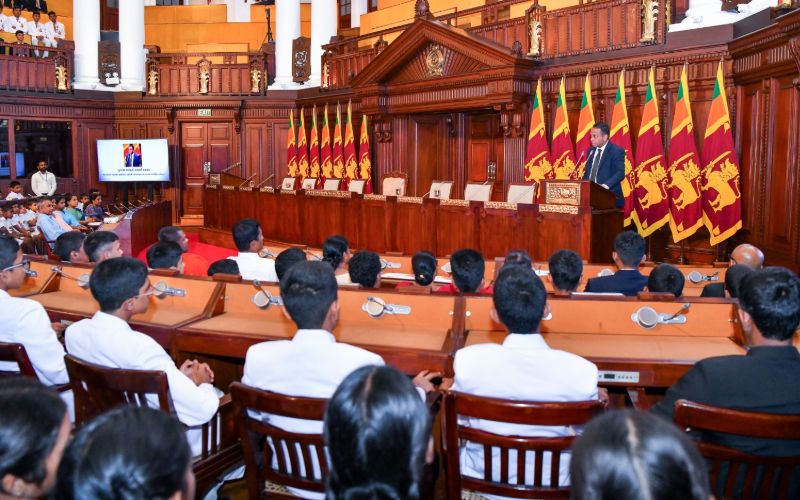
Marking the completion of two years of the ‘Vision’ Programme, students from Pinnawala Central College and Matale Siri Seevali College were given an opportunity on Thursday (24) to visit the Presidential Secretariat.
The ‘Vision’ Programme was launched for schoolchildren jointly by the Presidential Secretariat, the Ministry of Education and the Department of Communication of the Parliament of Sri Lanka.
Following a visit to the former Parliament building at the Presidential Secretariat, the students were also briefed on the history of Parliament.
The role of the President’s Fund and its importance to schoolchildren were explained by Senior Additional Secretary to the President Roshan Gamage.
The ‘Vision’ commemorative book, featuring the two-year journey of the ‘Vision’ Programme and its special activities, was also presented to the participating schools.
As part of the programme, valuable plants were also presented to the schools as a symbolic gesture underscoring the importance of environmental conservation.
Director General of Public Relations Dharmasiri Gamage, the Director and Assistant Director of the Tri-Services Security Coordination Unit, the principals and teaching staff of Pinnawala Central College and Matale Siri Seevali College, and students were among those present on the occasion.
President’s Media Division (PMD)
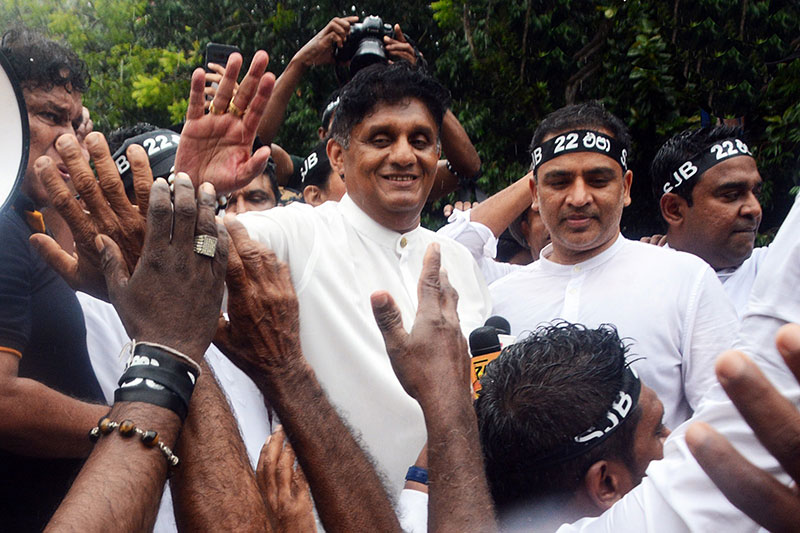
Opposition and SJB Leader Sajith Premadasa yesterday vowed that an SJB government would repeal the 22nd Amendment (22A) to the Constitution.Premadasa made the pledge while addressing thousands of SJB supporters who gathered near Parliament to protest against 22A.
Addressing the rally at Polduwa Junction, Battaramulla, Premadasa said the proposed constitutional amendment would undermine democracy and judicial independence and enable the concentration of political power in the Executive.
“Even if they pass it, under an SJB government we will scrap it,” Premadasa told the gathering, claiming that 22A was aimed at paving the way for a one-party state and placing the State under the control of a single political party.
Braving the rain, Premadasa said they had gathered there peacefully and had no intention of resorting to violence.
“We have gathered here to protect democracy,” he said, challenging the government to hold Provincial Council elections if it was confident of facing the people.
Premadasa said the SJB was prepared to work with any democratic and clean political force committed to the country’s progress and public welfare, amid ongoing discussions on cooperation among Opposition parties, including the United National Party.
Premadasa also accused groups aligned with the government of attempting to discourage people from attending the protest through statements and other measures.
SJB General Secretary Ranjith Madduma Bandara said the protest had been organised against the proposed amendment, which the party had opposed on the grounds that it could pave the way for authoritarianism.
The demonstration began around 9 a.m. at Polduwa Junction and coincided with Parliament taking up the proposed 22nd Amendment for debate. Proceedings on the Bill are scheduled to continue today (25).
The Supreme Court has determined that the proposed amendment does not require approval at a referendum and could be passed with a special majority in Parliament.
Meanwhile, traffic congestion was reported on roads surrounding Parliament and Polduwa Junction following the demonstration.
Security was also tightened in and around the Parliamentary complex, with a heavy police presence observed at Polduwa Junction and near the main entrance to Parliament.

Two retired female Navy petty officers were ordered to be remanded until October 5 over their alleged involvement in the abduction and disappearance of two women in Trincomalee during the war.
Trincomalee Chief Magistrate M.S.M. Samsudeen yesterday ordered that the two suspects be remanded and directed that they be produced for an identification parade on October 5.
The suspects, residents of Chilaw and Haputale, were arrested after appearing before the CID in connection with another court case. They were subsequently produced before the Trincomalee Magistrate’s Court.
The court was informed that the investigation concerned the alleged abduction of Sasikumar Thenmoli and Mary Delsia, residents of Paalaiyootru, Trincomalee, on or around May 13, 2008.
The CID told court that information uncovered during its investigations indicated that the two women had allegedly been detained at an underground location known as the “Gun Site” at the Trincomalee Naval Base while the two suspects were serving in the Navy. The women were subsequently reported missing.
Further investigations into the alleged abduction and disappearance of the two women are continuing.

Lalit Rajbanshi, Kushal Bhurtel set up Nepal’s opening win

‘Vision’ Programme Marks Two Years

Costa Rica minister fired for unapproved meeting with Trump in US

At least 41 die as boat capsizes in DRC’s Lake Tanganyika

Showers will occur at times in the Western, Sabaragamuwa, Southern, Central and North-western provinces

Sajith vows to scrap 22A under future govt.

‘Dates have the highest sugar content to fight Coronavirus’

Sunday Island 27 December – Headlines

#SundayIsland 17th December – Headlines

Sunday Island – 28th March

Sunday Island Headlines – 21 March

Sunday Island – 21st February – Headlines
-

 News7 days ago
Shanakiyan urges urgent action over reported death sentence for Lankan in Saudi Arabia
-

 News6 days ago
Namal Rajapaksa Buddhist gambit fails, bail denied
-

 Features6 days ago
Why the spelling Sri Lankan names in English vary
-

 Features6 days ago
Three bands, a new identity: Sri Lankan wolf snake recognised as distinct species
-
 Business6 days ago
SLIIT holds largest-ever convocation
-

 News6 days ago
Vehicle prices drop by up to Rs. 1 mn, says importers’ body
-

 News6 days ago
Govt monitors reported Saudi death sentence – Foreign Ministry
-

 Business6 days ago
All-new Bolero MaXX Pik-Up unveiled in Lanka