
Latest News
ICC and World Cricketers Association clash over player terms ahead of T20 World Cup


The ICC and the global players’ body the World Cricketers Association (WCA) are locked in a fresh tussle over player terms, including name, image and likeness (NIL) rights, ahead of the 2026 Men’s T20 World Cup.
The WCA claims the ICC has sent a version of the squad participation terms to players from several countries in the tournament that does not align with an agreed version signed by both bodies in 2024. The WCA claims the new, non-agreed version is exploitative when compared to the 2024 version.
WCA had written to the ICC about these concerns and ESPNcricinfo understands the ICC, in its response, disagreed, saying the 2024 agreement was only applicable to eight member boards (referred to as National Governing Boards, or NGBs). The ICC told WCA that the remaining members who are part of this World Cup were not bound by the 2024 agreement.
The eight NGBs are Australia, England, New Zealand, South Africa, West Indies, Ireland, Netherlands and Scotland – in as a replacement for Bangladesh, who have been excluded after they refused to travel to India. Of the remaining 12 participating countries, boards from India, Pakistan, Sri Lanka, Nepal, Oman and the UAE do not recognise WCA and hence their players are not affiliated with it. Italy, Zimbabwe, Afghanistan, Namibia, USA and Canada have player bodies but had not received the squad terms as of January 15, and were expected to get the non-approved version, the WCA said in a memo.
In its follow-up response, WCA told the ICC that the 2024 agreement stated it was applicable to all players affiliated with the players body – both that were participating in the World Cup and from countries that were not part of the 20-team tournament. As a result, WCA noted, all players should be protected by the 2024 agreement, which it believes is legally binding.
WCA sent a memo on January 15 informing players that the squad terms distributed by ICC were “substantially different” to the agreed 2024 version. It is understood WCA also sent an email to ICC on the same day.
Tom Moffat, the WCA CEO, highlighted differences across eight areas between the two versions: content/media appearances, behind the scenes content, changing room access, biological player related data, licensing, name, image likeness (NIL), player agreement and dispute resolution.
The WCA’s broader contention was that the 2024 agreement gave players the right to decide, and negotiate via the global players body, whereas the ICC version says player consent is not needed, with their boards having that authority.
An example of the significant differences is NIL rights, according to the communication Moffat sent to players. In the ICC’s new version, “the player is required to license their NIL to any third party; 3 players from the same team can be used by an ICC Partner for commercial content which can directly relate to the promotion of the Partners brand or product; the player’s national board approves all use of NIL on behalf of the player; Any use of NIL outside of the Squad Terms can be agreed by the player’s national board.”
In the 2024 agreement, the NIL rights were “restricted” only to the ICC’s commercial partners and the event hosts and the WCA is authorised on behalf of the players to negotiate terms and use. The 2024 version also said a group of players – not three per team – would be “represented in all content” promoting the ICC tournament.
There are significant differences in the terms for the usage of player data during the event as well. The WCA said in the ICC version, the governing body “can use and commercialise player data with the agreement of the player’s national board” and that the ICC “owns” the data. The approved version, WCA said, says the player owns the data and their consent is necessary “given the sensitivities.”
In the ICC version, once the players participate in a global tournament, “he /she is deemed to have accepted the Squad Terms regardless of whether they sign the Terms.” In the version agreed between the WCA and ICC, the players are required to agree the terms and sign for every event separately.
In the memo to players, Moffat accused the ICC and member boards of “deliberately removing” all the protection that players were assured of in the 2024 terms, while “attempting” to “own” players and “claim an almost unlimited ability to use and commercialise it with third parties without your consent, with the only recourse to an in-house dispute resolution process run by the ICC itself .” Moffat also said the ICC and member boards were trying to “exploit the most vulnerable, and worst paid player groups at this World Cup, some of whom are amateur,” through the non-approved version.
This week, Moffat told ESPNcricinfo that the WCA did not want to disrupt the World Cup, but admitted being “deeply concerned” by ICC presenting terms that did not “align” with the 2024 agreement. “The (ICC) terms provided significantly erode player rights and protections including around image and commercial use, compared to those agreed,” Moffat said. “It is especially concerning that it is the most vulnerable playing groups who appear to have been targeted and expected to compete under different terms and conditions to other playing groups participating in the same Men’s T20 World Cup. For many players affected, participation in ICC Events represents a primary source of income and career progression.
“The WCA supports the growth of the game and ICC events, but these objectives should be pursued in partnership with players, not at their expense. The agreed Squad Terms have now been signed by impacted WCA players, and our expectation is for these terms to be honoured by the ICC for the T20 World Cup.”
It is understood the ICC has not responded to WCA’s follow-up mail sent earlier this week. The ICC has been asked for a comment.
[Cricinfo]

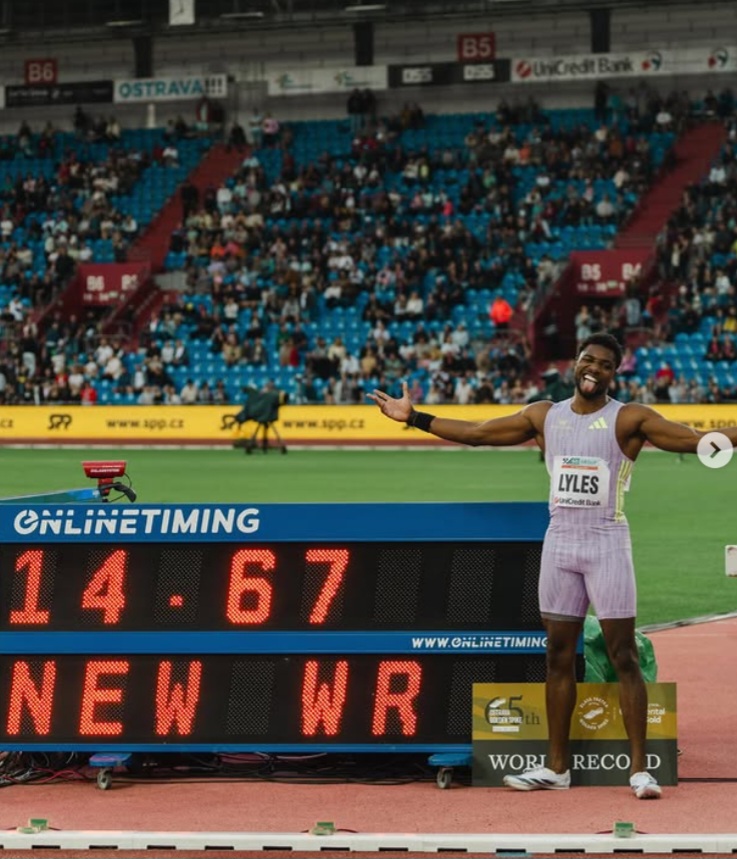
United States sprinter Noah Lyles has set the world’s best-ever time over the rarely-run 150 metres race, clocking 14.67 seconds at the Golden Spike meet in the eastern Czech city of Ostrava.
The 28-year-old Lyles on Tuesday beat the previous best of 14.72 set by Kishane Thompson of Jamaica in Florida in April.
At Ostrava, Lyles beat Sinesipho Dambile of South Africa with 14.78, while Australian teenager Gout Gout finished third in 14.96.
“Was there ever any doubt? Was there ever any doubt? We came for a show,” an elated Lyles told Czech TV.
Earlier this month, Lyles took a comfortable win at the Wanda Diamond League meet in Rome with a 9.88 in the 100m, his fastest since clinching gold at the Paris 2024 Olympics.
The high-energy, anime-loving showman has had strong indoor and outdoor performances throughout the year so far, and was named on this year’s Time100 list of the most influential people.
Dutch star Femke Broeders-Bol had to bow to in-form Swiss Audrey Werro in her outdoor debut in the 800m.
The 26-year-old Broeders-Bol has switched from 400m hurdles, in which she had won two world gold medals, and clocked an impressive 1 minute 57.13 seconds for second place.
“It was so cool, I love racing in Ostrava. It was tough, but I enjoyed it,” she said.
Broeders-Bol has also claimed multiple medals as the anchor leg in 4x400m relay teams, notably a gold in the mixed event in the Paris Olympics.
She ran her first 800m since 2017 in February, clocking a national record of 1 minute 59.07 seconds before withdrawing from the rest of the indoor season to nurse a foot injury.
The 22-year-old Werro won in 1 minute 54.45 seconds, half a second behind her personal best from March, after shedding Broeders-Bol with 200 metres to run.
“It was a really crazy run, but the time is very good, so I’m really happy,” Werro said.
Having set the eighth best time ever, she stayed over a second behind the oldest world record in athletics of 1:53.28 set in 1983 by Jarmila Kratochvilova of then-Czechoslovakia, who watched the race from the stands.
South Africa’s 20-year-old Bayanda Walaza won the men’s 100m as he equalled his personal best of 9.94 seconds, beating Emmanuel Eseme of Cameroon with 9.99 seconds.
US favourites Ronnie Baker and Jordan Anthony were demoted to the fourth and fifth spots, respectively, with times well over 10 seconds.
[Aljazeera]
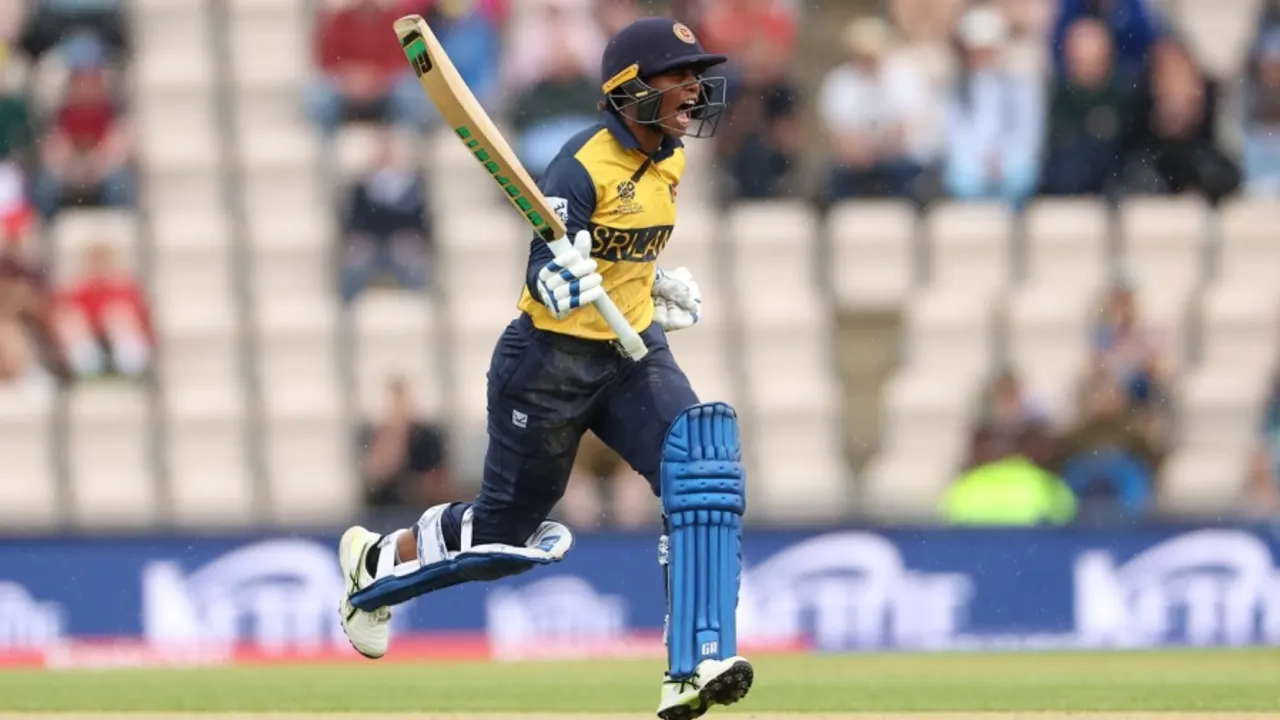
An outstanding fifth-wicket stand and an even better sixth-wicket partnership electrified a Sri Lanka chase and propelled them to a tight final-over win against New Zealand. Nilakshika Silva was the primary architect. Having arrived at the crease at 55 for 4, with the required rate soon climbing above nine, she produced her finest international innings – a perfectly-paced 54 not out off 37 that saw Sri Lanka to victory with two balls and five wickets to spare.
Nilakshika had serious support in the two partnerships she was involved in. Kavisha Dilhari joined her for a 50-run stand that repaired the innings, though New Zealand were still firm favourites when they were parted with 45 still needed off 30 deliveries. Kaushini Nuthyangana, who had already had a good game behind the stumps, then hit a nerveless 24 not out off 14, outpacing even Nilakshika during a stand that yielded 48 runs off 28 deliveries.
New Zealand were scuttled by their own poor catching again. Had Bree Illing held a sitter at short fine leg in the 10th over, Nilakshika would have been out for only 1, and New Zealand would have claimed five wickets in five overs. Their ground fielding also fell away during the last few overs, when Sri Lanka’s batters were beginning to reverse pressure effectively.
Their batting had also been reined in by a tight Sri Lankan bowling effort, in which the spinners imposed themselves. Sophie Devine and Melie Kerr hit 45 each, but 150 for 6 always seemed a little light on a Southampton surface that was a little slow, but remained largely good for batting.
The loss means New Zealand have lost their two opening matches, and must now treat games against England, Scotland, and Ireland as must-wins. Sri Lanka, meanwhile, are on the points table following their opening defeat at the hands of England. They will now prepare for the match against West Indies on Sunday. A victory there will set them up beautifully for a semi-finals push.
Nilakshika resurrects Sri Lanka
When Nilakshika arrived, Sri Lanka were down to their last three recognised batters, with 95 runs to get off 57 deliveries. It was clear she was timing the ball nicely from the outset, but she repeatedly had trouble piercing the infield and did not find her first boundary until the 13th ball she faced. Thankfully for Sri Lanka, Dilhari was buoyant through the early phase of this partnership, never allowing the required rate to climb too far out of reach.
After the 12th over, however, Nilakshika began to find the open spaces. There were fours through wide mid on and extra cover, and then a six over the head of Devine at deep midwicket, who could have pouched that catch had she stood closer to the rope.
A running mix-up, which perhaps was Nilakshika’s fault, cost Dilhari her wicket. But that only seemed to solidify the resolve within Nilakshika to see the chase through. She was magnificent through the last five overs, finding vital boundaries just as the pressure was mounting, while finding singles in between. With 28 runs needed off the last two overs, it was Nilakshika’s two boundaries off Melie in the 18th that swung the match more decisively in Sri Lanka’s favour. One was a bent-kneed square drive through cover point when Melie had hung the ball out wide. One was a sweep she blasted past Jess Kerr at fine leg.
Nuthyangana shines behind the stumps and with bat
Nuthyangana produced both Sri Lanka’s first piece of brilliance in this game, as well as their last. Her low catch to dismiss Isabella Gaze off the bowling of slinger Mithali Amodhya set the tone for a spirited Sri Lanka fielding performance. She would go on to claim two further catches – running hard towards fine leg to get under one high chance, plus an easier take to dismiss Brooke Halliday, though she did instigate the review that overturned the not out decision.
It will be for her batting that she will be remembered in this game, however. She’d had a high score of 19 not out in 10 T20I innings before this, but played a near-flawless finishing hand alongside Silva. Her first two boundaries came through wide long on, but crucially, she also found the singles and twos in between these bigger blows. With two required off three balls, she spanked one through square leg to spark beaming smiles and joyful celebrations in the Sri Lanka dugout.
Devine and Kerr hold NZ together
In the absence of Suzie Bates, Devine and Kerr were easily New Zealand’s most experienced batters, and they hit 45 apiece to keep the New Zealand innings above water. Kerr enjoyed a 49-run stand with Georgia Plimmer, though both batters failed to find frequent boundaries in the powerplay. Devine later led New Zealand through the middle overs, as Sri Lanka’s spinners found breakthroughs, striking at 150.
NZ’s four in four
New Zealand’s best passage in the game came between overs five and nine in Sri Lanka’s innings, in which they claimed four wickets for 10 runs. Offspinner Nensi Patel struck twice through this spell, eventually finishing with New Zealand’s best figures of 2 for 23. Bree Illing took the important wicket of Chamari Athapaththu, who made 27. The other wicket came from an excellent direct hit run out from Melie Kerr.
SCORES:
Sri Lanka Women 153 for 5 in 19.4 overs (Vishmi Guneratne 17, Chamari Athapaththu 27, Kavisha Dilhari 17, Nilakshika Silva 54*, Kaushini Nuthyangana 24*; Bree Illing 1-33, Nensi Patel 2-23) beat New Zealand Women 150 for 6 (Georgia Plimmer 18, Sophie Devine 45, Melie Kerr 45, Maddy Green 18*; Mithali Ayodya 1-24, Sugandika Kumari 1-28, Chamari Athapaththu 1-21, Nimasha Meepage 1-26, Kavisha Dilhari 2-35) by five wickets
[Cricinfo]
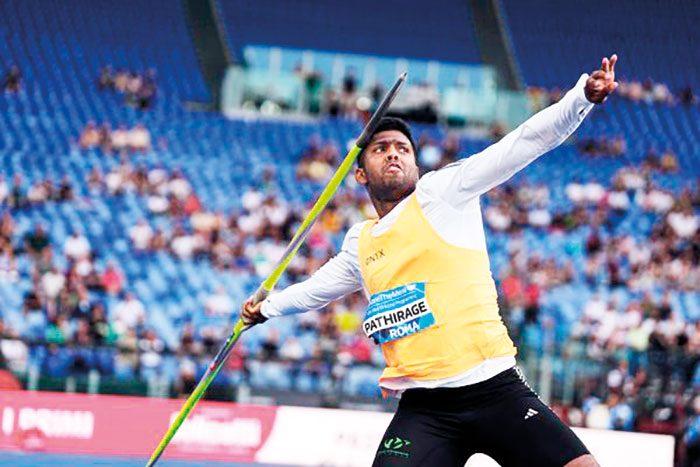
Rumesh Tharanga will head to the Doha Diamond League as the athlete to beat following a commanding victory at the Ostrava Golden Spike on Tuesday.
Fresh from his recent record-breaking exploits, Tharanga once again stamped his authority on the world stage, dominating the competition with three throws beyond the 85-metre mark. Remarkably, any one of those efforts would have been enough to secure victory.
The 23-year-old produced his best throw of 86.57 metres in the third round to claim top honours ahead of two-time world champion Anderson Peters, who finished second with a best effort of 84.27 metres.
Tharanga’s consistency throughout the competition underlined his status as one of the world’s leading javelin throwers. His latest triumph further strengthens his credentials ahead of the Doha Diamond League, where he is expected to be among the favourites alongside World champion Keshorn Walcott, two-time world champion Anderson Peters and world bronze medallist Curtis Thompson.
Tuesday’s victory continues a remarkable season for the former Peterite, who has emerged as a genuine contender on the international circuit with a string of world-class performances. [RF]

Plans to open underutilised state land for new investment opportunities

National Export Development Plan (2026–2030) presented to the President

Iran draw 2-2 with New Zealand in politically charged World Cup match

US sprinter Noah Lyles sets world best 150m time at Golden Spike meet

Nilakshika, Nuthyangana stun New Zealand to seal famous win for Sri Lanka

Showers will occur in the Western, Sabaragamuwa and North-western provinces and in Galle, Matara, Kandy and Nuwara-Eliya districts.

‘Dates have the highest sugar content to fight Coronavirus’

Sunday Island 27 December – Headlines

#SundayIsland 17th December – Headlines

Sunday Island – 28th March

Sunday Island Headlines – 21 March

Sunday Island – 21st February – Headlines
-

 News5 days ago
CIABOC summons Yoshitha over his participation in British Navy training programme
-

 Sports2 days ago
Tharanga set for high-profile javelin clash in Ostrava
-

 News5 days ago
Justice Minister responds to social media claims he represented Easter Sunday ringleader
-

 News4 days ago
Commonwealth lawyers urge Lanka to uphold rule of law
-

 Features3 days ago
Politics of protected species
-

 News2 days ago
Theft of USD 2.5 mn from Treasury: CoPF accused of complicity in NPP cover-up
-

 News1 day ago
Beijing Capital Airlines to resume flights to Colombo signalling boost to tourism
-

 News2 days ago
Release of 2025 O/L results likely to be delayed