
Opinion
Remembering Cedric, who helped neutralise LTTE terrorism

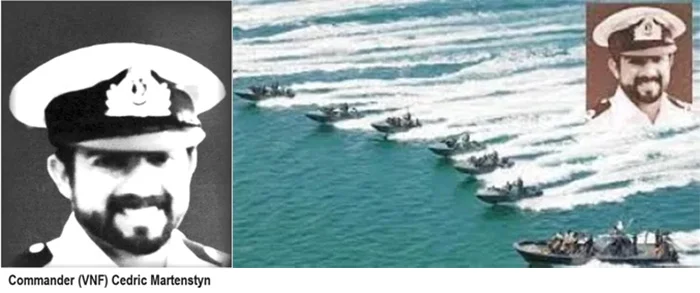
Salute to a brave father-son
Cedric Martenstyn was a very affluent man. He owned a house in Colombo 7, valuable properties throughout the country, vehicles / speed boats and ran the lucrative business of importing Johnson and Evinrude Outboard Motors (OBM) and sold them to local fishermen and businessmen.
Cedric was the local agent for the OBMs, which were known for reliability and after-sales service, and among his customers were humble fishermen. He was fondly known as Sudu Mahattaya “(white Gentleman) by humble fishermen and he would often travel in his double cab across the country to meet his customers and solve their problems.
He had a loving wife and children. He was an excellent scuba diver, member of Sri Lanka Navy Practical Pistol Firing team and his knowledge of wildlife and reptiles was amazing.
A member of the Dutch Burgher community of Sri Lanka, he was a true patriot, who volunteered to protect country and people from terrorists. An old boy of S. Thomas’ College, Mount Lavinia, he was an excellent sportsman.
The founding father of Sri Lanka Army Commando Unit, Colonel Sunil Peris, was his classmate at S.Thomas’.
I first met Cedric when I was a very junior officer at Pistol Firing Range at Naval Base, Welisara. I helped him catch a poisonous snake in the Range. I think he carried that snake home in a bottle! That was the type of person Cedric was!
We became very close friends as we both loved “guns and fishing rods”. His experience and tactics in angling helped me catch much bigger Paraw (Trevallies) in the Elephant Rock area at the Trincomalee harbour. He was a dangerous man to live with at Trincomalee Naval Base wardroom (officers’ mess), because he had various live snakes kept in bottles and fed them with little frogs!
Even though he was a keen angler, he was keen to conserve endangered species both on land and in water. He spent days in Horton Plains and the Knuckles Mountain Range streams to identify freshwater species in Sri Lanka. Did you know there is an endangered freshwater fish species he found in Horton Plains and Knuckles Mountain Range has been named after him?
Feeding of snakes was an amusement to all our stewards at the wardroom at that time! They all gathered and watched carefully what Cedric was doing, keeping a safe distance to run away if the snake escaped. Our Navy stewards dare to enter Cedric’s cabin (room) at Trincomalee wardroom (officers’ mess), even keeping his tea on a stool outside his cabin door. One day pandemonium broke in the officers’ mess when Cedric announced that one snake escaped! We never found that snake, and that was the end of his hobby as the Commander Eastern Naval Area, at that time, ordered him to ” get rid of all snakes! Sadly, Cedric released all snakes to Sober Island that afternoon.
Cedric was a volunteer Navy officer, but still joined me (he was 47 years old then) to help SBS trainees (first and second batch) on boat handling and OBM maintenance in 1993, when I raised SBS. It was exactly 31 years ago!
The Arrow Boat
Being an excellent speed boat race driver and boat designer, he prepared the blueprint of the first “18-foot Arrow Boat” and supervised building it at a private Boat Yard in 1993. This 18- foot Arrow Boat was especially designed to be used in the shallow waters of the Jaffna lagoon, fitted 115 HP OBMs, and with two weapons he recommended; 40mm Automatic Grenade Launcher (AGL) and 7.62×51 mm General Purpose Machine Guns (GPMGs). In no time, we had highly trained and highly motivated four SBS men on board each Arrow Boat at Jaffna lagoon, and they were very effective.
Same hull (deep V hull) developed during the tenure of Admiral of the Fleet Wasantha Karannagoda, as Commander of the Navy, by Naval architects, with knowledge-gained through captured LTTE Sea Tiger boats, designed 23- foot Arrow Boats and implemented the “Lanchester Theory” (theory of battle of attrition at sea in littoral sea battles) to completely nullify LTTE’s superiority which it had gained with small craft and deadly suicide boats.
Thank you, the Admiral of the Fleet for understanding the importance of Arrow Boat design and mass production at our own boatyard at Welisara. Karannagoda, under whom I was fortunate to serve as Director Naval Operations, Director Maritime Surveillance and Director Naval Special Forces during the last stages (2006/7) of the Humanitarian Operations, always used to tell us “You cannot buy a Navy- you have to build one”! Thank you, Sir!
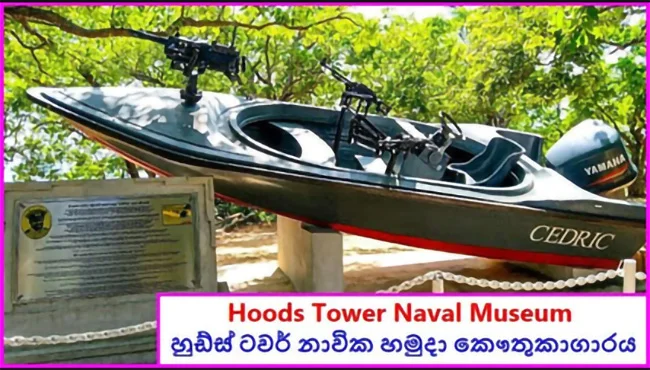
Cedric craft display at Naval Museum, Trincomalee
The Hero he was
When I was selected for my Naval War Course (Staff Course) conducted by the Pakistan Navy Staff College at Karachi, Pakistan, (now known as Pakistan Navy War College relocated at Lahore), Cedric took over the command (even though he was a VNF officer) as Commanding Officer of SBS.
Being one of the co-founders of this elite unit, he was the most suitable person to take over as CO SBS. He was loved by SBS officers and sailors. They were extremely happy to see him at Kilali or Elephant Pass, where SBS was deployed during a very difficult time of our recent history – fighting against terrorists during the 1996-97 period.
Motivated by father’s patriotism, his younger son, Jayson, who was a pilot working in the UK at that time, came back to Sri Lanka and joined the SLAF as an volunteer pilot to fly transport aircraft to keep an uninterrupted air link between Palaly (Jaffna) and Ratmalana (Colombo). Sometimes Jayson flew his beloved father on board from Palaly to Ratmalana. Cedric was extremely happy and proud of his son.
Tragically, young Jayson was killed in action in a suspected LTTE Surface-to-Air missile attack on his aircraft. Cedric was sad, but more determined to continue the fight against LTTE terrorists. He would also lead the rescue and salvage operation to identify the aircraft wreckage his son flew in. The then Navy Commander advised him to demobilise from VNF and look after his grieving family or join Naval Operations Directorate and work from Colombo which he vehemently refused. When I called him from Pakistan to convey my deepest condolences, he said, he would look after the “SBS boys”, he had no intention of leaving them alone at that difficult hour of our nation. That was Cedric. He was such a hero—a hero very few knew about!
The young officers, and sailors in SBS were of his sons’ age, and Cedric would not leave them even when he was facing a personal tragedy. He was a dedicated and courageous person.

Scientific name: Systomus Martenstyni
English name : Martenstyn’s Barb
Local name: Dumbara Pethiya
Sadly, like many who served our nation and stood against terrorists, Cedric would go on to be considered Missing In Action (MIA) following a helicopter crash off the seas of Vettalikani with Lt. Palihena (another brave SBS officer- KDU intake). He was returning to Point Pedro after visiting the SBS boys at Elephant Pass, Jaffna.
Cedric and his son, Jayson, will go down in history as a brave father-son duo who paid the supreme sacrifice for the motherland. MAY THEY REST IN PEACE ! Salute!
Commander Martenstyn was considered missing in action (MIA) on 22 January 1996 in the sea off Vettalaikerni, while returning to Palaly Air Force Base in an SLAF helicopter when it was lost to enemy fire. He was returning from visiting an SBS detachment in Elephant Pass near the Jaffna Lagoon. Considering his contribution to the war effort, his gallentry and valour in fighting the enemy, and his steadfast service to the Sri Lanka Navy in manufacturing Arrow Boats, and training the SBS, all SLN Arrow Boats were renamed ‘Cedric’ on his 70th Birthday.
(The writer is former Chief of Defence Staff and Commander of The Navy, and former Chairman of the Trincomalee Petroleum Terminals Ltd.)
By Admiral Ravindra
C Wijegunaratne
(Retired from Sri Lanka Navy)
Former Chief of Defence Staff and Commander of the Sri Lanka Navy,
Former Sri Lanka High Commissioner to Pakistan


Had former Sri Lankan President Ranasinghe Premadasa lived to celebrate his 102nd birthday, it would have fallen on June 23, 2026. Premadasa, a politically self-made leader from humble beginnings, served as the second Executive President of Sri Lanka from 1989 until his assassination in 1993. He was the first non-aristocratic “commoner” to rise to the nation’s highest office, breaking the long-standing dominance of the landed elite, high-caste aristocracy, and wealthy political families. Emerging from modest social origins, Premadasa represented a rare example of social mobility in Sri Lankan politics. He often marked his birthdays in remote villages through the “Gam Udawa” (Village Reawakening) programme.
It is fitting to begin this column with an anecdote connected to Gam Udawa. Following the Gam Udawa ceremony in Buttala, Premadasa took a helicopter ride with several officials and identified a site in Mahiyangana for the next programme. He instructed the Director of Town and Country Planning to prepare a sketch plan for the location.
When the Director later returned to Colombo and met the President, Premadasa asked, “Where is the sketch plan?” Instead of producing a plan, the Director handed over a small piece of paper and said, “Sir, when I stepped out of the vehicle, a youth handed me this note.”
Premadasa brought the note to a meeting at Sethsiripaya attended by nearly one hundred officials and read it aloud. The message stated: “If you visit again, you will not leave alive.”
Holding up the note before the gathering, Premadasa asked sharply: “If a mere threat is enough to stop an officer from carrying out his duty, what use are such officers to the country?”
Ascendency to the Presidency
Premadasa assumed office during one of the most turbulent periods in the country’s post-independence history. Sri Lanka was engulfed in twin civil conflicts while still grappling with the consequences of the sweeping economic and constitutional changes introduced through the open economy reforms and the 1978 Constitution. Poverty had deepened, export growth had slowed, balance-of-payments pressures persisted, and external debt continued to mount. The nation stood politically divided, economically strained, and socially unsettled.
At a public meeting, Premadasa once remarked that the Presidency was not “a crown placed upon my head, but a melting pot.” He believed governance should not remain the preserve of a privileged few. Ordinary people, in his view, had to participate in every aspect of governance — from policymaking to implementation. Citizens should share both the responsibility and the benefits of development.
Premadasa often argued that the root cause of unrest was the reduction of people into “mere voting machines operating once in five years.” It was within this philosophy that he introduced the concept of poverty alleviation into Sri Lanka’s national development agenda. He frequently observed that while institutions existed for every crop, few truly existed for the people themselves.
Janasaviya (People’s Strength) Programme
Out of this thinking emerged the people-centred programme Janasaviya, which combined welfare with production-oriented development. Its objective was not merely to help the poor survive, but to enable them to rebuild their lives with dignity and self-reliance. Purpose was alleviating poverty and empowering low-income households. Initially, Janasaviya beneficiaries received baskets of essential goods, many of which consisted of inexpensive imported utensils and crockery purchased through cooperative channels. Premadasa quickly recognised the contradiction and directed that the baskets instead contain locally produced items such as brooms, pottery, serviettes, and other village products. In this way, he envisioned the village not only as a marketplace, but also as a centre of production and economic self-sufficiency. Approach was to combine welfare assistance with credit, livelihood support, and production-oriented activities aimed at self-reliance.
Landmark 200 Garment Factory Programme
Thereafter, he launched the 200 Garment Factory Programme with the purpose of decentralising industrialisation and create rural employment. Approach was to Utilize U.S. garment quotas while offering incentives and infrastructure support for investors willing to establish factories outside major urban centres. Transformed apparel into a major foreign exchange earner while creating employment opportunities, particularly for rural women. At the time, many mocked the idea, questioning whether the country could survive by “selling underwear to Western markets.” Premadasa, however, remained undeterred. Within a few years, garment factories emerged across rural Sri Lanka, bringing investment, employment, and economic activity to regions long neglected. For the first time, investors moved decisively beyond Colombo into the country’s remote periphery.
Those who attended his weekly review meetings at the BMICH would remember the relentless follow-up that characterized his leadership. Secretaries and heads of institutions responsible for urban development, housing, electricity, telecommunications, water supply, and roads rushed from office to office to ensure they could report back to the President with a simple answer: “Yes, Sir, it is done.”
One incident became emblematic of his problem-solving style. A Ceylon Electricity Board official informed an investor that electricity could not be supplied because there were no poles available in the area. Premadasa summoned the official and asked a single question: “Are there coconut trees in the area?” When the answer was yes, he immediately ordered that the lines be drawn using the coconut trees until proper poles could be installed. The issue was resolved within minutes.
Premadasa personally inspected garment factory construction sites and monitored even the smallest details. During one visit, he noticed that several roofs in the adjoining village remained uncovered. Turning to the factory manager, he instructed that by the time he returned to declare the factory open, every roof must be properly covered.
Other Key Programmes
Gam Udawa (Village Reawakening) Movement
Purpose: To provide housing for the poor and improve rural living conditions.
Focus: Development of model villages with housing, roads, schools, water supply, and health facilities. The programme was Sri Lanka’s most ambitious rural housing initiative that drew international recognition leading to the United Nations’ declaration of International Year of Shelter for the Homeless.
Presidential Mobile Service
Purpose: To reduce bureaucratic delays and bring government services directly to the people.
Method: Ministers, secretaries, and senior officials travelled to the provinces to resolve public grievances on the spot creating direct engagement between the state and rural communities.
Industrial, Educational, and Cultural Initiatives
Established the Koggala Free Trade Zone and transformed the Greater Colombo Economic Commission into the Board of Investment of Sri Lanka (BOI), helping attract export-oriented investment.
Introduced free school uniforms to ease the burden on low-income families.
Established the Tower Hall Foundation to support theatre and music and introduced pension schemes for elderly artists.
Job Bank
On a concept introduced by President Premadasa, the Government established a “Job Bank” with the objective of eliminating arbitrary recruitment practices and political patronage in public sector appointments. Unemployed youth were invited to register with the Job Bank, and President Premadasa directed that vacancies in the public sector be filled from among those registered candidates through competitive written examinations and interviews rather than through ministerial recommendations or political influence.
Resource Profile
On the instructions of President Premadasa, a Resource Profile for every Divisional Secretary’s Division (DSD) was also prepared. These profiles contained detailed information on the resources, development potential, issues, and opportunities within each DS Division. The system became an important planning and development tool and continues to be updated and maintained in DSDs across the country.
Independent Verification of Information
He was also known for independently verifying information rather than relying on a single source. Soon after assuming office, a tragic accident occurred at an unprotected railway crossing in Ahangama, where a train collided with a school bus, killing and injuring students. Deeply disturbed, Premadasa ordered the General Manager of Railways (GMR) to ensure that within two weeks no unprotected railway crossing remained in the country.
When the GMR later submitted a report confirming completion, Premadasa sought independent verification from police stations around the country. One station confirmed that a crossing still remained unprotected. The GMR then faced his day of reckoning.
On another occasion, Premadasa invited opposition political parties for discussions on proposals relating to District Development and Coordination. Arriving early for the meeting, I quietly peeped into the room and saw a man rearranging furniture and shifting chairs. As he turned, smiling, he said, “Ah, you have come.” It was President Premadasa himself.
Impatience with Negativity
His impatience with bureaucratic negativity was legendary. During a discussion on land alienation and ownership, officials repeatedly explained why his proposals could not be implemented. Finally, in visible frustration, he remarked: “I have asked you to do 101 things. Is there not even one thing that all of you can do?” The officials understood the message immediately.
On another occasion, he promised every local authority a set of maintenance machinery before the Sinhala and Tamil New Year. Procurement was entrusted to a senior minister, who failed to secure the equipment in time. Yet once the President fixed the date for the handing-over ceremony, “No” was not considered an acceptable answer.
At the time, I had imported several maintenance machines for distribution among Divisional Secretariats. The minister contacted me urgently and requested that I lend him the machinery for one week. Trusting his assurance, I agreed. The following day itself, the machines appeared at Galle Face Green, where an elaborate ceremony was held with local authority chairmen from across the country. President Premadasa commended the minister for the “prompt completion” of the task and ceremonially handed over the equipment. The following day, the relieved minister telephoned me and said gratefully: “Mr. Maliyadde, you saved my neck.”
Visionary Driven by Action
Premadasa was a visionary driven by action. Under his leadership, garments emerged as Sri Lanka’s first major industrial export, transforming an export economy that for more than a century had depended overwhelmingly on tea, rubber, and coconut. Even decades later, apparel remains the country’s principal industrial export sector.
Though not formally trained as an economist, Premadasa instinctively understood concepts that economists often confined to seminars — growth nodes, export diversification, value addition and forward and backward linkages. He transformed these concepts into practice.
He believed the economy could not depend solely on garment assembly. Garment factories, in his view, had to become centres of wider economic activity that stimulated industrial and social development. He encouraged textile production for local supply to garment factories, while also seeking to integrate Janasaviya beneficiaries into these expanding economic networks. For Premadasa, the garment factory programme was not merely an export initiative; it was a bridge linking the village poor, local entrepreneurs, and international markets within a single chain of opportunity.
Right Man for the Right Job
He also possessed a remarkable ability to identify the right man (not the right-hand man) for the right job. Political loyalty, caste, or creed mattered less to him than competence and commitment. That was why he appointed Susil Siriwardane, a prominent JVP activist who was involved in 1971 insurrection, for which he was detained and convicted by the courts, as the first Commissioner of Janasaviya. Many individuals chosen to lead his programmes came not from his own party, but from outside it.
President Premadasa held office for only four years. Yet within that brief period, he launched programmes with the scale and impact of decades of development.
Leadership Style
Premadasa’s leadership style was defined by relentless follow-up, strict monitoring, and an uncompromising belief that obstacles existed to be overcome. Officials knew they had to be prepared for action at any hour of the day. He cultivated a reputation as a leader who refused to accept the words “cannot” or “impossible.”
His vision sought to combine social welfare with a regulated market economy, pursuing what many viewed as a distinctly Sri Lankan “third path” of development. He remains remembered as a determined and action-oriented leader whose policies left a lasting imprint on Sri Lanka’s social and economic landscape.
(Chandrasena Maliyadde is a former Secretary, Ministry of Plan Implementation. He can be reached at chandra.maliyadde@gmail.com)
by Chandrasena Maliyadde

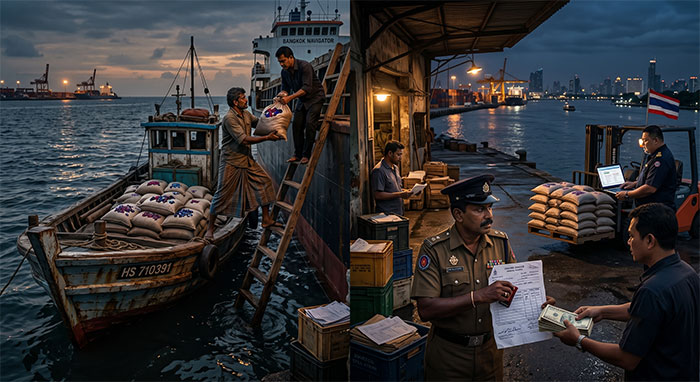
A Case Study on Sri Lanka-Thailand Trade
In March 2026, a Washington-based think tank, Global Financial Integrity (GFI), released its report on “Trade-Related Illicit Financial Flows in Developing Asia” for the 2013–2022 period. The report calculates the possible misappropriation of 20.51% of Sri Lanka’s total trade value through trade misinvoicing.
A calculation of Sri Lanka’s exports to Thailand in 2024, using the same GFI methodology, shows a possible misappropriation of 207% of the export value by Sri Lankan exporters and Thai importers
The phrase “plunder of Sri Lanka” normally refers to resource extraction through violent foreign invasions with swords and guns. This article is not about them. This article focuses on a more discreet and genteel version of plunder through illicit financial flows and the stashing of foreign exchange earnings offshore through trade misinvoicing.
What is Trade Misinvoicing?
Trade misinvoicing is the fraudulent recording of key invoice information for the purpose of facilitating illicit cross-border financial flows. One of the easiest ways to identify possible misinvoicing is the study of “mirror trade” data, that is, the comparative analysis of partner-country trade data with Sri Lankan trade data. If this flags discrepancies (value gaps), those are indicators of misinvoicing. These gaps could be due to overinvoicing imports, underinvoicing exports, or phantom imports.
Overinvoicing imports occurs when Sri Lankan importers and their foreign counterparts artificially inflate invoice prices for goods. The importer remits foreign currency abroad to settle the bogus invoice amount in full, and the surplus cash is subsequently split or retained in offshore accounts.
Similarly, underinvoicing exports happens when exporters ship high-value goods (for example, gems) out of Sri Lanka but state a considerably lower price on the customs invoice and the importer pays the low price through official channels. Then the actual market balance is paid directly into foreign bank accounts.
Phantom imports occur when bogus companies are set up to execute telegraphic transfers to foreign suppliers under the pretext of importing goods, which never physically enter Sri Lanka. The recently uncovered large-scale foreign exchange fraud totalling around US$85 million linked to fictitious imports revealed by the Public Security Minister Ananda Wijepala is an example of phantom imports. However, what he revealed was just the tip of the iceberg. The annual loss from overinvoicing imports and underinvoicing exports is much larger and may be as high as US$ billion or higher.
So, whenever value gaps occur in mirror data, they should be treated as risk indicators. If the gaps are significantly large, then the authorities should immediately investigate the relevant invoices with the partner countries to find out the reasons for the disparities.
Misinvoicing in Sri Lanka
In 2017, the Washington, D.C.-based think tank Global Financial Integrity (GFI) released a landmark investigative report exposing massive gaps in Sri Lanka’s trade data due to trade misinvoicing during the period 2005–2014. The estimated amount that may have been misappropriated during the period is US$36.83 billion. This report received wide publicity in Sri Lanka. It is not clear if the authorities had initiated any investigations into this foreign exchange hemorrhage. In March 2026 the GFI released its report on “Trade-Related Illicit Financial Flows in Developing Asia” for the 2013–2022 period. The report calculates Sri Lanka’s trade value gap at 20.51% of total trade.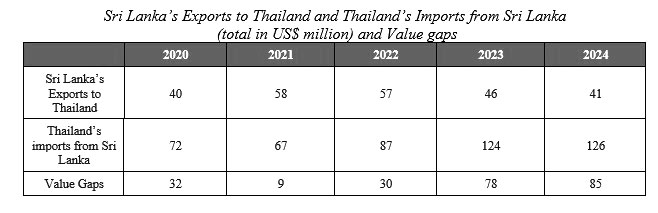
Underinvoicing in Sri Lanka – Thailand Trade
Why a case study on Sri Lanka – Thailand Trade?
Thailand is a relatively small export market for Sri Lanka and ranks 47th as an export destination. As per Sri Lankan customs data, in 2024 Sri Lanka’s total exports to Thailand were valued at US$ 41 million. However, according to Thai customs data, in 2024 Thailand’s imports from Sri Lanka were valued at US$ 126 million. This is a value gap of US$ 85 million. That is a massive 207% value gap… ten times larger than the global average for Sri Lanka. As the table below illustrates, these large value gaps have been growing over the years. (See Table)
A closer look at the data would reveal that the largest value gaps are under gemstones (HS 710391). It is common knowledge that the Sri Lanka–Thailand gem trade suffers from prevalent underinvoicing, resulting in millions of dollars in lost export revenue. Yet, it appears that Sri Lanka Customs and the National Gem and Jewellery Authority (NGJA) have not intervened to curtail this practice. One may argue that the trade ministry, the NGJA, or the customs do not routinely analyse mirror data. However, as Thailand is the third-largest market for Sri Lankan gems, the NGJA should have a very good knowledge of that market, including Thai customs statistics. In-depth analysis of Thai customs data is also a main responsibility of the Sri Lanka embassy in Bangkok.
Sri Lanka-Thailand Free Trade Agreement (SLTFTA)
In addition to that, Sri Lanka commenced negotiations for the Sri Lanka-Thailand Free Trade Agreement (SLTFTA) in 2018. After multiple rounds of negotiations covering trade in goods, services, investments, and customs cooperation, both nations officially signed the SLTFTA in February 2024. While preparing for these multiple rounds of negotiations, Sri Lankan trade negotiators and the embassy in Bangkok should have extensively analysed the Thai customs data. They should have also known Sri Lanka’s export data like the back of their hands. Then, didn’t they discover these massive discrepancies in data sets? If they did, did they address them during the negotiations?
Whatever happens, the gaps keep growing.
So, now it is time for the appropriate agencies to start investigating these enormous value gaps … after all, a massive US$ 85 million, 207% value gap is simply not loose cash.
(The writer can be reached at enadhiragomi@gmail.com) )
By Gomi Senadhira
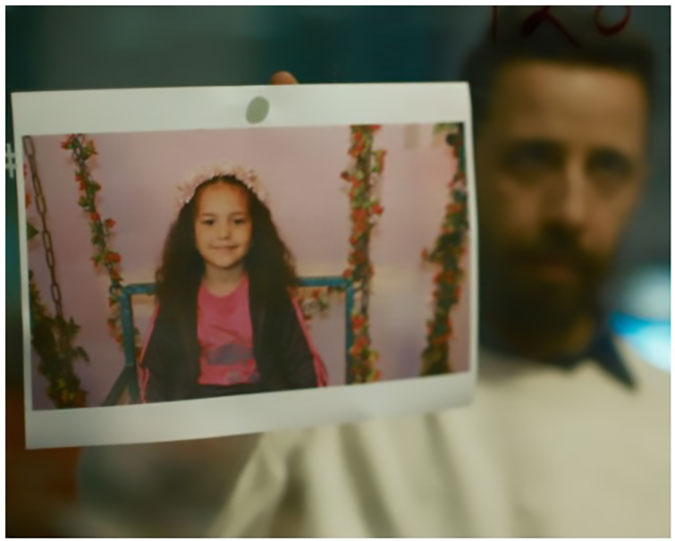
“May their hard hearts soften towards you”- Voice on the phone to Red Crescent team trying to save Hind Rajab
Nothing really prepares one for the intense experience, for that is what it was, of sharing in the helpless anguish of the Palestine Red Crescent team at the emergency call centre in Gaza, making frantic efforts to rescue the 5 year old girl trapped for several hours in a car among the corpses of 5 members of her family, gunned down by members of the Israeli Defense Force. Nor was it easy to hear the pleas of the little girl, begging to be rescued in her sweet, child’s voice for hours on the phone, as the feature film dramatizing her last hours, played the original recordings of her voice made at the emergency call center, interspersed with actors playing the roles of the desperate Red Crescent team. After that searing encounter, deep reflection is an inevitable compulsion.
8 Minutes too far
Hind Rajab’s story was already well known, from the moment the Red Crescent call centre released the voice recordings on social media, in an attempt to pressure the Israeli authorities into giving a safe route for the ambulance to reach the child, hiding in a bullet riddled car. The distance between the closest ambulance and the child was 8 minutes, according to calculations of the call center. More than two hours later, they were still pleading for approval for a safe route, to ensure this ambulance crew wouldn’t join the rest of the names of more than a dozen rescue workers on their wall, killed by the Israeli forces while on rescue missions.
The feature film “The Voice of Hind Rajab” depicting those last hours of Hind Rajab’s precious life, premiered in Colombo at the Platinum Screen, Majestic City, sponsored by the Embassy of the State of Palestine, the Sri Lanka Committee for Solidarity with Palestine and Ceylon Theatres (Pvt) Ltd, on the 18th of June 2026.
Hind Rajab, the 5 year old Palestinian girl was murdered in Gaza in January 2024. The film, produced by Brad Pitt and Joaquin Phoenix among others, won several awards: The Silver Lion Grand Jury Prize at the Venice International Film Festival, CICT_UNESCO Enrico Fulchignoni Award, Audience Award at the San Sebastian Film Festival, and Audience Award for International Feature at the Middleburg Film Festival, as well as the Main Prize (Brussels section) at the One World Festival.
The system vs Red Crescent
In the film, the vantage point is that of the members of the Palestinian Red Crescent emergency call center team who were involved in the exchange with the little girl as she lay hidden in the car, after her cousin, another little girl a few years older, was killed while on the phone to them minutes earlier. The older girl said that there were tanks next to the car and that they were shooting at her. They heard the shots, then she fell silent.
Miraculously, Hind survived that spell of shooting, and the team was able to be in contact with her while they tried to get a rescue team to reach the car in which she was hiding. The family was in compliance with an Israeli order to vacate that area of Gaza where they lived and was on their way out when their car was attacked, killing most of the occupants, except for two girls. Their only hope for survival was the Red Crescent emergency response center.
What unveils in the film is the unbearable emotional rollercoaster the members of the Red Crescent team go through, as their humanity is repeatedly tested against the requirements of a brutally lopsided, oppressive system of administrative authority which is structured with layer upon layer of permissions, approvals, co-ordinations which delay and hamper their efforts to respond urgently to an emergency.
In a story that holds tragedy within tragedy, an accumulation of hopeless despair, some of the issues of the impossible conditions of existence of the people of Gaza are laid bare. As individual members of the Red Crescent team respond to these events, their own hearts are broken by the predicament of little Hind Rajab, as they helplessly promise they would come to her aid, desperately hoping they would be able to live up to their promise. Rana, a female member of the team, keeps her talking until Rajab herself says she is dying. Rana, overcome with grief, gets her to repeat a verse from the Holy Quran, with little Hind doing so beautifully and fluently. She urges Rana to come soon to save her, which Rana knows by then, is an impossible request.
The daily encounter with the conditions of a heartless occupation come alive, as the supervisor at Red Crescent bends over backwards to comply with the list of rules and regulations even to allow an ambulance crew 8 minutes away to save a child, in a convoluted process with arbitrary decisions at each stage. As the team continues the calls to get approvals, a safe route and coordination with the IDF, a doctor at the other end of the phone hearing that permission had still not been granted says with resignation, “May their hard hearts soften towards you”.
A knife’s edge
The dramatisation of the day’s events shows the knife’s edge their nerves have to balance on, with a younger employee’s patience and tolerance of an unfair system reaching their limits in the face of the callous disregard by the system of a little girl begging to be saved. The staff at Red Crescent survive the stress by having a trained counsellor on hand, to help them deal with the deaths while on the phone to victims. The counsellor herself is finally called upon to keep little Hind company in her last minutes, teaching her to breathe deeply while imagining her favourite places.
The tragedy is that their unrelenting efforts including the release of all tapes of the little girl appeals uploaded to social media eventually succeeded in getting a safe route for the ambulance to get to her, but still failed to complete the mission to save her. The ambulance itself was shot at when it got to within 50 meters of the car which held Hind Rajab still alive, killing both rescue workers and destroying the vehicle. The logic of a hostile occupation over the Palestinian population took its predictable course, having granted permission to arrive at the site, the rescue ambulance was nevertheless attacked, simply because the occupation force could, despite every effort to stick to the rules by the Red Crescent.
The younger man’s impassioned indictment of his law-abiding supervisor at one moment shouting “We are still occupied because of men like you!” as the supervisor continued to comply with every impossible rule set upon them even at the cost of delaying the rescue effort, revealed the churning depths of a subterranean sea of emotion an occupied people must endure, keeping it controlled in survival mode until it bubbles up in tidal waves of frustration and anger. The young man who was unable to hide his emotions that day, was reportedly arrested subsequently and was killed by the occupying authorities.
Not without consequence
It is impossible not to be shocked at the bullet riddled ambulance and the totally destroyed car shown at the end of the movie. For 12 days there was no news of what happened to the girl or where the car was, until the IDF left the area. Then they found her, with the other bodies, with almost three hundred bullets in Hind Rajab. Whatever those conducting atrocities may think at the time they celebrate such “triumphs” over innocents, such continued conduct clearly impairs their humanity.
The story being told from the perspective of the Red Crescent employees, brings home the fact that these are every day traumas borne by the people of Palestine, not isolated incidents of excesses. There were young people at the Majestic Cinema who were sobbing in shocked empathy. How is it that year after year, the Palestinians bear these tragedies, as their country keeps getting smaller and smaller, their lands taken over, their buildings destroyed, and their history reduced to patches of hopelessness in a sea of gray rubble?
We have watched it together with the rest of the world for decades. Some of our own leaders have prevented or tried to prevent, and even punished those who couldn’t be prevented from speaking out against the injustices carried out in broad daylight against the Palestinian people. Fortunately, they do not represent most of the people of Sri Lanka. The Security Council held an emergency session this week, called by all 10 non-permanent members and supported by 4 of the permanent members, to debate the prevention of humanitarian aid to Gaza. One permanent member didn’t sign it.
Given the current global dynamics facilitating a peace agreement, at least in the form of an MoU, between Iran and the United States, one can only hope that things will change and one day sooner than later, all members of the Security Council will speak with one voice on the situation of Palestine, and that the courage of the film makers and all those involved in its creation will be rewarded with justice for the incredibly resilient people of the State of Palestine. May their hard hearts soften towards the long-suffering Palestinian people, innocent civilians caught up in an unending war, who in helping each other have retained their humanity in the most trying of circumstances, while their occupiers are rapidly losing theirs.
by Sanja de Silva Jayatilleka

Pakistan issues nationwide alert over fears of heavy rains, floods

Lionel Messi scores brace as Argentina beat Austria 2–0 at World Cup 2026

Egypt denied flight to Seattle ahead of final World Cup group match

Mbappe leads France to win over Iraq in lightning-delayed World Cup game

US partially lifts Iran oil sanctions amid ‘encouraging’ talks

England lose 12 WTC points for slow over rate at The Oval

‘Dates have the highest sugar content to fight Coronavirus’

Sunday Island 27 December – Headlines

#SundayIsland 17th December – Headlines

Sunday Island – 28th March

Sunday Island Headlines – 21 March

Sunday Island – 21st February – Headlines
-
 Features6 days ago
Killing of Colombo’s ancient trees — a warning on UN’s World Desertification Day – 17 June
-

 News4 days ago
Creditor receives USD 2.5 mn as Lankan public bears loss from theft of Treasury funds
-

 News3 days ago
Creditor not yet paid
-
 News3 days ago
Consumers bearing 22% tax burden despite 18% VAT claim: Dr. Harsha de Silva
-

 Opinion5 days ago
Beyond diagnosis: A strategic design for 7% growth by 2029 (Part I)
-
 News6 days ago
India provides military stores worth USD 5.5 mn to SL
-

 Opinion4 days ago
SriLankan Airbus struck by lightning
-

 Editorial2 days ago
Fuel crisis: Beyond price debate