
News
PCoI recommendations will marginalise, ostracise radicalise and counter-radicalise communities – Muslim civil society

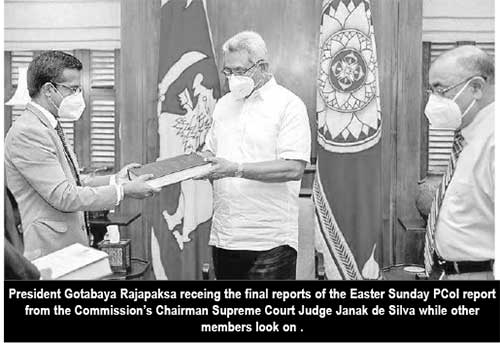
Several of the measures recommended in the report of the Commission of Inquiry into the Easter Sunday attack will put the majority community on a confrontational course with ethno-religious minorities, specially the Muslims, a group of Muslim civil society activists alleged yesterday (10).
Instead of winning over the Muslim community and establishing unity and peaceful co-existence with all others, most of the recommendations will marginalize, ostracise, radicalise and counter-radicalise communities. Implementation of some of the recommendations will create an unacceptable situation worse than the presently reversed enforced cremation policy implemented for nearly one year, the group alleged. The following is the text of statement issued by M.M. Zuhair, PC former MP, Latheef Farook, Journalist and Author, Mass L Usuf, Attorney-at- Law and Advocacy Columnist and Mansoor Dahlan, Theology Scholar: “The problem is primarily because the report is inspired by unsubstantiated and unproven speculative narratives, which the right wing extremists in the West, at war with Islam, had been marketing since 1992 and not based on critically evaluated evidence led before the Commission taking the Sri Lankan situation into consideration. Sri Lanka will become trapped further in communal confrontations that will be to the detriment of the economic advancement of the country. Of course the Commission has also made some positive recommendations. We will refer to some of them in another discourse.
“But it will not be acceptable to punish the Muslim community, or Islam, or its time-tested institutions, for the crimes committed by NTJ’s deviant terrorists. Such extended assault on the community will be similar to the US government penalizing Sri Lanka’s Army Commander’s family for the Commander’s alleged wrongs or US indiscriminately bombing Afghanistan for the 9/11 attacks committed allegedly by the Saudis.
“We need to draw attention to some instances amongst several in the report. The report recommends “preventive detention” (page 454) of persons alleged to be “religious extremists”. The country’s criminal law provides for the preventive detention of Island Reconvicted Criminals (IRCs) at times of visits of foreign dignitaries and serious emergencies. Can we treat religious dignitaries or intensely religious persons on par with IRCs possibly on someone’s allegation that some amongst them are extremists? Unlike violent extremism, it is not an offence to have extreme views because that is a universally recognized limb of the freedom of expression! In a country which gives ‘foremost place’ to Buddhism, sadly liquor bars, night clubs, gambling dens proliferate without any objection while those engaged in religious activities and invite people to desist from wrong doings are recommended to be possibly detained like IRCs! This may lead to open conflicts and must be avoided.
“The report wrongfully attempts to blame Islam (at page 18- “threat posed by Islam”) for the Easter Sunday attacks. It is a shocking accusation that will inevitably be firmly resisted. There is no credible evidence before the Commission to make such a serious, unacceptable and flawed insinuation on Islam with a 1,500 year history. Such recommendations will only lead to conflicts and not solve even existing problems! It will be used as cannon fodder in international fora. The Archbishop of Colombo in a globally quoted speech on 21/07/2019 at Katuwapitiya said that the Easter Sunday attacks were an international conspiracy and not merely the work of Islamic extremists. He said Islamic ideology was being used to create mayhem all over the globe.
“Blaming Islam is undoubtedly a travesty of justice. Was the Commission regrettably misled by years of malicious propaganda against Islam by the world’s notorious war mongers and its agents supported by sections of the international media?
“The Commission has also referred to “exclusivism” as the first step to terrorism (page 11). Questions will naturally arise whether priesthood, monkhood, abandoning worldly life, celebacy or even meditation are also evidence of the bizarre theory of ‘exclusivism’? Of course there is no priesthood in Islam. These new dimensions laid through agents of the Western arms industry are in conflict with Asian historical norms. They are aimed at conflict creation.
It has also referred to ‘Sufism’ and its ‘meditation centre’ at Kattankudy being attacked (page13) quoting journalists. Sufism is a well- recognized facet of Islam as much as ‘monotheism’ or ‘thowheed’ or ‘oneness’ of Allah as distinguished from the Christian concept of ‘Trinity’. Any attack on Sufism or Thowheed is an attack on Islam. The attempt to lump the Muslims with terrorists while seeking to divide the Muslims as Sufis, Thowheeds, Thablighs and Jamaaths or more importantly from the other communities in Sri Lanka will be seen only as an extension of the West’s war on Islam. It will end as a costly exercise that can destructively contribute to the dismemberment of Sri Lanka on ethno-religious lines that might soon be exploited by the West. Sri Lankans should read in this regard the many great works and speeches of Sri Lanka’s eminent jurist Dr C.G. Weeramantry of International Court of Justice (ICJ) fame or John Perkins (US) “Confessions of an Economic Hit Man”.



More than 1,600 students sat this year’s Russian Classical Ballet Examination, the largest number ever to take part in the examination in Sri Lanka. Exams were held in Colombo from 5, to 18, October and in Galle on 10 October.
Students aged four and above came from across the island, including Colombo, Galle, Gampaha, Negombo, Matara, Kelaniya, Panadura, Wattala, Kiribathgoda, Ratnapura, Kandy, Kurunegala, Bandarawela and Badulla. They are taught by 15 dedicated teachers trained in the Vaganova method, the renowned Russian system of classical ballet training.
They were examined by Dr. Oxana Karnovich of the Moscow State Academy of Choreography, a distinguished academic and curator.
The Russian School of Ballet and Dancing was established in 2001 by Michael Ustinov, Buddhapriya Ramanayake and Mrs Chandi Aluvihare, with Mrs Galina Pleshakova as its founding instructor. Today the School is led by Director Madam Maria Popova, Counsellor of the Embassy of the Russian Federation in Sri Lanka.


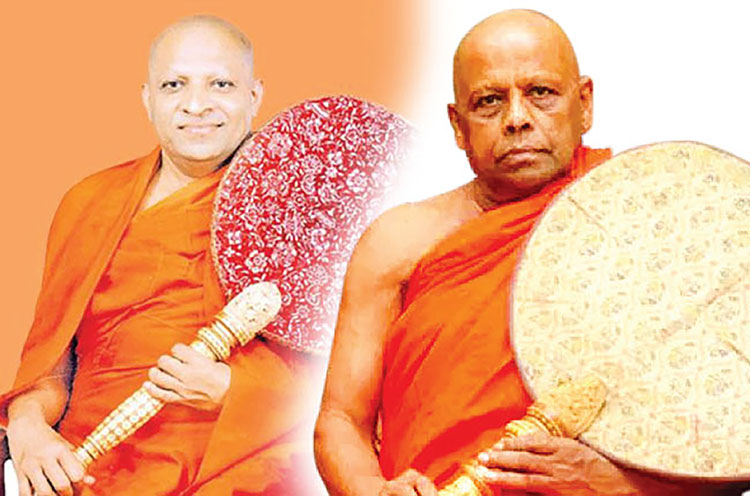
MONETABRIEF– Sri Lanka’s two most senior Buddhist chapters, Malwatte and Asgiriya, demanded special concessions for monks serving prison sentences, following the disrobing of convicted monk Ven. Galagodaatte Gnanasara in line with established procedures.
The chief prelate of the Asgiriya chapter, Most Venerable Warakagoda Sri Gnanarathana, told Prisons Commissioner Senaka Palletenna that Ven. Gnanasara, who is serving a six-year sentence for contempt of court, must be released immediately.
Prison authorities have no power to release or pardon convicts, but Palletenna told the monk in Kandy on Friday that he would convey his request to the relevant government authorities.
“There is no point in talking about this and that… The entire country has been shaken (??????? ) . He must be released,” the Asgiriya chief prelate said.
The Malwatte chief prelate, Most Venerable Thibbatuwawe Sri Siddhartha Sumangala, appeared to accept the court verdict against Ven. Gnanasara, but asked the prisons chief whether a separate section could be established for convicted monks.
Palletenna noted that a special ward for the clergy already existed at Welikada Prison.
At least 63 convicted Buddhist monks are currently incarcerated within Sri Lanka’s criminal justice system.
Meanwhile, a group of 34 Buddhist monks named in a Colombo Fort Magistrate’s Court order to vacate the vicinity of the Presidential Secretariat ended their protest and dispersed after lunch on Friday.The monks are demanding an unconditional pardon for Ven. Gnanasara, who has previously been imprisoned, making him a reconvicted prisoner.
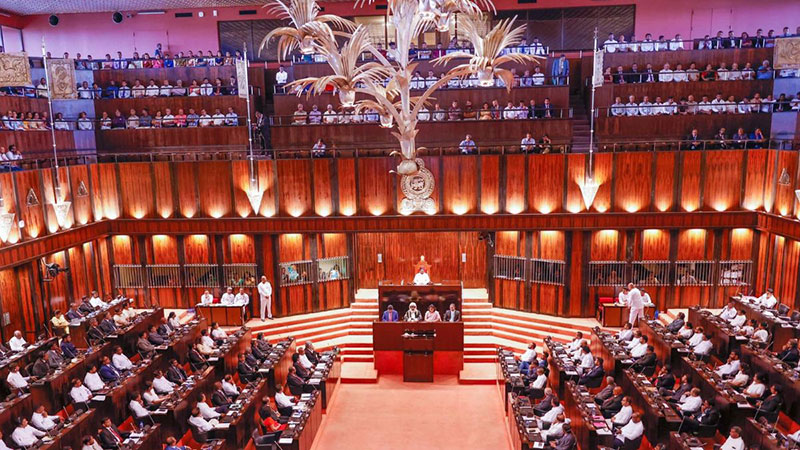
The debate on the no-confidence motion against Speaker Dr. Jagath Wickramaratne, submitted by the Samagi Jana Balawegaya (SJB), has been postponed indefinitely pending the Attorney General’s opinion on certain technical issues in the motion.
Government representatives raised the matter at a meeting of the Committee on Parliamentary Business, pointing out that several provisions of the motion required clarification and that the Attorney General’s advice should be obtained.
As obtaining the opinion would take time, the debate could not be scheduled for the next parliamentary week, parliamentary sources said.
Chief Opposition Whip Gayantha Karunatilaka said a date for the debate would be decided after the Attorney General’s advice was received.
Meanwhile, Parliament is scheduled to meet from October 20 to 23, Secretary General of Parliament Kushani Rohanadeera announced.
The parliamentary business for the week was finalised at a meeting of the Committee on Parliamentary Business held on Friday (16) under the chairmanship of Deputy Speaker Dr. Rizvie Salih.
On each sitting day, the period from 9.30 a.m. to 10 a.m. will be allocated for parliamentary business under Items 1 to 6 of Standing Order 22. Questions for Oral Answers will be taken up from 10 a.m. to 11 a.m., followed by questions under Standing Order 27(2) from 11 a.m. to 11.30 a.m.
On Tuesday, October 20, an Opposition-sponsored Adjournment Motion will be debated from 11.30 a.m. to 5.30 p.m.
On Wednesday, October 21, a resolution under the Public Debt Management Act and a Supplementary Estimate will be taken up for debate and approval from 11.30 a.m. to 5 p.m. The annual reports of five statutory institutions will subsequently be presented for approval without debate, while questions at the Adjournment Time will be taken up from 5 p.m. to 5.30 p.m.
On Thursday, October 22, the Second Reading debates on two Bills to amend the Poisons, Opium and Dangerous Drugs Ordinance (Bills Nos. 79 and 80) will be held from 11.30 a.m. to 5 p.m.
The annual reports of five statutory institutions will then be taken up for approval without debate, followed by an Opposition-sponsored Adjournment Motion from 5 p.m. to 5.30 p.m.
On Friday, October 23, the Second Reading debate on the Elimination of Rabies and Registration of Dogs Bill will be held from 11.30 a.m. to 5 p.m. A Government-sponsored Adjournment Motion will be debated during the final half-hour of the sitting.

Record 1,600 students take Russian Classical Ballet examination in Sri Lanka

Half a million people join protests in France, but some turn violent

Deadly fire breaks out at Canada military base

Showers or thundershowers will occur in most parts of the island after 1.00 p.m.

Buddhist hierarchy demands prison perks for monk convicts

Debate on NCM against Speaker postponed indefinitely

‘Dates have the highest sugar content to fight Coronavirus’

Sunday Island 27 December – Headlines

#SundayIsland 17th December – Headlines

Sunday Island – 28th March

Sunday Island Headlines – 21 March

Sunday Island – 21st February – Headlines
-

 Latest News5 days ago
Nissanka’s return headlines Sri Lanka’s Test squad against Pakistan
-

 Latest News7 days ago
Farhan and Sadaqat help Pakistan seal series in style
-
 Features7 days ago
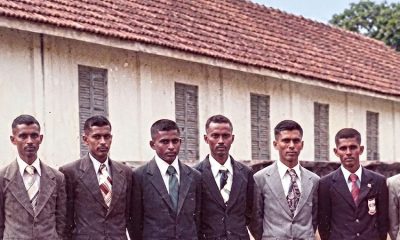
Intake 16: 45 years of duty and honour
-
 News7 days ago
Malwathu Chapter issues statement on talks with President over Gnanasara Thera’s robes
-
 News7 days ago
CP alleges NPP has taken the blame for illegal US sanctions on Iranian vessels
-

 News5 days ago
Sri Lanka, India caught in US-Iran ship crisis
-

 Opinion7 days ago
How long can Sri Lanka remain silent on its demographic crisis?
-
 Latest News5 days ago
Kusal Mendis’ unbeaten 87 hands Sri Lanka consolation win