
Latest News
Estonia seeks Nato consultation after Russian jets violate airspace


Estonia has requested a consultation with other Nato members after Russian warplanes violated its airspace on Friday.
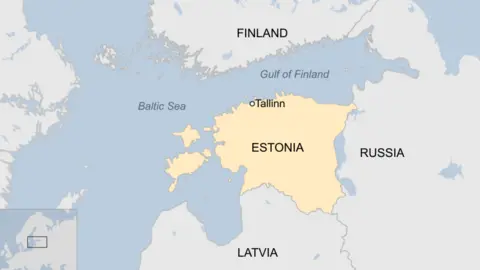
Estonia’s foreign ministry condemned the incursion as “brazen”. It said three Russian MiG-31 fighter jets entered the Estonian skies “without permission and remained there for a total of 12 minutes” over the Gulf of Finland.
A Nato spokesperson said the military alliance “responded immediately and intercepted the Russian aircraft”, calling it “yet another example of reckless Russian behaviour and Nato’s ability to respond”.
Italy, Finland and Sweden scrambled jets under Nato’s mission to bolster its eastern flank. Later Russia denied violating Estonian airspace.
Russia’s defence ministry said the jets were on a “scheduled flight… in strict compliance with international airspace regulations and did not violate the borders of other states, as confirmed by objective monitoring”.
It said they flew over neutral Baltic waters, more than 3km (two miles) from Vaindloo Island, which belongs to Estonia.
Tensions have escalated between the Nato military alliance and Russia since Moscow launched a full-scale invasion of Ukraine in 2022.
They have risen in the last week, after Poland and Romania – both Nato members – said Russian drones breached their airspace. In response, Nato pledged to move military assets, including fighter jets, eastwards to strengthen defence.
Speaking later on Friday, Estonian Prime Minister Kristen Michal said his government had “decided to request Nato Article 4 consultations” at an urgent meeting.
“Nato’s response to any provocation must be united and strong. We consider it essential to consult with our allies to ensure shared situational awareness and to agree on our next joint steps,” Michal said.
Article 4 of the Nato treaty formally starts urgent consultations within the 32-member alliance, which ties the US and many European nations together on collective defence.
It is the second time in a week that a Nato member has requested Article 4 consultations. Poland did so after Russian drones entered its airspace.
US President Donald Trump told reporters he was due to be briefed on the incident later on Friday.
He said: “I don’t love it. I don’t like when that happens. Could be big trouble. But I’ll let you know later.”
Estonia’s foreign ministry earlier said it had summoned the Russian chargé d’affaires “to lodge a protest” over Friday’s incursion, while top EU diplomat Kaja Kallas described the incident as “an extremely dangerous provocation”.
The minister added Russia had already violated Estonia’s airspace four times in 2025. Estonia shares a border with Russia to the east.
Estonia said the aircraft entered its airspace from the north east and were intercepted by Finnish jets over the Gulf of Finland. Once inside Estonian airspace, Italian F-35 jets, based in Estonia, were deployed under Nato’s Baltic Air Policing mission to escort the aircraft out.
The government said the Russian jets had no flight plans, had their transponders turned off and also did not have two-way radio communication with Estonian air traffic control.
Estonian Defence Minister Hanno Pevkur told the BBC: “It is unprecedented that for 12 minutes the Russians were in our airspace.”
He added that “in this situation, the only right thing to do is to push them out of Estonian airspace”.
Michal also said the Russian incursion showed its war of aggression in Ukraine was not proceeding as the Kremlin had planned.
“The aim is to draw attention and assistance away from Ukraine by forcing Nato countries to focus more on the defence of their own territories,” he added.
In a post on X, Kallas, who is an Estonian national, said the EU “will continue to support our member states in strengthening their defences with European resources”.
She said Russian President Vladimir Putin was “testing the West’s resolve. We must not show weakness”.
Echoing her words, European Commission President Ursula von der Leyen said on X: “We will respond to every provocation with determination while investing in a stronger Eastern flank.”
“As threats escalate, so too will our pressure,” she added.
Estonia’s ambassador to the UK, Sven Sakkov, told the BBC that “clear, practical steps” to increase the protection of airspace above Nato’s eastern flank were needed in light of Friday’s incident.
“If we had to face such times as we are living in now alone, we would be extremely concerned,” he said, adding that Estonians nonetheless felt “determined” to defend themselves.
Last week, Poland’s military said it had shot down at least three Russian drones, with prime minister Donald Tusk saying 19 drones were recorded entering Polish airspace.
Russia insisted the incident was not deliberate, and its defence ministry said there had been “no plans” to target facilities on Polish soil.
Belarus, a close Russian ally, said the drones entered Polish airspace accidentally after their navigation systems were jammed.
Several days later, Romania’s defence ministry said it had detected a Russian drone when two F-16 jets were monitoring the country’s border with Ukraine, after “Russian air attacks on Ukrainian infrastructure on the Danube river”.
The ministry said the drone later disappeared from the radar.
Russia has not commented on the issue.
In response to Russia’s incursions into Poland and Romania, Nato pledged tomove troops and fighter jets eastwards.
Planes from the UK, France, Germany and Denmark are all taking part in air defence missions over Poland in a bid to bolster the alliance’s eastern flank.
Pevkur said Nato needed to “put more focus on the eastern flank” and described it as “our joint response line in a way, that here in Estonia we keep the front door closed”.
On Monday, a French jet was scrambled in response to another potential incursion by Russian drones. Nato said that alert was quickly over.
[BBC]

Latest News
Heavy showers about (100-150) mm are likely at some places in the Central, Sabaragamuwa, Uva and Southern provinces

WEATHER FORECAST FOR 13 October 2026
Issued at 2.00 p.m. on 12 October 2026 by the Department of Meteorology
A low-pressure area may form over the southeastern Bay of Bengal by 13 October.
Under the influence of this system, an increase in rainfall is expected over the island and the deep and shallow sea areas around the island during the next few days from tomorrow (13).
The general public, as well as the naval and fishing communities, are requested to be attentive to the future forecasts and bulletins issued by the Department of Meteorology in this regard.
Heavy showers about (100-150) mm are likely at some places in the Central, Sabaragamuwa, Uva and Southern provinces.
Fairly heavy showers above 75 mm are likely at some places in the other areas of the island. Showers or thundershowers will occur in most parts of the island.
The general public is kindly requested to take adequate precautions to minimize damage caused by temporary localized strong winds and lightning during thundershowers.
Misty conditions can be expected at some places in the Sabaragamuwa, Central and Uva provinces during the early hours of the morning.

Maaz Sadaqat crashed 96 off 51,Sahibzada Farhan clobbered 73 off 44, and Pakistan scorched their way through the last 12 overs of their innings to mount a fearsome total of 215 for 3. Pakistan reaped 156 runs just in the last 12 overs of their innings, as a 73-run stand between Sadaqat and Farhan was followed by a manic 72-run partnership between Sadaqat and Hasan Nawaz.
Sri Lanka’s batting was woeful in response. They slumped to 64 for 5 by the 11th over, with none of their top seven managing to get to 30. They limped to 133 for 7, having had their hopes of leveling the series wrecked by quicks Mohammad Imran and Salman Mirza, who took five wickets between them.
Sadaqat propels Pakistan into the stratosphere
The openers had laid a decent platform with Pakistan having got to 55 for 1 by the end of the seventh over. But it was Sadaqat who injected the energy that truly set Pakistan on course to their mammoth total. Having gone at less than a run a ball in his first eight balls, Sadaqat unleashed a spectacular lofted square drive off Eshan Malinga to collect his first six, before pumping the same bowler down the ground later in the 10th over.
Sadaqat would go on to clobber six further sixes and five further fours. The big hits tended to come down the ground, while his fours were more square of the wicket. Of the 125 runs Pakistan plundered in the second half of their innings, 79 off 40 came from Sadaqat, who pummeled both pace and spin with equal relish. Off the sixteenth over, bowled by Maheesh Theekshana, Sadaqat thumped three sixes in the arc between long on and midwicket.
Sadaqat, whose previous top score in three T20Is had been 50, could have gone to triple figures off the last ball of the innings, but holed out to deep cover instead, unable to quite find the power to lift a Malinga slower ball over the ropes. He had utterly dominated the middle and late overs, however.
Farhan sets the tone
On another flat Rawalpindi deck, Farhan made the first big charge, although he waited until spin came on to really get into high gear. Theekshana was one of his main victims as well. Farhan’s first six came from a slog sweep off Theekshana in the seventh over, before he launched the same bowler over wide long on and cow corner off successive balls in the ninth over. Getting to his 12th T20I fifty off the 31st ball he faced, Farhan began to aim big blows off the seamers as well. He was caught at deep third off the bowling of Dasun Shanaka, in the 15th over.
Sri Lanka stumble in the powerplay
An excellent Salman Mirza bouncer took the glove of Lahiru Udara in the first over, ending the innings of one of Sri Lanka’s few form batters for a mere five runs. And although Sineth Jayawardena – playing his first international in a full-strength Sri Lanka side – hit three consecutive boundaries in the third over, Sri Lanka were unable to build up any momentum in the powerplay. By the end of the sixth over, they had laboured to 35 for 2.
Imran’s spell lights up the middle overs
A full house in Rawalpindi was treated to some excellent fast bowling by Imran, who finished with the game’s best figures of 3 for 11 from his four overs. Having got Jayawardena to top-edge a desperate pull shot at the end of his second over, Imran had Kusal Mendis caught behind off a slower delivery, before two balls later (a wide in between), he took Sahan Arachchige’s edge with a quick delivery angled across the left-hander. Wicketkeeper Khawaja Nafay made two diving grabs to convert these chances in the eighth over.
All through his unbroken spell, Sri Lanka’s batter struggled to so much as hit Imran off the square, despite the good batting conditions on offer. Imran mixed up his pace, frequently going to slower balls, but his line and length control were also excellent through the spell. When he finished his unbroken spell at the end of the 10th over, Sri Lanka’s required rate had climbed past 15.
Chamindu Wickramasinghe and Theekshana struck some late boundaries, but by the time they came to the crease, Sri Lanka did not have a realistic shot at levelling this series. They lost by 82 runs in the end.
Scores:
Pakistan 215 for 3 in 20 overs (Sahibzada Farhan 73, Fakhar Zaman 22, Maaz Sadaqat 96, Hasan Nawaz 19*; Maheesh Theekshana 1-55, Eshan Malinga 1-41,Dasun Shanaka 1-30) beat Sri Lanka 133 for 7 (Sineth Jayawardena 22, Kamnbdu Mendis 23, Chamindu Wickremasinghe 29, Maheesh Theekshana 32*; Salman Mirza 2=28, Mohammad Imran 3-11, Saim Ayub 1-19, Shadab Khan 1-19) by 82 runs
[Cricinfo]

At least 139 people, including 15 children, have died and 84 are missing after a boat capsized off the coast of Djibouti, according to the United Nations migration agency.
In a statement on Sunday, the International Organization for Migration (IOM) quoted survivors as saying that the incident happened near Guhere off Djibouti’s eastern coast in the Gulf of Aden near the Bab al-Mandeb strait from Thursday night to before dawn on Friday.
The boat was heading from Djibouti to Yemen with more than 300 people on board. More than 80 people – all Ethiopians – survived the shipwreck while Djiboutian search and rescue operations continued.
“Our teams are on the ground alongside local authorities to provide emergency assistance,” IOM Chief of Mission in Djibouti Alexandre Coissac said, lamenting the “devastating loss of life”.
That number only includes those buried by authorities in Djibouti. Others have been buried by the migrants themselves but they won’t be added to the official count until authorities can verify the bodies, Alexandre Coissac, IOM Chief of Mission in Djibouti, told the Associated Press.
“This tragedy is a stark reminder of the dangers faced by migrants along this migration corridor as they seek economic opportunities,” Coissac added.
[Aljazeera]

Heavy showers (100-150) mm likely at some places in the Western, Sabaragamuwa, Central, Uva and Southern provinces showerss above 75 mm are likely in the other areas of the island.

Presidential pardons: Govt. studying Justice Thurairaja’s recommendations – Minister

Mahinda and Shiranthi hospitalised

Monks must be allowed to wear robes when produced in court: Mahanayake Theras

Jt. Opp. seeks presidential pardon for Ven. Gnanasara

Shiranthi’s anticipatory bail application rejected

‘Dates have the highest sugar content to fight Coronavirus’

Sunday Island 27 December – Headlines

#SundayIsland 17th December – Headlines

Sunday Island – 28th March

Sunday Island Headlines – 21 March

Sunday Island – 21st February – Headlines
-

 Features5 days ago
The Sri Lankan who made Scottish history
-

 Sports5 days ago
Nissanka absence opens door for Sri Lanka’s young guns
-

 News6 days ago
Gnansara Thera to be assigned to prison printing section: Officials
-

 News4 days ago
NDB fraud Rs 60mn more than reported
-

 News4 days ago
Removing monk’s robes matter for Sangha to decide: Mahanayake Theras
-

 Features5 days ago
Future of Sri Lanka’s state university system: Should it be shut down and reopened?
-

 News6 days ago
OIC of FCID summoned before Maligakanda Magistrate
-

 News5 days ago
Shiranthi R remanded until 13 Oct.