
Foreign News
Tight vote in Norway to decide whether to stick with Labour or turn right


Norwegians go to the polls on Sunday and Monday in a tight race to decide whether to continue with a Labour-led government or turn to the centre right.
There are only four million voters in this founding member of Nato, which shares an Artic border with Russia and is part of the EU’s single market but not a member state.
Despite its small population, Norway has long punched above its weight on the international stage, and the wars in Gaza and Ukraine – as well as US trade tariffs – have played a significant part in the election campaign.
Nevertheless, in the final stretch of the race, the focus has switched to the increasing cost of living and inequality.
“Public spending, school and infrastructure, railway infrastructure and road construction, those kinds of things,” says Andreas, who is father to a small child, about what he considers the key issues.
This domestic focus became clear during Norway’s summer politics fest in the small town of Arendal, last month.
Every year, Norway’s political class joins company bosses, unions and the public on the south-east coast for an array of panel talks and meetings. This time, it opened with a nationally televised election debate in which all the main political leaders took part.
Among them was Labour Prime Minister Jonas Gahr Støre, 65, who is aiming for a second term in office after eight years of conservative rule ended in 2021.
He is fighting off a challenge from a bloc made up of two conservative parties: the right-wing populist Progress Party under Sylvi Listhaug, 47, which has risen in popularity, and the Høyre party of ex-Prime Minister Erna Solberg, which is looking to return to power.
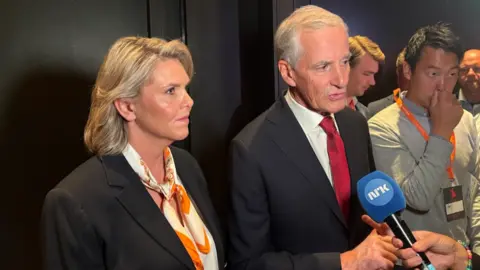
One of the hot-button issues of the campaign has been the future of a 1% wealth tax, which Norwegians pay if their assets add up to more than 1.76m Norwegian kroner (£130,000; $175,000).
Hundreds of wealthy Norwegians have already left the country for Switzerland in recent years, anecdotally because of their native country’s high taxes.
Can that exodus be reversed?
Sylvi Listhaug has called for the abolition of the wealth tax and cutting other taxes too, while Solberg’s conservatives want to remove the wealth tax on what they call “working capital”, such as shares.
Labour refuses to go that far but has promised a wide-ranging review of taxation. It has heavyweight former Nato chief Jens Stoltenberg in charge of finance and he warns against creating a tax system that means the wealthiest in Norway end up paying little or no tax.
Opinion polls ahead of the vote have put Labour in the lead, ahead of Listhaug’s Progress party and the conservatives, and buoyed partly by the “Stoltenberg effect”.
But if the combined forces of the centre right win, one of the big questions of this election is which of the two party leaders would be prime minister.
Solberg, 67, who was prime minister for eight years, has so far refused to accept the idea that her populist rival could take office ahead of her, suggesting that voters see her as too polarising as a politician.
Foreign policy has rarely been far away from the election campaign, and recent weeks have been dominated by a move by Norway’s sovereign wealth fund – the world’s largest – to scrap investments in almost half the Israeli companies it held because of alleged rights violations.
The $1.9tn (£1.4tn) fund, built up over decades from Norway’s enormous oil and gas resources, is managed by the central bank but it has to follow ethical guidelines.
Buffeted by political headwinds surrounding the Gaza war, the fund’s chief executive Nicolai Tangen, has described its recent decisions as “my worst-ever crisis”.
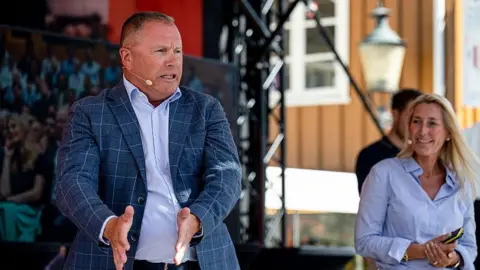
Although Norway is part of Nato, it has never been part of the European Union.
It does have access to the EU’s single market through its membership of the European Economic Area, so it has to respect its rules. And it is part of the EU’s border-free Schengen zone.
Russia’s war in Ukraine may have brought Norway closer to its European neighbours on a range of levels, but the question of joining the EU has been barely touched on during the election campaign as parties are wary of losing voters on such a polarising issue.
“There’s still a massive ‘no vote’ in Norway. And so the voters are not there,” said journalist Fredrik Solvang, who was one of the moderators of the TV debate in Arendal.
For Solberg’s conservatives, working actively towards EU membership is a core policy, but it would have to be based on a referendum.
“So it’s not about this election campaign,” she told the BBC. “And of course, as long as we don’t see a clearer move towards a majority for EU membership, none of us will start a new debate about the referendum.”
“The Labour Party has always been pro-EU, but it’s not a topic on the agenda today,” said foreign minister Espen Barth Eide.
“I’m not precluding that it could happen in the future if major things happen, but right now, my mandate as foreign minister is to try to maintain as best as possible the relationship as we have it.”
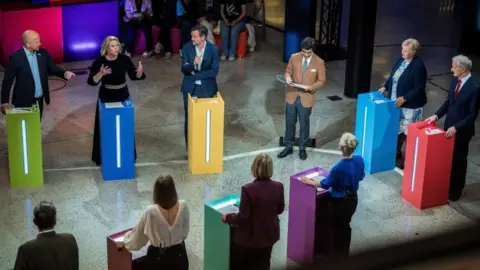
Part of the TV debate in Arendal featured a duel between party leaders from the same side in politics.
When two parties on the centre right – the Liberals who want to join the EU and the Christian Democrats who don’t – were offered a choice between the EU or Pride flags in schools, they preferred to discuss flags.
“I guess with the geopolitical status, it’s an unsure future and I think that we maybe have to take the discussion seriously,” said Iver Hoen, a nurse.
Christina Stuyck, who has both Norwegian and Spanish nationality, agrees.
“I think Norwegian politics kind of acts as if it’s on a separate island to the rest of the world and isn’t affected, but clearly it is.”
Norway’s political system requires parties to attract 4% of the vote to get into parliament, and because it has proportional representation no party can govern on its own.
To form a majority in the 169-seat Storting, a coalition needs 85 seats, and minority governments have long been common in Norway.
Støre’s Labour Party formed a minority government with the Centre party after the last election, but that two-party coalition collapsed in January in a row over EU energy policies.
The centre-right bloc has its own disagreements, so this election may end up with no clear majority when votes are counted on Monday evening.
[BBC]


The UK and South Korea have finalised a trade deal which the government says will create thousands of jobs and bring billions into the British economy.
British industries including pharmaceuticals, car manufacturing, alcohol and financial services are expected to benefit from an extension to the current tariff-free trade on most goods and services.
The deal is the fourth such agreement struck by the Labour government, following deals with the EU, US and India — none of which have had a material impact on the UK’s economy so far.
South Korean culture, including music, cosmetics and food, has become much more popular in the UK in recent years.
(BBC)

A son of film director Rob Reiner and Michele Singer Reiner has been arrested and booked on suspicion of murder after the couple were found dead in their Los Angeles home.
The Los Angeles Police Department said on Monday that Nick Reiner, 32, had been arrested and that he was in custody with no bail.
The deceased couple’s 28-year-old daughter, Romy, found her parents in their home with multiple stab wounds on Sunday, sources told the BBC’s US partner CBS News.
Rob Reiner is known for directing several iconic films in a variety of genres, including When Harry Met Sally, This is Spinal Tap, Stand By Me, Misery and A Few Good Men.
Emergency services were called to provide medical aid at the Reiners’ Brentwood, California, home at around 15:38 local time (23:38 GMT) on Sunday.
The Los Angeles Fire Department said two people – later identified as Rob Reiner, 78, and his wife Michele, 68 – were pronounced dead at the scene.
Police said Nick Reiner was arrested several hours later, at about 21:15 local time on Sunday. Investigators have not publicly outlined a motive and said the investigation remains ongoing.
(BBC
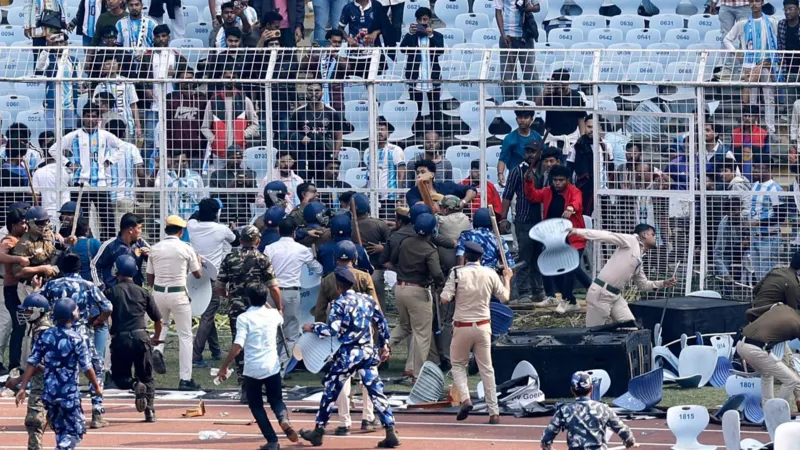
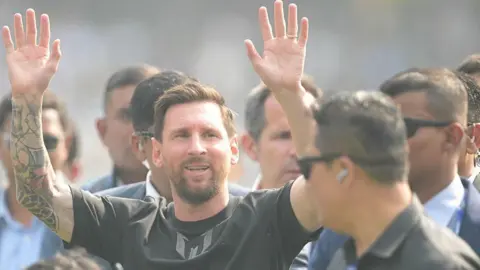
Angry fans attending Lionel Messi’s tour of India ripped up seats and threw items towards the pitch after his appearance at Kolkata’s Salt Lake Stadium.
Thousands of adoring supporters had paid up to 12,000 rupees (£100; $133) to catch a glimpse of the football star, but were left disappointed when he emerged to walk around the pitch and was obscured by a large group of officials and celebrities.
When the Argentina and Inter Miami forward was whisked away early by security after around 20 minutes, elements of the crowd turned hostile.
West Bengal’s chief minister, Mamata Banerjee, said she was “deeply disturbed and shocked” by the events.
Announcing an enquiry, Banerjee apologised to Messi and “sports lovers” for the incident at the stadium.
“The enquiry committee will conduct a detailed enquiry into the incident, fix responsibility, and recommend measures to prevent such occurrences in the future,” the chief minister said on X.
A spokesperson for Messi said that he fulfilled the time commitment that had been agreed in advance. In terms of the organisation of the event itself, he referred the BBC to the apology issued by Banerjee on social media.
A police official told reporters that the event’s “chief organiser” had been arrested, without giving any further details, AFP reports.
Authorities will look into how organisers could refund money to those who bought tickets, the official added.
The All India Football Federation (AIFF) said it was not involved in the “private event”.
Messi is in India for his ‘GOAT [greatest of all time] tour’, a series of promotional events in Kolkata, Hyderabad, Mumbai and Delhi.
His tour began with the unveiling of a 70ft [21m] statue of himself in Kolkata, which had been assembled over the course of 27 days by a 45-strong crew. Messi appeared virtually due to security concerns.
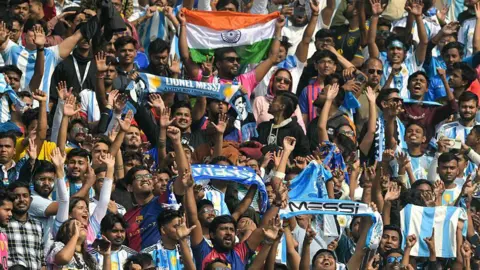
Thousands of fans travelled to the city’s stadium for a chance to see the footballer in person.
They were chanting, buying jerseys and wearing “I love Messi” headbands.
Messi initially walked out at the stadium waving to fans, but after his appearance was abruptly ended on Saturday, some frustrated fans stormed the pitch and vandalised banners and tents, as others hurled plastic chairs and water bottles.
The 2022 World Cup winner – consdered one of football’s greatest ever players – had been expected to play a short exhibition game at the stadium, the AFP news agency reports.
“Only leaders and actors were surrounding Messi… Why did they call us then? We have got a ticket for 12,000 rupees, but we were not even able to see his face,” a fan at the stadium told Indian news agency ANI.
One angry fan told the Press Trust of India news agency people had paid the equivalent of a month’s salary to see the eight-time Ballon d’Or winner.
“I paid Rs 5,000 for the ticket and came with my son to watch Messi, not politicians,” they said.
“The police and military personnel were taking selfies, and the management is to blame.”
Messi was accompanied on his brief visit by his Inter Miami teammate and Uruguay star Luis Suarez, and Argentina’s Rodrigo de Paul.
Bollywood actor Shah Rukh Khan also met Messi earlier in the day, according to the Reuters news agency.
Kolkata is the capital of the Indian state of West Bengal and has a large football fanbase in an otherwise cricket-crazed country.
In the city, it is common to see hundreds of thousands of fans gather at stadiums at a derby of local clubs.
In the early hours of Saturday, thousands lined the roads and congregated outside the hotel where Messi was staying to try and catch a glimpse of him.
Hitesh, a 24-year-old corporate lawyer, flew nearly 1,900 kilometres from the south Indian city of Bengaluru.
“For me it’s personal. You can see I am quite short, and I love to play football with my friends,” Hitesh told the BBC, standing in front of the statue.
“Messi is the player I related with the most, no one can match his talent. He gives me hope that with talent you can do anything.”
[BBC]

Flood warning issued to the Mahaweli River Basin

200 km of the 340 km of damaged electric fences in the Polonnaruwa Wildlife Zone Reactivated

Zelensky appeals to EU leaders facing crunch decision on Russia’s frozen cash

Australian PM announces crackdown on hate speech after Bondi shooting

Conway 178* and Latham 137 grind West Indies to dust in Mount Maunganui

Australia have the urn in their sights as England self-destruct again

‘Dates have the highest sugar content to fight Coronavirus’

Sunday Island 27 December – Headlines

#SundayIsland 17th December – Headlines

Sunday Island – 28th March

Sunday Island Headlines – 21 March

Sunday Island – 21st February – Headlines
-

 Features5 days ago
Why Sri Lanka Still Has No Doppler Radar – and Who Should Be Held Accountable
-

 Features7 days ago
Ditwah: A Country Tested, A People United
-

 News17 hours ago
Pakistan hands over 200 tonnes of humanitarian aid to Lanka
-
 News7 days ago
Rs 1. 3 bn yahapalana building deal under investigation
-
 News17 hours ago
Pope fires broadside: ‘The Holy See won’t be a silent bystander to the grave disparities, injustices, and fundamental human rights violations’
-

 Midweek Review2 days ago
How massive Akuregoda defence complex was built with proceeds from sale of Galle Face land to Shangri-La
-

 Business7 days ago
Fluctuating fortunes for bourse in the wake of selling pressure
-

 Opinion7 days ago
Comfort for some, death for others: The reality of climate change