
Foreign News
Tight vote in Norway to decide whether to stick with Labour or turn right


Norwegians go to the polls on Sunday and Monday in a tight race to decide whether to continue with a Labour-led government or turn to the centre right.
There are only four million voters in this founding member of Nato, which shares an Artic border with Russia and is part of the EU’s single market but not a member state.
Despite its small population, Norway has long punched above its weight on the international stage, and the wars in Gaza and Ukraine – as well as US trade tariffs – have played a significant part in the election campaign.
Nevertheless, in the final stretch of the race, the focus has switched to the increasing cost of living and inequality.
“Public spending, school and infrastructure, railway infrastructure and road construction, those kinds of things,” says Andreas, who is father to a small child, about what he considers the key issues.
This domestic focus became clear during Norway’s summer politics fest in the small town of Arendal, last month.
Every year, Norway’s political class joins company bosses, unions and the public on the south-east coast for an array of panel talks and meetings. This time, it opened with a nationally televised election debate in which all the main political leaders took part.
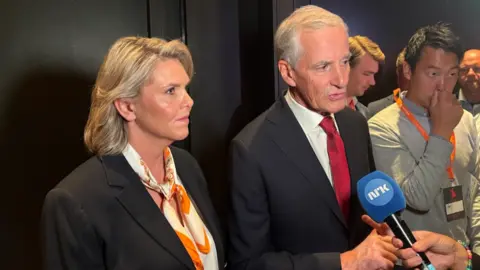
Among them was Labour Prime Minister Jonas Gahr Støre, 65, who is aiming for a second term in office after eight years of conservative rule ended in 2021.
He is fighting off a challenge from a bloc made up of two conservative parties: the right-wing populist Progress Party under Sylvi Listhaug, 47, which has risen in popularity, and the Høyre party of ex-Prime Minister Erna Solberg, which is looking to return to power.
One of the hot-button issues of the campaign has been the future of a 1% wealth tax, which Norwegians pay if their assets add up to more than 1.76m Norwegian kroner (£130,000; $175,000).
Hundreds of wealthy Norwegians have already left the country for Switzerland in recent years, anecdotally because of their native country’s high taxes.
Can that exodus be reversed?
Sylvi Listhaug has called for the abolition of the wealth tax and cutting other taxes too, while Solberg’s conservatives want to remove the wealth tax on what they call “working capital”, such as shares.
Labour refuses to go that far but has promised a wide-ranging review of taxation. It has heavyweight former Nato chief Jens Stoltenberg in charge of finance and he warns against creating a tax system that means the wealthiest in Norway end up paying little or no tax.
Opinion polls ahead of the vote have put Labour in the lead, ahead of Listhaug’s Progress party and the conservatives, and buoyed partly by the “Stoltenberg effect”.
But if the combined forces of the centre right win, one of the big questions of this election is which of the two party leaders would be prime minister.
Solberg, 67, who was prime minister for eight years, has so far refused to accept the idea that her populist rival could take office ahead of her, suggesting that voters see her as too polarising as a politician.
Foreign policy has rarely been far away from the election campaign, and recent weeks have been dominated by a move by Norway’s sovereign wealth fund – the world’s largest – to scrap investments in almost half the Israeli companies it held because of alleged rights violations.
The $1.9tn (£1.4tn) fund, built up over decades from Norway’s enormous oil and gas resources, is managed by the central bank but it has to follow ethical guidelines.
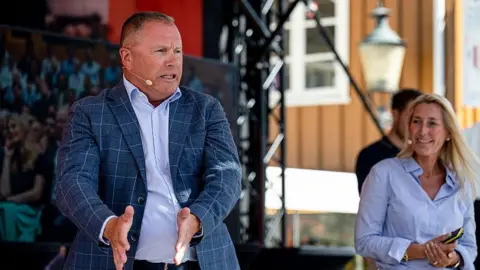
Buffeted by political headwinds surrounding the Gaza war, the fund’s chief executive Nicolai Tangen, has described its recent decisions as “my worst-ever crisis”.
Although Norway is part of Nato, it has never been part of the European Union.
It does have access to the EU’s single market through its membership of the European Economic Area, so it has to respect its rules. And it is part of the EU’s border-free Schengen zone.
Russia’s war in Ukraine may have brought Norway closer to its European neighbours on a range of levels, but the question of joining the EU has been barely touched on during the election campaign as parties are wary of losing voters on such a polarising issue.
“There’s still a massive ‘no vote’ in Norway. And so the voters are not there,” said journalist Fredrik Solvang, who was one of the moderators of the TV debate in Arendal.
For Solberg’s conservatives, working actively towards EU membership is a core policy, but it would have to be based on a referendum.
“So it’s not about this election campaign,” she told the BBC. “And of course, as long as we don’t see a clearer move towards a majority for EU membership, none of us will start a new debate about the referendum.”
“The Labour Party has always been pro-EU, but it’s not a topic on the agenda today,” said foreign minister Espen Barth Eide.
“I’m not precluding that it could happen in the future if major things happen, but right now, my mandate as foreign minister is to try to maintain as best as possible the relationship as we have it.”
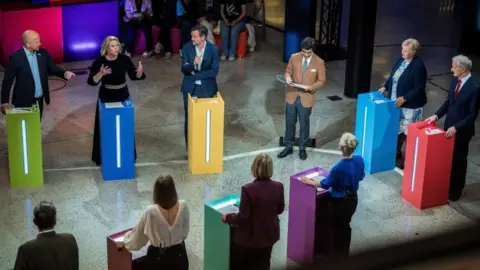
Part of the TV debate in Arendal featured a duel between party leaders from the same side in politics.
When two parties on the centre right – the Liberals who want to join the EU and the Christian Democrats who don’t – were offered a choice between the EU or Pride flags in schools, they preferred to discuss flags.
“I guess with the geopolitical status, it’s an unsure future and I think that we maybe have to take the discussion seriously,” said Iver Hoen, a nurse.
Christina Stuyck, who has both Norwegian and Spanish nationality, agrees.
“I think Norwegian politics kind of acts as if it’s on a separate island to the rest of the world and isn’t affected, but clearly it is.”
Norway’s political system requires parties to attract 4% of the vote to get into parliament, and because it has proportional representation no party can govern on its own.
To form a majority in the 169-seat Storting, a coalition needs 85 seats, and minority governments have long been common in Norway.
Støre’s Labour Party formed a minority government with the Centre party after the last election, but that two-party coalition collapsed in January in a row over EU energy policies.
The centre-right bloc has its own disagreements, so this election may end up with no clear majority when votes are counted on Monday evening.
[BBC]

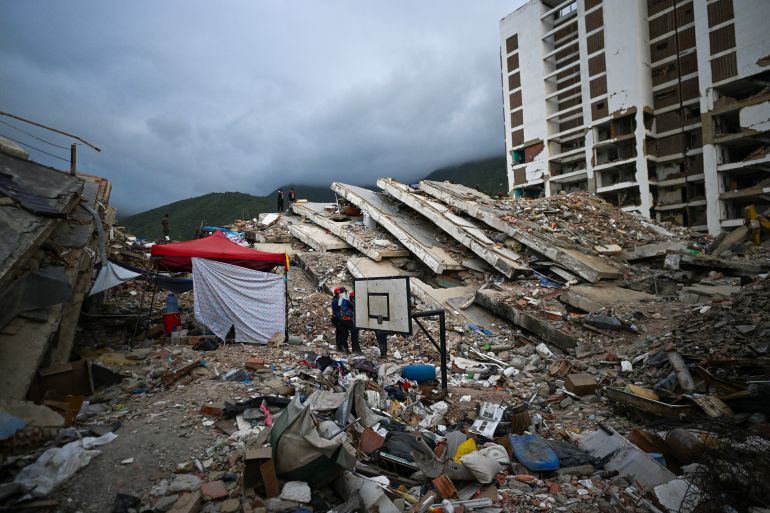
The World Bank has said that the powerful earthquakes that struck Venezuela in late June caused an estimated $19.6bn in physical damage, underscoring the country’s challenging path to recovery.
In a statement on Thursday, the World Bank said 47 percent of the damage occurred to residential buildings, while 27 percent occurred to infrastructure and 26 percent to non-residential buildings.
“The earthquakes have disrupted lives, damaged critical infrastructure, and created new challenges for Venezuela’s recovery,” Susana Cordeiro Guerra, the World Bank vice president for Latin America and the Caribbean, said in a statement. “Recovering effectively begins with reliable evidence.”
Government authorities have estimated that the magnitude 7.2 and 7.5 earthquakes that struck Venezuela on June 24 killed at least 5,000 people and injured nearly 17,000. An additional 18,000 remain homeless, as the country struggles to recover from the destruction amid persistent economic hardship.
Even before the disaster, the World Bank estimated that 76 percent of people in Venezuela, suffering from years of economic mismanagement and crushing US sanctions, were living in poverty.
“Without timely additional investment, the negative impact on productive capacity and living standards will slow the path to recovery,” said Cordeiro Guerra.
The World Bank says its estimate is meant to provide the Venezuelan government and those hoping to assist with recovery efforts with data on the scale of the challenges ahead.
The report, conducted using Global Rapid Damage Estimation (GRADE), says the areas of La Guaira state and Distrito Capital were most severely impacted. The estimate relies on local seismic data, remote-based earthquake modelling, satellite imagery, and damage reports from government and humanitarian groups.
While countries around the world have pledged support for Venezuela, it remains unclear where the funds for recovery might come from.
(Aljazeera)
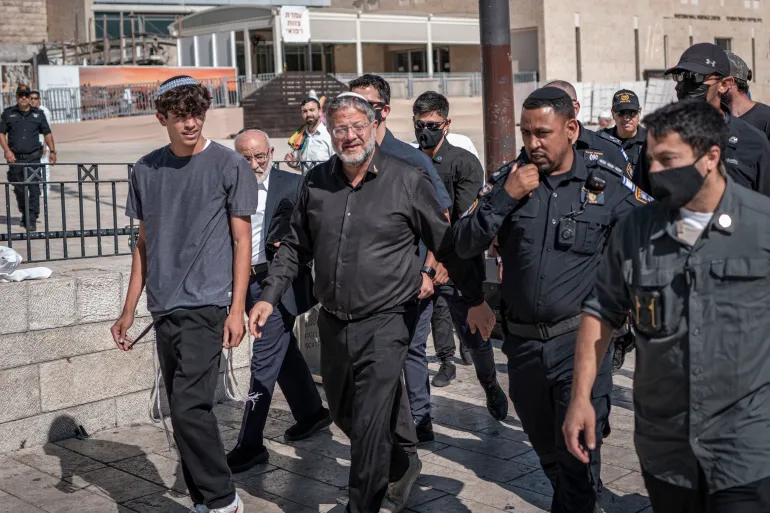
More than 4,200 Israeli settlers and members of far-right groups have stormed the Al-Aqsa Mosque compond in occupied East Jerusalem in one of the largest incursions this year as they mark a Jewish holiday, Palestinian officials say.
Far-right Israeli National Security Minister Itamar Ben-Gvir also entered the site under heavy police protection on Thursday for Tisha B’Av, a Jewish day of mourning that marks the destruction twice of an ancient Jewish temple believed to have stood at the site known to Muslims as Al-Aqsa and to Jews as the Temple Mount.
The Palestinian administration of the Jerusalem governorate said 4,288 Israelis had so far entered the compound.
This number was expected to keep rising until sundown, perhaps reaching 5,000, the governorate said, which would exceed the numbers recorded in previous years during the same Jewish holiday.
Palestinian officials said Israeli forces imposed tight restrictions at the mosque’s gates, barred large numbers of Palestinian worshippers and students from entering, and assaulted several worshippers.
Nour Odeh, Al Jazeera’s correspondent in Ramallah in the occupied West Bank, said Israeli authorities had “taken extreme measures in the Old City” of Jerusalem, including barring entry to the Al-Aqsa compound for all but the elderly and tightening checkpoints such as those at Qalandiya and around East Jerusalem.
Israeli settlers performed Talmudic rituals inside the compound, including prostrating themselves, singing and praying, the Jerusalem governorate said.
Israeli media reported that police allowed more than 1,000 Israelis to pray at the site on Thursday. While non-Muslims are allowed to visit Islam’s third holiest site, they are forbidden from praying there as part of a 1967 agreement.
Ben-Gvir said Jews visiting the site on Tisha B’Av “feel like the owners”, praising what he called “tremendous progress” there, the Haaretz newspaper reported.
[Aljazeera]
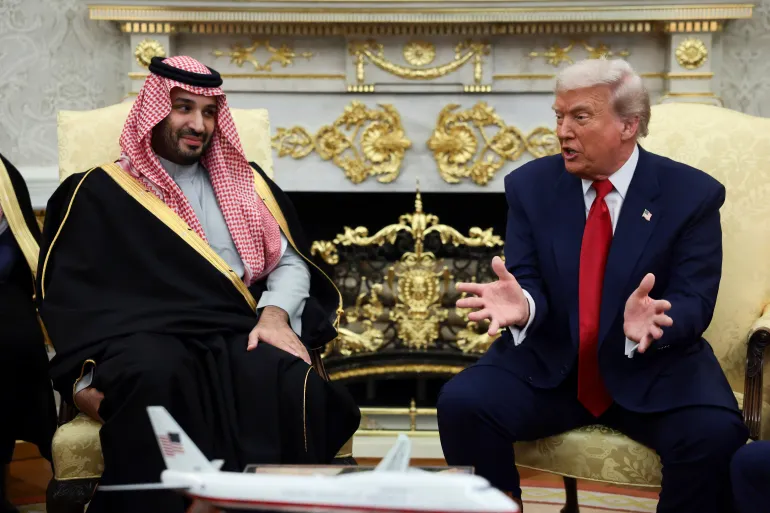
The United States and Saudi Arabia have reached a civilian nuclear cooperation deal, the administration of US President Donald Trump announced, as Washington and Riyadh push to deepen ties.
The US Department of Energy hailed the agreement as “historic” on Wednesday, saying that US companies will provide nuclear technology to the kingdom.
The deal consists of an accord under Section 123 of the Atomic Energy Act of 1954, known as a 123 agreement, “alongside an accompanying bilateral safeguards agreement”, the department said.
“These agreements reflect our two nations’ shared commitment to strengthening US-Saudi commercial relations, delivering prosperity at home and security to our allies abroad,” Energy Secretary Chris Wright said in a statement.
“Rest assured, these agreements uphold the highest standards of nuclear safety and nonproliferation, while relying on the world’s best nuclear technology and scientists, designed right here in the United States.”
Some US media reports have suggested that the deal will allow Saudi Arabia to enrich uranium domestically rather than import nuclear fuel from the US.
The Energy Department’s statement did not provide details on enrichment. If the reports are confirmed, the deal is likely to face opposition in Washington.
The statement called the agreement a “decades-long, multi-billion-dollar partnership” and said it will now be submitted to Congress for review.
Trump, together with Israel, launched a war on Iran in February to prevent the country from enriching uranium and acquiring a nuclear weapon, which Tehran denies seeking.
[Aljazeera]

Sooryavanshi the star as India complete 3-0 sweep

US and Iran hit pause on strikes for second day

Showers will occur in the Western, Sabaragamuwa and North-western provinces and in Galle, Matara, Kandy and Nuwara-Eliya districts

Chamika, Colambage help Galle Gallants consolidate top spot

BASL challenges NPP MP to repeat false claims outside Parliament

Judges’ retirement age row: Govt.-BASL powwow on the cards

‘Dates have the highest sugar content to fight Coronavirus’

Sunday Island 27 December – Headlines

#SundayIsland 17th December – Headlines

Sunday Island – 28th March

Sunday Island Headlines – 21 March

Sunday Island – 21st February – Headlines
-
 Features1 day ago
MBS: The Man of the Last Laugh
-
 Features1 day ago
A Landmark Gathering of Minds: The Ceylon Journal Roundtable Revives the Spirit of Intellectual Dialogue
-
 Midweek Review5 days ago
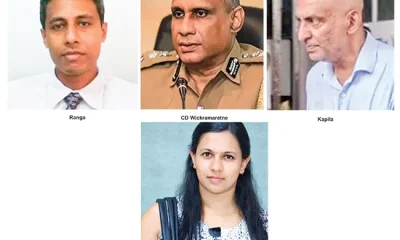
Three high-profile alleged suicides shaping key investigations
-
 Latest News2 days ago
Develop a programme to allocate underutilised state land for investment by returning migrant workers – President
-
 Life style1 day ago
A proud Sri Lankan voice in Australian Parliament
-

 News2 days ago
Fort Magistrate orders arrest of MP Archchuna
-

 Editorial1 day ago
‘Cockroaches’ tame a mighty regime
-
 Editorial2 days ago
An indictment of all parties