
Foreign News
Child sex abuse victim begs Elon Musk to remove links to her images


A victim of child sexual abuse has begged Elon Musk to stop links offering images of her abuse being posted on his social media platform X.
“Hearing that my abuse – and the abuse of so many others – is still being circulated and commodified here is infuriating,” says “Zora” (not her real name) who lives in the United States and was first abused more than 20 years ago.
“Every time someone sells or shares child abuse material, they directly fuel the original, horrific abuse.”
X says it has “zero tolerance for child sexual abuse material” and tackling those who exploit children remains “a top priority”.
The BBC found images of Zora while investigating the global trade of child sex abuse material, estimated to be worth billions of dollars by Childlight, the Global Child Safety Institute.
The material was among a cache of thousands of similar photos and videos being offered for sale on an X account. We got in contact with the trader through the messaging app Telegram, and this led us to a bank account linked to a person in Jakarta, Indonesia.
Zora was first abused by a family member. A collection of images of her abuse have become infamous among paedophiles who collect and trade such content. Many other victims face the same situation, as images of abuse continue to circulate today.
Zora is angered the trade continues to this day.
“My body is not a commodity. It never has been, and it never will be,” she says. “Those who distribute this material are not passive bystanders, they are complicit perpetrators.”
Images of Zora’s abuse were originally only available on the so-called dark web, but she now has to live with the reality that links are being openly promoted on X.
Social media platforms are trying to rid their platforms of illegal material, but the scale of the problem is enormous.
Last year the US National Center for Missing and Exploited Children (NCMEC), received more than 20 million mandatory reports from tech companies about incidents of child sexual abuse material (CSAM) – illegal images and videos on their platforms.
NCMEC attempts to identify victims and perpetrators, the organisation then contacts law enforcement.
We approached “hacktivist” group Anonymous, whose members are trying to combat the trade in child abuse images on X. One of them told us the situation was as bad as ever.
They tipped us off about a single account on X. It used a photo of the head and shoulders of a real child as its avatar. There was nothing obscene about it.
But the words and emojis in the account’s bio made it clear the owner was selling child sexual abuse material and there was a link to an account on the messaging app Telegram.
The trader appeared to be based in Indonesia and was offering “VIP packages”, collections of images and video files of abuse for sale to paedophiles around the world.
The Anonymous activist had been working to report this trader’s multiple accounts on X, so they could be removed by the platform’s moderation systems. But each time one account was removed, he told us, another new one would replace it.
The trader appeared to have been overseeing more than 100 almost-identical accounts. The activist told us that when he had contacted the trader directly using Telegram, the trader had replied saying he had thousands of videos and images for sale.
“I have baby. Kids young 7-12”, he wrote in messages to the activist seen by the BBC. He also explained that some of the content showed child rape.
We got in touch with the trader ourselves.
He provided links to samples of material, which we did not open or view. Instead, we contacted experts from the Canadian Centre for Child Protection (CCCP) in Winnipeg – who work alongside law enforcement and are legally permitted to view such content.
“The Telegram account was, for lack of a better term, a taster pack – essentially a collage of the material he had available of all the different victims,” explained Lloyd Richardson, the CCCP’s director of technology. “When we looked at all the different images in the collages, I would say there were thousands.”
Among the files were images of Zora.
Her abuser in the US was prosecuted and imprisoned many years ago, but not before footage of the abuse had already been shared and sold across the world.
Zora told us: “I have tried over the years to overcome my past and not let it determine my future, but perpetrators and stalkers still find a way to view this filth.”
As she grew older, stalkers uncovered Zora’s identity, contacting and threatening her online. She says she feels “bullied over a crime that robbed me of my childhood”.
Finding the trader
To identify the trader selling photos of Zora, we posed as a buyer.
The trader sent us his bank information and an online payment account, both had the same name listed as the account holder.
The Anonymous activist had discovered this name was also linked to two money transfers and another bank account.
We tracked down a man with the same name as that listed on the accounts, to an address on the outskirts of the Indonesian capital, Jakarta.
A producer working in the city for the BBC World Service went to visit the address and confronted a man on the premises who, when presented with the evidence, said he was shocked.
“I don’t know anything about this,” he said.
The man confirmed one of the bank accounts was his and stated it was created for a single mortgage-related transaction. He said he had not used the account since and that he would contact his bank to find out what had happened. He denied knowledge of the other bank account or the money transfers.
We cannot know for certain if, and to what extent, he may be involved and as a result we are not naming him.

The way Zora’s images were being marketed is a method used by hundreds of traders across the world, our investigation found.
Posts on X use different hashtags familiar to paedophiles. Images that appear on the platform are often taken from known child abuse images but can be cropped so they are not obscene.
Elon Musk said removing child sexual abuse material was his “top priority” when he took over X, then known as Twitter, in 2022.
Social media platforms in general, not just X, could do much more to prevent criminals posting repeatedly in this way, says Lloyd Richardson from the CCCP.
“It’s great that we can send a takedown notice [to social media platforms], and they remove the account, but that’s the bare minimum.”
The problem is that users can come back onto the platforms in a few days with a new account, he says.
X told us it has “zero tolerance” for child sexual exploitation. “We continually invest in advanced detection to enable us to take swift action against content and accounts that violate our rules,” said a spokesperson.
The platform told us it works “closely with the National Center for Missing and Exploited Children (NCMEC) and supports law enforcement efforts to prosecute these heinous crimes”.
Telegram said: “All channels are moderated, and more than 565,000 groups and channels related to the spread of CSAM have been banned so far in 2025.”
The platform said it has more than a thousand moderators working on the issue.
“Telegram proactively monitors public content across the platform and removes objectionable material before it can reach users or be reported,” a spokesperson said.
When we told Zora her photos were being traded using X, she had this message for the platform’s owner, Elon Musk: “Our abuse is being shared, traded, and sold on the app you own. If you would act without hesitation to protect your own children, I beg you to do the same for the rest of us. The time to act is now.”
[BBC]

Nigeria says it will seek compensation from South Africa for its citizens who have left the country following recent protests targeting undocumented migrants.
Foreign ministry spokesperson Kimiebi Imomotimi Ebienfa told the BBC that the issue would be discussed between the two governments “at the highest levels”.
Acting High Commissioner to South Africa Alexander Ajayi said on local television on Tuesday that the government had begun documenting businesses and properties left behind by Nigerians.
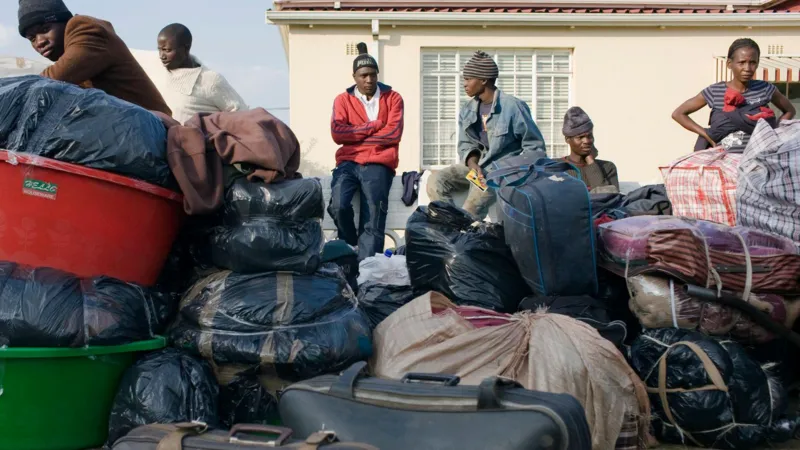
One Nigerian trader waiting to be repatriated told the BBC he had lived in South Africa for nearly a decade and had abandoned his business and home because he feared for his safety.
Oghodero Erejor Wilson, 32, said he was losing “everything because of fear”.
“I left everything in my house including clothes.”
He is among hundreds of Nigerians still waiting to be evacuated from South Africa. More than 600 Nigerians have already been repatriated in recent weeks.
The South African authorities say those who have been flown home were in the country illegally – though this is disputed by Nigeria.
About 25,000 nationals of other African countries have left South Africa following a wave of protests in recent weeks by groups demanding that the government does more to curb illegal migration.
Some anti-migrant groups had given undocumented foreigners a deadline of 30 June to leave the country and organised marches attended by thousands of people on Tuesday. These were largely peaceful but there were isolated incidents of violence against foreigners.
The South African police say that about 900 people were arrested, mostly for immigration-related offences and looting.
The BBC has asked South Africa’s government for comment on Nigeria’s compensation demand.
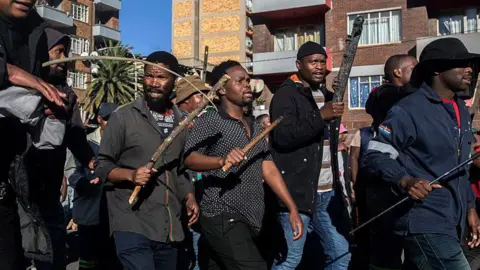
Nigeria’s acting high commissioner said he had asked all of those who had left South Africa “to document very accurately those things they were leaving behind in terms of businesses, in terms of even cars, movable and immovable properties”.
Foreign ministry spokesperson Ebienfa told the BBC that all claims would be verified before any formal request was made
“We have not severed ties with South Africa, we are still engaging them at the highest level, we will sort those details using our usual diplomatic channels,” he said.
Wilson, the trader, said he had run a clothing business in the South African city of Centurion in Gauteng province for several years.
But he said he had now closed his shop and fled to stay near the Nigeria High Commission in South Africa’s capital, Pretoria.
Scheduled to leave on the next repatriation flight to Nigeria on Friday, he estimates the goods left in his shop are worth more than 16,000 rand ($975; £735).
Wilson said his residency documents had expired in 2021 and he had been unable to renew them.
He said he was not very hopeful about the prospect of getting compensation.
“If South Africa government can compensate it, it will be nice, but I know they won’t,” he said.
(BBC)
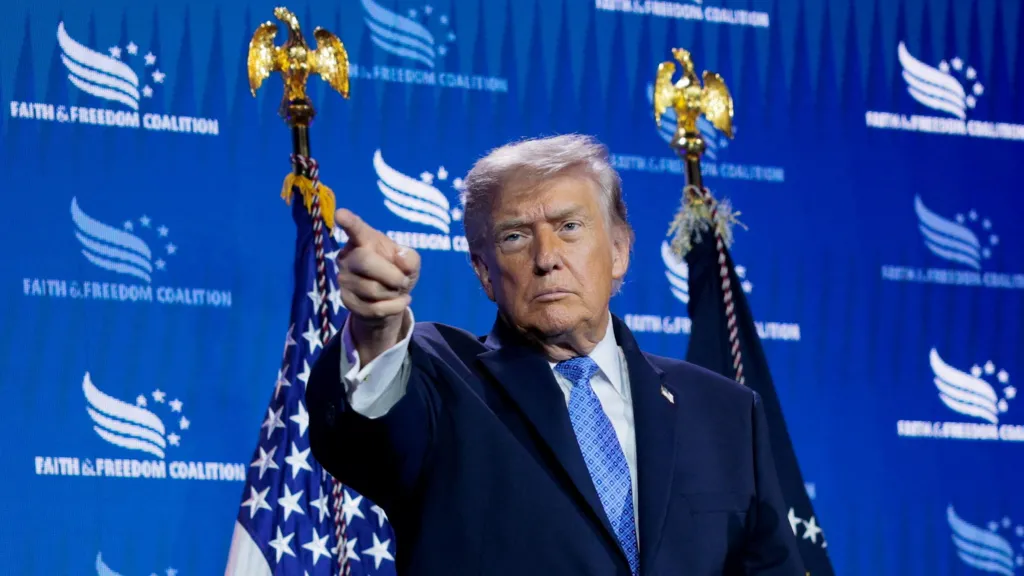
US President Donald Trump made more than $1bn (£750m) last year from business dealings in cryptocurrency, according to his mandatory financial report for 2025.
In a 927-page disclosure, he reported $635m in royalties from a Trump meme coin that has plunged in value since he launched it days before taking office.
He also reported over $500m in income from World Liberty Financial, a cryptocurrency firm founded by his own sons and the children of his special envoy, Steve Witkoff.
He earned millions more from real estate and Trump-themed items. But the White House denied he was profiting from the presidency.
The earnings from his latest financial disclosure far outpace the previous ones for 2024, when Trump disclosed over $600m in income.
But the White House, which has repeatedly emphasised that Trump has placed his business in a trust managed by his sons, again denied any conflict of interest.
White House deputy press secretary Anna Kelly said the president had proudly made the US “the crypto capital of the world”.
“Neither the President nor his family has ever engaged – or will ever engage – in conflicts of interest,” she said in a statement.
She added: “All actions by President Trump and his administration are taken in the best interest of the American people – and any so-called ‘reporters’ pushing otherwise are recycling the same, tired, false narrative that Democrats and the legacy media have been pushing for a decade.”
The president himself has also highlighted that he is not subject to federal conflict of interest laws.
Trump once criticised cryptocurrency, famously calling Bitcoin a “scam” and a “disaster waiting to happen”.
But Tuesday’s disclosure shows his crypto earnings far overshadow income from his real estate business, which first catapulted him to fame.
He earned around $77m from his Mar-a-Lago club and $122m from his golf club in Doral, Florida.
He also earned more than $30m each from golf clubs in Bedminster, New Jersey, and Jupiter, Florida, and Turnberry, Scotland.
Trump also earned millions from other business ventures, according to the financial disclosure.
These included $4.7m in royalties from Trump-branded watches, along with Trump-branded Bibles, trainers, fragrances and guitars.
First Lady Melania Trump also listed her income from 2025 in the disclosure. She made $10.7m from a “license agreement” related to the documentary about her that was released last year.
Another $6m in income is listed for her from the sale of NFTs, which are digital images sold online.
The president listed millions of dollars, too, in settlements from various legal actions.
These included $16m from a lawsuit against ABC, $16m from CBS Broadcasting and CBS Interactive, $24.5m from Meta, $22m from YouTube and $8m from X.
But the White House has said most of that money went towards Trump’s future presidential library or a nonprofit dedicated to the upkeep of park sites in the Washington DC area.
According to a list of the world’s richest people compiled by Forbes magazine, Trump has an estimated fortune of $6bn – up from $2.3bn in 2024. Bloomberg’s Billionaire’s Index puts the president’s net worth at $7.6bn.
After his return to the White House, Trump adopted a friendly approach to the crypto industry, even as companies linked to his family issued digital tokens.
The Trump-appointed head of financial regulator, the Securities and Exchange Commission, is also seen as an ally of the crypto industry.
Since taking office in April 2025, Paul Atkins has shifted the agency away from the strict, regulation-by-enforcement approach of his predecessor.
Last July, the president signed the GENIUS Act into law, to make “make America the undisputed leader in digital assets”.
(BBC)
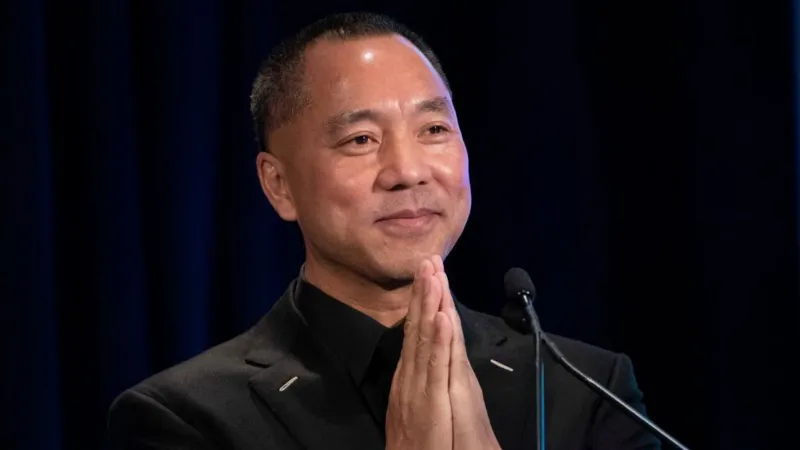
Guo Wengui, who was once believed to be one of China’s richest businessmen, has been sentenced to 30 years in jail in the US for running a billion dollar scam.
The former property tycoon fled China to the US in 2017, where he reinvented himself as a Communist Party critic and built a loyal online following.
But Guo was later convicted on charges of racketeering, fraud and money laundering.
New York court judge Analisa Torres said Guo had “preyed on those seeking to bring democracy to China”, taking their money to fund his lavish lifestyle.
The BBC has contacted Guo’s representatives for comment.
Guo – who goes by several names, including Miles Guo and Ho Wan Kwok – was sentenced in a courtroom packed with his supporters.
US attorney Sean S Buckley told the BBC: “Rather than being satisfied with the many legitimate opportunities afforded to him, Guo exploited the trust that thousands had placed in him for his own greed.”
“Today’s sentence shows that fame and wealth do not place you above the law, and that fraudsters who victimise families to enrich themselves will be met with significant consequences,” Buckley said.
Before fleeing China, Guo built a fortune as a property developer and had good ties with the country’s government.
But he sought asylum in the US after being accused by top Chinese officials of corruption.
Guo became a critic of China’s Communist regime and cultivated a wide online following among the Chinese community in the US.
Prosecutors said Guo raised more than $1bn (£760m) from online followers, who joined him in investment and cryptocurrency schemes between 2018 and 2023.
The money he raised was used to fund Guo’s lavish lifestyle which included a 50,000 square foot mansion, a $1m Lamborghini and a $37m yacht, they said.
Guo denied the allegations, saying the funds were used for his political activism.
He had built ties with other China critics, including Steve Bannon, a former adviser to US President Donald Trump.
Bannon and Guo often appeared in online videos and, in 2020, launched a campaign called the New Federal State of China, with the goal of overthrowing the Chinese Communist Party.
Later that year, Bannon was arrested on Guo’s yacht in Connecticut. Bannon was charged in an unrelated case with fraud in an alleged scheme to defraud people who funded a not-for-profit company to build a US-Mexico border wall.
Bannon entered a guilty plea in a Manhattan court to a first degree scheme to defraud charge and received a sentence of conditional discharge for three years.
He also faced federal charges over the wall campaign after he was indicted by a federal grand jury, but the prosecution came to a halt after Trump pardoned him 8n the final hours of his first White House term.
(BBC)

Juventus Training Camp from 6-10 July in Colombo

Wijesundara set for debut as injury-hit Sri Lanka struggle to make up XI

UNEP support pledged to strengthen Sri Lanka’s Environmental Priorities

Ronaldo scores as Portugal come back to win, Croatia denied by late VAR

Lister replaces injured Sears for ODI series in the West Indies

Showers will occur in the Western, Sabaragamuwa and North-western provinces and in Galle, Matara, Kandy, Nuwara-Eliya and Anuradhapura districts

‘Dates have the highest sugar content to fight Coronavirus’

Sunday Island 27 December – Headlines

#SundayIsland 17th December – Headlines

Sunday Island – 28th March

Sunday Island Headlines – 21 March

Sunday Island – 21st February – Headlines
-

 News5 days ago
LAWASIA warns against ad hoc initiative to increase judges’ retirement ages
-
 News6 days ago
Another 1,132 Sri Lankan Personnel to be deployed for United Nations Peacekeeping Missions
-
 News4 days ago
Chamuditha to seek removal of injunction on Youtube programme
-

 Business7 days ago
Month-end profit-takings drive stock trading; indices up
-
 Features4 days ago
Climate action to bring South Asia together
-

 Features6 days ago
People’s Bank expands digital banking network with 125th cheque deposit kiosk
-
 News4 days ago
CPRP alleges another death in custody, seeks protection for witness
-

 News7 days ago
FSP complains of irregularities in a Guinness World Record event held in Sri Lanka