
Features
THE POST-WAR PERIOD AND INDEPENDENCE

Continued from last week
NU’s Career Advances
In May of 1942, a month after the Japanese attack, NU was promoted to a higher post within the Department of Commerce and Industries. He was also seconded to serve as Deputy Commissioner in the Department of Commodity Purchase, where he was placed in charge of arranging the supply of commodities such as desiccated coconut and copra to the Food Ministry in Britain. (Interestingly, NU had selected “The Oil Seed Trade with Specific Reference to Copra” as his special subject when he applied for his M.Sc. (Econ.) degree. Correspondence from his Personal Files show that, while NU was studying at the LSE, Professor Paish, who was one of his professors, recommended NU to a London merchant dealing in edible oils, to carry out a survey of “The Trade in Edible Oils… from Production, through Importation, Distribution and Marketing to Consumers’ Demand” (N.U. Jayawardena Personal Files).
In NU’s words:
As Deputy Commissioner of Commodity Purchase, it fell to my lot to plan out the organization of the department in the early stages, particularly in regard to the purchase schemes for copra, oil and plumbago. Later I was engaged in reorganizing the operative methods of the Department and, in this connection, compiled a comprehensive code of departmental instructions.
He listed the activities of the Department of Commodity Purchase, “which was run on business lines,” and described the strength of the staff:
[There were] 11 Staff Officers including a full-time Commissioner and myself as Deputy, a store personnel of 112, and a clerical establishment of 117, while the annual turnover of the transactions of the Department exceeds Rs. 50 million. (N.U. Jayawardena Personal Files)
The Department of Commodity Purchase was based in the Bristol Hotel, which was located opposite the Cargill’s store, in the Colombo Fort. The Director of the Department was L.J.B. Turner, for whom NU had earlier worked at the Registrar General’s Office. In his rapid career ascent, NU would begin to catch up with and overtake persons for whom he had worked earlier. In 1946, he was appointed Acting Commissioner of War Risks Insurance to fill in for F. Leach, who had left the country. One may recall that it was F. Leach who had tried to appoint a Mudaliyar’s son over NU when he had applied for his first government job as a junior clerk of the District Road Committee in Hambantota (see Chapter 5).
Another Career Landmark
In June of 1946, NU was seconded to serve in the newly created post of Additional Controller of Finance and Supplies (Economics), in addition to the other posts he held. This was the first posting in the Treasury Department and it would have brought him much satisfaction, as the Treasury Department was considered to be the pinnacle of the civil service. Such a swift ascent was bound to create problems. The ‘mandarins’ of the Civil Service did not take kindly to the promotions which NU, the outsider, was given by the time he was 38, and to the multiple posts he held. Their resentment was all the more because the salary he received from these combined posts was ‘somewhat in excess of two Officers of State, one of whom was [his] superior authority’ (N.U. Jayawardena, 11 May 1987, p.3).
NU had risen on proven merit, rather than by passing the Civil Service examination, and as head of four separate departments, he received an income equal to a Class 1, Grade II official of the Ceylon Civil Service – even though he was not a member. This led the
Ceylon Civil Service Association to lodge a strong protest against NU. ( There is a letter addressed to NU in his Personal Files, dated 18 November 1946, in which the Chief Secretary wrote to inform him of his provisional appointment, to act “in addition to your own duties… as Additional Commissioner, Commodity Purchase, and Commissioner, War Risks Insurance, pending receipt of the advice of the Public Services Commission” (emphasis added). In this connection, NU described in detail a revealing episode involving the Acting Financial Secretary, C.E. Jones, which clearly exemplifies the phenomenon of the dethroning of the old guard elite – the “cultivated gentlemen” – by specialist technocrats who succeeded on merit (mentioned in the previous chapter):
There was, before [the Acting Financial Secretary] a rather bulky file containing dispatches from the Secretary of State on a highly complex subject of Economic Relations, which it fell to my lot to study, analyse and present in the form of a comprehensive report to… the Governor… to be signed by the Financial Secretary, together with a lengthy dispatch to the Secretary of State. [This was] a subject he did not know, [and] on which he could rely without reservation on my analysis and presentation. He then handed them the file with the request that if they or their colleagues felt they could do a better job than I had done, they were free to identify such a person to take over my position and other positions I held, and also receive the aggregate emoluments I was paid. (Apart from being dependent on NU to get through his work, it is interesting to speculate whether C.E. Jones’ sympathies with NU may have been strengthened due to the fact that Jones, too, had graduated from the London University (BSc.), unlike many of the senior members of the Ceylon Civil Service who were mostly products of Cambridge and Oxfor (ibid)
Following this interview with Jones, the representatives of the Civil Service Association left NU – as he triumphantly termed it – “severely alone.” Whether he was disturbed or not by the episode, NU was not slow to see its moral. Though he noted that it spoke volumes for the Association’s sense of ‘fair play’ and ‘merit,’ it no doubt made NU aware of the pitfalls and hazards of holding important positions in public life. Chapter 10 can read online on https://island.lk/nu-at-the-london-school-of-economics/
In regard to finance, my government intends to seek expert advice with regard to changes in our financial structure which may be necessitated by the transition from a colonial to a free, national economy.
(Throne Speech, Sir Henry Monck-Mason Moore, Governor, 25 Nov. 1947)
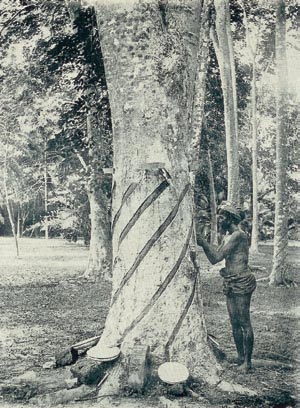
Slaughter tapping a rubber tree
The post-war period presented the country with a series of further economic hardships and challenges. The burdens of inflation, shortages of food and other imported items, as well as rationing and a series of controls, increased in the war’s aftermath. The State continued to play an interventionist role in the market, stepping up its regulatory controls, due to the continuing shortages of essential goods and the scarcity of exchange with which to buy these goods. Stanley Wickramaratne has aptly described, the “plethora of controls” regulating the supply of goods and services, and in general the free mobility of its citizens during and after the Second World War, which
… were departmentalized by the State and named Food Control, Textile Control, Rubber Control, Tea Control, Milk Food Control, Petrol Control, Poonac Control, Price Control and Import-Export and Exchange Control…
[After] Independence these control mechanisms gradually ceased to function except the last two mentioned. (Wickramaratne, 2002)
Sri Lanka was adversely impacted by factors associated with the worldwide economic and physical destruction caused by the war and had to hold its own in a world reeling from economic breakdown. Competing for access to markets and limited resources from a weak position, Sri Lanka had few options and was held hostage to the vagaries of the international market. As a small nation with an undiversified economy, it relied heavily on the export of a few agricultural commodities – primarily tea and rubber – for a large part of its revenue. (According to Das Gupta (1949, p.9), Sri Lanka produced “only a few things, but produces them almost entirely for export,” and derived about 60% of
its income from agricultural exports, producing only a quarter to a third of its total rice requirements.) Furthermore, it was not self-sufficient in the production of essential goods and was disadvantaged by an undeveloped banking system and capital market, as well as the lack of an industrial base. Thus, Sri Lanka had next to no recourse to internal financing that could help provide a financial cushion to tide over this period, nor the means to provide the investment capital to step up local production of essential goods to replace costly imports.
There was much that needed to be worked out and negotiated, and new institutions had to be set up to help meet the needs of the soon-to-be independent Sri Lanka and the challenges of the evolving post-war economic order. In addition, financial and trade arrangements had to be planned to bridge the immediate needs of the nation. After independence, Sri Lanka would be faced with the additional challenge of asserting itself as an independent sovereign nation.
NU described his work during this period of transition as a time when he “performed the functions of the principal financial and economic adviser to the Ceylon Government” (N.U. Jayawardena Personal Files). Over the four-year period, which stretched from 1946 to 1950, NU attended and assisted in several international conferences and negotiations. On the eve of national independence, NU would rise from his position as Controller of Finance and Supplies (Economics) to become both Controller of Exchange and Controller of Imports and Exports, and would set up the machinery for the operations of exchange control.
Declining Terms of Trade
By the war’s end, Sri Lanka had managed to accumulate substantial foreign-exchange surpluses, which were largely due to increased earnings from stepped-up rubber production, a reduction in imports during wartime as well as payments for basing the British South East Asia Command in Sri Lanka. However, as pointed out by Das Gupta (1949, p.31), these surpluses were “a measure not so much of prosperity but of privation,” since during the war, these could not be utilized as desired to purchase essential imports, and consumption had to be curtailed at great hardship to the population. Furthermore, following the war, these hard-earned savings actually lost value in real terms as the prices of imports rose sharply and the rise in the export price of rubber – Sri Lanka’s major export – did not keep pace. The restoration of Malaysian and Indonesian rubber stocks to the world market, and consequent increase in supply, had a somewhat dampening effect on the world price of rubber.
Sri Lanka’s foreign-exchange surpluses were quickly depleted, even though consumption continued to be restricted by the government to meet this dilemma. Ironically, by the year 1947, although imports were reduced to about the same level they had been in 1938, the economy experienced a balance-of-payments crisis, owing to a decline in the terms of trade. The case of rice imports starkly illustrates the economic dilemma Sri Lanka faced. According to Das Gupta, in 1947, Sri Lanka imported half the quantity of rice it had in 1938, but the bill for this was about two and a half times what it had been in 1938 (ibid, pp.90-91).
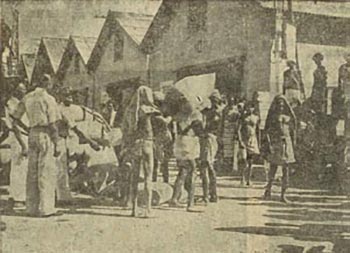
Workers loading dry goods in a Colombo warehouse
NU’s Link with Oliver Goonetilleke
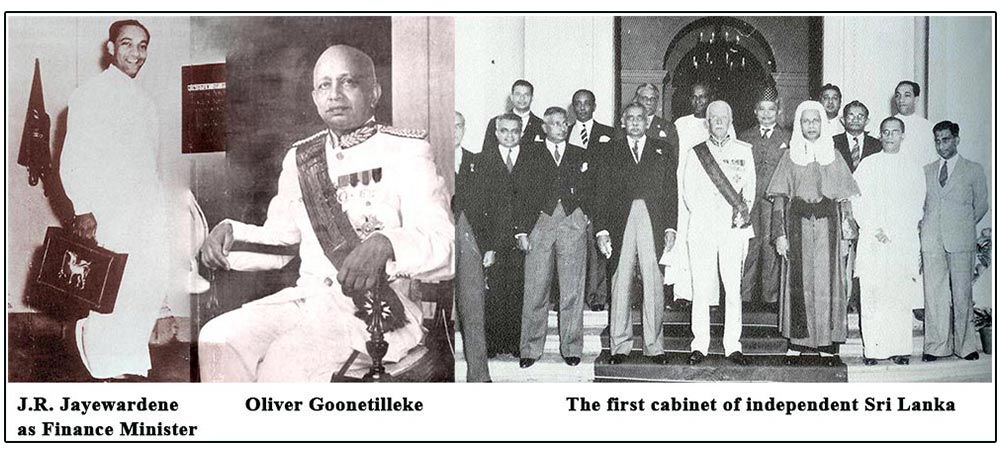
In 1945, Oliver Goonetilleke (OEG) was appointed to the prestigious post of Financial Secretary – one of the three Officers of State – as the first (and last) Sri Lankan to hold this position. NU would now work more closely with him. In 1946, on one of his first high-level visits abroad, NU accompanied OEG to the UK to assist him in the negotiations with the British government on “post-war financial issues affecting Sri Lanka” (Ceylon Civil List, 1950, p.86). According to Jeffries, during this period one of the chief areas of negotiation involved “the continual struggle to secure an economic price for Ceylon rubber” (1969, p.106). When Indonesia and Malaysia fell under Japanese control during the war, both Britain and its allies relied heavily on Sri Lanka to step up production to meet the shortfall in this critical war material. At the war’s end, Sri Lanka’s rubber yields were adversely affected due to the wartime “slaughtertapping” (over-tapping) of its rubber trees. ( Das Gupta stated that at least one-quarter of all the rubber trees in Sri Lanka had been slaughter-tapped during the war.) According to Jeffries:
The [Sri Lankan rubber] industry had already sacrificed its interest in order that the war might be won, but now Ceylon was being expected to compete on equal terms in the market with Malaya and Indonesia whose plantations were in full production after the enforced wartime rest. (Jeffries, 1969, p.106) ( Sri Lanka’s strong reliance on rubber for its revenue continued into the early 1950s. In 1952 R.G. Senanayake, who was Minister of Trade and Commerce, negotiated a Rubber-Rice Pact with the People’s Republic of China, in which the former agreed to purchase Sri Lanka’s entire annual output of rubber for five years at a premium, in exchange for rice supplied at a price well below the world market price (see de Silva & Wriggins, 1988, pp.269-71).)
OEG, who had a reputation as an astute negotiator, would have reminded the British government of Sri Lanka’s loyal support and sacrifices made during the war and of Britain’s moral obligation towards Sri Lanka. His skills of persuasion were legendary both in Sri Lanka and in Britain. A British government official was said to have woefully remarked that, “after shaking hands with him, it was advisable to check that all one’s fingers were there” (ibid, p.82). OEG once described himself as “no chicken in either strategy or in tactics” (ibid, p.74); and NU characterized him as someone who was “uncommonly intelligent,” and “highly imaginative… astute to the point of being uncanny, and an able negotiator” (quoted in de Zoysa manuscript, p.15).
Negotiations in London took place over a period of three and a half months from the end of July to mid-November 1946. An interesting side note to this episode is that during this time, NU visited his professors at the London School of Economics to inquire into the possibilities of resuming studies for his interrupted M.Sc. degree. He apparently had not abandoned hopes of completing his studies for a postgraduate degree. Although records show that his professors were amenable to this proposition, NU’s career again overtook him and he never completed this degree (LSE Student Records on N.U. Jayawardena).
Independence
Earlier in 1942, when the British government entered into discussions with India on the question of its independence, the Sri Lankan leadership also began to place pressure on the British regarding the same issue. According to Charles Jeffries, the Civil Defence Department
became the regular meeting place for “the triumvirate” of D.S. Senanayake, Oliver Goonetilleke and Ivor Jennings, who planned and worked out the negotiating points and strategies that would be undertaken towards this goal (Jeffries, pp.68-69). By 1943, this group had managed to wrest preliminary terms of agreement from the colonial government. In December 1944, a Commission composed of Lord Soulbury, Sir Frederick Rees and Frederick Burrows visited the island, and the resulting Soulbury Constitution (1947) introduced to the country a parliamentary government with a cabinet system for the first time. Elections were held under this constitution in August and September 1947, and the newly founded United National Party (UNP) formed the government. Its leader, D.S. Senanayake became the first Prime Minister of Sri Lanka and J.R. Jayewardene (JR) was appointed Finance Minister.
Working with J.R. Jayewardene
NU worked with JR in various official capacities over a period of nearly six years. He first came to know JR in 1946, when NU was appointed, along with his colleague K. Williams, to the Treasury in the newly created positions of Controller of Finance and Supply (Economics) – a year before JR assumed office as Finance Minister. NU was to work for him successively in his capacities as Controller of Exchange, Deputy Governor and Governor of the Central Bank.
NU found JR to be an unassuming and courteous Minister, who was never “intellectually stubborn or arrogant,” and who possessed a “fine sense of humour.” He found him “more ready to learn than to talk” and felt he “brought to bear a trained… [and] legal mind”
(N.U. Jayawardena, c.1985, p.59). According to NU:
JR wanted facts and their analysis, but would not accept any rendering of analysis unless he was convinced of its validity… He was thus more concerned with the substance and less with the detail… JR was quick to perceive and was not slow to decide, which he did with deliberation but once he had decided he remained unshakeable unless new facts or new situations emerged to justify the review of decisions taken. (ibid)
For NU, working for JR was “both a demanding duty and an intellectual pleasure” (ibid). He found in JR an eagerness to learn – a quality which NU himself valued and shared. JR, a lawyer by profession, felt he needed a grounding in economics. NU worked closely
with him, explaining the economic realities to the Minister – as did Professor B.B. Das Gupta of the Economics Department of the University, whom JR consulted on economic issues. The new Finance Minister had to absorb his lessons quickly, as he had to contend with several technically complex issues and crises during this period, including the international negotiations that led to two Sterling Assets Agreements with the UK, setting up the exchange control machinery required to ensure the success of these agreements, as well as laying the groundwork for the creation of a Central Bank. NU would be centrally involved in all of these areas.
Controller of Exchange
NU was appointed Controller of Exchange in April 1947. This was a prestigious post in which he was the implementer of some “purely central banking functions,” including “the determination of foreign exchange rates, control of foreign exchange holdings of commercial banks, and arrangements for forward cover” (N.U. Jayawardena, 1950, p.11). Exchange control originally came into operation in Sri Lanka upon the outbreak of war in Europe in September 1939, and was initially restricted to financial transactions in the non-sterling area. NU started out with a “skeleton staff” of nine members, working from an office on the first floor of the De Mel Building on Chatham Street (N.U. Jayawardena, 1949, p.29).
Near the end of 1947, Sri Lanka suffered a severe drain on its “overseas balances,” which was also causing “serious financial difficulties” to Britain. This crisis resulted in the government’s tentative decision to extend exchange control to include the sterling area – in other words, it would now cover “all financial transactions between Ceylon and the outside world” (ibid, p.10; and N.U. Jayawardena, 1950, p.3). Before undertaking this step, NU was sent to spend a “short but useful period” at the Reserve Bank of India in Mumbai to study the exchange control operations of that institution.( . A couple of months earlier, in September 1947, India had already extended her controls to cover the sterling area, due to similar circumstances (N.U. Jayawardena, 1949, p.10). He later spent additional time studying the exchange control operations at the Bank of England to obtain further technical training. When exchange control was extended to cover the sterling areas in June 1948, NU was appointed full-time Controller of Exchange and relieved of his other duties to enable him to devote his full energies and attention to exchange control (ibid, p.12).
This extension of controls “multiplied the volume of work manifold,” demanding “a new orientation of policy on principles which bore little relationship to the practices pertaining to non-sterling area transactions” (The increased scale of operations can be put into perspective if one bears in mind that at that time, 60% of all imports and 70% of all exports were transacted with sterling-area countries (see de Silva & Wriggins, p.220).
Also, earlier, exchange control was limited to a few but not all countries in the non-sterling area, and these “transactions were mainly derived from instructions received from the Secretary of State for the Colonies” (N.U. Jayawardena, 1949, p.11). (ibid, p.11). With the introduction of extended controls, every transaction involving foreign trade or foreign remittances had to pass through the Exchange Control Department and therefore required close coordination with other government departments such as Customs, the Post Office, Import and Export Control, and Food Control. In addition, an advisory committee, which included the heads of the main banks such as the Bank of Ceylon and the Imperial Bank, was formed to give advice to the Controller.
A comprehensive manual was drawn up and distributed to banks and authorized exchange dealers as well. A large number of staff members had to be recruited to carry out the expanded operations, requiring the Department to locate to more spacious quarters on York Street. ( The extent and rate of increase in staff numbers gives some indication of the onerous nature of exchange control operations. After relocating to York Street, by the end of 1948, a mere one and a half years after NU took over as Exchange Controller, the staff would increase to 191 members. “Congested conditions” later necessitated a further move to more spacious quarters in Echelon Barracks, some time in 1950 (N.U. Jayawardena, 1949, p.32).
In spite of the recruitment of additional staff, NU noted that: “it was still necessary to work long hours at a stretch to keep the machinery of control working and to avoid delays and inconvenience to the… public.”
Another challenge during the first year of operations was to train the staff, who initially did not have the technical knowledge required to carry out these controls. According to NU, it was “to their credit that they overcame this handicap in a short time” (N.U. Jayawardena,
1949, p.11). In his Administrative Report for the year 1949, NU described the year as a “trying and strenuous year” for his staff. He proudly noted that it gave him “no little pleasure to record that the Department of Exchange Control has, on the whole, maintained a high
reputation… an achievement of which every member of the staff should justly be proud” (N.U. Jayawardena, 1950, p.22). NU described exchange control as “an irksome restriction,” however, noting that it was a necessity at that time to promote a “more equitable distribution of goods in short supply.” Nonetheless, NU’s firm belief in the superiority of the market mechanism clearly comes out in this report, when he speculates about alternatives to exchange control, asking whether its ends could not be better served by:
methods based on the alternative principle of regulating the demand for foreign currencies at a stable exchange rate through the price mechanism. This is undoubtedly a question with many implications, administrative, economic and financial… It… deserves close study… by everyone who naturally resents the irksome restrictions of control. (ibid, p. 23, emphasis added)
A Passion for Work
There was no cutting back on his working hours when NU reached the position of Controller of Exchange. As before, a twelve-hour workday was the rule – with eighteen hours not being unusual. His daughter Neiliya recalls how NU would often ask her mother to
bring her for a drive and to pick him up in office:
I remember my mother and myself going to the Exchange Controller’s office, and sitting in the car for an hour or more waiting for my father to finish work. But he always kept us waiting. His assistant would bring bundles and bundles of files when he finally came down and put them in the luggage boot. This was always after 7:30 or 8 p.m.
Neiliya recalls how at other times:
I would have my dinner and go with my mother and pick him up. I would be given an ice-cream cone on the way home. He would go home and have a shower, have dinner and sit with his files from about 10 p.m. and work until around 2 a.m. He would then get up at 5 a.m., work until 7.30 a.m. and we would see him at his desk on our way out to school.
To be continued
(Excerpted from N.U. JAYAWARDENA The first five decades)
By Kumari Jayawardena and Jennifer Moragoda ✍️


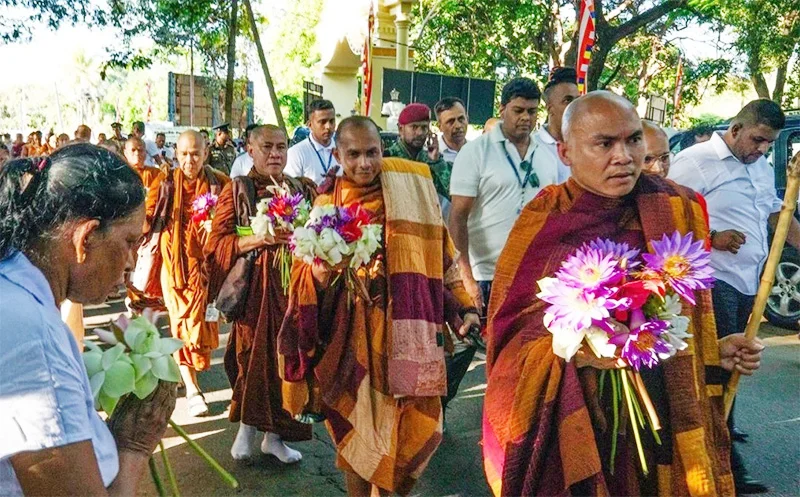
The ongoing peace march by a group of international Buddhist monks has captured the sentiment of Sri Lankans in a manner that few public events have done in recent times. It is led by the Vietnamese monk Venerable Thich Pannakara who is associated with a mindfulness movement that has roots in Vietnamese Buddhist practice and actively promoted among diaspora communities in the United States. The peace march by the monks, accompanied by their mascot, the dog Aloka, has generated affection and goodwill within the Buddhist and larger community. It follows earlier peace walks in the United States where monks carried a similar message of mindfulness and compassion across communities but without any government or even media patronage as in Sri Lanka.
This initiative has the potential to unfold into an effort to nurture a culture of peace in Sri Lanka. Such a culture is necessary if the country as the country prepares to move beyond its history of conflict towards a more longlasting reconciliation and a political solution to its ethnic and religious divisions. The government’s support for the peace march can be seen as part of a broader attempt to shape such a culture. The Clean Sri Lanka programme, promoted by the government as a civic responsibility campaign focused on environmental cleanliness, ethical conduct and social discipline, provides a useful framework within which such initiatives can be situated. Its emphasis on collective responsibility and shared public space makes it sit well with the values that peacebuilding requires.
government’s previous plan to promote a culture of peace was on the occasion of “Sri Lanka Day” celebrations which were scheduled to take place on December 12-14 last year but was disrupted by Cyclone Ditwah. The Sri Lanka Day celebrations were to include those talented individuals from each and every community at the district level who had excelled in some field or the other, such as science, business or arts and culture and selected by the District Secretariats in each of the 25 districts. They were to gather in Colombo to engage in cultural performances and community-focused exhibitions. The government’s intention was to build up a discourse around the ideas of unity in diversity as a precursor to addressing the more contentious topics of human rights violations during the war period, and issues of accountability and reparations for wrongs suffered during that dark period.
Positive Response
The invitation to the international monks appears to have emerged from within Buddhist religious networks in Sri Lanka that have long maintained links with the larger international Buddhist community. The strong support extended by leading temples and clergy within the country, including the Buddhists Mahanayakes indicates that this was not an isolated effort but one that resonated with the mainstream Buddhist establishment. Indeed, the involvement of senior Buddhist leaders has been particularly noteworthy. A Joint Declaration for Peace in the world, drawing on Sri Lanka’s own experience, and by the Mahanayakes of all Buddhist Chapters took place in the context of the ongoing peace march at the Gangaramaya Temple in Colombo, with participation from the diplomatic community. The declaration, calling for compassion, dialogue and sustainable peace, reflects an effort by religious leadership to assert a moral voice in favour of coexistence.
The popular response to the peace march has also been striking. Large numbers of people have been gathering along the route, offering flowers, water and support to the monks. Schoolchildren have been lining the roads, and communities from different religious backgrounds extend hospitality. On the way, the monks were hosted by both a Hindu temple and a mosque, where food and refreshments were provided. These acts, though simple, carry a message about the possibility of harmony among Sri Lanka’s diverse communities. It helps to counter the perception that the Buddhist community in Sri Lanka is inherently nationalist and resistant to minority concerns that was shaped during the decades of war and reinforced by political mobilisation that too often exploited ethnic identity.
By way of contrast, the peace march offers a different image. It shows a readiness among ordinary people to embrace values of compassion and coexistence that are deeply embedded in Buddhist teaching. The Metta Sutta, one of the most well-known discourses in Buddhism, calls for boundless goodwill towards all beings. It states that one should cultivate a mind that is “boundless towards all beings, free from hatred and ill will.” This emphasis on universal compassion provides a moral foundation for peace that extends beyond national or ethnic boundaries. The monks themselves emphasised this point repeatedly during the walk. Venerable Thich Pannakara reminded those who gathered that while acts of generosity are commendable, mindfulness in everyday life is even more important. He warned that as people become unmindful, they are more prone to react with anger and hatred, thereby contributing to conflict.
More Initiatives
The presence of political leaders at key moments of the march has emphasised the significance that the government attaches to the event. Prime Minister Harini Amarasuriya paid her respects to the peace march monks in Kandy, while President Anura Kumara Dissanayake is expected to do so at the conclusion of the march in Colombo. Such gestures signal an alignment between political authority and moral aspiration, even if the translation of that aspiration into policy remains a work in progress. At the same time, the peace march has not been without its shortcomings. The walk did not engage with the Northern and Eastern parts of the country, regions that were most affected by the war and where the need for reconciliation is most acute. A more inclusive geographic reach would have strengthened the symbolic impact of the initiative.
In addition, the positive impact of the peace march could have been increased if more effort had been taken to coordinate better with other civic and religious groups and include them in the event. Many civil society and religious harmony groups who would have liked to participate in the peace march found themselves unable to do so. There was no place in the programme for them to join. Even government institutions tasked with promoting social cohesion and reconciliation found themselves outside the loop. The Clean Sri Lanka Task Force that organised the peace march may have felt that involving other groups would have made it more complicated to organise the events which have proceeded without problems.
The hope is that the positive energy and goodwill generated by this peace march will not dissipate but will instead inspire further initiatives with the requisite coordination and leadership. The march has generated public discussion, drawn attention to the values of mindfulness and compassion, and created a space in which people can imagine a different future. It has been a special initiative among the many that are needed to build a culture of peace. A culture of peace cannot be imposed from above nor can it emerge overnight. It needs to be nurtured through multiple efforts across society, including education, religious engagement, civic initiatives and political reform. It is within such a culture that the more difficult questions of power sharing, justice and reconciliation can be addressed in a constructive manner.
by Jehan Perera
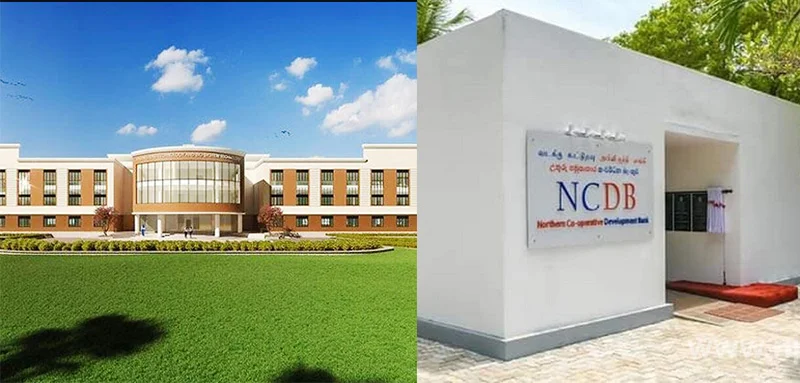
 The countryside and peripheral regions have been neglected in the national imagination for many decades. This has also been the case with regional universities which were seen as mere appendages to the university system, and sometimes created to appease political constituencies in the regions. The exclusion of the rural world and the institutions in those regions was not accidental nor inevitable, but the consequence of conscious policies promoted under an extractive and exploitative global order. Neoliberalism globalisation, initiated in the late 1970s with far-reaching policies of free trade and free flow of capital, or the “open economy,” as we call it in Sri Lanka, is now dying. The United States and the Western countries that promoted neoliberalism, as a class project of finance capital to address the falling profits during the long economic downturn in the 1970s, are themselves reversing their policies and are at loggerheads with each other. However, those economic processes will continue to have national consequences into the future.
At the heart of such policies is the neoliberal city, which has become the centre of the economy with expanding financial businesses and a real estate boom. Such financialised cities also had their impact on universities, in lower income countries, where commercialised education with high fees, rising student debt, research for businesses and transnational educational linkages with branch campuses of Western universities, have become a reality.
In the case of Sri Lanka, while neoliberal policies began with the IMF and World Bank Structural Adjustment Programmes, in the late 1970s, the long civil war forestalled the accelerated growth of the neoliberal city. I have argued, over the last decade and a half, that it is with the end of the civil war, in 2009, coinciding with the global financial crisis, that a second wave of neoliberalism in Sri Lanka led to global finance capital being absorbed in infrastructure and real estate in Colombo. The transformation of Colombo into a neoliberal city was overseen by Gotabaya Rajapaksa as Defence Secretary with even the Urban Development Authority brought under the security establishment. While Colombo was drastically changing with a skyline of new buildings and shiny luxury vehicles drawing on massive external debt, there were also moves to promote private higher education institutions. The Board of Investment (BOI) registered many hundred so-called higher education institutions; these were not regulated and many mushroomed like supermarkets and disappeared in no time when they incurred losses.
In contrast to these so-called private higher education institutions that proliferated in and around Colombo, Sri Lanka, drawing on its free education system, has, over the last many decades, also created a number of state universities in peripheral regions. However, these regional universities lack adequate funding and a clear vision and purpose. The current conjuncture with the neoliberal global order unravelling, and the immediate global crisis in energy and transport are grim reminders of the importance of local economies and self-sufficiency. In this column I consider the role of our regional universities and their relationship to the communities within which they are embedded.
Regional context
The necessity and the advantage of robust public services is their reach into peripheral regions and marginalised communities. This is true of public transport, as it is with public hospitals. Private buses will always avoid isolated rural routes as their margins only increase on the busy routes between cities and towns. And private hospitals and clinics flock to the cities to extract from desperate patients, including by unscrupulous doctors who divert patients in public hospitals to be served in the private health facilities they moonlight. Similarly, it is affluent cities and towns that are the attraction for private educational institutions.
Public institutions, including universities, can only ensure their public role if they are adequately funded. Over the last decade and a half, with falling allocations for education, our state universities have been pushed into initiating fee levying courses, both at the post-graduate level and also for undergraduate international students. These programmes are seen as avenues to decrease the dependence of universities on budgetary support. However, the reality is that it is only universities in Colombo that can draw in students capable of paying such high fees. Furthermore, such fee levying courses end up pushing academics into overwork including by offering additional income.
Therefore, allocations for underfunded regional universities need to be steadily increased. Housing facilities and other services for academics working in rural districts would ensure their continued presence and greater engagement with the local communities. Increased time away from teaching and research funding earmarked for community engagement will provide clear direction for academics. Indeed, such funding with a clear vision and role for regional universities can provide considerable social returns. In a time when repeated crises are affecting our society, agricultural production to bolster our food system as well as rural income streams and employment are major issues. Here, regional universities have an important role today in developing social and economic alternatives.
Reimagining development
In recent months, there have been interesting initiatives in the Northern Province, where the Universities of Jaffna and Vavuniya have been engaging state institutions on issues of development. In an initiative to bring different actors together, high level meetings have been convened between the staff of the Agriculture Faculty and officials of the Provincial Agriculture Ministry to figure out solutions for long pending agricultural problems. Similar meetings have also been organised between provincial authorities and the Faculties of Technology and Engineering in Kilinochchi. These initiatives have led to academics engaging communities and co-operatives on their development needs, particularly in formulating new development initiatives and activating idle projects and assets in the region. Such engagement provides opportunities for academics to share their knowledge and skills while learn from communities about challenges that lead to new problems for research.
One of the most rewarding engagements I have been part of is an internship programme for the Technology Faculty of the University of Jaffna, where four batches of final year students, from food technology, green farming and automobile specialities, have been placed for six months within the co-operative movement through the Northern Co-operative Development Bank. This initiative has created a strong relationship between the Technology Faculty and the co-operative movement, with a number of former students now working fulltime in co-operative ventures. They are at the centre of developing solutions for rural co-operatives, including activating idle factories and ensuring quality and standards for their products.
I refer to these concrete initiatives because universities’ role in research and development in Sri Lanka, as in most other countries, are often narrowly conceived to be engagement with private businesses. However, for rural regions, the challenge, even with technological development, is the generation of appropriate technologies that can serve communities.
In Sri Lanka, we have for long emulated the major Western universities and in the process lost sight of the needs of our own youth and communities. Rethinking the development of our universities may have to begin with an understanding of the real challenges and context of our people. Our universities and their academics, if provided with a progressive vision and adequate resources and time to engage their communities, have the potential to address the many economic and social challenges that the next decade of global turmoil is bound to create.
Ahilan Kadirgamar is a political economist and Senior Lecturer, University of Jaffna.
(Kuppi is a politics and pedagogy happening on the margins of the lecture hall that parodies, subverts, and simultaneously reaffirms social hierarchies)
by Ahilan Kadirgamar
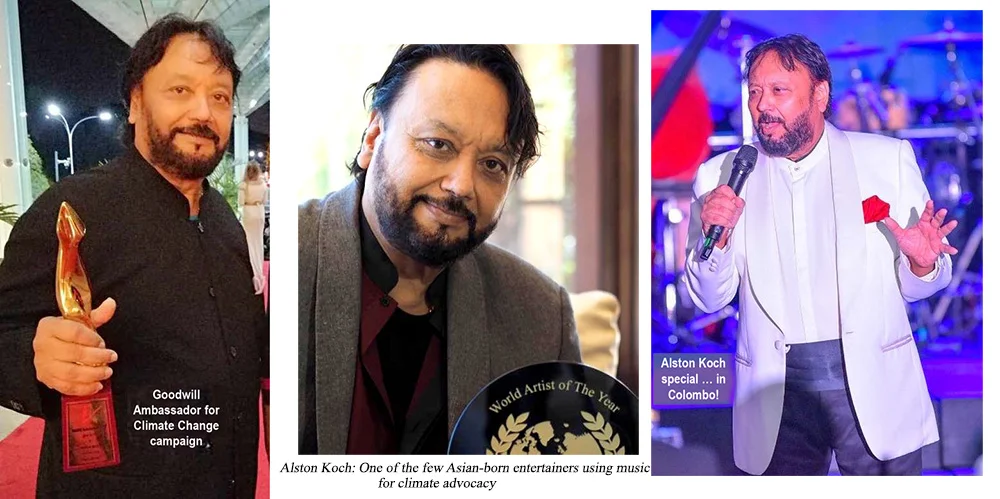
 The name Alston Koch is generally associated with the hit song ‘Disco Lady.’ Yes, he has had several other top-notch songs to his credit but how many music lovers are aware that Alston is one of the few Asian-born entertainers using music for climate advocacy, since 2008.
He is back in the ‘climate change’ scene, with SUNx Malta, to celebrate Earth Day 2026, with the release of ‘A Symphony for Change’ – a vibrant Dodo4Kids video by Alston.
The inspiring musical video highlights ocean conservation and empowers children as future climate champions, honouring Maurice Strong’s legacy through education, creativity, and global collaboration for a sustainable planet.
The four-minute animated musical, composed and performed by platinum award-winning artiste Alston Koch, brings to life a resurrected Dodo, guiding children on a mission to clean up marine environments.
With a catchy melody and an uplifting message, the video blends entertainment with education—making climate awareness accessible and engaging for the next generation.
SUNx Malta is a Climate Friendly Travel system, focused on transforming the global tourism sector that is low-carbon, SDG-linked, and nature-positive.
Professor Geoffrey Lipman, President of SUNx Malta, described the project as a joyful collaboration with purpose:
“It’s always a pleasure to produce music with Alston for the good of our planet. And this time, to incorporate our Dodo4Kids in the video urging the next generation of young climate champions to help save our seas.”
For Alston, now based in Australia, the collaboration continues a long-standing journey of climate-focused creativity:
Says Alston: “I have been working on climate songs since the first release, in 2009, of the video ‘Act Now.’ Since then, I’ve performed at major global events—from Bali to Glasgow. I wrote this song because the climate horizon is darkening, and our kids and grandkids are our best hope for a brighter future.”
Alston’s very first climate song is ‘Can We Take This Climate Change,’ released in 2008.
It was written by Alston for the World Trade Organisation presentation, in London, and presented at ‘Live the Deal Climate Change’ conference in Copenhagen.
The Sri Lankan-born singer was goodwill ambassador for the campaign, and the then UK Minister Barbara Follett called it a “gift in song to the world suffering due to climate change.”
Alston said he wrote it after noticing butterflies, birds, and fruit trees disappearing from his childhood days.
In 2017, his creation ‘Make a Change’ was released in connection with World Tourism Day 2017.
Alston Koch’s work on climate advocacy is pretty inspiring, especially as climate change is now creating horrifying problems worldwide, and in Sri Lanka, too.
Alston also indicated to us that he has plans to visit Sri Lanka, sometime this year, and, maybe, even plan out a date for an Alston Koch special … a concert, no doubt.
Can’t wait for it!

US press gala shooting suspect charged with attempting to kill Trump

Showers above 75 mm are likely at some places in the Western, Sabaragamuwa, Central, North-western, North-central and Southern provinces and in Mannar district

Hazlewood and Bhuvneshwar lead rout of Delhi Capitals

Govt. assures UN of readiness to introduce ‘vetting process’ for troops on overseas missions

Lawyers cannot be denied right to represent a suspect – Udaya

Police seek Interpol help to probe monks nabbed with narcotics at BIA

‘Dates have the highest sugar content to fight Coronavirus’

Sunday Island 27 December – Headlines

#SundayIsland 17th December – Headlines

Sunday Island – 28th March

Sunday Island Headlines – 21 March

Sunday Island – 21st February – Headlines
-

 News5 days ago
Lanka faces crisis of conscience over fate of animals: Call for compassion, law reform, and ethical responsibility
-
 News4 days ago
Whistleblowers ask Treasury Chief to resign over theft of USD 2.5 mn
-

 News4 days ago
No cyber hack: Fintech expert exposes shocking legacy flaws that led to $2.5 million theft
-

 News1 day ago
BIA drug bust: 25 monks including three masterminds arrested
-
 Business2 days ago
Nestlé Lanka Announces Change in Leadership
-

 News1 day ago
Banks alert customers to phishing attacks
-

 News5 days ago
USD 2 mn bribe: CID ordered to arrest Shasheendra R, warrant issued against ex-SriLankan CEO’s wife
-
 News2 days ago
Hackers steal $3.2 Mn from Finance Ministry