
Sports
Superman Stokes puts England in command but Rahul, Gill keep India in the fight


Music echoed around Old Trafford this morning. The trumpeter had chosen well. The things Ben Stokes was doing out there was beyond the realms of normal men. So he or she picked up their instrument, put it against their lips and belted out the Superman theme. Paaaa-pa-pa-pa-paaaaaa…
England ended day four with 137 runs and two Indian wickets in the bank and it’s largely because of their captain’s exertions. A century and a five-for in the same Test match. Leading his team to their fifth-highest total in the format ever. Gatecrashing a club of only two. The big two. The ultimate two. Before Saturday, only Garry Sobers and Jacques Kallis could puff their chests out and say they had 7000 runs and 200 wickets. Now they have to scooch over. Cricket’s rosy old past and its complicated present have clashed a lot over the past 48 hours thanks to Joe Root and his successor.
A lead of 311 looked match-winning-well-ahead-of-time, particularly with Chris Woakes daring to be on a hat-trick with the very first over he bowled. India had spent 943 deliveries on the field. The fatigue that sets in as a result undid two of their top order in five. Shubhman Gill and KL Rahul came together with the score 0 for 2 and strung up back-to-back wicketless sessions (which suggests the pitch has flattened out) to make sure their team could push the fight to the final day, when there’s rain expected in the morning. The forecast says it will clear up by the afternoon.
So England remain in command, although there might be worry about how Stokes did not bring himself on to bowl any of the 63 overs in the day. He’d done a fair bit of leg work earlier, meeting even the slightest sign of the balance shifting with extreme prejudice. Mohammed Siraj thought India had run Stokes out in the first over of the day. Stokes punished his optimism by charging at him the next over. The four runs were incidental. The disdain was the point. Stokes spent a few nervy moments in the nineties but as soon as he got one on his hips, he was able to deflect it off to the boundary behind him – which was the cue for the trumpeter in the crowd to make their mark on this game – and celebrate it with a look up to the heavens and a sign of tribute to his father, Ged.
England’s ninth-wicket stand racked up 95 runs in 97 balls with Brydon Carse almost scoring back-to-back fities. Their highest total at Old Trafford fell. Then the highest total at Old Trafford fell. Eventually England finished with 669, their fifth-highest in Tests and their best since, oh scoring a paltry 823 against Pakistan in October 2024. Stokes made the last 41 of his 141 runs in 34 balls including all three of his sixes. He hit one of them so hard – the deterrent at long-off be damned – his follow through had him spun around and almost facing the wrong way on the pitch. He seemed emotional getting to his first hundred in 35 innings, and vengeful after it.
India had 15 minutes to see off before lunch. England clearly wanted to make the most of them. Woakes went around the wicket straight away and that decision yielded great results. Yashasvi Jaiswal couldn’t leave the ball alone. Not with the angle coming into him. He played for it, closing the face, and a peach of a delivery, nipping away off the seam took the edge through to Root at first slip. He fumbled the first time but not the second. In walked B Sai Sudharsan to become an advert for what happens to a team when they spend 157.1 overs in the middle. He was undecided against a short and wide delivery and in the end got caught trying to leave it.
Gill looked troubled at the start. His front pad was a big target. Thirty-seven percent of his dismissals in Test cricket are lbw and bowled and England went really after him. Jofra Archer produced an inswinging yorker that nearly took him out only for DRS to reveal that the ball hit both the inside edge of his pad and the outside of his front pad almost at the same time. In the middle of this examination, Gill played a shot away from his body and immediately looked like he hated himself. Eventually, he looked up and realised it had raced away towards the cover boundary. And from there, he just decided to trust his game and play his shots. Not in the same way as throwing the bat around and hitting himself out of trouble, just backing himself to play to his strengths.
Out came the drives, and when Gill went down the ground, he evoked the history of that bat he was holding. A couple of guys with MRF sponsored equipment were good with that particular stroke. He cut the ball well, gaining a little payback over Archer who had hit his hand which had been bandaged up. There were also several drop-and-runs to rotate strike and share the pressure with his partner. It was a good innings, which could easily have been cut short at 46 when Carse had him playing away from his body again only for Liam Dawson to drop a tough catch at gully.
Gill made the most of that generosity to continue his run-spree. He went past Virat Kohli’s 655 runs against England in 2016 and is chasing down Sunil Gavaskar’s record of most runs as an Indian captain in a Test series (732). Crucially, he became confident of his defence too. From being 46 off 52 with eight fours, he went to stumps scoring a further 32 off 111 with two fours.
Rahul was old-school too, right from the start. He backed his technique even when the new ball drew plenty of life out of the pitch. This was a thrill for him. He shared smiles with Archer when an absolute seed snaked past his outside edge. Rahul’s judgment on what to play and what to leave was all the more impressive considering the time India were stuck in the field and how they were trailing the game. He was 20 off 71. Perfectly content, then bit by bit he accepted the rewards of his patience, scoring 67 off the next 139 balls and going past 500 runs in a series for the first time in his career. Rahul too had a little luck break his way when on 36, and an inside edge off Dawson skirted just wide of his leg stump.
A day five with immense possibility awaits.
Brief scores: [Stumps day 4]
India 358 and 174 for 2 in 63 overs (KL Rahul 87*, Shubman Gill 77*; Chris Woakes 2-48) trail England 699 in 157.1 overs (Zak Crawley 84. Ben Duckett 94, Ollie Pope 71, Joe Root 150, Ben Stokes 141, Brydon Carse 47; Jasprit Bumrah 2-112, Ravindra Jadeja 4-143, Washington Sundar 2-107) by 137 runs
[Cricinfo]

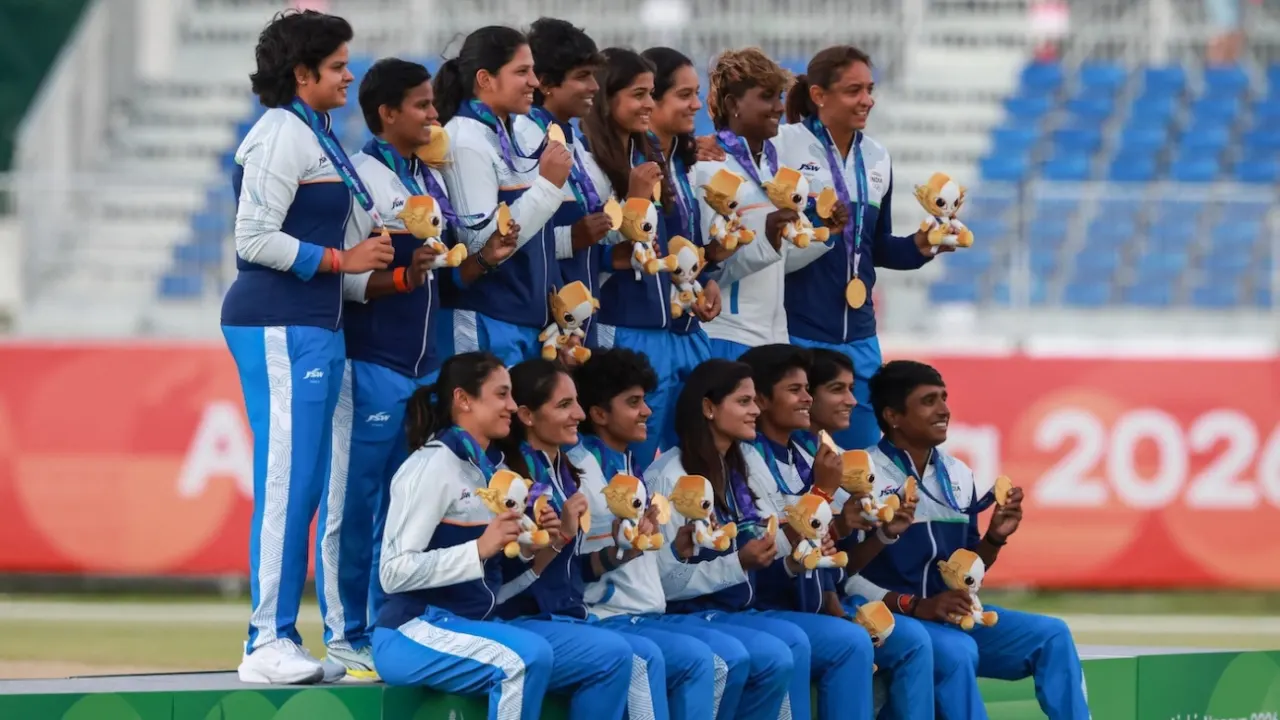
India thrashed Sri Lanka by 147 runs in the Asian Games women’s cricket competition final in Nisshin to win the country’s first gold medal of the multi-sport event, with Smriri Mandhana, Shafali Verma, Richa Ghosh and the bowling group starring in the dominant display. That made it back-to-back gold medals for India in the event after their triumph in 2023.
Mandhana and Shafali laid the foundation of the win for India with a 99-run opening stand after they opted to bat, with Mandhana finishing on 79 off 45 balls. Ghosh then provided the finishing touches, making 49 not out off 22 balls to power India to 216 for 3, the highest Asian Games innings total.
Sri Lanka couldn’t get anywhere near India’s firepower as they struggled against spin. Chamari Athapaththu fought with a 21-ball 29, but they folded for a paltry 69 – just two runs more than what India managed in their powerplay – to lose another final to India in the space of ten days after going down in the Asia Cup title contest.
The match unfolded similarly to that game in Dubai. Mandhana in particular was at her menacing best, starting off with two boundaries off Sugandika Kumari in the first over and then launching three sixes to different parts of the ground. She first rocked back to Sugandika’s short delivery outside off and cleared mid-on with ease. Sugandika then went fuller and strayed onto the pads, allowing Mandhana to whip it over square leg for another six. And in the next over, she stepped down the track and carved Mithali Ayodhya over cover for her third six of the day.
Shafali then joined in the fun, taking Athapaththu for two sixes, pulling a short ball over deep midwicket before driving a floated delivery over mid-off. Mandhana rounded off the over by flat-batting a back-of-a-length delivery just beyond long-on for another six, much to Athapaththu’s frustration. India were going at over 11 at that point, posting 67 for no loss at the end of the powerplay.
Fours and sixes came frequently with Mandhana continuing to be the more aggressive of the two, bringing up her fifty off 30 balls in the tenth over. Shafali survived a stumping scare in the same over but couldn’t cash in on the chance as she top-edged a shot to Kawya Kavindi at short third off Chamudi Praboda for 48 off 29 balls.
Sri Lanka briefly managed to stem the flow of runs, conceding just one boundary in 19 balls, but that period did not last long. Harmanpreet Kaur and Mandhana started finding the gaps soon, though the India captain’s stay did not last long as she departed for a 17-ball 19.
Ghosh walked out at No. 4 and helped India pick up the pace again, taking on Praboda for two boundaries while Mandhana continued to attack at the other end. Mandhana went on to clobber two more sixes before falling in an attempt to go big, miscuing a length delivery from Sugandika while looking to clear deep-backward square-leg.
With 200 in sight, Ghosh took charge as she helped India plunder 19 runs, including two fours and a six, off Kavindi’s over before launching two more sixes off Ayodhya in the next, pulling a half-tracker over deep midwicket before moving across to club another full delivery over cow corner. Ayodhya also conceded five wides in the over. Ghosh capped the innings with another boundary as India finished on 216.
Sri Lanka were facing a daunting target, but it was not the brightest of starts for India on the field either. After Shreyanka Patil dropped a regulation catch off Imesha Dulani at backward point in the first over, Athapaththu looked in good touch as she scored two boundaries off Nandani Sharma in the second.
Harmanpreet then turned to India’s go-to part-time spin option – Shafali – and she delivered instantly, deceiving Dulani in flight, with Ghosh completing the stumping. She claimed her second wicket in her next over, with a loopy delivery that Hasini Perera sliced to cover point.
Sri Lanka found boundaries against the faster bowlers but could barely keep up with the required run rate, moving to 41 for 2 at the end of the powerplay. India then turned to spin for the rest of the innings, and Sri Lanka’s chase quickly unravelled.
Deepti Sharma ended their slim hopes when she had Athapaththu miscuing to long-off in the seventh over. Patil then had Harshitha Samarawickrama caught and bowled for a duck, before N Shree Charani dismissed Hansima Karunaratne for 1 after another miscued slog.
Deepti then added a second wicket when Kavisha Dilhari spooned a drive back to her, leaving Sri Lanka six down and in deep, deep trouble.
The result all but decided by then, and India continued to strike at regular intervals with Sri Lanka offering no resistance, barring a six and a four from Kaushini Nuthyanganam, whose wicket brought Sri Lanka’s innings to an end in the 16th over. Deepti finished with figures of 3 for 6, while Shafali, Shree Charani and Patil bagged two each.
Scores:
India Women 216 for 3 in 20 overs (Shafali Verma 48, Smriti Mandhana 79, Harmanpreet Kur 19, Richa Ghosh 49; SugandikaKumari 1-49, Kavisha Dilhari 1-35, Chamudi Praboda 1-34) beat Sri Lanka 69 in 15.4 overs (Chamari Athapaththu 29, Kavisha Dilhari 11, Kaushini Nuthyangana 14; Deepti Sharma 3-06, Shafali Verma 2-03, Shreyanka Patil 2-9, N Shree Charani 2-13) by 147 runs
[Cricinfo]
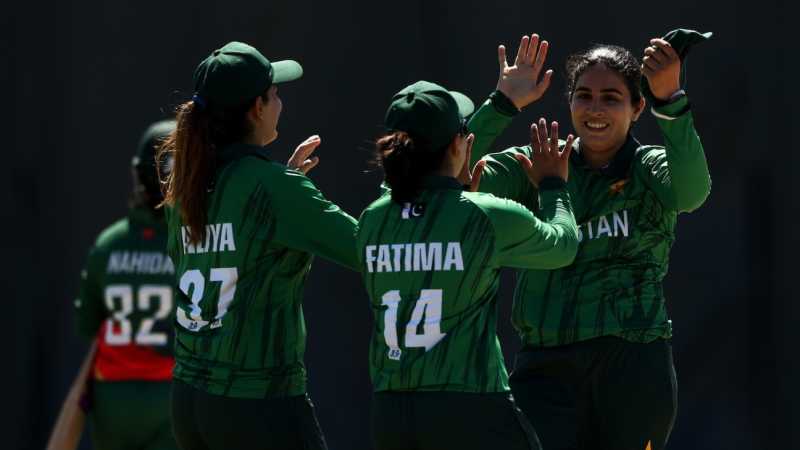
At 67 for 5 in the 12th over, Pakistan were under the cosh against Bqngladesh in their bronze-medal playoff at the Asian Games women’s competition. That’s when Fatima Sana walked out, slammed 45 in 30 balls, and gave Pakistan 145, which was 31 too many for Bangladesh, especially after Umm-e-Hani picked up three top- and middle-order wickets to end with 3 for 10 from her four overs.
Bangladesh’s big concern, of late and in general, has been the number of dot balls they play out in a typical T20 innings. In this game, it was a marginal improvement from the loss to India in the semi-final – they had 43 dot balls here compared to 61 in that game. But it was still fewer than the 48 they bowled to Pakistan in the first half. The difference was Sana, who scored at 150.00 to change the complexion of the contest.
Pakistan’s start had been decent, thanks to Gull Feroza, after they won the toss and opted to bat. Feroza and Shawaal Zulfiqar added 46 in 41 balls before being separated in the seventh over. The one to be dismissed was Feroza, who had scored 31 in 23 balls. Zulfiqar batted on before becoming the third batter to fall, having struggled to 17 off 27 balls. And the wickets kept falling, Shorna Akter picking up two of them to leave Pakistan in a mess with five batters gone.
Sana had a solid stand for the sixth wicket with Aliya Riyaz, who scored 25 in 22 balls and added 67 with Sana in just 43 balls. The control Bangladesh had was gone with the two hitting five sixes between them.
The target for Bangladesh, which looked like it might be in the region of 100, was suddenly closer to 150. And the chase never took off. Umm-e-Hani struck in the third over, then in the fifth over, and again in the 16th over. By then, Bangladesh were floundering: 77 for 5 with under five overs to go.
The resistance came from senior pro Sharmin Akther, who scored an unbeaten 46 in 45 balls, but there was nothing around her, and Pakistan ran out comfortable, 31-run victors.
Scores:
Pakistan women 145 for 8 in 20 overs (Shawaal Zulfiqar 17, Fatima Sana 45, Gull Feroza 31, Aliya Riyaz 25; Sanija Akter Meghla 1-28, Nahida Akter 2-21, Shorna Akter 2-16, Ritu Moni 2-27) beat Bangladesh women 114 for 7 in 20 overs (Dilara Akter 12, Nigar Sultana 25, Sharmin Akhter 46*, Nahida Akter 10*; Tasmia Rubab 1-25, Fatima Sana 1-25, Umm-e-Hani 3-10, Nashra Sandhu 1-19, Ayesha Zafar 1-10) by 31 runs
(Cricinfo)

India Women won the toss and chose to bat first in the Asian Games women’s cricket final in Nishin, Japan.
India: Smriti Mandhana, Shafali Verma, G Kamalini, Harmanpreet Kaur (capt), Richa Ghosh (wk), Bharti Fulmali, Deepti Sharma, Shreyanka Patil, Kranti Gaud, N Shree Charani, Nandani Sharma
Sri Lanka: Imesha Dulani, Chamari Athapaththu (capt), Hasini Perera, Kavisha Dilhari, Harshitha Samarawickrama, Hansima Karunaratne, Kaushini Nuthyangana (wk), Kawya Kavindi, Mithali Ayodhya, Chamudi Praboda, Sugandika Kumari
(Cricinfo)

High Court convicts 14 over deadly Easter bombings

Mandhana, Shafali and Ghosh lead dominant India to Asian Games gold

Fatima Sana and Umm-e-Hani secure bronze for Pakistan in Asian Games

India bat first in Asian games womens cricket final

Showers about 100mm will occur in the Western, Sabaragamuwa, Central and North-western provinces and in Galle and Matara Districts

Govt. confident of 2/3 majority despite NPP split speculation

‘Dates have the highest sugar content to fight Coronavirus’

Sunday Island 27 December – Headlines

#SundayIsland 17th December – Headlines

Sunday Island – 28th March

Sunday Island Headlines – 21 March

Sunday Island – 21st February – Headlines
-

 News6 days ago
US embassy won’t comment on IGP’s probe into joint drug raid
-

 News4 days ago
Shanakiyan urges urgent action over reported death sentence for Lankan in Saudi Arabia
-

 News5 days ago
Bid for Basil’s extradition nears final stage: Police
-

 Business6 days ago
All-new Bolero MaXX unveiled in Sri Lanka
-

 News3 days ago
Namal Rajapaksa Buddhist gambit fails, bail denied
-

 Opinion6 days ago
A journalist who wrote across the divide
-

 Editorial7 days ago
More fuel price shocks shrouded in secrecy
-

 Features3 days ago
Why the spelling Sri Lankan names in English vary