
Editorial
Chilling stats and inaction


Friday 19th February, 2021
Police Spokesman DIG Ajith Rohana has alerted the public to an alarming increase in killer road accidents recently. During the past seven days, as many as 23 people have died in road mishaps, he says. Prangs, near misses and the attendant chaos on roads have become the order of the day, again. This may be taken as an indication that the country has returned to normal earlier than expected. During the pandemic-related lockdowns and travel restrictions, there was a sharp drop in road fatalities, which began to increase gradually as the country limped back to normalcy.
Road accidents snuff out more lives than coronavirus does in this country. Deaths due to road mishaps average eight a day. Not even the war destroyed lives at this rate. The National Council for Road Safety has revealed that 2,641 fatal road accidents caused as many as 2,829 deaths in 2019, when 10,691 mishaps occurred. There were 776 pedestrians, 1,162 motorcyclists, 282 drivers, 405 passengers and 204 cyclists and 10 others among the victims. There is a war of sorts against the runaway virus, which must be stopped, but there has been no such national effort to prevent road accidents. Why?
What action have the police taken to minimise road accidents and fatalities. The practice of revealing chilling statistics, from time to time, will not help prevent such tragedies however necessary it may be to raise public awareness. Hiru TV yesterday highlighted the danger motorists and pedestrians are exposed to at Rilawala, Kahatuduwa on the Colombo-Horana road. More than ten accidents happen at this busy intersection a month, according to witnesses, but the police have not done anything to make the place safe for motorists and pedestrians. All it takes to prevent such mishaps is to install signal lights or deploy traffic policemen there. Neither the traffic police nor the Road Development Authority nor the Pradeshiya Sabha concerned nor any other state institution seems to care.
The traffic police are maintained with public funds to make roads safe. They have to prevent road mishaps and ease traffic congestion. Instead, they patiently wait on the roadside until traffic laws are violated so that they can fine errant motorists. At some intersections in the city, there are posses of policemen hiding behind wayside lampposts and trees to nab those who drive through a red light, endangering their lives as well as others’. The presence of a single policeman is sufficient to ensure the safety of road users at some junctions, provided it is made conspicuous so that it will have a deterrent effect on reckless motorists.
Many newly carpeted roads in suburban areas are without sidewalks, and vehicles move extremely fast on them, posing a danger to pedestrians. Such roads run through even bustling townships, and speeding trucks and buses knock down many pedestrians and motorcycles daily. What one gathers from the numerous accidents shown on television daily is that vehicles, especially buses, trucks and motorcycles move like bats out of hell with the police doing precious little to control them. Why can’t cameras be installed to nab speedsters?
If the high-performance speedsters, as it were, are identified with the help of cameras and awarded tickets or hauled up before courts regularly, there will be a significant decrease in accidents. This method works well on expressways, where, as cynics say, drivers’ speeding skills are recognised at exit points, where the police courteously present them with detailed spot fine statements; why it is not employed elsewhere is the question. The government will be able to recover the cost of installing cameras in next to no time as the country is full of motorists who try to break the sound barrier.
Today, we carry an article on road accidents, which reveals that last year, the Stockholm Declaration adopted by the Third Global Ministerial Conference on Road Safety focuses on speed management besides strengthening of law enforcement to prevent speeding––the leading cause of road fatalities––and mandating a maximus speed of 30 km/h, in places where road users and vehicles have to move in a planned manner. One may argue that in Colombo and its suburbs, vehicles cannot exceed the aforesaid speed limit except around midnight, but the lowering of speed limits will work in areas like busy townships through which arterial roads run.
A Presidential Task forces has been appointed to battle COVID-19. The need for such a national effort to tackle the scourge of road accidents as well cannot be overemphasised.



The past few weeks have seen several high-profile arrests, much to the delight of critics of former rulers whose governments were widely associated with abuse of power, the suppression of democracy, political interference in key state institutions and corruption.
The arrest and remand of former First Lady Shiranthi Rajapaksa have triggered what may be described as a social media feeding frenzy, with government propagandists having a field day. The Rajapaksas and their allies were accused of manipulating legal and judicial processes for political expediency and harassing the Opposition when they were in power. Today, the boot is on the other foot, and they are crying foul. If only they had realised then that those who manipulate the law for political ends might one day find themselves at the receiving end of the same treatment.
It is hardly surprising that the JVP-led government is accused of resorting to show arrests and detentions to divert public attention from pressing issues and advance its political agenda. The government has gone on the offensive, seeking to neutralise key Opposition figures politically. Its modus operandi brings to mind Maslow’s hammer, the cognitive bias of relying excessively on a familiar tool or approach to tackle every problem, much like someone who has only a hammer and sees every problem as a nail. Critics see the suppression of dissent as ingrained in the JVP’s political culture and consider it naïve to expect a JVP-led government to refrain from using state power against its political opponents. After all, successive governments have done so, setting deeply damaging precedents.
Minister and Leader of the House Bimal Rathnayake took great pains in Parliament on Thursday to debunk the Opposition’s claim that the government has launched a witch-hunt against its political rivals. He sought to convince the House and the public that the government had nothing to do with most of the court cases and investigations against the Opposition politicians and their family members. He said all cases against Opposition politicians, except a few, had been filed during the Yahapalana and SLPP governments. If it is true that the cases were initiated under previous administrations, can the JVP/NPP leaders legitimately claim credit for fulfilling their pledge to punish the corrupt? Shouldn’t that credit go to the UNP and the SLFP, the two main constituents of the Yahapalana coalition?
Can anything be more disingenuous than politicians’ claims that they keep their hands off the legal process and the administration of justice? Governments in this country are notorious for making the wheels of justice turn at a politically expedient pace, often resorting to flimsy excuses to justify their shameful actions. While justice delayed is justice denied, justice hurried is justice buried. Justice must be neither delayed nor rushed to achieve political ends. It must be allowed to take its course, free from political interference. This has not happened under any government during the past several decades.
Some suspects are arrested and remanded or detained even before investigations against them get underway in earnest. Such action ought to be the exception, if it is warranted at all, rather than the rule. Otherwise, it could turn law enforcement into political theatre and investigations into a witch-hunt in the eyes of the public. The police and the Commission to Investigate Allegations of Bribery or Corruption must therefore act with such impartiality and professionalism that they cannot reasonably be accused of staging arrests to help the government of the day score political points. As legal experts have pointed out, premature arrests before investigations have established reasonable grounds for suspicion, risk violating individual liberty and the presumption of innocence, compromising the gathering of reliable evidence, and undermining public confidence by making law enforcement appear politically motivated or driven by a desire for publicity rather than justice. Perceptions matter as much as reality when it comes to the dispensation of justice.
The incumbent leaders ought to remember that they, too, will eventually lose their grip on power and may sooner or later have to answer for their actions. Their administration is already facing very serious questions over several controversies, including the release of 323 shipping containers without mandatory inspections, coal procurement, the disappearance of US$ 2.5 million from Treasury funds and alleged import rackets. When the Rajapaksas were at the height of their power, who would have imagined that some of them, too, would one day find themselves in remand prison? The incumbent leaders and their associates would do well to learn from their predecessors’ predicament.

Saturday 10th October, 2026
It will soon be showtime in Parliament. The Opposition has submitted a motion of no confidence against Speaker Dr Jagath Wickramaratne to Secretary General of Parliament Kushani Rohanadheera. Debates on no-confidence motions invariably descend into slanging matches, with members of both sides of the House trading insults and dragging one another’s reputations through the mud.
The motion of no confidence reportedly contains about 50 allegations, including misconduct, misuse of public property, financial irregularities, conflict of interest and violation of parliamentary procedures. The Opposition has called upon the Speaker to step down immediately.
The fate of no-confidence is not difficult to guess. What determines the outcome of a vote on such a motion is the numbers the opponents and the proponents can muster. There is no such thing as a conscience vote in the Sri Lankan Parliament. The Opposition has only 66 members as opposed to the government’s 159 including the Speaker. Some Opposition MPs are accused of running with the hare and hunting with the hounds. They disappear during crucial votes in the House. So, the no-confidence motion against the Speaker is doomed. The Opposition cannot be so naïve as to expect a different outcome; it is apparently planning to use the motion to inflict maximum possible damage on the government.
Gone are the days when the Speakers acted impartially, commanding the respect of all members of the House. Over the past several decades, the Chair has been reduced to little more than an appendage of the government of the day. Hence the Opposition’s frequent complaints of grievances. Worryingly, the campaigners for democracy and rights and privileges of lawmakers act out of expediency rather than principle once ensconced in power.
Ideally, the Speaker should be independent of political parties if he or she is to act impartially. Time was when political parties did not field candidates to challenge the Speakers at general elections. That helped A. F. Peiris (1952) and R. S. Pelpola (1960) enter Parliament without facing competition. The practice was that a Speaker would not normally be opposed at the next general election, reflecting the expectation that the office should be impartial and above party politics.
There have also been instances where the Speakers were elected unanimously in Parliament. They include Speaker Wickramaratne, his predecessors Asoka Ranwala and the late Anura Bandaranaike. Sadly, Ranwala had to resign over a degree certificate issue and Dr Wickramaratne is facing a no-confidence motion.
A government with a parliamentary majority can shoot down no-confidence motions with ease, but the issues raised by the Opposition do not go away. The SLPP-UNP government defeated a no-confidence motion against the then Health Minister Keheliya Rambukwella over a procurement scam, but subsequently he was prosecuted. It also defeated a no-confidence motion against Speaker Mahinda Yapa Abeywardena. But both the SLPP and the UNP suffered humiliating defeats at the last general election. Most of the SLPP MPs who voted to defeat the no-confidence motions against Rambukwella and Abeywardena could not even contest the last general election. The NPP MPs defeated a no-confidence motion against the Energy Minister Kumara Jayakody, but he had to step down subsequently albeit over some other allegation and legal action. This is something the JVP/NPP politicians who think no end of their supermajority ought to take cognisance of.

Friday 9th October, 2026
Some crucial problems have remained intractable in the public sector because a chronic lack of inter-institutional cooperation has stood in the way of tackling them. The Committee on Public Enterprises (COPE) has recently addressed one such issue. While examining the affairs of the Coconut Development Authority (CDA), the Coconut Research Institute, and the Coconut Cultivation Board, the COPE raised serious concerns over the food-safety risks posed by reprocessed and adulterated coconut oil entering the local food industry.
When COPE Chairman Dr. Nishantha Samaraweera pointed out that there had been about 150 instances of non-compliance with required standards in the coconut-oil manufacturing sector and asked what action had been taken against the errant companies, CDA Chairman Shantha Ranatunga said his institution could only trace such manufacturers and ensure corrective action. Dr. Samaraweera asked why the Health Ministry or the Consumer Affairs Authority had not been informed of those illegal practices, but he did not receive a clear answer. The officials only said they were not authorised to do so. Faulting most state institutions for working in silos with no cooperation among them, the COPE Chairman revealed the health risks posed by the waste cooking oil trade. He deserves praise for taking up this vital issue and calling for action to protect the public.
Sri Lanka’s edible oil problem has been a recurring food-safety concern for decades, with the evidence pointing to several forms of malpractice, from blending coconut oil with cheaper vegetable oils and reselling used oil to the distribution of products contaminated with aflatoxins. The repeated detection of such products also raises questions about the effectiveness of market surveillance, testing and enforcement.
In 2017, raids conducted by the Consumer Affairs Authority revealed that large quantities of used cooking oil had been placed alongside barrels of oil apparently processed with chemicals and colouring. Some samples were found to be adulterated. Officials said vendors had bought used cooking oil from food outlets and resold it after treating it with chemicals.
A 2021 study by a team of university researchers, has revealed an established chain in which hotels and restaurants sell used cooking oil to vendors, who filter it and remove sediments, before distributing it to small-scale restaurants for further use as cooking oil. Public health experts have pointed out that repeatedly heated, degraded or adulterated edible oils may increase the risk of cardiovascular disease and other chronic diseases. Volumes have been written about the waste cooking oil racket in the food industry, but it is doubtful whether any meaningful interventions have been made to eliminate it.
Media reports have shed light on another dimension of the waste edible oil racket. It has been reported that trade-data records indicate 67 shipments in the July 2024-June 2025 period under a category including “used cooking oil”, involving 31 Sri Lankan buyers and 38 suppliers. However, the database groups several oil categories together, and therefore this by itself does not prove that the imported used oil was intended for human consumption, but it is believed that at least a part of those imported waste cooking oil consignments entered the food industry. A thorough investigation is needed to prevent such illegal practices.
Non-communicable diseases (NCDs) reportedly account for about three-quarters of all deaths in Sri Lanka, making them the country’s dominant cause of mortality. Doctors have warned that the consumption of degraded, repeatedly heated or contaminated cooking oil may increase the risk of some NCDs, particularly certain cancers. Hence the pressing need for a comprehensive strategy to monitor and regulate the cooking oil trade and prosecute those who engage in illegal practices.
There are about 20 medical doctors in the current Parliament, including Health Minister Dr. Nalinda Jayatissa. They ought to use their collective voice to press for the proper enforcement of existing laws, or for new legislation, where necessary, to put an end to the waste cooking oil racket and other such illegal practices that endanger public health.

Iranian ships stranded, Lanka fears US sanctions

Sri Lanka CERT warns of overseas university admission scams

Navi Pillay’s Lankan affairs in focus as she wins 2026 Nobel Peace Prize

Lanka welcomes Indian SC remarks on Katchatheevu dispute

UN at Crossroads, Trump nearing End of the Road

Opposition moves to oust Speaker

‘Dates have the highest sugar content to fight Coronavirus’

Sunday Island 27 December – Headlines

#SundayIsland 17th December – Headlines

Sunday Island – 28th March

Sunday Island Headlines – 21 March

Sunday Island – 21st February – Headlines
-

 News6 days ago
Geneva takes up Sallay’s case and govt. ignores opportunity to answer accusations
-

 Features5 days ago
Preventing grievances from becoming communal
-

 Sports3 days ago
Nissanka absence opens door for Sri Lanka’s young guns
-

 Features3 days ago
The Sri Lankan who made Scottish history
-

 News4 days ago
Gnansara Thera to be assigned to prison printing section: Officials
-
 Features6 days ago
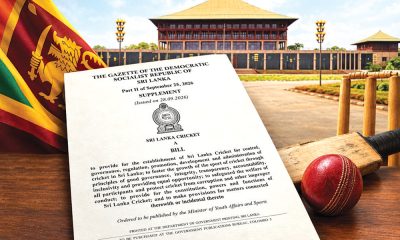
Sri Lanka Cricket Bill: Governance reform is not yet a cricket strategy
-

 Editorial6 days ago
Dons’ frustration and rulers’ nonchalance
-

 Features3 days ago
Future of Sri Lanka’s state university system: Should it be shut down and reopened?