
Latest News
Jos Buttler 96, Liam Dawson four-for seal spoils for England


Jos Buttler began life back in the ranks of England’s T20I side by making his highest score on home soil, his supremely calculated innings of 96 from 59 providing a reassuring touch of quality to a new-look batting order. Liam Dawson then marked his return to England duty after more than two years out of the side with his best return in any format, figures of 4 for 20 putting the skids under West Indies in the chase.
Buttler scored almost exactly half of England’s runs but did most of the heavy lifting to give his successor, Harry Brook a largely comfortable first outing as T20I captain. Jamie Smith and Jacob Bethell were the only other batters to make double-figures on a lop-sided scorecard, but West Indies paid for a profligate start with the ball that allowed England to race away to 78 for 1 at the end of the powerplay.
Run-scoring became harder thereafter on a Chester-le-Street surface that was unusually receptive to slow bowling – something England had twigged by only including two seamers in their XI. Having notched a half-century from 25 balls, Buttler added 46 from his next 34 as partners came and went but did enough to steer England to an above-par total.
West Indies struggled to get going in reply. Dawson opened the bowling and made the breakthrough in his second over, luring Johnson Charles from his ground, before Mathew Potts removed West Indies’ new T20I captain, Shai Hope, with his second ball on debut. Evin Lewis briefly threatened to fire up the chase during an over from Bethell than cost 24 – but he was caught in the deep from the final ball, and when Dawson claimed the wickets of Sherfane Rutherford and Roston Chase in the space of three balls, the jig was as good as up.
It is only just over a year since Dawson seemed to have turned his back on international cricket, after 20 sporadic appearances across formats since his debut in 2016. He was overlooked for the Test tour of India, and seemed happy to embrace a future on the T20 franchise circuit rather than carrying drinks for England.
However, his continued excellence for Hampshire, coupled with the retirement of Moeen Ali and the decision to drop Liam Livingstone, opened up a window of opportunity with the T20I side. He grasped it with both hands on a chilly Friday night in Durham. His first over was Spandex tight, giving up just four runs; his second saw off Charles with a classic one-two, following a speared-in delivery with one that was beautifully flighted.
West Indies had been 44 for 2 at the end of the powerplay, but recovered somewhat to be 91 for 3 at halfway, needing 98 more. A tight over from Adil Rashid pushed the required run rate above 10, and then Dawson returned to take the guts out of the innings: Rutherford and Chase were caught in the deep before Rovman Powell was castled by one that skidded through from round the wicket. Afterwards, the 35-year-old Dawson admitted to nerves on making his comeback – but by that stage he was holding the Player-of-the-Match award.
Without Phil Salt on paternity leave, England opted to simply plug in his replacement at opener. Smith had auditioned for the job with a 25-ball fifty opening the batting in the Oval ODI on Tuesday, and was preferred up top to Tom Banton, back in the side for the first time since January 2022 but asked to bat out of position at No. 5.
With England opting to put runs on the board, Smith had a clear brief – one he set about putting into action as he charged Jason Holder, playing his first T20I since February 2024, from the off to pick off three boundaries in the opening over. While Ben Duckett fell to the third ball of the second, duped by Romario Shepherd’s offcutter to send a leading edge behind, that only brought Buttler out to the middle. After a brief period of reconnaissance, the second-wicket pairing went pedal to the metal to ensure England got what they wanted from the powerplay.
Andre Russell, back in the side after being injured against England in November, was greeted by Buttler reverse-scooping his first ball for four to start the fifth over. Smith twice launched Russell disdainfully for six over long-on in an over that cost 22 – but worse was to come for West Indies. Alzarri Joseph repeatedly missed his lengths as Buttler crunched 6-6-4-6 through the leg side – two cross-batted, two ramps – as another 23 went on the scoreboard to leave England 78 for 1 after six.
The introduction of Gudakesh Motie brought an immediate slowdown, and signalled that spin could play a more significant role than expected. Motie bowled four boundary-less overs off the reel, while Shepherd returned to remove Smith, who holed out to deep midwicket after being forced to hit square. Brook was bowled by Chase the ball after reverse-slapping him for four, while Banton fell lbw to a marginal call against Russell as England slipped to 116 for 4.
They were grateful for the skill and experience of Buttler in navigating a path through the middle overs. Having notched his fifty in the eighth, he prioritised knocking the ball around with the field out. England had rattled off 11 boundaries during the powerplay, but only managed six more during the second half of the innings; Buttler hit four of them, including another audacious reverse-swat off Shepherd. An edged four to deep third moved him to 95 but Joseph had his revenge in the same over when pinning him in front, the lbw decision confirmed via umpire’s call on DRS.
The Chester-le-Street crowd groaned in unison as Graham Lloyd’s finger went up, and Buttler missed out on adding a second T20I hundred to the one he made in Sharjah at the 2021 World Cup. But for England under their new captain, it was pretty much job done.
Brief scores:
England 188 for 6 in 20 overs (Jamie Smith 38, Jos Buttler 96, Jacob Bethell 23*; Romairo Shepherd 2-33, Alzarri Joseph 1-51, Andre Rusell 1-25, Roston Chase 1-19) beat West Indies 167 for 9 in 20 overs (Evin Lewis 39,Johnson Charles 18, Roston Chase 24, Rovman Powell 13, Andre Rusell 15, Romairo Shepherd 16, Jason Holder 16*; Liam Dawson 4-20, Mathew Potts 2-48, Adil Rashid 1-22, Jacob Bethell 2-27) by 21 runs
[Cricinfo]

Latest News
Landslide Early Warnings issued to the Districts of Kandy, Kegalle, Matale and Ratnapura

The Hational Building Research Institute (NBRI) has issued landslide early warnings to the Districts of Kandy, Kegalle, Matale and Ratnapura valid from 2200 hrs on 03rd October upto 2200 hrs on 04th October 2026.
Accordingly,
LEVEL II (AMBER) landslide early warnings have been issued to the Divisional Secretaries Divisions and surrounding areas of Udu Dumbara and Minipe 8n the Kandy district, Dehiowita in the Kegalle district, and Ambanganga Korale and Matale in the Matale district.
LEVEL I (YELLOW) landslide early warnings have been issued to the Divisional Secretaries Divisions and surrounding areas of Rambukkana in the Kegalle district, Rattota in the Matale district, and Eheliyagoda in the Ratnapura district.

The head of Turkiye’s football refereeing body and four other officials have been placed in pretrial detention by a court as part of a corruption investigation, the state news agency Anadolu reports.
Ferhat Gundogdu, head of the Central Referees Committee, and six others appeared before a judge over allegations of manipulation of the referee administration process, Anadolu said on Saturday.
They appeared on Friday before a judge at Istanbul’s Caglayan courthouse on several charges, including forgery of official documents, breach of trust and illegal acquisition of personal data, the report said.
The judge remanded five people in custody and granted the other two conditional release, Anadolu said.
It was the latest scandal to shake football in Turkiye, coming exactly a year after the Turkish Football Federation (TFF) suspended 149 referees on charges of illegal betting.
On Thursday night, police from the illegal betting and sports crime unit also detained Yasin Kol, a referee from Turkiye’s top-flight Super Lig, as well as an assistant referee, media reports said.
Justice Minister Akin Gurlek said prosecutors are examining claims about “interference in the processes of referee classification, assignments, scoring and appointments as well as the exams on rules”.
During raids on Tuesday, police searched the VAR room at TFF’s headquarters in Istanbul. Observers said the investigation was likely linked to last year’s betting scandal and would have implications for the federation.
“It does seem to be a continuation of 2025, and it looks like it will continue further,” sports journalist Ayhan Sensoy told the AFP news agency.
Sensoy, who wrote a 2024 book on the issue called The Gambling Pit, said it was unlikely that federation bosses “have any chance of staying in office”.
So far, the TFF has not directly addressed the arrests as its top officials are due to fly home on Saturday after attending Friday night’s Belgium-Turkiye UEFA Nations League clash in Liege, which Turkiye lost 3-0.
[Aljazeera]
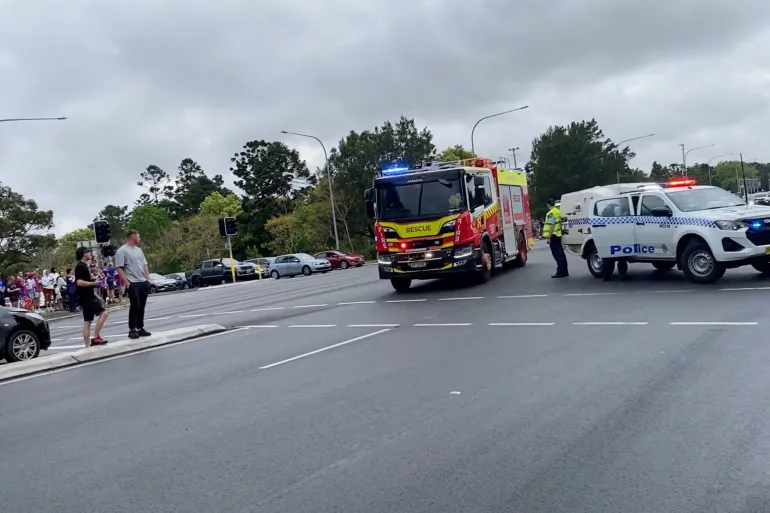
A car has crashed into a crowd of rugby league supporters in the eastern Australian city of Newcastle, injuring 10 people, including three children.
New South Wales police said on Saturday that two of the injured – a five-year-old girl and a 67-year-old man – were in a critical condition and the other eight were in stable condition in hospital.
Police said they had arrested the 18-year-old man driving the vehicle and were investigating what happened. They said the crash was not believed to be related to “terrorism”.
The crowd had gathered to farewell the local rugby league side, the Newcastle Knights, ahead of their grand final against the Sydney Roosters on Sunday.
Newcastle Lord Mayor Gavin Morris said the driver, a rugby league fan, had lost control of his vehicle and had been taken into custody.
“He was revving the car, he was excited, he was a supporter, he was there for the joy of the moment,” Morris told the national broadcaster ABC.
“Somehow he lost control of the car … and he’s gone into the crowd,” he added.
Prime Minister Anthony Albanese said: “My thoughts are with everyone injured or involved in the horrible incident this morning in Newcastle.”
“Rugby league brings people together, and this should have been a weekend of excitement and pride for Newcastle fans,” he wrote in a social media post.
[Aljazeera]

Showers or thundershowers will occur at several places in the most part of the island after 1.00 p.m

Geneva takes up Sallay’s case and govt. ignores opportunity to answer accusations

Section of wartime KKS High Security Zone vacated to facilitate economic development in the area

Lawyer lodges complaint against Govt. Printer, Media Ministry Secy.

Sri Lankan troops in joint anti-terrorist exercise in Russia

Nine Indian poachers brought to KKS with their boat

‘Dates have the highest sugar content to fight Coronavirus’

Sunday Island 27 December – Headlines

#SundayIsland 17th December – Headlines

Sunday Island – 28th March

Sunday Island Headlines – 21 March

Sunday Island – 21st February – Headlines
-

 Latest News6 days ago
Gold winner Tharanga gets brand-new Honda Vezel from SLAAJ
-

 Features6 days ago
Why Sri Lanka needs an Inclusive Civic Nationalism – urgently
-

 News5 days ago
US-assisted ‘Ice’ detection: NPC to examine IGP’s move to transfer drug-busting team
-

 Features7 days ago
Thailand’s biggest new global star …
-

 Editorial4 days ago
Colombo Port drug bust: The plot thickens
-
 News7 days ago
First cases taken up by SC after enactment of 22A dismissed
-

 News6 days ago
Civil society activist accuses govt. of favouring Ven. Gnanasara
-

 Editorial7 days ago
Aftershocks of 22A