
News
Milestone maritime exercise for EUNAVFOR and India’s navy in Indian Ocean


(EU) The European Union and India have teamed up for a major naval exercise in the Indian Ocean. This exercise was undertaken to boost maritime security cooperation between the two forces.
The exercise involved forces from the European Union Naval Force (EUNAVFOR) Operation ATALANTA and the Indian Navy. It focused on improving interoperability and advancing counter-piracy tactics.To test cooperation between ATALANTA and India, the exercise in early June 2025 simulated a scenario of a piracy attack on a merchant vessel.
The goal was to improve interoperability between Indian and European navies and advance counter-piracy tactics. EU and Indian naval ships and air assets (such as maritime patrol aircraft and a helicopter) cooperated on monitoring the situation, gathering intelligence, and planning hostages rescue..
Ships involved included the Italian ship Antonio MARCEGLIA, Spanish frigate REINA SOFIA and Indian frigate TRIKAND supported by the respective air assets. An Indian Maritime Patrol aircraft joined the event as well.
The exercise and port call were planned by ATALANTA Operation Headquarters based in Rota, Spain, together with the Indian Navy.
‘The whole exercise represented a huge milestone,’ said ATALANTA Force Commander, RDML Davide Da Pozzo. ‘It was the first time that ATALANTA and India conducted such complex exercises at sea. This represents an encouraging step in the growing cooperation between ATALANTA and the Indian Navy, for the sake of maritime security.’
While visiting the European ships ahead of the exercise, the EU Ambassador to India, H.E. Hervé Delphin, emphasised the value of such activities. ‘The strategic importance of the Indian Ocean is as crucial for the EU as it is for India,’ he said. ‘There is a strong interest and momentum on both EU and India sides to deepen our cooperation from political to operational cooperation levels.’ The boosting of EU-Indian cooperation is necessary ‘for a secure, free and open Indian Ocean and Indo-Pacific.’
The Indian Ocean is a vital maritime corridor for global trade and security. It is essential to secure an open maritime environment there. The EU and India share a commitment to tackle various threats in the region, including piracy, arms smuggling and illegal fishing.
The naval exercise is a key step in the growing cooperation between the EU and India. It followed the first ever port call of EUNAVFOR ATALANTA ships in India, carried out in Mumbai on 26-31 May 2025. Port calls, or naval visits to foreign ports, are a significant aspect of defence cooperation, fostering interoperability between partners.
The EU and India held a fourth Maritime Security Dialogue in March. They have also previously conducted “passing exercises” (PASSEX) when naval assets are in the same area to ensure that navies are able to communicate and cooperate in times of crisis at sea.
Over recent years, EU-India naval cooperation has expanded beyond the Indian Ocean. Joint exercises have taken place in the Gulf of Guinea and Gulf of Aden. The Indian Navy also supports escort missions for World Food Programme vessels coordinated by EUNAVFOR ATALANTA.
The EU and India’s joint naval exercise in the Indian Ocean marks a significant step in maritime security cooperation. By working together, both regions aim to ensure a secure, free, and open Indian Ocean and Indo-Pacific. This exercise highlights their shared commitment to a rules-based maritime order and sets the stage for future collaborations.

Latest News
Flood warning issued to the Divisional Secretariat Divisions of Ganga Ihala Korale, Udapalatha, Doluwa, Udunuwara, Yatinuwara, Gangawata Korale, Harispattuwa, and Pathadumbara


Due to heavy rainfall received in the upper catchment areas of the Mahaweli River over the past few hours, there is a risk of minor flooding in the low-lying areas surrounding the Mahaweli River within the Divisional Secretariat Divisions of Ganga Ihala Korale, Udapalatha, Doluwa, Udunuwara, Yatinuwara, Gangawata Korale, Harispattuwa, and Pathadumbara.Residents living in the above mentioned areas and motorists using roads passing through these areas are urged to exercise extreme caution and remain highly vigilant regarding the prevailing situation.
Furthermore, residents living in close proximity to the Mahaweli River in these areas are advised to remain highly alert to the situation and take all necessary precautions to protect themselves from any potential flooding.The relevant disaster management authorities are requested to take all necessary measures in response to this situation.

The National Building Research Organisation [NBRO] has issued landslide Red Alerts to the districts of Kandy, Kegalle and Nuwara Eliya effective from 14:00 hrs on 20.09.2026 To 14:00 hrs on 21.09.2026
Accordingly,
LEVEL III [RED] Land Slide early warnings have been issued to the Divisional Secretaries Divisions and surrounding areas of Pasbage Korale in the Kandy district, Dehiowita, Aranayake, Deraniyagala, Mawanella and Yatiyanthota in the Kegalle district and Kothmale West, Kotmale East, Ambagamuwa and Norwood in the Nuwara Eliya district
LEVEL II [AMBER] Land Slide early warnings have been issued to the Divisional Secretaries Divisions and surrounding areas of Padukka in the Colombo district, Nagoda, Thawalama and Neluwa in the Galle district, Bulathsinhala, Palindanuwara, Walallawita and Agalawatta in the Kalutara district, Ganga Ihala Korale in the Kandy district, Bulathkohupitiya and Kegalle in the Kegalle district, Akuressa and Pitabeddara in the Matara district, Thalawakele in the Nuwara Eliya district and Pelmadulla, Ratnapura, Ayagama, Kuruwita and Ratnapura in the Ratnapura district.
LEVEL I [YELLOW] Land Slide early warnings have been issued to the Divisional Secretaries Divisions and surrounding areas of Seethawaka in the Colombo district, Niyagama and Baddegama in the Galle district, Mirigama in the Gampaha district, Ingiriya in the Kalutara district, Udapalatha and Yatinuwara in the Kandy district, Galigamuwa, Warakapola and Ruwanwella in the Kegalle district, Kotapola, Pasgoda and Athuraliya in the Matara district, and Eheliyagoda, Kalawana and Elapatha in the Ratnapura district.
News
Development projects can deliver results to the people more quickly when the political authority and the public service work together towards a common goal – PM
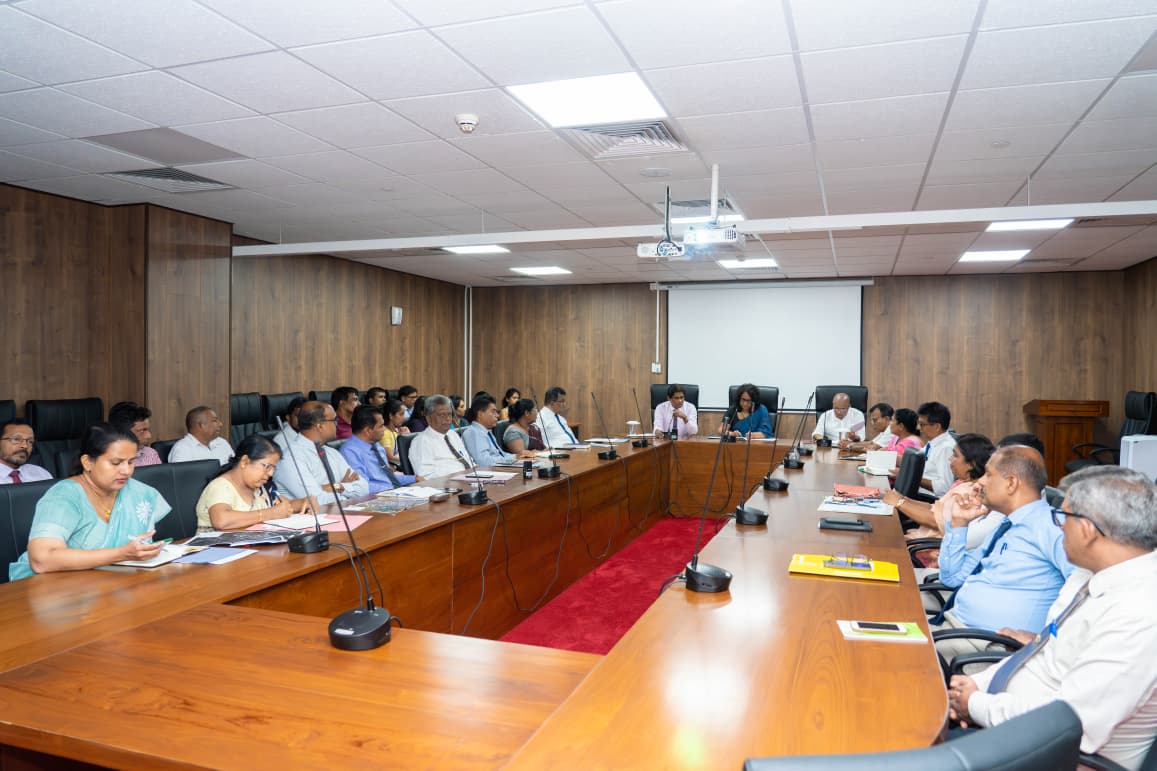
Prime Minister Dr. Harini Amarasuriya stated that development projects can deliver results to the people more quickly when the political authority and the public service work together towards a common, people-oriented objective.
The Prime Minister made these remarks while participating in a discussion held on Friday [September 18] at the Western Province Council Auditorium to review the progress of the development project to rehabilitate Rathmalana Kandawala Road and the drainage system on either side of the road, within the Dehiwala–Mount Lavinia Municipal Council limits in the Colombo District.
The project, which commenced on September 10, 2026, is scheduled to be completed before June 30, 2027. Implemented by the Provincial Road Development Authority (PRDA), the project includes the construction of a bridge at a cost of Rs. 64 million, the rehabilitation of the drainage system at a cost of Rs. 930 million, and the rehabilitation of the road at a cost of Rs. 115 million.
The Prime Minister also paid special attention to the progress of the responsibilities assigned to the Western Province Council, the Irrigation Department and the Ratmalana Divisional Secretariat in accordance with decisions taken at the previous committee meeting. Attention was also given to the current status of the plans being carried out by the Sri Lanka Land Development Corporation (SLLRDC), as well as the construction and maintenance activities being undertaken by the Provincial Road Development Authority (PRDA).
Commending the expedite and commendable progress of the project, the Prime Minister particularly appreciated the commitment demonstrated by officials of the relevant government institutions to work in close coordination with one another and in collaboration with the political authority.
The Prime Minister also emphasised the importance of taking measures well in advance to control flooding and minimise its impact on Colombo and several other districts in view of the rainy weather that may affect the Western Province during the latter part of this year.
The meeting was attended by the Chairman of the Colombo District Coordinating Committee and Member of Parliament Lakshman Nipuna Arachchi, Chairperson of the Ratmalana Divisional Coordinating Committee and Member of Parliament Samanmalee Gunasinghe, Chairman of the Roads Sub-Committee of the Colombo District Coordinating Committee Dewananda Suraweera, Mayor of the Dehiwala–Mount Lavinia Municipal Council Parakum Shantha, Chief Secretary of the Western Province K.G. Pradeep Pushpakumara, along with a number of government officials.
[Prime Minister’s Media Division]

Flood warning issued to the Divisional Secretariat Divisions of Ganga Ihala Korale, Udapalatha, Doluwa, Udunuwara, Yatinuwara, Gangawata Korale, Harispattuwa, and Pathadumbara

Landslide Red Alerts issued to the districts of Kandy, Kegalle and Nuwara Eliya

Shafali dazzles with 49-ball unbeaten 100 and India march into Asian Games final

Development projects can deliver results to the people more quickly when the political authority and the public service work together towards a common goal – PM

Landslide Early Warnings issued to the Districts of Colombo, Galle, Kalutara, Kandy, Kegalle, Matara, Nuwara Eliya and Ratnapura

Chamari Athapaththu’s unbeaten 83 leads Sri Lanka into final

‘Dates have the highest sugar content to fight Coronavirus’

Sunday Island 27 December – Headlines

#SundayIsland 17th December – Headlines

Sunday Island – 28th March

Sunday Island Headlines – 21 March

Sunday Island – 21st February – Headlines
-

 Opinion7 days ago
From Galkissa (Mount Lavinia) to Tambuttegama
-

 News4 days ago
US embassy won’t comment on IGP’s probe into joint drug raid
-

 Features6 days ago
The emptying university: why are academics leaving?
-

 Features7 days ago
Sri Lanka’s university crisis: Brain drain and union action demand urgent reform
-

 News3 days ago
Bid for Basil’s extradition nears final stage: Police
-

 Business4 days ago
All-new Bolero MaXX unveiled in Sri Lanka
-

 Opinion7 days ago
Ashraff: From the SLMC towards the National Unity Alliance
-

 Editorial7 days ago
Muscle flexing, astroturfing and dog-and-pony shows