
News
President’s Office denies ex-US Ambassador’s claim ‘Killing of LTTE leaders who surrendered’

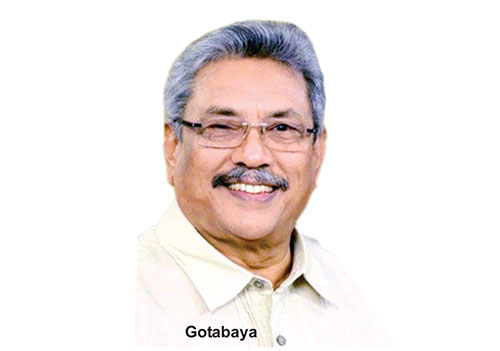
… recalls US Defence Advisor in Colombo contradicting battlefield executions
By Shamindra Ferdinando
President Gotabaya Rajapaksa’s Office yesterday (15) strongly denied a claim by former US Ambassador for War Crimes and Global Criminal Justice Stephen Rapp (2009-2015) that wartime Defence Secretary Gotabaya Rajapaksa had admitted to killing LTTE leaders followign their surrender to the Army in 2009. Rapp claimed Rajapaksa had told him so when he met the latter in Colombo.
There was absolutely no basis for Rapp’s claim, the President’s Office said when The Island sought President Gotabaya Rajapaksa’s response to the former Ambassador’s accusation. The President’s Office questioned the former US official’s motive to make such a statement seven years after leaving office.
The allegation was made on Friday (12) at an online panel discussion organised by a group of organizations targeting Sri Lanka led by the Global Tamil Forum (GTF) on Justice and rule of law in the run-up to the 46th sessions of the Geneva-based United Nations Human Rights Council. Rapp recalled a conversation with the then Defence Secretary and now President Gotabaya Rajapaksa regarding LTTE leaders who surrendered to the army. Rapp said the government “hated the LTTE”.
“I remember raising this issue with defence secretary Gotabaya, now President Rajapaksa when I was there,” Rapp said at the webinar.
“I remember the defence secretary saying, “Oh, trials, trials, you know they go on so long and people get off”. And then he said, “I killed them, I killed them, I killed them,” Rapp recalled.
Stephen J. Rapp is a Senior Fellow at the US Holocaust Memorial Museum’s Centre for Prevention of Genocide and at Oxford University’s Centre for Ethics, Law & Armed Conflict. He also serves as Chair of the Commission for International Justice and Accountability (CIJA).
The former US Ambassador was responding to a question regarding Sri Lanka’s suspicions about the failure on the part of the UN to inquire into atrocities committed by the LTTE as well as others, including the Indian Army. Rapp noted that one way to have made the Tigers accountable for violations would have been to arrest leaders and put them on trial. Rapp added: “Of course, recalling, that many of the individuals (in the LTTE) that could have been charged were in fact, according to credible evidence, killed after surrender. The numbers are around 360 that were given out”.
The President’s Office while pointing out Rapp visited Sri Lanka in 2012 and 2015, emphasized that the dramatic present accusation was meant for the Geneva sessions. Obviously, Rapp’s claim was nothing but overall part of the campaign to discredit Sri Lanka, the President’s Office said, drawing the former Ambassador’s attention to a wartime US defence attaché Lt. Col. Lawrence Smith declaration in 2011 in Colombo that battlefield executions didn’t take place.
The President’s Office said that the Office of War Crimes and Global Criminal Justice owed an explanation whether Rapp during his tenure as the head of that Office reported such a conversation with the then Sri Lankan Defence Secretary or whether Rapp shared information with UNHRC in the run up to 2015 Geneva sessions. Rapp should peruse Lt. Col’s Smith’s response to retired IPKF Maj. Gen. Ashok Metha’s query, the President’s Office said. Pointing out one-time LTTE mouthpiece TNA was represented at the webinar by its Jaffna District MP M.A. Sumanthiran, PC, the President’s Office questioned how US and the TNA backed the then General Sarath Fonseka’s candidature at the presidential election less than year from the conclusion of the war after having accused him and his army of genocide.
The President’s Office said that Sri Lanka rehabilitated over 12,000 LTTE cadres. Hundreds of LTTE cadres now live abroad under assumed names and were holders of various foreign passports, the President’s Office said adding that leaked US diplomatic cables revealed the Army could have finished off the LTTE with less casualties of its own but suffered losses due to ground commanders taking the civilian factor into consideration.
The President’s Office said that human right campaigning is a lucrative industry where plenty of funds are disbursed among those groups and individuals following the Western agenda. The former Ambassador Rapp’s claim reminded Sri Lanka of US-British campaign on WMDs leading to invasion of Iraq. Rapp’s claim in a way could be compared with former Northern Province Chief Minister C.V. Wigneswaran’s August 2016 high profile claim the Army poisoned 104 surrendered LTTE cadres.


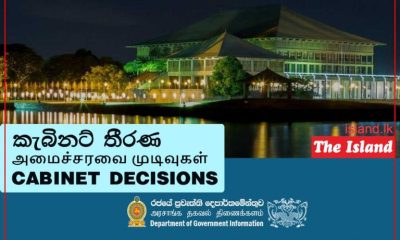


Access to safe drinking water for populations residing in small towns and rural areas of Sri Lanka has not yet been fully ensured, and this continues to pose a major challenge to the country’s social and economic development.
With a view to overcome this situation, a programme has been planned to provide clean drinking water to approximately 600,000 families living in semi-urban and rural areas through the implementation of 300 projects covering 50 small towns and rural areas.
The projects are aimed at establishing safe, reliable and sustainable drinking water supply systems, with water to be treated through modern purification technologies, including chlorination and filtration systems, in conformity with national and international drinking water standards.
Accordingly, having considered the resolution furnished by the Minister of Housing, Construction and Water Supply, the Cabinet of Ministers granted approval for the implementation of the proposed programme by the National Water Supply and Drainage Board and the National Community Water Supply Department during the period 2027–2029, subject to the conduct of a feasibility study on the proposed programme and inclusion in the Public Investment Programme based on its outcome.
News
Cabinet nod to submit Import and Export (Control) Regulations No. 04 of 2026 to Parliament for its concurrence

Hydrochlorofluorocarbons (HCFCs), which are chemical compounds widely used in refrigerators and air conditioning units, are being globally phased out under the Montreal Protocol due to their high potential for ozone layer depletion and global warming.
Sri Lanka has likewise committed to phasing out these chemical substances by the year 2030 in a stepwise manner. Accordingly,
regulations under the Import and Export (Control) Act, No. 1 of 1969, namely the Import and Export (Control) Regulations No. 04 of 2026, published in Extraordinary Gazette Notification No. 2487/29 dated 2026-05-07, have been issued, prohibiting, with effect from 2026-06-06, the importation of equipment and appliances that operate solely on hydrochlorofluorocarbons, and prohibiting, with effect from 2028-01-01, the importation of compressors used as components in refrigeration systems of equipment and appliances that operate solely on hydrochlorofluorocarbons.
Accordingly, the Cabinet of Ministers has approved the resolution furnished by the President in his capacity as
the Minister of Finance, Planning and Economic Development to submit the aforementioned Regulations to Parliament for its concurrence.
News
Declaration of Elephant Migratory Corridors to minimize HEC in Monaragala and Hambantota districts
Wild elephants inhabit approximately two-thirds of the land area of Sri Lanka, and it has been identified that the rapid obstruction of elephant habitats and migratory corridors due to various development projects and human activities has directly contributed to the escalation of human–elephant conflict.
It has been recognised that, in order to mitigate such conflict to a certain extent, the protection of wild elephant habitats and migratory corridors must be undertaken as a matter of urgency.
The Department of Wildlife Conservation is currently engaged in identifying wild elephant migratory corridors in collaboration with relevant Divisional Secretaries, stakeholder agencies, and organisations.
Under the Wild Elephant Migratory Corridor Identification Programme in Monaragala District, the Wild Elephant Migratory Corridor from Handapanagala to Demodara
across Menik Ganga (River Menik) up to Yala National Park has been identified, and approval has been granted by the Monaragala District Coordinating Committee for that.
The Elephant Migratory Corridor from Yala National Park’s Zone VI -Lunugamvehera National Park to Udawalawe National Park has already been declared as the Wetahira Kanda Nature Reserve in 2002.
Within this area, five (05) licensed land plots have been identified, and these lands have not yet been developed.
Accordingly, the Cabinet of Ministers has approved the resolution furnished by the Minister of Environment to take the following measures:
To declare, under the provisions of the Flora and Fauna Protection Ordinance, the elephant migratory corridor from Handapanagala in Monaragala District to Demodara across Menik Ganga up to Yala National Park as a sanctuary.
To provide alternative land outside the wildlife reserve area in lieu of the five (05) licensed land plots located within the Wetahira Kanda Nature Reserve area, and to re-declare the Wetahira Kanda Nature Reserve as an elephant migratory corridor.
To acquire, upon payment of compensation, land parcels containing buildings constructed in a manner that obstruct the Koholankala elephant corridor in the Hambantota District, and to declare the relevant area of the Hambantota Wild Elephant Management Reserve as a sanctuary.

Battling Australia force series decider as questions grow for Pakistan

West Indies bowl vs Sri Lanka, Hetmyer not in the XI

Implementation of water supply projects in small town and rural areas.
Cabinet nod to submit Import and Export (Control) Regulations No. 04 of 2026 to Parliament for its concurrence
Declaration of Elephant Migratory Corridors to minimize HEC in Monaragala and Hambantota districts

Qualifier Maja Chwalinska extends dream French Open run

‘Dates have the highest sugar content to fight Coronavirus’

Sunday Island 27 December – Headlines

#SundayIsland 17th December – Headlines

Sunday Island – 28th March

Sunday Island Headlines – 21 March

Sunday Island – 21st February – Headlines
-
 News5 days ago
IMF urges Lanka not to meddle with exchange rate
-
 Business6 days ago
Sri Lanka’s construction industry losing ground while no one watches
-

 Business3 days ago
IMF’s unstated rate:Sri Lanka’s $695m loan costs about 5.33% per annum
-

 News2 days ago
Lankan duo emerge winners in Latin dance championship held in Blackpool, UK
-
 News5 days ago
State of emergency extended
-

 Features6 days ago
The Division Bell Mystery
-
 News3 days ago
UNP challenges NPP move to amend Vihara – Devalagam Act
-

 Features4 days ago
Are threats to Buddha Sasana external or from within?