
Sports
Mathews carried the bat through Sri Lanka’s transition


When Angelo Mathews burst onto the scene, it felt like Sri Lanka had found their very own Jacques Kallis in the making – a brisk seamer who could bend his back with the ball and a batsman who brought both silk and steel to the crease. He had the technique to weather any storm and the temperament to anchor innings under pressure. But as the years ticked by, it became clear he wouldn’t quite climb into Kallis’ league. Still, Mathews hung up his boots as Sri Lanka’s third-highest run-getter in Test history, only behind the twin towers – Kumar Sangakkara and Mahela Jayawardene.
From early on, the script had greatness penciled in. Mathews turned heads at two Under-19 World Cups and led the second on home soil. The big league beckoned soon after and he found himself rubbing shoulders with a dressing room full of heavyweights. But fate, as fickle as a worn pitch on Day Five, had other plans – his body often gave out just when his career seemed ready to take flight.
With legends exiting stage left within the span of 18 months, the baton fell to Mathews far sooner than expected. It wasn’t easy carrying the load on his shoulders – he was often a one-man army trying to plug holes in a sinking ship. But while other sides crumbled post-transition, Sri Lanka stayed afloat, thanks in no small part to Mathews’ resolve.
His finest hour came at Headingley in 2014 – a cricketing cauldron where reputations are made or broken. With the tail for company, Mathews batted like a man possessed, eking out every run to set up Sri Lanka’s maiden series win on English soil. Earlier in the series, he’d scored a century at Lord’s – his very first outing at the Home of Cricket. Talk about a debut to remember.
Leadership too came calling early. At 25 years and 279 days, Mathews became Test captain – eclipsing none other than Aravinda de Silva in the record books as the nation’s youngest Test captain. Big boots? He didn’t buckle under the pressure. The highlight of his captaincy came in 2016, when Sri Lanka steamrolled a full-strength Australia 3–0. Steve Smith’s men were run ragged as Mathews marshaled his troops like a seasoned general.
And then, just as momentum gathered, he stepped down. Cricket politics had started to creep in like uninvited guests and the toll was showing.
In recent months, the writing was on the wall. With Sri Lanka losing four consecutive Tests to WTC finalists Australia and South Africa, and with Mathews’ own returns dwindling, Father Time was knocking on the door. The final straw? Only four Tests scheduled for the year. For a man who held the red-ball game sacred, that was as good as being asked to pad up for a rain-curtailed net session.
He’s expressed willingness to continue in white-ball formats, but the selectors may have already turned the page. Even so, his impact can’t be overstated. When the stars had dimmed and hope flickered, Mathews stood tall – leading from the front and holding things together with grit, grace, and gumption.
Now, fittingly, he returns to Galle – where his journey began in 2009 – for his swansong. Cricket’s circle of life, poetic and poignant. The curtain falls, the crowd rises and Mathews walks back into the pavilion of memories – one of Sri Lanka’s finest, flawed perhaps, but never found wanting in heart.
“It’s been an amazing run representing my country for the last 17 years. As a kid, all what I wanted was to play in just one Test match and to do it for over 100 Tests is a blessing indeed,” Mathews told Telecom Asia Sport.
“Very proud about what I have accomplished and as a team we had some great memories. Always grateful for people who stood by me throughout my career. It has been an amazing run, but I feel now is the time to go and give a young player an opportunity,” he added.
(Telecom Asia Sport)

by Rex Clementine
Last week, the scorebooks of school cricket needed a fresh rewrite as Kingswood College, Kandy broke a 68-year hoodoo to clinch their Big Match against Dharmaraja College in the hill capital. Almost in tandem, down south, another long wait ended when St. Servatius’ College, Matara turned the tables on arch-rivals St. Thomas’ College, Matara, sealing a famous win after 55 years.
St. Servatius’ rise has not been a flash in the pan. For the better part of 15 years, they have been punching well above their weight, taking guard in Division 1 and holding their own against the heavyweights. The production line has not dried either, with a steady stream of Sri Lanka Under-19 cricketers making their mark on bigger stages. In many ways, they have helped put outstation cricket back on the front foot.
Behind the sightscreen, however, stands a quiet architect. Ruchira Palliyaguruge, a name that may not grab headlines but one that has been doing the hard yards. A former teammate of Sanath Jayasuriya at St. Servatius’, Ruchira was no mug with the bat or ball, enjoying a prolific domestic career after narrowly missing the national cap.
Post-retirement, he swapped spikes for the white coat, rising through the ranks to officiate on the ICC panel, standing in matches across the globe. But his most telling contribution has come away from the glare of international arenas.
In the aftermath of the Big Match triumph, it emerged that for two decades Ruchira had been quietly footing the bill for the school’s cricket coaches, no drum roll, no fanfare, just a man playing a straight bat for a cause close to his heart.
This has not been merely about opening his wallet. He has invested time, energy and know-how, ensuring the game at St. Servatius’ keeps moving in the right direction. Even after the boys hang up their school caps, he has remained in their corner, helping them find employment and navigate life beyond the boundary.
Good Samaritans like Ruchira are the need of the hour if outstation cricket is to stay in the game. While Colombo schools enjoy the luxury of deep pockets and old boys’ networks, many rural schools are forced to play on a sticky wicket. It is through the generosity and vision of individuals like him that the game continues to tick over smoothly beyond the city limits.
Sports
Wins for Inqube Global , WSO2, Star Garments, MAS Active Kreeda, CDB ‘B’ and Wiley Global Technology on Sunday [22]


15TH STAFFORD MOTORS – MCA G DIVISION T20 LEAGUE CRICKET TOURNAMENT
Inqube Global, WSO2, Star Garments, MAS Active Kreeda , CDB ‘B’ and Wiley Global Technology emerged victorious in the league stage matches of the Stafford Motors sponsored, MCA G division T20 League Cricket Tournament played on Sunday 22nd March.
At the SLC Ground in Banadaragama, Kanishka Eshan grabbed four wickets and Hiranga Jayasinghe and Suresh Madusanka chipped in with 40 runs and 30 runs respectively to help Inqube Global beat Swisstek Ceylon by four wickets to lead group F of the tournament. Daminda Wijekoon contributed 58 runs off 38 balls for the losers. In the afternoon game at the same venue Dimutu Madushan captured four wickets to help WSO2 defeated Hayleys Group by five wickets .
At the Royal College Grounds, Star Garments registered their fourth win in four outings defeating Pyramid Wilmar by one wicket in the penultimate ball of their innings. In a group B game played in the afternoon, MAS Active Kreeda consigned group leaders Emar Pharma to their second defeat in the tournament.
At de Mazenod College Grounds in Kandana, Chathuranga Dikkumbura and Isuru Jayaranga scored 39 runs each to help CDB ‘B’ registered a net run rate boosting ten wicket win over Sysco Labs. In the afternoon match Panitha Dangalla and Sayuru Wanasinghe guided Wiley Global Technology to a five wicket win over 99X.
At SLC Grounds Bandaragama:
Inqube Global won by 4 wickets
Swisstek Ceylon 174/8 in 20 overs
[Lasith Karunathilake 10, Danidu Wijekoon 58, Tihan Senanayake 17, Dushmantha Dias 33, Lahiru Piyumal 25, Nadeera Liyanage 16; Isuru Lakshan 1-21, Lahiru Subashana 1-35, Kanishka Eshan 4-25]
Inqube Global 175/6 in 19.5 overs
[Hiranga Jayasinghe 40, Isuru Lakshan 18, Suresh Madusanka 30, Sanindu Deshan 23*, Upul Chandra 23; Dushmantha Dias 1-16, Tihan Senanayake 1-25, Saranga Lakshan 1-18, Lahiru Piyumal 1-18, Gamini Wanasinghe 2-35]
WSO2 won by five wickets
Hayleys Group 127/8 in 20 overs
[Adeesha Jayarathna 50, Dilan Suraweera 13, Lasantha Prabath 31*; Dimuthu Madushan 4-19, Osanda Herath 1-25, Oshanda Yomal 2-24, Dev Wijewarden 1-14]
WSO2 132/5 in 18.5 overs
[Devin Jayasinghe 42, Isuru Ruhunage 31, Kaveesha Rajapaksha 19, Osanda Herath 13, Dev Wijewardena 15*; Mahesh Deepal 1-15, Lasantha Prabath 1-45, Pasindu Adithya 2-14, Sumudu Marasinghe 1-39]
At Royal College Grounds:
Star Garments won by 1 wicket
Pyramid Wilmar 140/10 in 20 overs
[Lasith Fernando 54, Shanaka Fernando 24, Sahas Vihanga 21; Randu Fernando 2-25, Dunik Perer 1-29, Dhanuka Dulanjana 1-21, Yohan Aloka 2-25, Rishantha Anushka 2-19]
Star Garments 141/9 in 19.5 overs
[Nadeesha Rajakaruna 12, Chathuranga Dilshan 13, Yohan Aloka 25, Shakila de Silva 22, Randu Fernando 20, Dhanuka Dulanjana 17*; Budhdhika Herath 2-22, Udesh Nishan 3-23, Umeda Madusha 2-23, Upeksha Lakshan 2-31]
MAS Active Kreeda won by 5 wickets
Emar Pharma 101/10 in 20 overs [Janith Jayasinghe 23, Devinda Ayesh 26, Dishan Hettiarachchi 30; Suventhiran Subikaran 2-28, Adeesha Miyusara 1-18, Sivakumar Partheepan 3-12, Kanesh Piratheepan 2-23]
MAS Active Kreeda 103/4 in 12.1 overs
[Jineetha Malith 14, Adeesha Miyusara 28, Suventhiran Subikaran 29*; Deshan Fernado 3-34, Rajendran Sagitharan 1-21]
At De Mazenod College Grounds
CDB ‘B’ won by 10 wickets
Sysco Labs 79/9 in 13 overs
[Bhagya Dissanayake 20, Chathura Hennanayake 10; Vishwa Dhananjaya 2-14, Chamod Madushan 2-17, Dhanushka Dharmasiri 1-08, Dasun Senevirathne 1-09]
CDB ‘B’ 82/0 in 20 overs
[Chathuranga Dikkumbura 39*, Isuru Jayaranga 39*]
Panitha and Sayuru power Wiley Gliobal to a 5 wicket win
99X 122/7 in 20 overs
[Sachith Jayasinghe 14, Ishrath Raji 35, Sameera Piyasundera 18, Saranga Liyanage 19; Sayuru Wanasinghe 1-13, Lilan Karunarathne 1-14, Omal Bhagya 2-25]
Wiley Global Technology 125/5 in 15.4 overs
[Thushara Peiris 19, Lilan Karunarathne 15, Panitha Dangalla 40*, Sayuru Wanasinghe 25*; Sachith Jayasinghe 1-31, Kushan Rathnayake 2-21, Ishrath Raji 1-21, Saranga Liyanage 1-19]
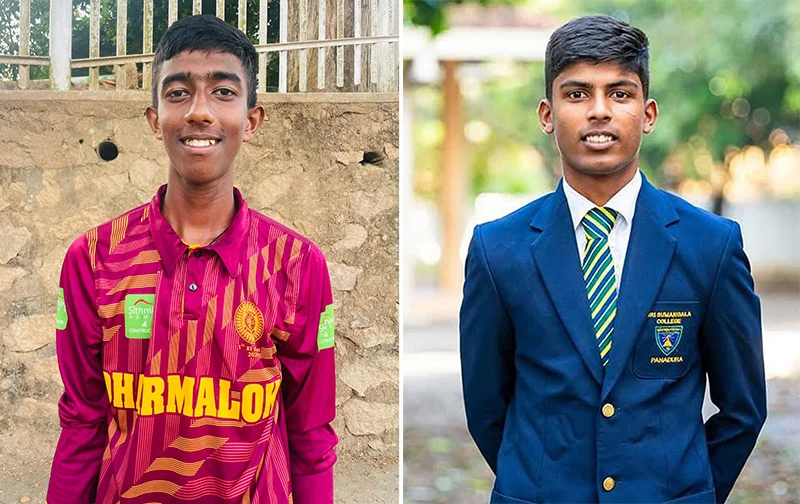
An impressive century by opener Kaveen Deneth and a five-wicket haul from Mevindu Kumarasiri highlighted an absorbing first day in the Under 19 Division I Tier B quarter-final between Sri Dharmaloka College, Kelaniya and Sri Sumangala College, Panadura played at Kuruvita on Wednesday.
After winning the toss and electing to bowl first, Sri Sumangala kept the pressure on by striking at regular intervals. However, Deneth produced a determined innings to anchor the Sri Dharmaloka batting line-up and keep his team in the contest.
Sri Sumangala made the early breakthrough in only the second over when paceman Sihas Nethdinu dismissed Mewan Randeepana without scoring. Deneth then shared a brief partnership with Tharusha Mihiranga, whose 24-ball stay produced just seven runs.
With Sri Dharmaloka struggling at 30 for 2 in the 10th over, Deneth steadied the innings and received useful support from the middle order. Senuka Pehesara contributed 29 runs, while Chanul Nethsitha (17) and Koshitha Adithya (19) also chipped in with valuable runs.
Deneth’s patient knock of 106 off 161 balls, which included 12 fours and two sixes, proved crucial in holding the innings together as Sri Dharmaloka were eventually bowled out for 211 in 76.3 overs.
Sri Sumangala’s bowling honours went to Mevindu Kumarasiri, who delivered a tireless spell and finished with impressive figures of 5 for 82 in 32.3 overs, emerging as the standout bowler of the day.
In reply, Sri Sumangala encountered early trouble as spinner Sathindu Prabodha struck in successive overs to put the Panadura side under pressure.
At stumps on day one, Sri Sumangala were struggling at 11 for 2, setting up an intriguing second day in this closely contested quarter-final encounter.

A strong Technical and Vocational Education and Training (TVET) system equips individuals with practical, relevant, and future-oriented skills helping to innovate responsibly towards a greener and sustainable future – PM

PM reviews progress of the committee appointed for the establishment of a National Nursing University

UN votes to recognise enslavement of Africans as ‘gravest crime against humanity’

Meta and YouTube found liable in landmark social media addiction trial

Showers expected in the Western and Sabaragamuwa provinces and in Galle and Matara districts after 2.00 pm.

Heat Index at ‘Caution level’ in the Western, Sabaragamuwa, Southern and North-western provinces and in Anuradhapura, Mannar, Vavuniya and Monaragala districts

‘Dates have the highest sugar content to fight Coronavirus’

Sunday Island 27 December – Headlines

#SundayIsland 17th December – Headlines

Sunday Island – 28th March

Sunday Island Headlines – 21 March

Sunday Island – 21st February – Headlines
-

 News2 days ago
Senior citizens above 70 years to receive March allowances on Thursday (26)
-

 Features4 days ago
Trincomalee oil tank farm: An engineering marvel
-

 News7 days ago
CIABOC tells court Kapila gave Rs 60 mn to MR and Rs. 20 mn to Priyankara
-
 Features7 days ago
Science and diplomacy in a changing world
-

 Features4 days ago
The scientist who was finally heard
-
 News2 days ago
Japanese boost to Sri J’pura Hospital, an outright gift from Tokyo during JRJ rule
-

 News2 days ago
CEB Engineers warn public to be prepared for power cuts after New Year
-

 News6 days ago
Colombo, Oslo steps up efforts to strengthen bilateral cooperation in key environmental priority areas