
Features
EMANCIPATION THROUGH EDUCATION


CHAPTER III
I remember my first day in school when I was five years old… There were about 30 students. Our classroom was a long, single room with a low wall from where we could see the playground, and the paddy fields further away.
(NU, interview with Carol Aloysius, 2000)
The Colonial School System
In Sri Lanka there had been a virtual revolution in education in the late 19th and early 20th centuries, reflected in the rise of literacy and educational levels. Primary schools expanded in urban and rural areas, and literacy rates increased rapidly. In leading towns, wellstaffed and equipped high schools in the English medium (some with boarding facilities), drew in boys and girls from all parts of the island. Parents from rural areas or small towns would try to somehow raise the necessary funds to send their children to schools in provincial capitals (and if possible, to Colombo) for their secondary studies, in order to broaden their horizons and prospects. While those living in villages were often caste-conscious, the schools in the towns had a universalism, which discouraged parochial feeling. Students sent to urban centres for their studies became more aware
of social and political issues affecting Sri Lanka and the rest of the world. NU was part of this process. His family, in the quest for upliftment through education, chose to move him from a small school in Hambantota (St. Mary’s), where he had his primary education, to a secondary school in the larger town of Matara (St. Servatius’), and then to a prestigious school (St. Aloysius’) in the provincial capital of Galle – all of which were run by Jesuits.

A pansala (temple) school
The country had a network of non-fee-levying government schools teaching in Sinhala and Tamil, and one – Royal College – teaching in English. There were also English-medium non-government schools, which received government grants and levied fees. The latte were run by Christian missionaries and Buddhist organizations in Colombo and the provincial capitals. The first Englishmedium schools, during early British rule, were attended by the sons of Muhandirams, Mudaliyars and the local new-rich. A few children
from less-affluent families also attended. These schools, based on the British school system, implanted modernizing ideologies among the children. Similarly, there was also an expansion of English-medium Buddhist schools in urban areas, which modelled their curricula on the former, imparting a western-oriented, modern education, but with an emphasis on Sri Lankan and Indian history and on Buddhism. English-medium schools were a training ground for the professions, producing lawyers and doctors as well as teachers, planters, businessmen, clerks, bookkeepers and secretaries. The demand for a
modern English education increased with the growth of the colonial economy, the creation of mercantile establishments, and the consequent expansion of the job market.
Early Education at St. Mary’s
The reverence for education in Sri Lankan culture is reflected in the traditional ceremony of ‘first letters,’ in which a child is initiated into the process of writing by a respected or learned person. NU’s education started at the age of three with this ritual, which was conducted by his maternal grandfather, Gajawira. This was preceded by a visit to the temple by the whole family (de Zoysa manuscript, p.48). A few years later, registered as Ubesinghe Jayawardenage Nonis, he began his formal education in 1913 at St. Mary’s School, a typical, one-room village school for children under the age of 10. The school, located barely a mile away from the Hambantota Resthouse, was founded in 1900 by a Belgian Jesuit, Father Paul Cooreman (1863-1919), even though there were only about a dozen Catholics in the town (Perniola, 2004, p.28). Father Paul Cooreman, born in Ghent, Belgium, in 1863, came to Sri Lanka in 1899 after joining the Jesuit Order. His elder brother, Father Joseph Cooreman, was already teaching in the Southern Province. The former was allocated to Hambantota, which was referred to as “a sterile station… a locality burnt by the sun and inhabited only by Muslim merchants of salt of whom… nobody is ever converted.” Since it was difficult to recruit teachers “to come and re- side under the burning heat of this place,” Cooreman himself taught at St. Mary’s (Report of Father Feron, 1913, quoted in Perniola, pp.510-11).

NU’s sister Wimala, dressed up as Queen Victoria for a school play, Christ Church School, Tangalle
Father Cooreman was described as a “man full of duty, full of zeal,” who gave himself “body and soul to the hard work.” Cooreman worked for 20 years in Hambantota, until his death of cholera in 1919. As Perniola writes: “in his humble bullock cart he crossed the jungle or vast burning desert… paying no attention to distances or to fatigue” (ibid, p.574). St. Mary’s in NU’s time was headed by Father Wickremasinghe.
Two and a half years later, NU changed his school when his father left his job as Hambantota Resthouse keeper. The circumstances of his leaving reveal the latter’s temperament. Diyonis had declined to carry out his duties in the way the Government Agent (GA) of the Southern Province wanted, and eventually told him to ‘do the job himself.’ The GA appears to have been a difficult person to work for; as Leonard Woolf wrote many years later, he himself had been “rapped on the knuckles” by the Governor for including in his diary “some sarcastic and not unjustified criticism” of his superior, the
GA (Woolf, 1969, p.200). NU’s cousin, a clerk in the Kachcheri Mudaliyar’s office, tried to persuade Diyonis not to jeopardize his job by challenging officialdom. Disregarding his advice, Diyonis left the job and went home to Tangalle with his family (de Zoysa manuscript, p.49). NU’s maternal grandfather, Gajawira was ambitious for his grandson and felt he should be sent to a good school. In 1916 the change was made to St. Servatius’ College, Matara, which, like St. Mary’s, was run by Belgian Jesuits. NU moved to Devundara, where his maternal grandparents lived, since this was closer to Matara.
Meanwhile, Diyonis turned to cultivating his paddy land at Angunakolapelessa, a drought-stricken and depressed area frequented by elephants, 15 miles from Tangalle. NU commented: “As a child I would often help my father who had a small paddy field in a jungle area. It was a source of our income and I, being the eldest boy, was useful to my father in his work.” NU also in an interview referred to the “unproductive paddy land” his father farmed (Roshan Pieris, 1987). These childhood experiences may have resulted in NU’s realization that small landownership was neither a source of income or status, and, in later life, in his particularly critical view of those engaged in absentee-landlordism.
Some miles away from where his father farmed was an imposing dagoba on the summit of a rock known as Mulkirigala, 300 feet high. Its historic temple, carved out of rock, is famous for a wall painting depicting a troupe of female musicians, including a woman drummer. The summit presents a panoramic view of the province. Bordering Diyonis’ paddy land on all sides was forest. The backwoods in which this land lay could be viewed from the treehouse, or platform, which it was customary to have in such areas. It served as a watch-post for the cultivator to protect his crops from elephants. Made of two gnarled tamarind trees, the structure was 12 feet high, and one climbed on to it with the help of a ladder (de Zoysa manuscript, p.52).
The Tangalle Connection
Tangalle, where Diyonis and his family had their home, lay roughly midway between Matara and Hambantota. Unlike Hambantota, which was the administrative and commercial centre of the district, Tangalle was a quiet town situated on a bay. Diyonis’ house was on the Medaketiya Road – a loop road branching off from the main Tangalle-Hambantota Road, which skirts the sea front and joins the Hambantota Road at Ranna. The house was nearly two miles beyond the bridge over the Kirama Oya. A tiny lake nearby, called Rekava Kohalankala, added to the attractive setting.
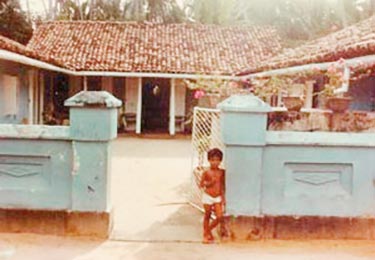
NU’s parents’ home in Tangalle

A one-room school
NU’s daughter Neiliya has vivid recollections of her grandparents’ home, which she used to visit as a child:
My grandparent’s home was in Tangalle, which they sold subsequently when they moved to Colombo. I still visit this house on occasion, though the surroundings have changed. The house is still in its original condition – a U-shaped building with a central courtyard, covered with sea sand of sparkling gold. ( The house remained in its original condition up until the tsunami of December 2004, when it was completely destroyed.) The base of the ‘U’ is the living and dining rooms, and the right side has the kitchen storeroom and servant’s room, and the left side the bedrooms. During my childhood, the house had one boundary at the rear and the other was the river. It was a beautiful location, an ideal hunting ground and playing field for us children – 8 brothers’ and sisters’ children – 27 grandchildren in all. There were no other houses within sight.
Near the Jayawardena house and land at Medaketiya was the house of the Amarasinghe family, where Kusuma Gunawardena née Amarasinghe – later Member of Parliament and wife of leftist leader Philip Gunawardena – was born in 1905. Lakmali Gunawardena has
written of her mother’s birthplace and the string of towns and ports that dotted the southern coastline between Galle and Kirinde. She refers to the “thin ribbon of road [along which were] these towns, Matara, Devundara, Tangalle, Ambalantota, and smaller ones of local importance… Ranna, Hungama, Netolpitiya, and Nonagama… up to and beyond Tissamaharama” (Gunawardena, 2004, p.1).
Tangalle was a natural site for a small harbour, where the British built a resthouse on a promontory overlooking the Indian Ocean… In the early 1900s it had schools, a post office, a police station and other establishments that had elevated it from a sleepy fishing town. (ibid)
The Amarasinghes and U.J. Diyonis’ family knew each other. The second Amarasinghe son, Dayananda was a contemporary of NU’s and they kept in touch with each other throughout their lives. The houses of both families were situated on coconut land that adjoined the sea, and their lifestyles were similar. Both families were Buddhist; the Amarasinghe father, Don Davith was a building contractor who was active in the Tangalle branch of the Buddhist Theosophical Society and was the leading patron of the town’s Buddhist school – Sri Rahula Vidyalaya, which Kusuma attended. Amarasinghe, being independently employed, could afford to sponsor Buddhist education and be involved in the agitation carried out by the Buddhist movement. In contrast, Diyonis had to be cautious – if he held any ‘controversial’ views – while he served the government as a resthouse keeper.
Devundara and Matara
NU’s first break with his home was when he was sent to live with his grandfather. NU’s maternal relatives – the Gajawiras of Devundara – constituted the more-learned side of his family, and NU always acknowledged the role of his mother’s father, who took a great interest in NU’s education. By all accounts, his grandfather Gajawira was well versed in Sinhala grammar and poetry, as he had been educated at a pirivena (temple school). Gajawira had four daughters and a son. NU’s mother Podi Nona was the eldest; the youngest, Arlis Perera Gajawira (1901-82) was seven years older than NU. Like NU, his uncle Arlis also attended St. Servatius’ and joined the clerical service. He and NU became close and kept in touch in later life. Arlis even named one of his sons Neville, after NU. (Interview with Dr. Bandula Gajawira, Arlis Gajawira’s son. The family link continued when Arlis’ granddaughter married Dr. Mahilal Ratnapala, NU’s sister Wimala’s son.)
Devundara is the southernmost point of Sri Lanka, with a lighthouse, marketplace and a historic Vishnu devale. NU’s grandfather’s small house was on Lighthouse Road, which leads to the famous lighthouse. St. Servatius’ was three miles away in the town of Matara
with its Dutch fort, low ramparts, government offices and courthouse. This English-medium school, founded in 1897, was off the main road and close to a promontory called Brown’s Hill. NU studied at St. Servatius’ for four years.
On his first day in school, NU, who was accompanied by his grandfather and his uncle Arlis, was introduced to the principal. The 3-mile trek to school along the road, and probably along the beautiful Wellamadama beach, was not unusual at the time. In 1911 in Sri Lanka, the average distance on foot to the nearest school was 3 miles, with provincial averages ranging from 5 miles in the North Central Province to three-quarters of a mile in the Western Province (Denham, 1912, p.405).
NU seemed to have enjoyed his long walk to school and back, noting its beneficial effects:
My grandfather decided to have me educated at St. Servatius’ College in Matara. To reach school we had to walk three miles and this I did at the age of eight in 1916. I did not feel that walking to school was some kind of drudgery. I enjoyed school. I would get up as early as five o’clock, and by six in the morning I left with my uncle and walked to school. Looking back now perhaps it appears tedious, but I enjoyed the walk. School was over at about three in the afternoon, and I would reach home by six in the evening. The walk did have its impact, for, I think, it made me hardy and strong, especially since roads at that time were not tarred and finished as they are now and I would walk barefoot to and from school. In fact, my determination to study, to gain knowledge as it were, made me make this daily trip without finding any excuses to stay away from school. (interview by Manel Abhayaratne)
Lucien de Zoysa notes that, NU “preferred to walk barefoot, carrying his shoes in one hand… shoes were compulsory at school, but NU found it more comfortable to walk barefoot, and put on socks and shoes only as he entered the school premises” (de Zoysa manuscript, p.53). As NU recalled: “I don’t remember wearing shoes until I went to St. Servatius” (Roshan Pieris, 1992). According to Pat Williams (who was at St. Aloysius’), inexpensive Japanese tennis shoes became readily available in Sri Lanka around that time, and thus, the use of shoes became more widespread (personal communication, 2006). The walk to school, however, did appear to have put a strain on the young NU, with a negative impact on his studies. The grandfather, noting the boy’s weariness, placed NU at the home of the school catechist who lived in a house situated within the Matara
fort, one mile from St. Servatius’ College.
This change did not seem to make much of a difference to his progress in school – and perhaps made him feel more isolated and lonely. Lucien de Zoysa writes that NU’s grandfather knew, by the way that “NU got on with his Sinhalese grammar and poetry, that he was no dullard, but how to get him interested in his books was the problem.” In retrospect, de Zoysa speculated that NU’s poor performance may have been caused by separation from his doting mother and sisters. To his grandfather, he seemed to be in a world of his own. Perhaps it was due to this loneliness and homesickness that NU played truant from time to time – sometimes bathing in the Nilvala Ganga, which flowed under the bridge at Matara – perhaps recalling happier times at the river and beach back home in Tangalle (de Zoysa manuscript, p.53).
Given this separation from his parents and siblings, NU looked forward to returning to Tangalle during school holidays. We have evidence of this from NU’s niece, Chandrani, who says:
My mother [Rosalind] related to us that she looked forward to my uncle [NU’s] school vacation so that they could give him the best of food to make him plump and healthy. She said that she measured his arm on the
first day he came home to check how much weight he had put on by the end of the vacation. The food they had was thala guli [sesame sweet] and banana on waking; then a plate of rice with bala maalu [tuna] and kiri hodhi [coconut gravy]. After lunch, they had mi kiri [buffalo curd] and
honey [palm treacle].
NU also soon had two younger brothers: David born in 1910, and the ‘baby’ Peter born in 1915. David was outgoing and boisterous, whereas NU tended to be introverted. In 1920, after 4 years at St. Servatius’, NU at the age of 12 was sent to St. Aloysius’ College in Galle. The move to St. Aloysius’ was to be a crucial milestone in his life.
Ironically, in his early days NU did not do well in arithmetic or mathematics. He himself often stated that he was a late developer, and his childhood schooling, though it opened to him a new world of books, did not really give him any impetus to further his knowledge in any particular subject. When he reached the 5th standard in school, family circumstances favoured him once again, when his eldest sister Charlotte was married in 1919 to Thevis Nanayakkara. This was a fortuitous event that solved the dilemma facing his maternal grandfather, who had been worried about his grandson’s progress. They decided that NU should go to St. Aloysius’ College in Galle, since Charlotte’s house was half a mile away from the Talpe railway station, 6 miles from Galle. NU was later joined at the Nanayakkara residence by his younger brothers, David and Peter.
The Importance of Railways Indrani Munasinghe’s book, The Colonial Economy on Track (2001) documents the story of transport expansion and the way the network of roads and railways built in the 19th century changed the lives of many who lived in areas remote from Colombo. Before the coming of the railways, towns such as Kandy, Jaffna and Galle had been linked by new roads to Colombo, but travel was by cart, horsedrawn coach, or on horseback. Norah Roberts writes that, the Colombo- Kandy coach was started in 1832, and by 1838 there was a two-horse Galle Royal Mail Coach leaving Galle at 6 o’clock in the morning to arrive in Colombo at 4.30 in the afternoon, as well as a Galle-Matara coach. These coaches, which charged differential amounts from various categories of persons – Europeans, Burghers, lawyers and Mudaliyars – were, however, beyond the reach of the mass of people, who used bullock carts, and hackeries (light carriages)
or walked to their destinations (Norah Roberts, 1993, p.9).
After the Colombo-Kandy rail connection was opened in 1867, railways were extended to other towns in the Central and Uva provinces, to cater to the needs of the plantation sector. Railway expansion, which benefited the inhabitants of other provinces, occurred subsequently. This accessibility between provincial towns and Colombo enabled many to commute to work and even to school from outlying areas. The coastal line from Colombo to Matara via Galle, a distance of 100 miles, was completed by 1895. The expansion of railways was certainly a most welcome innovation for southerners. A schoolteacher described the arrival of the first train in Galle in 1894, “with decorated engine,” adding that “the band played and people danced on the platform” (quoted in Roberts, 1993, p.9).
NU benefited from the coming of railways to the South. He had once used to walk many miles from Devundara to school in Matara and back, as the railway line did not go beyond Matara. But when he was transferred to school in Galle, he travelled in the trains that operated between Matara and Galle. The railways changed NU’s life, as did his new school, St. Aloysius’ College. (N.U. JAYAWARDENA The First Five Decades Chapter 2 can read online on https://island.lk/nus-social-milieu/))
(Excerpted from N. U. JAYAWARDENA The first five decades)
By Kumari Jayawardena and Jennifer Moragoda



 Going forward, it is hoped that a reported ceasefire agreement between the US and Iran would provide a basis for a degree of stability in the Middle East and pave the way for substantive peace talks between the powers concerned. The world is compelled to fall back on hope because there is never knowing when President Donald Trump would change his mind and plans on matters of the first importance. So erratic has he been.
Yet, confusion abounds on who has agreed to what. The US President is on record that a number of conditions put forward by him to Iran to deescalate tensions have been accepted by the latter, whereas Iran is yet to state unambiguously that this is so. For instance, the US side claims that Iran has come clear on the point that it would not work towards acquiring a nuclear weapons capability, but there is no official confirmation by Iran that this is so. The same goes for the rest of the conditions.
Accordingly, the peace process between the US and Iran, if such a thing solidly exists, could be said to be mired in uncertainty. Nevertheless, the wider publics of the world are bound to welcome the prospects of some sort of ceasing of hostilities because it would have the effect of improving their economic and material well being which is today under a cloud.
However, questions of the first magnitude would continue to bedevil international politics and provide the breeding ground for continued tensions between East and West. Iran-US hostilities helped highlight some of these divisive issues and a deescalation of these tensions would not inevitably translate into even a temporary resolution of these questions. The world community would have no choice but to take them up and work towards comprehending them better and managing them more effectively.
For example, there are thorny questions arising from the Treaty on the Non-Proliferation of Nuclear Weapons (NPT). Essentially, this treaty bans the processing and use of nuclear weapons by states but some of the foremost powers are not signatories to it.
Moreover, the NPT does not provide for the destroying of nuclear arsenals by those signatory states which are already in possession of these WMDs. Consequently, there would be a glaring power imbalance between the latter nuclear-armed states and others which possess only conventional weapons.
Such a situation has grave implications for Iran’s security, for instance. The latter could argue, in view of the NPT restrictions, that the US poses a security threat to it but that it is debarred by the Treaty from developing a nuclear arms capability of its own to enable it to match the nuclear capability of the US. Moreover, its regional rival Israel is believed to possess a nuclear weapons capability.
Accordingly, a case could be made that the NPT is inherently unfair. The US would need to help resolve this vexatious matter going forward. But if it remains, US-Iran tensions would not prove easy to resolve. The same goes for Iran-Israeli tensions. Consequently, the Middle East would remain the proverbial ‘powder keg’.
Besides the above issues, the world has ample evidence that it could no longer speak in terms of a united NATO or West. Apparently, there could be no guarantee that US-NATO relations would remain untroubled in future, even if the current Iran-US standoff is peacefully resolved. US-NATO ties almost reached breaking point in the current crisis when the US President called on its NATO partners, particularly Britain, to help keep open the Hormuz Straits for easy navigation by commercial vessels, militarily, on seeing that such help was not forthcoming. Such questions are bound to remain sore points in intra-Western ties.
In other words, it would be imperative for the US’ NATO partners to help pull the US’ ‘chestnuts out of the fire’ going ahead. The question is, would NATO be willing to thus toe the US line even at the cost of its best interests.
For the West, these fractious issues are coming to the fore at a most unpropitious moment. The reality that could faze the West at present is the strong opposition shown to its efforts to bolster its power and influence by China and Russia. Right through the present crisis, the latter have stood by Iran, materially and morally. For instance, the most recent Security Council resolution spearheaded by the US which was strongly critical of Iran, was vetoed by China and Russia.
Accordingly, we have in the latter developments some marked polarities in international politics that could stand in the way of the West advancing its interests unchallenged. They point to progressively intensifying East-West tensions in international relations in the absence of consensuality.
It is only to be expected that given the substance of international politics that the West would be opposed by the East, read China and Russia, in any of the former’s efforts to advance its self interests unilaterally in ways that could be seen as illegitimate, but what is sorely needed at present is consensuality among the foremost powers if the world is to be ‘a less dangerous place to live in.’ Minus a focus on the latter, it would be a ‘no-win’ situation for all concerned.
It would be central to world stability for International Law to be upheld by all states and international actors. Military intervention by major powers in the internal affairs of other countries remains a principal cause of international mayhem. Both East and West are obliged to abide scrupulously with this principle.
From the latter viewpoint, not only did the West err in recent times, but the East did so as well. Iran, for instance, acted in gross violation of International Law when it attacked neighbouring Gulf states which are seen as US allies. Neither Iran nor the US-Israel combine have helped in advancing international law and order by thus taking the law into their own hands.
Unfortunately, the UN has been a passive spectator to these disruptive developments. It needs to play a more robust role in promoting world peace and in furthering consensual understanding among the principal powers in particular. The need is also urgent to advance UN reform and render the UN a vital instrument in furthering world peace. The East and West need to think alike and quickly on this urgent undertaking.
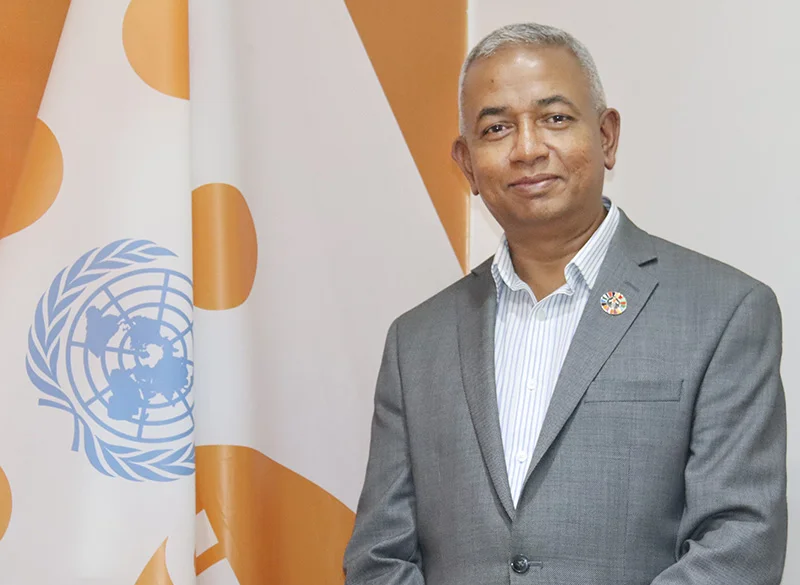
Marking World Health Day on April 7, health experts have called for a stronger commitment to science-based decision-making to address increasingly complex and evolving health challenges in Sri Lanka and beyond.
Dr. Dayanath Ranatunga, Assistant Representative of the United Nations Population Fund, stressed that health is no longer confined to hospitals or traditional medical systems, but is shaped by a broad spectrum of social, environmental, and technological factors.
“This year’s theme, ‘Together for Health. Stand with Science,’ reminds us that science is not only for laboratories or policymakers. It is a way of thinking and a tool that shapes everyday decisions,” he said.
Dr. Ranatunga noted that modern health challenges are increasingly interconnected, ranging from infectious diseases such as COVID-19 to climate-related risks, demographic shifts, and emerging forms of online violence.
He warned that maternal and newborn health continues to demand urgent attention despite progress. Globally, an estimated 260,000 women died from pregnancy and childbirth-related causes in 2023 alone—many of them preventable through timely, science-based interventions.
“In countries like Sri Lanka, where fertility rates are declining and survival rates improving, every pregnancy carries greater significance—not just for families, but for the future of communities and economies,” he said.
The UNFPA official also highlighted the growing threat of Technology Facilitated Gender-Based Violence (TFGBV), including cyber harassment and online abuse, noting that these forms of violence can have deep psychological consequences despite lacking visible physical harm.
He emphasised the need for multidisciplinary, science-informed approaches that integrate mental health, digital safety, and survivor-centered care.
Turning to demographic trends, Dr. Ranatunga pointed out that increasing life expectancy is bringing new challenges, particularly the rise of non-communicable diseases such as diabetes, cardiovascular illnesses, and cancers.
In Sri Lanka, nearly 13.9% of mothers develop diabetes during pregnancy, a trend attributed to obesity and unhealthy lifestyles, underscoring the urgent need for preventive healthcare strategies.
“Are we investing enough in prevention?” he asked, noting that early intervention and healthier lifestyles could significantly reduce long-term healthcare costs, especially in a country with a free public healthcare system.
He underscored the importance of data-driven policymaking, stating that scientific research and analytics enable governments to identify gaps, anticipate future needs, and allocate resources more effectively.
The UNFPA, he said, is already leveraging tools such as Geographic Information Systems (GIS) to improve access to maternal healthcare, including mapping travel times for pregnant women to reach health facilities.
Digital innovation is also transforming healthcare delivery, from telemedicine to real-time data systems, improving efficiency and ensuring continuity of care even during emergencies.
In Sri Lanka, partnerships between the government and development agencies are helping to modernise training institutions, including facilities in Batticaloa, equipping healthcare workers with both clinical and digital skills.
However, Dr. Ranatunga cautioned that technology alone is not a solution.
“It must be guided by evidence and grounded in equity,” he said, pointing out that women’s health remains significantly underfunded, with only about 7% of global healthcare research focusing on conditions specific to women.
He also drew attention to the growing health impacts of climate change, including extreme weather, food insecurity, and displacement, describing it as an emerging public health crisis.
“Health does not begin in hospitals. It is shaped by the environments we live in, the choices we make, and the systems we build,” he said.
Calling for renewed commitment, Dr. Ranatunga urged stakeholders to invest in prevention, embrace innovation, and ensure that science remains central to policy and practice.
“Science is not just about knowledge—it is about ensuring that everyone has the opportunity to live healthy, dignified lives, and that no one is left behind,” he added.
By Ifham Nizam

 Melantha Perera is well known as a very versatile musician.
He was involved with the band Mirage, as their keyboardist/vocalist, and was also seen in action with other outfits, as well, before embarking on a trip to Australia, as a solo artiste.
I now hear that he has plans to operate as a trio.
However, what has got many talking about Melantha, these days, is his awesome work with the visually impaired Bright Light Band.
They have worked out a special song for the Sinhala and Tamil New Year, aptly titled ‘Awurudu Kaale.’
Says Melantha: “This song has been created to celebrate the spirit of the Sinhala and Tamil New Year and to share the joy of the Awurudu season with all Sri Lankans”.
Yes, of course, Melantha composed the song, with the lyrics written collaboratively by Melantha, Badra, and the parents of the talented performers, whose creative input brought the song to life during moments of inspiration.
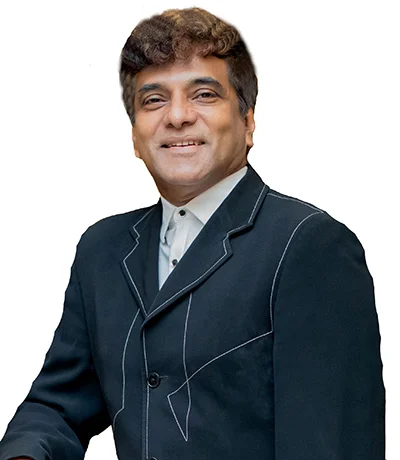
Melantha Perera: Awesome work with Bright Light Band
This meaningful collaboration reflects the strong community behind the Bright Light Band.
According to Melantha, accompaning the song is a vibrant video production that also features the involvement of the parents, highlighting unity, joy, and togetherness.
Beyond showcasing their musical talents, the visually impaired members of Bright Light Band deliver a powerful message, through this project, that their abilities extend beyond singing, as they also express themselves through movement and dance.
Melantha expressed his satisfaction with the outcome of the project and looks forward to sharing it with audiences across the country during this festive season.
He went on to say that Bright Light Band extends its sincere gratitude to Bcert Australia for their generous Mian sponsorship, the CEO of the company, Samath Fernando, for his continuous support in making such initiatives possible, and Rukshan Perera for his personal support and encouragement in bringing this project to completion.
The band also acknowledges Udara Fernando for his invaluable contribution, generously providing studio space and accommodating extended recording sessions to suit the children’s availability.
Appreciation is warmly extended to the parents, whose unwavering commitment from ensuring attendance at rehearsals to supporting the video production has been instrumental in the success of this project.
Through ‘Awurudu Kaale’, Bright Light Band hopes to spread festive cheer and inspire audiences, proving that passion and talent know no boundaries.

Transgender women banned from women’s PDC darts

Heat Index at Caution Level in the Western, Sabaragamuwa, Southern, Eastern, North-western, Northern and North-central provinces and in Monaragala district.

PSL 2026: Iftikhar’s all-round show seals last-ball win for Zalmi

BCCI curbs movement of benched IPL players in latest rules

Prasidh trumps Miller in last-ball finish as Gujarat Titans clinch thriller

Greece to ban social media for under-15s from next year

‘Dates have the highest sugar content to fight Coronavirus’

Sunday Island 27 December – Headlines

#SundayIsland 17th December – Headlines

Sunday Island – 28th March

Sunday Island Headlines – 21 March

Sunday Island – 21st February – Headlines
-

 Features5 days ago
Ranjith Siyambalapitiya turns custodian of a rare living collection
-

 News5 days ago
Global ‘Walk for Peace’ to be held in Lanka
-

 News3 days ago
Lankan-origin actress Subashini found dead in India
-

 Features5 days ago
Beyond the Blue Skies: A Tribute to Captain Elmo Jayawardena
-

 Opinion7 days ago
Hidden truth of Sri Lanka’s debt story: The untold narrative behind the report
-

 Features5 days ago
Aspects of Ceylon/Sri Lanka Foreign Relations – 1948 to 1976
-

 Business23 hours ago
Hayleys Mobility introduces Premium OMODA C9 PHEV
-
 Features7 days ago
The Ramadan War