
News
Docs granted significant salary increase, strike unfair – Dr. Jayatissa


By Saman Indrajith
Minister of Health Dr. Nalinda Jayatissa, on Tuesday, said that given the significant salary increases granted throught the latest Budget, it would be unfair for doctors to resort to trade union action. He reaffirmed that the government remained open to discussions on issues within the healthcare sector.
The Health Minister addressed concerns raised by the Government Medical Officers’ Association (GMOA), noting that its Secretary had announced plans for a strike over alleged reductions in allowances. He also pointed out that Opposition politicians, including the Leader of the Opposition, had met GMOA representatives.
Dr. Jayatissa highlighted that just two days after the Budget was presented, a former trade union leader representing the previous administration had called for a protest by nurses. This, he said, was even though salary increases for nurses had already been outlined in the Budget. He questioned the rationale behind such actions.
Reflecting on past events, Minister Jayatissa acknowledged that doctors had continued their service during various national crises, with some leaving the country while others played a role in supporting the recent government transition. He underscored that, for the first time in history, public sector salaries had been increased rather than just allowances, ensuring greater fairness.
The Minister also drew comparisons with the previous administration, recalling that in 2023, the GMOA had met then-President Ranil Wickremesinghe to request an increase in allowances. At the time, they were informed that such adjustments would require negotiations with the International Monetary Fund (IMF). Despite this, doctors did not protest against the government. In contrast, the current administration had approved salary hikes without any prior demands from medical professionals, incorporating increases in basic salaries, special duty allowances, holiday allowances, and annual increments, along with tax relief on supplementary earnings.
In addition to the previously mentioned salary increases, other categories of medical officers will also see significant adjustments. The basic salary for second-grade medical officers will rise from Rs. 58,305 to Rs. 101,370, reflecting an increase of Rs. 43,065. First-grade medical officers will receive an increment of Rs. 53,865, raising their salaries from Rs. 71,805 to Rs. 125,670. Meanwhile, junior specialists will experience a salary increase of Rs. 68,000, bringing their earnings from Rs. 88,000 to Rs. 156,000.
Further adjustments have been made across various medical officer grades. Grade 1 Preliminary Medical Officers will see their salaries increase from Rs. 56,960 to Rs. 98,950, an increment of Rs. 41,990. Similarly, MO Grade 2 salaries will rise from Rs. 63,685 to Rs. 111,050, reflecting an increase of Rs. 47,365, while MO Grade 2 (Advanced) salaries will be raised from Rs. 69,635 to Rs. 121,770, marking a Rs. 52,135 increment. For MO Grade 1 officers, salaries will increase from Rs. 80,485 to Rs. 141,270 (+Rs. 60,785), and for MO Grade 1 (Advanced), the increase will be from Rs. 86,695 to Rs. 152,970 (+Rs. 65,973). Senior MO Grade 1 officers will see their earnings rise from Rs. 93,505 to Rs. 164,670, reflecting a Rs. 71,165 increment, while MO Grade 1 (Specialist Entry Level) officers will have their salaries raised from Rs. 100,015 to Rs. 176,370 (+Rs. 76,355). The highest increase is for MO Grade 1 (Senior Specialist) officers, whose salaries will be revised from Rs. 104,315 to Rs. 184,170, marking a substantial increase of Rs. 79,815.
Additionally, duty-related allowances have been revised to reflect higher compensation. General Medical Officers will now receive Rs. 765, up from Rs. 687, while Second-Grade Medical Officers will see an increase from Rs. 796 to Rs. 925. First-Grade Medical Officers will receive Rs. 1,307, up from Rs. 1,101, and Junior Specialists will have their duty allowances raised from Rs. 1,302 to Rs. 1,542.
Leave-related allowances have also been adjusted accordingly. General Medical Officers will now receive Rs. 3,138, reflecting a Rs. 423.50 increase from the previous Rs. 2,714.50. Second-Grade Medical Officers will see their allowance rise from Rs. 2,915 to Rs. 3,379, while Grade 1 MOs will have an increase from Rs. 3,590 to Rs. 4,189. Junior Specialists will experience an increase of Rs. 800, bringing their allowance from Rs. 4,400 to Rs. 5,200.
Furthermore, annual salary increments have been significantly raised. Increments that were previously Rs. 1,335 will now be Rs. 2,400, while those at Rs. 1,340 will rise to Rs. 2,420. Similarly, salary increments of Rs. 1,630 will now be Rs. 2,940, and those at Rs. 2,170 will be revised to Rs. 3,900. These changes collectively represent a substantial improvement in the remuneration of medical professionals in the public sector.
The government has introduced substantial tax relief to further ease the financial burden on medical professionals. Under the new system:
* Those earning between Rs. 100,000 and Rs. 150,000, who previously paid between Rs. 35,000 and Rs. 40,000 in taxes, are now fully exempt.
* Salaries up to Rs. 200,000 now enjoy 72% tax relief.
* Salaries up to Rs. 250,000 receive 62% tax relief.
* Those earning Rs. 300,000 benefit from 47% tax relief.
With these salary hikes and tax benefits combined, doctors will see a substantial increase in their take-home earnings.
Minister Jayatissa said that his first official engagement upon assuming office was a discussion with the GMOA, which lasted nearly one hour and forty minutes. Despite this, the decision to pursue trade union action was made.
He said that launching strikes and protests, despite the generous salary increases, is unwarranted. The Minister urged medical professionals to engage in discussions rather than resorting to disruptive actions, stressing that any grievances can be addressed through dialogue with the government.
“I call on all medical professionals to act responsibly and refrain from engaging in unjustified trade union actions. Our doors are always open for discussion, and we remain committed to finding amicable solutions,” he said.

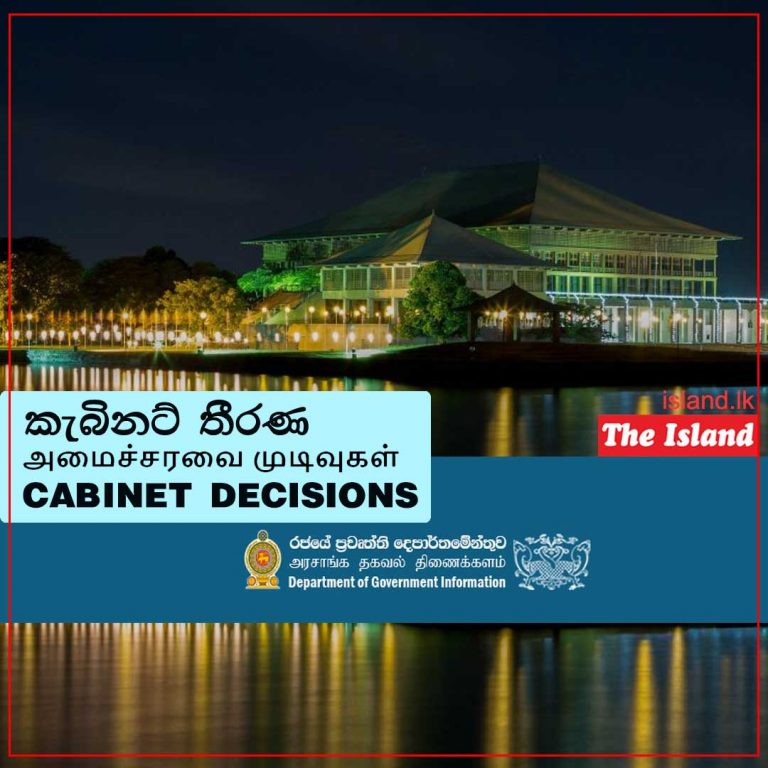
Approval of the Cabinet of Ministers was granted to the preparation of the Appropriation Bill for the financial year of 2027 at their meeting held on 30.06.2026.
Accordingly, clearance of the Attorney General has been given to the Appropriation Bill prepared by the Legal Draftsman.
Therefore, the Cabinet of Ministers approved the resolution furnished by the President in his capacity as the Minister of Finance, Planning and Economic Development to publish the aforementioned draft bill in the government gazette notification and thereby submit the same to the Parliament for its concurrence.
Latest News
Cabinet approves aditional Rs. 2,500 million to the Paddy Marketing Board to purchase 2026 Yala harvest

The Cabinet of Ministers has approved the resolution furnished by the Minister of Agriculture, Livestock, Land and Irrigation to provide an additional Rs. 2,500 million to the Paddy Marketing Board on a reimbursable basis from the Rs. 7,500 million additional allocations granted to the Ministry to implement
the expedited paddy purchasing program for the 2026 Yala harvest.
Latest News
Cabinet nod to host the 8th Asian Regional Conference of the Commonwealth Parliamentary Association and the 3rd Joint Asian and South-East Asian Regional Conference of the Commonwealth Parliamentary Association
The 8th Asian Regional Conference of the Commonwealth Parliamentary Association (CPA) and the 3rd Joint Asian and South-East Asian Regional Conference of the CPA are planned to be held over three days in Colombo during April/May 2027.
Approximately 90 delegates including speakers, Deputy Speakers, Member of Parliamentarians, and Parliamentary officers representing member countries of the Commonwealth Parliamentary Association, in the Asian and South-East Asian regions, are expected to participate in these conferences.
The Cabinet of Ministers has approved the resolution furnished by the Prime Minister of the Parliament of Sri Lanka to host the said conferences considering the opportunities to strengthen parliamentary diplomacy and regional cooperation, as well as to enhance international recognition of the Parliament of Sri Lanka within the Commonwealth Parliamentary Association.

Draft of the Appropriation Bill for the Financial Year 2027 su mitted to the Parliament
Cabinet approves aditional Rs. 2,500 million to the Paddy Marketing Board to purchase 2026 Yala harvest
Cabinet nod to host the 8th Asian Regional Conference of the Commonwealth Parliamentary Association and the 3rd Joint Asian and South-East Asian Regional Conference of the Commonwealth Parliamentary Association

SAARC Training Workshop on Financial Modeling for Renewable Energy Projects from 5th to 7th October in Colombo
National Children’s Week from 25th September to 01st October

Nairobi and Munich to host 2029 and 2031 World Athletics Championships

‘Dates have the highest sugar content to fight Coronavirus’

Sunday Island 27 December – Headlines

#SundayIsland 17th December – Headlines

Sunday Island – 28th March

Sunday Island Headlines – 21 March

Sunday Island – 21st February – Headlines
-

 Sports5 days ago
DDS set to lose Test captaincy
-

 News5 days ago
Sri Lanka faces new grid challenge as rooftop solar surges: former CEB GM
-

 Latest News5 days ago
Shafali, Deepti power India into sixth T20 Asia Cup final
-

 Opinion7 days ago
Navigating Sri Lanka’s Israeli Dilemma
-

 Latest News4 days ago
Sri Lanka thwart Fatima Sana challenge to secure Asia Cup final spot
-

 News3 days ago
Gnanasara Thero absconding after SC ruling
-

 Features6 days ago
Lost for 90 years: Rare Goby resurfaces in Jaffna
-

 News4 days ago
Ammunition cache found in old Kandy bungalow