
Latest News
Starc, Lyon keep Sri Lanka on a tight leash

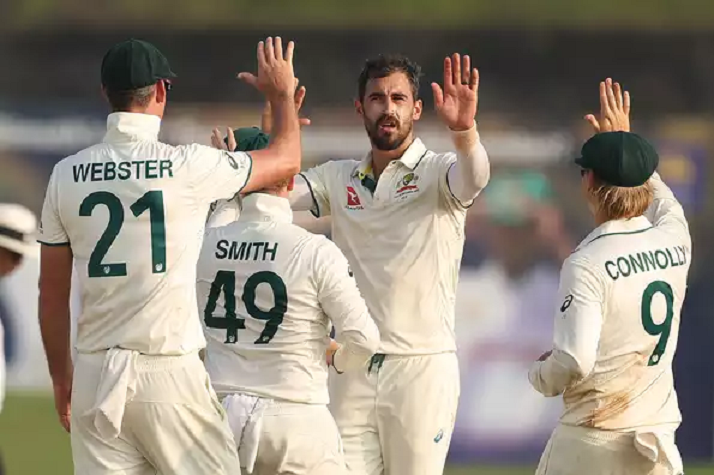
Sri Lanka endured another shoddy batting show at the start of the second Test in Galle as the hosts ended the opening day at 229/9. Despite half-centuries from Dinesh Chandimal and Kusal Mendis, Australia kept the home side on a tight leash to take early control in the second fixture.
Dhananjaya de Silva put his under-fire batting unit in on a dry surface after winning the toss. A week after Australia posted a first-innings total of 654/6 at the same venue, Sri Lanka made a fairly solid start through the senior pair of Dimuth Karunaratne – playing in his 100th and final Test for Sri Lanka, and Chandimal. Nathan Lyon was employed early on a surface that took sharp turn from the first hour itself, and saw the back of returning opener Pathum Nissanka. The second-wicket pair of Karunaratne and Chandimal, however, saw through the rest of the morning session with solidity and some intent to push the team ahead.
What transpired after this break though, would’ve further peeved head coach Sanath Jayasuriya, who chided his batters for their shot selection in the aftermath of the first Test defeat. Karunaratne, who’d moved along to 30s, fell in the third over after the break – cleaned up by Lyon from round the stumps. Angelo Mathews was scratchy and circumspect for 25 deliveries, before biting the bullet on the 26th when Lyon tossed one up for him to reach out and defend, only to nick behind to Alex Carey.
Right after the drinks break, Australia struck through the golden arm of Travis Head. The offie got Kamindu Mendis to nick to Steve Smith in first slip while attempting a cut shot. Dhananjaya de Silva’s arrival coincided with the return of Mitchell Starc, and the pacer dismissed the Sri Lankan captain right away. Starc bowled full and wide and Dhananjaya chased after it, nicking to Beau Webster at gully.
Chandimal, who scored his 32nd Test fifty in this session, batted out the rest of the session with Kusal Mendis. But once again it didn’t result in a bigger, more significant alliance as Sri Lanka lost a wicket early into a session. This time, Chandimal fell to an exceptional piece of glovework by Carey. Matthew Kuhnemann got Chandimal to press forward and miss, and Carey whipped the bails off with no part of the batter’s foot behind the line. He walked off for 74.
Kusal Mendis tried to throw Lyon off his lengths by repeatedly slog sweeping him. He and Ramesh Mendis pushed back for the majority of the final session, showing gumption for a big partnership. They added 65 runs for the seventh wicket to take Sri Lanka past the 200-mark but Starc returned, with new ball in hand, to ensure Australia finished the day in the driver’s seat.
Starc bowled a quick one – 144kmph – across the right-hander, who was indecisive in playing or leaving the delivery and ended up edging to Carey. Prabath Jayasuriya then edged one to Smith at second slip for a first-ball duck. Kuhnemann then reduced Sri Lanka to 224/9 by cleaning up Nishan Peiris. Steve Smith threw in a lot of catchers around the bat for the final pair who still had to negotiate 3.5 overs to get to stumps. Lahiru Kumara played 11 of those balls – dead-batting most, to survive the day in the company of Mendis, who went to stumps unbeaten on 59.
Brief Scores:
Sri Lanka 224/9 (Dinesh Chandimal 74, Kusal Mendis 59; Mitchell Starc 3-37, Nathan Lyon 3-78, Matthew Kuhnemann 2-53) vs Australia.

The detained former Myanmar leader Aung San Suu Kyi has been moved to house arrest, the country’s state media has reported.
The 80-year-old Nobel laureate has been held in detention – probably in a military prison in the capital Nay Pyi Taw – since she was removed from office in a military coup in 2021.
A statement by military leader Min Aung Hlaing, who led the coup, said he had “commuted her remaining sentence to be served at the designated residence”.
Aung San Suu Kyi came to power in 2015 after Myanmar’s then rulers introduced democratic reforms. Before that, she spent decades of military rule as a pro-democracy activist, and was previously held for more than 15 years under house arrest.
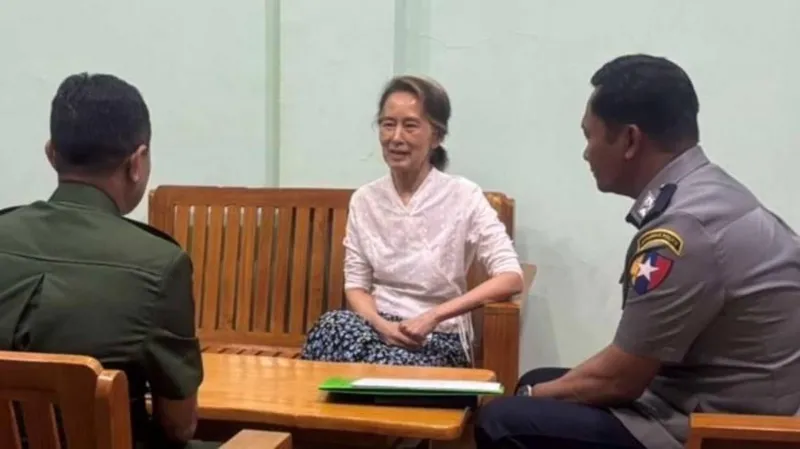
State media broadcast a picture of her sitting with two uniformed personnel.
Her son Kim Aris said he was sceptical about the announcement and that he did not even have proof that she was alive. He said the picture was “meaningless” as it was taken in 2022.
“I hope this is true. I still haven’t seen any real evidence to show that she has been moved,” he told the BBC.
“So, until I’m allowed communication with her, or somebody can independently verify her condition and her whereabouts, then I won’t believe anything.”
Prior to the announcement, nothing was known about her health or living conditions, and Kim Aris said in December he had not heard from her in years.
Her legal team told Reuters they had had no direct notification about her house arrest.
Little has been seen – and nothing heard – from Aung San Suu Kyi since she was arrested on the day the armed forces ousted her elected government more than five years ago.
Her lawyers have not seen her for more than three years; her family has had no contact with her for more than two.
The only image of her seen before Thursday was at a court appearance in May 2021, at the start of a series of trials by the military on charges which have been widely dismissed as fabricated.
Since then, her 33-year sentence has been reduced several times.
Her sudden appearance in state media suggests the military authorities may be preparing for further changes in her status – possibly her partial or complete release.
The coup leader Min Aung Hlaing is eager to end his regime’s international isolation, and appears more confident after a string of battlefield wins against armed opposition groups.
The military junta also held an election earlier this year restoring a notionally democratic government, but which leaves the same military leaders in charge.
“The military regime that rules Myanmar is very much on a [public relations] offensive at the moment,” Sean Turnell, the former economic adviser to Aung San Suu Kyi, told the BBC’s Newsday programme.
He added that Myanmar’s military was “trying to convince the world that it’s a legitimate government”, and the reports of Aung San Suu Kyi’s relocation to house arrest were “part and parcel of that”.
While Turnell said he was “really hopeful” the reports were true, he has “got a lot of doubts”.
Turnell, an Australian economist, was detained alongside Myanmar’s democratically elected leaders for more than a year after the 2021 military coup.
During that time, he was kept in the same prison as Aung San Suu Kyi, where conditions were “medieval” and “just really really awful”, Turnell recalled, adding that the food and medical care were “bad” and the cells were “open to the elements”.
With Aung San Suu Kyi now 80 years old, those are “terrible conditions for her”, Turnell said.
During her earlier confinement, Aung San Suu Kyi’s dignified, non-violent resistance won her admirers across Myanmar and around the world, and she famously made speeches to supporters from her family home. She won the Nobel Peace Prize in 1991.
But her decision to lead Myanmar’s defence against charges of genocide at the International Court of Justice over the military’s atrocities against Muslim Rohingyas in 2017 badly tarnished her saint-like international image.
Despite her years of incarceration away from the public eye, Aung San Suu Kyi’s standing among the Burmese people remains “extremely high”, according to Turnell.
“She has a charisma and connection with the Burmese people that is almost spiritual. And I don’t think that’s been diminished at all,” he said, adding that people in the country are “just hoping that she’ll be released”.
[BBC]
Latest News
“Let’s move forward together in unity to build a country where all labour is valued, rights are protected, and equality prevails” -PM
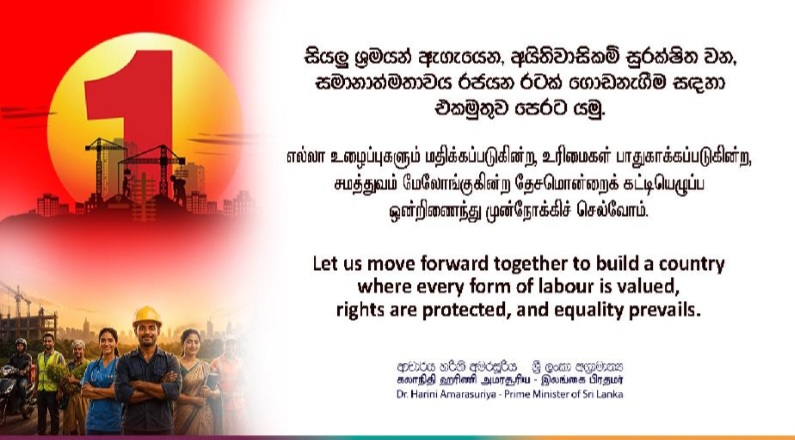
Prime Minister Dr Harini Amarasuriya in her May Day message called upon the working people in Sri Lanka to move forward together in unity to build a country where all labour is valued, rights are protected, and equality prevails.
The full text of the PM’s message:
The history of the Sri Lankan labour movement is a remarkable journey, shaped over decades by the blood, sweat, and sacrifices made in the pursuit of rights, justice, and dignity.
Beginning with the printers’ strike of 1893, the working people of this country emerged as an organised force. Through the trade union movement led by A. E. Goonesinha and the emergence of the Lanka Sama Samaja Party, the voice of labour gained political strength. The Railway Workers’ Strike of 1923 and the public service strike of 1947 reaffirmed that the true ’driving force’ behind the country’s economic and social transformation was its working people. I respectfully acknowledge the invaluable contributions of workers in the plantation sector, ports, railways, and across both the public and private sectors, whose dedication laid the foundation for many of the labour rights we benefit from today.
As we commemorate International Workers’ Day with dignity once again, we pay tribute to all working people across the world, including the heroic workers who sacrificed their lives in the struggle for an eight-hour workday in Chicago in 1886. This year’s May Day holds special significance as it is being celebrated under a government built through the power of the people, in honour of the entire working community of Sri Lanka.
Granting due respect to labour and safeguarding the rights of all working people are core policy commitments of our government. Accordingly, we remain dedicated to creating a fair and safe working environment by expanding existing services and implementing new programmes aimed at improving the living standards of working people.
Ensuring fair and equal access for all citizens is a fundamental objective of the government. Following that, it is our responsibility to create an environment in which everyone can lead a dignified professional life. Establishing a national social protection system that recognises unpaid labour and guarantees social security for unpaid labours is among the foremost priorities of our government.
On this May Day, we must reaffirm the importance of moving forward together in unity to build a country where all labour is valued, rights are protected, and equality prevails. With the strength and dedication of all working people, may we soon achieve the vision we all share: “A Thriving Nation – A Beautiful Life
There has been violence outside an Australian hospital where a man suspected of murdering a five-year-old girl was being treated.
Jefferson Lewis was arrested late on Thursday night local time in Alice Springs, after being seen by members of the local community and reportedly attacked.
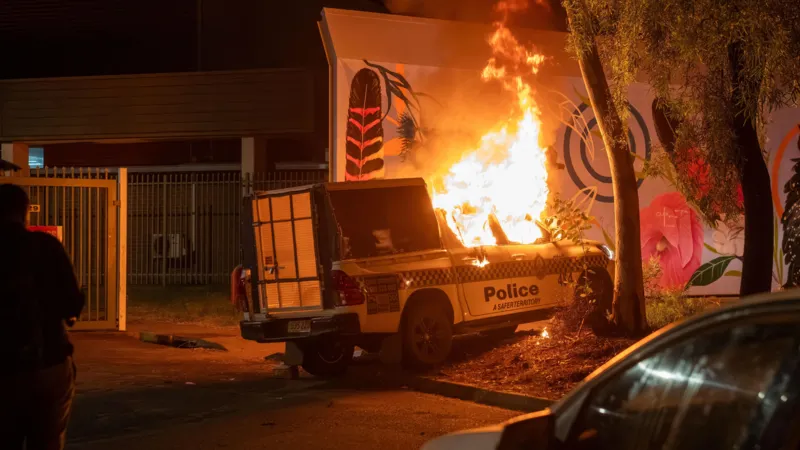
Video shows dozens of people gathering outside the town’s hospital, some throwing projectiles, with police using tear gas.
The body of the girl, who is identified only as Kumanjayi Little Baby for cultural reasons, was discovered earlier on Thursday.
She had last been seen on Saturday, when she was put to bed at an Aboriginal town camp near Alice Springs just before midnight.
Australia’s national broadcaster, the ABC, reports the crowd of about 400 Aboriginal people outside the hospital yelled that Lewis needed to face “payback” and accused the police of protecting him.
“Payback” is term for traditional punishment under Aboriginal law in Central Australia.
Many were chanting that he should be killed for his alleged attack on Kumanjayi Little Baby, the ABC added.
Video from the scene shows crowds throwing items towards police and items being thrown. Several police vehicles appear to have been damaged.
Northern Territory Police Commissioner Martin Dole told the ABC Lewis was unconscious when officers found him.
Dole said about 200 people turned on police and paramedics as they responded to reports Lewis was being assaulted.
Several people including members of the emergency services were injured, but no arrests have been made over the violent disorder.
Dole said the scenes outside the hospital were “not acceptable” and were not “reflective of what we’ve seen from the community of Alice Springs in the last five days”.
Lewis has been flown from Alice Springs to Darwin and has been taken into police custody, Dole said.
Charges are expected to be laid against Lewis in the coming days, Dole said.
Forensic test to confirm the young girl’s identity and cause of death will continue on Friday.
Police had been combing nearby bush and desert for Lewis, who was released from prison six days before Kumanjayi Little Baby disappeared and vanished around the same time.
Dole said everyone involved in the search for her had been holding out hope of finding her alive.
“When we made that discover yesterday [it was] absolutely devastating for everybody involved,” he said.
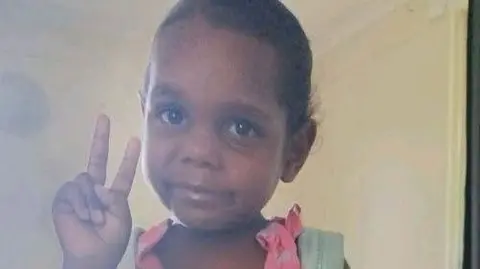
In a statement, Kumanjayi Little Baby’s mother – who was not named – said her daughter was loved and missed.
“It is going to be so hard to live the rest of our lives without you.”
“We know you are in heaven with the rest of the family and Jesus. Me and your brother will meet you one day.”
The girl’s mother also thanked the dozens of people, both police and volunteers, who have spent days searching the area around Old Timers Camp – a site set aside by the government for Aboriginal people to stay in when in Alice Springs.
“Around 200 people have worked tirelessly around the clock in searching for this beautiful little girl who went missing five days ago,” Chief Minister Lia Finocchiaro said.
“And for five days every Territorian has had their heart in their throat waiting for the moment when we got the announcement that she had been found safe and well… Everyone is incredibly devastated.”
Using the name of deceased people, as well as broadcasting their image or voice, breaches cultural protocols around mourning in many Aboriginal and Torres Strait Islander communities and cannot be done without the permission of their families.
[BBC]

Myanmar ex-leader Aung San Suu Kyi moved to house arrest, military says

“Let’s move forward together in unity to build a country where all labour is valued, rights are protected, and equality prevails” -PM

Violence in Australian town after arrest of man over girl’s murder

Holder, Rashid and Arshad give Gujarat Titans NRR-boosting win

Showers or thundershowers will occur in most parts of the island after 1.00 pm.

Heat Index at Caution Level at some places in the Northern, North-central, Eastern, Sabaragamuwa and North-western provinces and in Monaragala district during the day time

‘Dates have the highest sugar content to fight Coronavirus’

Sunday Island 27 December – Headlines

#SundayIsland 17th December – Headlines

Sunday Island – 28th March

Sunday Island Headlines – 21 March

Sunday Island – 21st February – Headlines
-
 News2 days ago
Treasury chief’s citizenship details sought from Australia
-

 News4 days ago
BIA drug bust: 25 monks including three masterminds arrested
-

 Business5 days ago
Nestlé Lanka Announces Change in Leadership
-
 News5 days ago
Hackers steal $3.2 Mn from Finance Ministry
-

 News4 days ago
Banks alert customers to phishing attacks
-
 News3 days ago
Govt. assures UN of readiness to introduce ‘vetting process’ for troops on overseas missions
-

 News1 day ago
Rooftop Solar at Crossroads as Sri Lanka Shifts to Distributed Energy Future
-

 Business3 days ago
ADB-backed grid upgrade tender signals next phase of Sri Lanka’s energy transition