
Features
Clean Sri Lanka environmentally, socially and psychologically


Philosophical approach should integrate sociological and psychological principles as an essential part of the campaign
by Prof. Athula Sumathipala
Clean Sri Lanka; what does it entail?
The mission of the “Clean Sri Lanka” project” is to reposition the nationwide efforts of environmental, social, and governance initiatives through introducing change, integration, and collaboration”.
As stated on its official website, “Clean Sri Lanka project aims to address a cleaner physical environment and a nationwide moral commitment to enhance ethical principles. Enhancement of the three pillars of sustainability; Economic, Social and Governance (EESG), have been identified as the framework to address the overarching objectives of this strategic plan with specific stakeholder goals, actions, time lines and outcomes”.
Human nature of resistance to change
Human nature is such that they are resistant to change. That is why so many people especially as organiations, when presented with a new initiative or idea—even a good one, with tons of benefits—will resist it.
We have already witnessed such resistance, in relation to the clean Sri Lanka project; threat to strikes, misinformation campaigns etc. No surprise. That resistance can also be easily exploited by the opportunists who wants to derail this programme for their own gains, no matter what the overall benefits the proposed programme brings.
The role of “proactive change management”
Proactive change management happens when leaders actively seek to manage the challenges and opportunities in a program. Every change projects comes with many unpredictable aspects. A proactive change manager will anticipate such potential challenges and plan for such problems well in advance. Thereby, they will be equipped to create contingency plans for unexpected challenges.
The role of the brain in facing changes
The brain has three main parts: the cerebrum, cerebellum and brainstem. Cerebrum is the largest part of the brain and is composed of right and left hemispheres. They interpret sights, sounds and touches. It also regulates emotions, reasoning and learning.
Cerebellum maintains the balance, posture, coordination and fine motor skills.
Brainstem, regulates many automatic body functions.
Part of the brain, the amygdala interprets change as a threat and releases the hormones leading to fear, fight, or flight. (See Figure 1)

In particular, the function of the brain’s prefrontal cortex, which is responsible for complex thinking, self-regulation, and future orientation, is only completed around the age of 24.
Because the brain’s prefrontal cortex is still developing, teenagers rely more on a part of the brain called the amygdala to make decisions and solve problems than adults. The amygdala is involved in emotions, impulses, aggression, and instinctual behaviour.
The limbic system, often referred to as the emotional centre of the brain, is responsible for processing emotions, forming memories, and regulating behaviour. It includes key structures like the amygdala, hippocampus, and hypothalamus, each playing a vital role in emotional and social processing.
Therefore, biologically, we can conclude that the younger generation acts more emotionally than rationally compared to the adults. However, that does not mean all adults are acting rationally. Understanding this phenomenon is in no way justifying and normalising it.
Hence, adolescents and also adults should learn about emotional regulation and improve their skills to communicate their frustrations, anger, disagreements in an acceptable and civilised manner.
Such frustrations, anger, disagreements are potential manifestations of the Clean Sri Lanka programme which could be easily exploited by opportunists.
That’s why the science and the art of science should be carefully integrated into proactive change management using cognitive behavioural principles, conformity theory and principles, as they are key components in this, Clean Sri Lanka project for successful implementation.
Emotional regulation
Emotional regulation is the conscious or unconscious processes of monitoring, evaluating, modulating, and managing emotional experiences and expression of emotion in terms of intensity, form, and duration of feelings, emotion related physiological states and behaviours.
Being able to regulate emotions is important since our emotions are closely connected to how we think and behave. Our thoughts and feelings help us to decide how best to respond to a situation and what action we should take. Essentially, emotional regulation can influence positive and negative behaviour.
Learning skills to regulate emotions means that, instead of acting impulsively and doing something that may be regretted later, we are able to make thought-out choices. It also helps out to manage our conflicts of interest or competing interests.
This means that we can learn to manage relationships with others, solve problems, and have better control over our behaviours.
To do so, one need to develop emotional intelligence. Positive attitudes and emotional intelligence go hand in hand. That is why it’s so important.
Attitude is a way of thinking or feeling about something, it’s a psychological construct which governs behaviours. Negative or destructive attitudes are like flat tyers, without changing one cannot go anywhere.
Emotional intelligence (EI)
In a book written by Daniel Goleman in 1995, on emotional intelligence theory, he outlined five components of EI: self-awareness, self-regulation, motivation, empathy, and social skills.
Self-regulation; helps openness to change, motivation; helps a passion for work beyond monetary returns, energy and persistence, empathy; putting yourself in others’ shoes, social skills; ability to find common ground and rapport, and persuasiveness. People with EI makes good leaders as they can use their ability to recognise and understand their own emotions to make more informed and rational decisions. They can also use their ability to empathise with the emotions of their team members to take into account their perspectives and needs when making decisions
Emotional Intelligence can matter more than IQ; “intelligence quotient”. In his book, Goleman pointed out that emotional intelligence is as important as IQ for success, including in academic, professional, social, and interpersonal aspects of one’s life. It’s something which can be developed through coaching and mentoring.
Conformity principles
Conformity is a form of social influence that involves a change in the common belief or behaviour of a person or group of people to fit into how others are. This may have a good outcome or bad outcome.
Solomon Asch conducted several experiments in the 1950s to determine how people are affected by the thoughts and behaviours of other people. In one study, a group of participants was shown a series of printed line segments of different lengths: a, b, and c (Figure 1). Participants were then shown a fourth line segment: x. They were asked to identify which line segment from the first group (a, b, or c) most closely resembled the fourth line segment in length. (See Figure 2)

Each group of participants had only one true, outsider. The remaining members of the group were confederates of Ash. A confederate is a person who is aware of the experiment and works for the researcher. Confederates are used to manipulate social situations as part of the research design, and the true, outside participants believe that confederates are, like them, uninformed participants in the experiment. In Asch’s study, the confederates identified a line segment that was shorter than the target line a, the wrong answer. The outside participant then had to identify aloud the line segment that best matched the target line segment.
Asch (1955) found that 76% of participants conformed to group pressure at least once by indicating the incorrect line. Conformity is the change in a person’s behavior to go along with the group, even if he does not agree with the group.
Research shows that the size of the majority, the presence of another dissenter, and the public or relatively private nature of responses are key influences on conformity.
The size of the majority: The greater the number of people in the majority, the more likely an individual will conform. In Asch’s study, conformity increased with the number of people in the majority, up to seven individuals. At numbers beyond seven, conformity leveled off and decreased slightly. The presence of another dissenter: If there is at least one dissenter, conformity rates drop to near zero (Asch, 1955).
The correct answer to the line segment question was obvious, and it was an easy task. But the outsiders who participated in the study gave wrong answers. Researchers (Deutsch & Gerard, 1955) have categorized the motivation to conform into two types: normative social influence and informational social influence
In normative social influence, people conform to the group norm to fit in, feel good, and be accepted by the group. However, with informational social influence, people conform because they believe the group is competent and has the correct information, particularly when the task or situation is ambiguous.
So, what is happening in current society. The great majority of good people conform to the bad minority allowing the wrong thing to happen. Therefore, the very same conformity principles can be used by empowering the majority of good people not to conform to the bad or wrong minority.
To achieve that people should get out of the “learned helplessness” mode, which was described by Seligman in 1976. Learned helplessness is what social science researchers call it when a person is unable to find resolutions to difficult situations, even when a solution is accessible. People that struggle with learned helplessness tend to complain a lot, feeling overwhelmed and incapable of making any positive difference in their circumstances. The feel that they are powerless to change others who have conformed to the “norm”. They give up and just get one.
There is also the bystander effect, or bystander apathy. Social psychological theory states that individuals are less likely to offer help to a victim or initiate an action in the presence of other people. They simply assume that the other person will do it. If everybody expects the other person will do ultimately no one will do it.
Social psychology is the scientific study of how thoughts, feelings, and behaviors are influenced by the actual, imagined, or implied presence of others. Social psychologists explain human behavior as a result of the relationship between mental states and social situations, studying the social conditions under which thoughts, feelings, and behaviors occur, and how these variables influence social interactions.
The best way to describe what to do in the context of all the above phenomena are operating, is using Cognitive behavioural theory and interventions based on that. Cognitive-Behavioral Theory states that human thinking determines human behaviour and feeling. Therefore, by changing one you can change the other.
The triad; behaviors, thoughts and feelings
The basis of cognitive behavioral theory is that a person’s thoughts, ideas, and beliefs underpin their emotional reactions and behaviors. (See Figure 2)
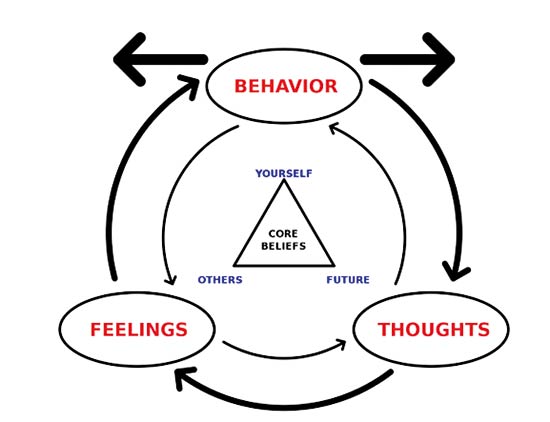
As described in the above diagram we have assumptions and core beliefs about us, the others, the future, the country, the world and so on. We call it a schemata. We process information using these schemata. Some of these can be positive and useful (functional) and some are negative and counterproductive.
The easiest way to understand this is to learn about Kisa Gothami’s story. When Kisa Gothami’s newborn son died, she did not realize so and she ran to Lord Buddha asking him to cure her son. Lord Buddha at once knew that the baby was dead but wanted Kisa Gothami to learn about death herself. Lord Buddha asked her to find a handful of mustard seeds from a household where no one has died. She went knocking on all the doors in the village but could not find a single house without a death in the family. Soon she realized the lesson Lord Buddha was trying to teach her: that no family is spared the occurrence of death. Lord Buddha used a bahaviour to teach Kisa Gothami to change the way she thinks about death. We call it cognitive restructuring.
Compatibilities between cognitive approaches to therapy, such as CBT, and Buddhism have been acknowledged by its originators Aron Beck (2005) and Kwee & Ellis (1998).
Our nation needs mass scale cognitive behavioural interventions to change the way they think about many things; us, others, future, country, what is rights and wrongs, one’s responsibilities and duties. We need to change our learned helplessness mentality created through the so-called bankrupt society that has no future.
Without addressing these assumptions, core beliefs, and thinking errors; the schemata, by using scientific principle and interventions, to change the crucial behaviors and thinking neither the President nor 159 MPs alone will be able to do much for the nation who expect a paradigm shift in the development of a nation. Their duty was not finished by voting a new President and a Government into power with the 2/3rd majority.
Each citizen who is seriously thinking of a prosperous nation need to change first to change the country and it;s wrong doings. If you want the Government to stop bribery and corruption you need to first stop offering bribes. Reflect on your self first and also inculcate such attitudes in the younger generations with optimism.
Role of media in behavioural change
The media has an undisputed role in influencing behavioral change by shaping public opinion, disseminating information, and creating awareness.
Raising awareness through campaigns can promote positive behaviors, changing stereotypes, bringing progressive narratives. modeling behaviors in films or on social media, can inspire individuals to adopt similar behaviors.
Creating social pressure through peer Influence challenging conformity, learned helplessness, conducting campaigns on social media encouraging widespread behavioral change, educating and empowering, supporting and influencing public policy and reinforcing positive behaviors are a few.
However, be mindful that media is a double-edged sword, it can inspire positive change when used responsibly but can also perpetuate negative behaviors if misused. Its influence on behavior depends largely on the accuracy, ethics, and creativity of the content it disseminates.
Be mindful, for the first time in history, the essential and fundamental conditions; objective and subjective, have come together offering a golden opportunity for a genuine change. The political leadership should not leave any stone unturned to use the scientific advances of science relevant to
three fundamental components: biological, psychological, and sociocultural factors. These elements are not isolated; they interact dynamically to shape the way we perceive the world and respond to it. They should understand how these foundational aspects of behavior provide a framework for understanding the complex nature of human actions and how to change them.
The author of this article is an internationally renowned academic with a strong track record in research especially carried out in Sri Lanka using cognitive behavioural principles. Some of his interventions are considered front line in post disaster situations.
He is an Emeritus Professor at Kings College London and Keele University. He is also the Director, Institute for Research and Development in Health and Social care and the Chairman of the National Institute of Fundamental Studies.
He had been an invited plenary speaker at the 11th International Congress on Behavioural Medicine, Washington DC, USA (August 2010), 19th World Psychiatric Association (WPA), World Congress of Psychiatry, Portugal, Lisbon (August, 2019). Melbourne, Australia (February, 2018). 16th Congress of the International Federation of Psychiatric Epidemiology Melbourne, Australia (Oct, 2017), Royal Australian and New Zealand College of Psychiatrists (RANZAP) Napier, New Zealand (Oct 2007), to name a few related to cognitive behavioral theory/therapy.

Features
Aligning graduate output with labour market needs:Why national policy intervention essential

The lack of a committed and competent workforce is no longer a routine managerial complaint in Sri Lanka; it has become a defining national problem. Recent widely reported malpractices, in leading public institutions, have exposed the depth of this challenge. From a macro-economic perspective, large and persistent gaps exist between the competencies required to perform jobs effectively and the competency profiles of the existing workforce. The consequences are visible across the economy; we witness the key economic drivers, such as agriculture, energy, tourism, finance, and education, continue to underperform. This chronic condition is not a result of insufficient and incapable human capital, but of its persistent misalignment and misutilisation.
Economic development in any country is ultimately driven by the quality and relevance of human capital deployed within its key industries. In Sri Lanka, however, the education sector, particularly higher education, has been repeatedly criticised for its limited role in producing graduates, aligned with economic needs. This misalignment is often justified by higher education institutions on the grounds that their role is not to train graduates for specific jobs, but to produce broadly capable individuals who can perform in any work context. This position appears defensible in principle. Nevertheless, it remains problematic in practice, when economic sectors continue to underperform, and graduates struggle to find productive and relevant employment.
We were surprised to see a large number of university graduates appear at a recruitment interview for post of office labourer. Their intention was to secure a public sector job as a career path, nothing else. Alas, in another job placement interview, to select office clerks, several candidates presented degree qualifications, in statistics, and degree programmes, like archeology and geography, although a degree was not an entry requirement. When questioned, the common response was the difficulty of finding jobs, relevant to their degrees. Does this mean university degrees are worthless? Certainly not, if strategically channelled into relevant economic drivers, they could have contribute meaningfully to national development. For instance, an archeology degrees can be directed to tourism, heritage management, city planning, or spatial development. The tragedy is neither the policymakers, nor the university authorities bother about the time and money spent on graduates, which go in vein in an inappropriate job. No one bothers to assess the value of having such graduates directly channelled to relevant economic sectors. The graduates also may not be bothered to question the value they dilute in generic jobs.
Periodically, state university graduates, particularly those qualified through external degree programmes, flock to the streets, demanding government employment. In response, successive governments absorbed large numbers of graduates as school teachers and development officers. Whether such recruitment exercises were grounded in a systematic analysis of labour market demand, and sector-specific competency requirements, is dubious. The persistent deterioration in productivity and service quality, across key economic sectors, therefore, raises a fundamental question: Does strategic alignment between graduate output and labour market demand exist?
Systemic Weaknesses across Economic Sectors
We see deep structural weaknesses in nearly all segments of the Sri Lankan economy. Persistent deficiencies in public sector management; outdated agriculture management systems, relying on raw exports, weak preservation and production practices; structurally underdeveloped, unattractive tourism sector slow to adopt modern global approaches; an education system, from early childhood to higher education, showing more decline than progress; and digitalisation and e-governance initiatives repeatedly undermined by implementation failures, are some lapses to mention here.
However, during the colonial period, Sri Lanka was a prosperous country in terms of agro-economy and infrastructure development. During this period, conscious alignment between education and economic priorities was clearly visible. Schools taught subjects relevant to employment and livelihood opportunities, within the prevailing economic structure. Universities were primarily producing personnel to meet the clerical needs of the administration. University enrolment remained limited and targeted, ensuring graduate output remained broadly commensurate with labour market demand. The clarity of policies and orderly execution resulted in comparatively high employee–job fit, highly competent workforce, and better service and minimal graduate unemployment. Nevertheless, during the 76 years of post-independence, Sri Lanka has fallen from its economic stability and administrative orderliness, with rising problems in every sphere of economic, cultural, social, political and environmental segments.
Decoupling of Higher Education and Economic Needs
As we see with the expansion of higher education, graduate–job fit has gradually weakened. Both public and private higher education providers continue to offer academic programmes that are decoupled from economic development priorities. If I may bring an example, one of the most critical constraints to development in Sri Lanka is the persistent absence of timely and accurate data. Decisions, policies, and reforms frequently encounter implementation difficulties due to judgments based on outdated or inaccurate data. Organisations continue to operate in the absence of reliable information systems, admitting failures and presenting excuses. Notwithstanding the need, limited attention has been given to producing competent graduates, specialised in statistics, data analytics, and information management. National-level interventions to address this gap remain minimal, despite the urgent need for such expertise, within key government institutions, and the overall industry. A large number of agriculture degree holders pass out every year from state universities, but insufficient progress has been made in modernising agricultural products and value chains, although the agricultural sector is a key economic driver in the country. We often meet agricultural graduates holding general administrative positions, which are supposed to be handled by the management graduates. Agricultural specialised knowledge is underutilised, despite the potential to deploy this expertise in promoting agricultural development. It is noteworthy to consider that when graduates, trained in specific disciplines, enter irrelevant job markets, their competencies gradually erode, organisational performance declines, and additional costs are imposed on both organisations and the wider economy.
Misalignment of human capital constitutes a significant negative externality to national development. The government invests substantial public funds, generated through taxation, to provide free education with the expectation that graduates will contribute meaningfully to economic and social development. When graduates are misaligned in the job market, the resulting costs are borne by the economy and society at large. Consequently, the economy suffers from an absence of appropriate competencies, skills, and work attitudes. Poor judgments arising from capacity deficiencies, performance inefficiencies, and a lack of specialised human capital, generate externalities.
Why Strategic Alignment Matters
A clear and coherent national human capital development policy is required, to ensure strategic alignment with national economic drivers. Such a policy should be formulated by the government, through structured consultation with government institutions, public and private higher education providers, industry representatives across key economic sectors, as well as stakeholders from social groups, and environmental authorities. Universities should ensure that degree programmes are explicitly linked to sector-specific labour market demand, based on objective and systematic analysis rather than ad hoc decision-making. National competency frameworks, for major job categories, should be developed to guide curriculum design and enrolment planning. Of course, there are competency frameworks developed as initiatives of the governments time to time, but the issue is although policies were made, they were displaced, and still to search for.
Countries that have achieved rapid economic development consistently demonstrate strong strategic alignment between human capital development and policy initiatives, underscoring the importance of coordinated planning between education systems and national economic objectives. Singapore, for example, closely aligns higher education planning with labour market demand through initiatives, such as graduate employment surveys and industry-focused programmes. Universities, like the National University of Singapore and Nanyang Technological University, play a vital role in such initiatives.
It is important for us to explore the strategies of the other countries and benchmark best practices, adopting to the local context. If we, at least, take this need seriously, and plan, in the long term, strategic alignment between graduate output and labour market demand could fundamentally change Sri Lanka’s development outcomes. Where alignment exists, productivity improves, service delivery strengthens, and institutional accountability becomes unavoidable. Effective utilisation of discipline-specific graduates would curb skill erosion and reduce the recurring fiscal cost of graduate underemployment, misallocation and ad hoc public sector recruitment.
The Role of the Government and Policymakers
Policymakers must treat human capital development as a strategic mechanism, maintaining explicit alignment between higher education planning, economic development priorities, and labour market absorption capacity. Fragmented policy stewardship across ministries and agencies should be reduced through coordinated human capital governance mechanisms. Public administration, including sector-level managers, must actively articulate medium and long-term competency requirements of key economic drivers, and feed these requirements into higher education policy processes. Governments should shift from ad hoc graduate absorption practices towards planned workforce deployment strategies, ensuring that graduate output is absorbed into sectors where national productivity, innovation, and service delivery gains are most needed. In this effort, continuous policy dialogue, between education authorities, economic planners, and industry stakeholders, is essential to prevent symbolic alignment of graduate outputs while functional mismatches persist, if we aim for a prosperous nation.
Dr. Chani Imbulgoda (PhD) is a Senior Education Administrator, author, researcher, and lecturer with extensive experience in higher education governance and quality
assurance. She can be reached at cv5imbulgoda@gmail.com.
By Dr. Chani Imbulgoda

… Young photographer captures rare moments of love, survival and intelligence in Udawalawe National Park’s Wilderness
In the silent heart of the Udawalawe National Park’s wilderness, where dust rises gently beneath giant footsteps, and the afternoon sun burns across dry landscapes, young wildlife photographer Hashan Navodya waits patiently behind his camera lens.
For the 25-year-old final-year undergraduate student at the University of Jaffna, wildlife photography is not merely a hobby. It is a lifelong passion, a spiritual connection with nature, and a journey into the hidden emotional world of wild animals — especially elephants.
Originally from Gampaha District, Hashan’s fascination with wildlife began during childhood. While many children admired animals from afar, he spent countless hours observing them closely, studying their movements, behaviour and relationships.
“From a young age, I loved watching animals and understanding how they behave,” Hashan said. “At first, I visited zoos because that was the only way I could see wildlife. But later I realised that animals are most beautiful when they are free in their natural habitats.”
That realisation transformed his life.
-

- A joyful young elephant bathing beside its family in the muddy waters of the wild
-

- A playful young elephant resting in the cool water on a hot afternoon
His photography journey officially began in 2019, while studying at Bandaranayake College Gampaha, where he served as a photographer for the school media unit. Initially, he covered school functions and events before gradually moving into engagement shoots and event photography to improve his technical skills and earn money.
“Wildlife photography equipment is extremely expensive,” he explained. “I worked hard to save money for camera bodies and lenses because I knew this was what I truly wanted to do.”
Armed with determination and patience, Hashan eventually turned fully toward wildlife and nature photography.
His journey has since taken him deep into some of Sri Lanka’s most celebrated natural sanctuaries, including Yala National Park, Wilpattu National Park, Bundala National Park, Udawalawe National Park and Horton Plains National Park.
Among the countless wildlife encounters he has documented, elephants remain closest to his heart.
One of the most remarkable moments he captured unfolded during a harsh dry spell inside the wilderness.
A mother elephant, sensing water hidden beneath the cracked earth, carefully dug into the ground using her powerful trunk. Slowly, fresh underground water, rich in minerals and nutrients, emerged from beneath the dry soil.
Nearby stood her calf, patiently waiting.
“As the water appeared, the baby elephant quietly moved closer and drank beside its mother,” Hashan recalled.

Hashan Navodya
“It was such a powerful moment. It showed survival, intelligence, trust and the deep bond between them.”
The scene revealed more than instinct. It reflected generations of inherited knowledge passed from mother to calf — wisdom essential for survival in difficult conditions.
“These mineral-rich water sources are very important for young elephants, especially during dry periods,” he said. “Watching the mother carefully search and dig for water showed how intelligent elephants truly are.”
Another unforgettable moment, captured through his lens, revealed the softer, deeply emotional side of elephant life.
In a quiet corner of the forest, a baby elephant stood beneath its mother, gently drinking milk, while remaining sheltered under her protective body. The tenderness of the scene reflected unconditional care and the inseparable bond between mother and child.
“You can truly feel the love and protection in moments like that,” Hashan said. “In the wild, survival depends on the herd and, especially, on the mother’s care.”
His photographs also highlight the playful and emotional behaviour of elephants, particularly around water.
Inside the cooling waters of the Udawalawe National Park, Hashan observed a herd gathering together beneath the tropical heat. Young elephants splashed water joyfully over their bodies, using their trunks, while others sprayed water behind their ears to cool themselves.
“One young elephant was playing happily in the water while another carefully sprayed water around its ears as if enjoying a relaxing bath,” he said with a smile. “You can clearly see that elephants experience joy, comfort and emotion.”
The scenes reflected the social nature of elephants and their strong family bonds. Water is not simply essential for survival; it also becomes a place for interaction, play, relaxation and emotional connection within the herd.
-

- A baby elephant feeds safely beside its mother
-
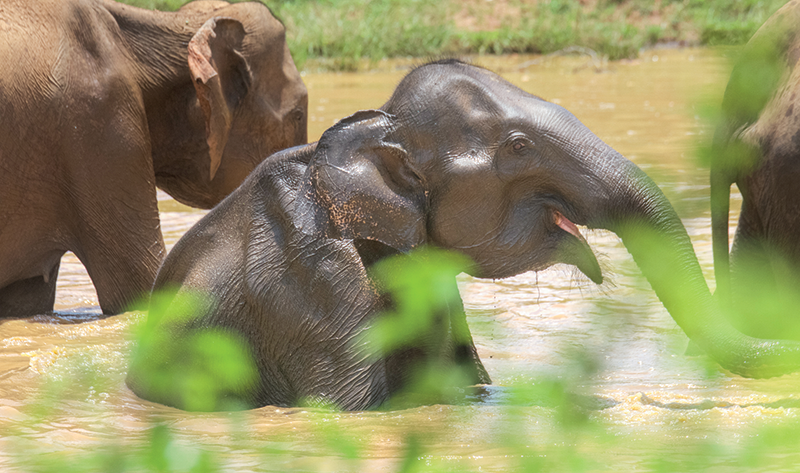
- A playful elephant splashing water and enjoying a peaceful bath with its family
For Hashan, wildlife photography offers far more than beautiful images.
“Wildlife gives me peace and happiness,” he said. “It reminds me that humans are also part of nature. Animals deserve freedom, respect and protection.”
His love for animals has even shaped his lifestyle choices.
“Because of my respect for wildlife, I avoid eating meat and fish,” he explained. “I want to live in a way that causes less harm to animals.”
Through every photograph, Hashan hopes to inspire others to appreciate Sri Lanka’s rich biodiversity and understand the importance of conservation.
“Wildlife is one of nature’s greatest treasures,” he said.
“Every animal plays an important role in maintaining the balance of nature. We must protect them and their habitats for future generations.”
His words carry the quiet conviction of someone who has spent long hours observing the rhythms of the wild — moments of struggle, affection, intelligence and harmony often unseen by the outside world.
As the golden light fades across Sri Lanka’s forests and grasslands, Hashan continues his search for nature’s untold stories, waiting patiently for another fleeting moment that reveals the extraordinary lives hidden within the wild.
“Nature still holds many beautiful stories waiting to be discovered,” he reflected. “Stories of survival, love, strength and harmony. Through my photographs, I hope people will understand why wildlife conservation matters so much.”
By Ifham Nizam
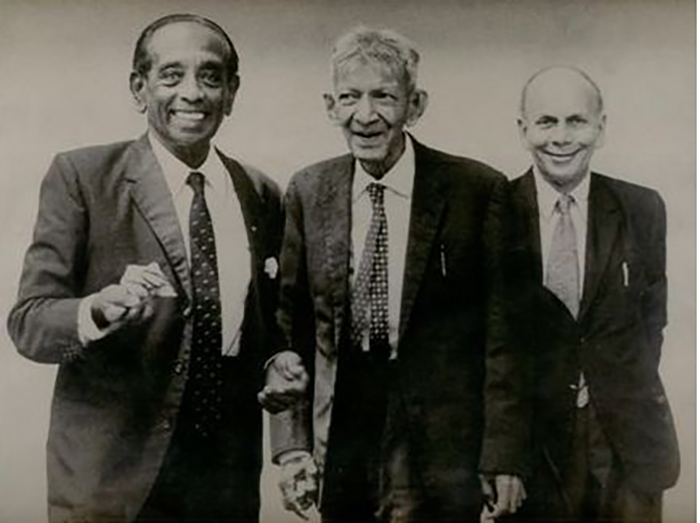
SJV Chelvanayakam, the founder leader of the Ilankai Thamil Arasu Kadchi, aka Ceylon Tamil Federal Party, passed away 49 years ago on 26 April 1977. There were events in Sri Lanka and other parts of the world where Tamils live, to commemorate his memory and his contributions to Tamil society and politics. His legacy is most remembered for his espousal of the cause of federalism and his commitment to pursuing it solely through non-violent politics. Chelvanayakam’s political life spanned a full 30 years from his first election as MP for Kankesanthurai in 1947 until his death in 1977.
Under the rubric of federalism, Chelvanayakam formulated what he called the four basic demands of the Tamil speaking people, a political appellation he coined to encompass – the Sri Lankan Tamils, Sri Lankan Muslims and the hill country Tamils (Malaiyaka Tamils). The four demands included the restoration of the citizenship rights of the hill country Tamils; cessation of state sponsored land colonisation in the North and East; parity of status for the Sinhala and Tamil languages; and a system of regional autonomy to devolve power to the northern and eastern provinces.
High-minded Politics
Although the four basic demands that Chelvanayakam articulated were not directly delivered upon during his lifetime, they became part of the country’s political discourse and dynamic to such an extent that they had to be dealt with, one way or another, even after his death. So, we can call these posthumous developments as Chelvanayakam’s vicarious legacies. There is more to his legacy. He belonged to a category of Sri Lankans, Sinhalese, Tamils and Muslims, who took to politics, public life, public service, and even private business with a measure of high-mindedness that was almost temperamental and not at all contrived. Chelvanayakam personified high-minded politics. But he was not the only one. There were quite a few others in the 20th century. There have not been many since.
Born on 31 March 1898, Chelvanayakam was 49 years old when he entered parliament. He was not an upstart school dropout dashing into politics or coming straight out of the university, or even a hereditary claimant, but a self-made man, an accomplished lawyer, a King’s Counsel, later Queen’s Counsel, and was widely regarded as one of the finest civil lawyers of his generation. He was a serious man who took to politics seriously. Howard Wriggins, in his classic 1960 book, “Ceylon: Dilemmas of a New Nation”, called Chelvanayakam “the earnest Christian lawyer.”
Chelvanayakam’s professional standing, calm demeanour, his personal qualities of sincerity and honesty, and his friendships with men of the calibre of Sir Edward Jayatilleke KC (Chief Justice, 1950-52), H.V. Perera QC, P. Navaratnarajah, QC, and K.C. Thangarajah, were integral to his politics. The four of them were also mutual friends of Prime Minister SWRD Bandaranaike and they played a part in the celebrated consociational achievement in 1957, called the B-C Pact.
Chelvanayakam effortlessly combined elite consociationalism with grass roots politics and mass movements. He led the Federal Party both as a democratic organization and an open movement. Chelvanayakam and the Federal Party used parliament as their forum to present their case, the courts to fight for their rights, and took to organizing non-violent protests, political pilgrimages and satyagraha campaigns. He was imprisoned in Batticaloa, detained in Panagoda, and was placed under house arrest several times. His Alfred House Gardens neighbours in Colombo used to wonder why the government and the police were after him, of all people, and why wouldn’t they do something about his four boisterous, but studious, sons!
He was a rare politician who filed his own election petition when he was defeated in the 1952 election, his first as the leader of the Federal Party, and was rewarded with punitive damages by an exacting judge. He had to borrow money from Sir Edward Jayatilleke to pay damages. The common practice for losing candidates was to file vexatious petitions in the name of one of their supporters with no asset to pay legal costs. Chelvanayakam was too much of a principled man for that. As a matter of a different principle, the two old Left parties never challenged election losses in court, but Dr. Colvin R de Silva singled out Chelvanayakam’s uniqueness for praise in parliament, in the course of a debate on amendments to the country’s election laws in 1968.
Disenfranchisement & Disintegration
Although he became an MP in 1947, Chelvanayakam had been associated with GG Ponnambalam and the Tamil Congress Party for a number of years. GG was the flamboyant frontliner, SJV the quiet mainstay behind. Tamil politics at that time was all about representation. In fact, all politics in Sri Lanka has been all about representation all the time. It started when British colonial rulers began nominating local (Sinhala, Tamil, Muslim) representatives to quasi legislative bodies, and it became a contentious political matter after the introduction of universal franchise in 1931.
Communal representation was conveniently made to look ugly by those who themselves were politically communal. Indeed, under colonial rule, if not later too, Sri Lankans were a schizophrenic society where most Sinhalese, Tamils and Muslims were socially friendly, but politically communal. The underlying premise to the fight over representation was that British colonialists were not leaving in a hurry and they were there to stay and rule for a long time. Hence the jostling for positions under a foreign master. It was in this context that Ponnambalam made his celebrated 50-50 pitch for balanced representation between the Sinhalese, on the one hand, and all the others – Tamils, Muslims, Indian Tamils – combined on the other. It was a perfectly rational proposition, but it was also perfectly poor politics.
But independence came far sooner than expected. The Soulbury Constitution was set up not for a continuing colonial state, but as the constitution for an independent new Ceylon. So, the argument for balanced representation became irrelevant in the new circumstances. The new Soulbury Constitution was enacted in 1945, general elections were held in 1947, a new parliament was elected, and Ceylon became independent in 1948. SJV Chelvanayakam was among the seven Tamil Congress MPs elected to the first parliament led by GG Ponnambalam.
The Tamil Congress campaigned in the 1947 election against accepting the Soulbury Constitution and for a vaguely formulated mandate “to cooperate with any progressive Sinhalese party which would grant the Tamil their due rights.” But what these rights are was not specified. In a Feb. 5, 1946 speech in Jaffna, Ponnambalam specifically proposed “responsive cooperation between the communities” – not parties – and advocated “a social welfare policy” to benefit not only the poor masses of Tamils but also the large masses of the Sinhalese.
So, when Ponnambalam and four of the seven Tamil Congress MPs decided to join the government of DS Senanayake with Ponnambalam accepting the portfolio of the Minister of Industries, Industrial Research and Fisheries, they were opposed by Chelvanayakam and two other Tamil Congress MPs. The immediate context for this split was the Citizenship question that arose soon after independence when DS Senanayake’s UNP government introduced the Ceylon Citizenship Bill in parliament. The purpose and effect of the bill was to deprive the estate Tamils of Indian origin (then numbering about 780,000) of their citizenship. Previously the government had got parliament to enact the Elections Act to stipulate that only citizens can vote in national elections. In one stroke, the whole working population of the plantations was disenfranchised.
GG Ponnambalam and all seven Tamil Congress MPs voted against the two bills. Joining them in opposition were the six MPs from the Ceylon Indian Congress representing the Malaiyaka Tamils and 18 Sinhalese MPs from the Left Parties. The Citizenship Bill was passed in Parliament on 20 August 1948. Ponnambalam called it a dark day for Ceylon and accused Senanayake of racism. But less than a month later, on September 3, 1948, he joined the Senanayake cabinet as a prominent minister and the government’s principal defender in parliamentary debates. Dr. NM Perera once called Ponnambalam “the devil’s advocate from Jaffna.”
Chelvanayakam remained in the opposition with two of his Congress colleagues. A little over an year later, on December 18, 1949, Chelvanayakam founded the Ilankai Tamil Arasu Kadchi, Federal Party in English. Not long after, joining Chelvanayakam in the opposition was SWRD Bandaranaike, who broke away from the UNP government over succession differences and went on to form another new political party, the Sri Lanka Freedom Party. As was his wont as a Marxist to see trends and patterns in politics, Hector Abhayavardhana saw the breakaways of Chelvanayakam and Bandaranaike, as well as the emergence of Thondaman as the leader of the disenfranchised hill country Tamils, as symptoms of a disintegrating society as it was transitioning from colonial rule to independence.
Abhayavardhana saw the Citizenship Act as the political trigger of this disintegration in the course of which “what was set up for the purpose of a future nation ended in caricature as a Sinhalese state.” Chelvanayakam may have agreed with this assessment even though he was located at the right end of the ideological continuum. “Ideologically, SJV is to the right of JR,” was part of political gossip in the old days. He saw “seeds of communism” in Philip Gunawardena’s Paddy Lands Act. For all their differences, Chelvanayakam and Ponnambalam were united in one respect – as unrepentant opponents of Marxism.
The Four Demands
Chelvanayakam had his work cut out as the leader of a new political party and pitting himself against a formidable political foe like Ponnambalam with all the ministerial resources at his disposal. Chelvanayakam may not have quite seen it that way. Rather, he saw his role as a matter of moral duty to fill the vacuum created by what he believed to be Ponnambalam’s betrayal, and to provide new leadership to a people who were at the crossroads of uncertainty after the unexpectedly early arrival of independence.
He set about his work by expanding his political constituency to include not only the island’s indigenous Tamils, but also the Muslims and the Tamil plantation workers from South India – as the island’s Tamil speaking people. It was he who vigorously introduced the disenfranchised Indian Tamils as hill country Tamils. In the aftermath of the Citizenship Act and disenfranchisement, restoring their citizenship rights became an obvious first demand for the new Party.
Having learnt the lesson from Ponnambalam’s failed 50-50 demand, Chelvanayakam territorialized the representation question by identifying the northern and eastern provinces as “traditional Tamil homelands,” and adding a measure regional autonomy to make up for the shortfall in representation at the national level in Colombo. To territorialization and autonomy, he added the cessation of state sponsored land colonization especially in the eastern province. Chelvanayakam and the Federal Party painstakingly explained that they were by no means opposed to Sinhalese voluntarily living in Tamil areas, either as a matter of choice, pursuing business or as government and private sector employees, but the nuancing was quite easily lost in the political shouting match.
The fourth demand, after citizenship, regional autonomy, and land, was about language. Language was not an issue when Chelvanayakam started the Federal Party. But he pessimistically predicted that sooner or later the then prevailing consensus, based on a State Council resolution, over equality between the two languages would be broken. He was proved right, sooner than later, and language became the explosive question in the 1956 election. As it turned out, the UNP government was thrown out, SWRD Bandaranaike led a coalition of parties to victory and government in the south, while SJV Chelvanayakam won a majority of the seats in the North and East, including two Muslims from Kalmunai and Pottuvil.
After the passage of the Sinhala Only Act on June 5, 1956, the Federal Party launched a political pilgrimage and mobilized a convention that was held in Trincomalee in the month of August. The four basic demands were concretized at the convention, viz., citizenship restoration for the hill country Tamils, parity of status for the Sinhala and Tamil languages, the cessation of state sponsored land colonization, and a system of regional autonomy in the Northern and Eastern Provinces.
The four demands became the basis for the Bandaranaike-Chelvanayakam agreement – the B-C Pact of 1957, and again the agreement between SJV Chelvanayakam and Dudley Senanayake in 1965. The former was abrogated by Prime Minister Bandaranaike under political duress but was not abandoned by him. The latter has been implemented in fits and starts.
The two agreements which should have been constitutionally enshrined, were severely ignored in the making of the 1972 Constitution and the 1978 Constitution – with the latter learning nothing and forgetting everything that its predecessor had inadvertently precipitated. The political precipitation was the rise of Tamil separatism and its companion, Tamil political violence. Ironically, Tamil separatism and violence created the incentive to resolve what Chelvanayakam had formulated and non-violently pursued as the four basic demands of the Tamils.
After his death in 1977, the citizenship question has finally been resolved. The 13th Amendment to the 1978 Constitution that was enacted in 1987 resolved the language question both in law and to an appreciable measure in practice. The same amendment also brought about the system of provincial councils, substantially fulfilling the regional autonomy demand of SJV Chelvanayakam. The land question, however, has taken a different turn with state sponsored land colonisation in the east giving way to government security forces sequestering private residential properties of Tamil families in the north, especially in the Jaffna Peninsula.
Further, the future of the Provincial Council system has become uncertain with the extended postponement of provincial elections by four Presidents and their governments, including the current incumbents. The provinces are now being administered by the President through handpicked governors without the elected provincial councils as mandated by the constitution. Imagine a Sri Lanka where there is only an Executive President and no parliament – not even a nameboard one. “What horror!”, you would say. But that is the microcosmic reality today in the country’s nine provinces.
by Rajan Philips

Thailand’s divisive ex-PM is out of jail, but is the Thaksin era over?

Andy Flower fined for ‘use of an audible obscenity’ during Mumbai Indians clash

Royal Challengers Bengaluru eliminate Mumbai Indians and go top after tense finish

Car bomb attack and ambush in northwest Pakistan kill at least 21 police

Overton, Urvil power Chennai Super Kings to fifth spot with third straight win

Showers about 100 mm are likely at some places in the Western, Sabaragamuwa, Central, Uva, Southern, North-western, Northern and North-central provinces and in Trincomalee district.

‘Dates have the highest sugar content to fight Coronavirus’

Sunday Island 27 December – Headlines

#SundayIsland 17th December – Headlines

Sunday Island – 28th March

Sunday Island Headlines – 21 March

Sunday Island – 21st February – Headlines
-

 News4 days ago
MIT expert warns of catastrophic consequences of USD 2.5 mn Treasury heist
-
 News6 days ago
CJ urged to inquire into AKD’s remarks on May 25 court verdict
-

 News1 day ago
Lanka Port City officials to meet investors in Dubai
-

 Editorial4 days ago
Clean Sri Lanka and dirty politics
-
 Opinion6 days ago
Security, perception, and trust: Sri Lanka’s delicate balancing act
-
 News2 days ago
SLPP expresses concern over death of former SriLankan CEO
-

 Editorial3 days ago
The Vijay factor
-

 News5 days ago
Development Officer bids Rs. 48 mn for CPC’s V8 at auction