
Opinion
Winning support from international community


by Jehan Perera
President Anura Kumara Dissanayake is scheduled to make his first international visit to India this week. This is expected to be followed by a visit to China in close order. The president, and the country itself, is walking a tightrope between these two Asian giants, one which is the world’s second largest economy and other its fifth largest. Both of them see the island of Sri Lanka as a strategic location for their geopolitical aims. In the case of India, the stakes are particularly high as it does not wish China to pose a military challenge to it in the south when it is a belligerent power in the north where the two countries have gone to war over territory each claims for itself.
The manner in which the government is seeking to project the two visits that the president is to make is to call them economic investment-related visits. Indeed, both countries hold keys to Sri Lanka’s future prosperity. If they invest in productive enterprises, they will enable Sri Lanka to provide jobs to its people and perhaps keep them at home instead of migrating in droves to foreign countries for employment. Increased economic production as a result of foreign investment can also reduce the heavy burden of foreign loan repayments that impoverish the people. Loans that are used in corrupt ways are no substitute for foreign investment in economic enterprises.
So far Sri Lanka has been walking the tightrope between giving preference to the countries that have sustained the economy after the economic bankruptcy. The role that India played in giving emergency assistance during the height of the crisis in 2021 cannot be forgotten. Thereafter Sri Lanka has accepted the IMF loans and the new government continues to abide by its terms. In the past, the JVP leadership opposed deals with the IMF or compromise with the UN on issues it saw as being in the realm of protecting the country’s sovereignty. The most positive feature of the NPP government is its rationality in doing what is necessary to protect the country’s interests even if it is not in alignment with positions taken by its own leadership in the past. This can be seen in relation to the IMF agreement, the approach to the UN Human Rights Commission and on inter-ethnic peacebuilding.
ANTI-CORRUPTION DRIVE
The visit of US Assistant Secretary of State for South and Central Asian Affairs, Donald Lu went smoothly with the president’s media division describing the outcome as being one in which the US envoy pledged “Unwavering Support for Sri Lanka’s Anti-Corruption Drive.” It also reported that the US is prepared to provide financial and technical assistance to strengthen Sri Lanka’s security and economy. Assistant Secretary Lu had also emphasized the US government’s willingness to offer technical expertise to help recover funds that were illegally taken out of the country, as part of Sri Lanka’s anti-corruption programme. The government’s positive understanding of the meeting was also that “The discussion highlighted the US government’s appreciation for the new administration’s prioritization of key political, economic, and social challenges.”
The driving force behind the Aragalaya people’s movement that drove the then government out of power despite its nearly two-thirds majority in parliament was the belief that corruption at the highest levels of that government was responsible for the economic debacle the country faced in 2021. There is a consensus in the country that crosses all its main divides, ethnic, religious and class, that corruption in high places is an evil that needs to be dealt with. The failure of previous governments to deal with this problem, notwithstanding their promises to do so, was the lack of internal political will. The unfortunate reality was that those at the helm of government were themselves complicit in the corruption they pledged to bring to an end.
The unique feature of the NPP government is that its leading members are not known to be complicit in corruption due to their ideological convictions and modest lifestyles. They have also not held positions of power to be tested nor do they appear to have personal relationships with those believed to be corrupt. The government’s commitment to ensuring that there will be no corruption and the general population’s alignment with that commitment provides the country with the opportunity to accept the US offer to help it tackle the problem of corruption. The modern digital economy that the government is emphasizing offers the best possibility of containing such corruption by the publication of all large calls for proposals or calls for tenders on a public website. Civil society think tank, Verite Research is currently completing a study on detecting corruption in procurement practices. The worst forms of corruption that cost, and continue to cost, the country billions have come as a result of corrupt contracts, unsolicited project proposals, where there is no competitive bidding and where there is no visibility.
CONSENSUS BUILDING
The main constraint to the government’s success at the present time is the lack of economic resources due to the profligacy and corruption of the past. It is difficult to understand the rationale why the previous government under President Gotabaya Rajapaksa thought it fit to reject the USD 450 milllion grant that the US was willing to provide to improve the country’s road and transport system under the Millennium Challenge Corporation (MCC) and the USD 1.2 billion long term low interest loan that Japan offered to set up a light rail transport system. At the present time these appear to be lost opportunities, though the new government needs to keep trying in the hope that fortune can smile a second time. Sri Lanka’s location in the Indian Ocean and its importance to the sea lanes is an asset that needs to yield positive returns to the country.
During his visit, Assistant Secretary Lu offered a different financial assistance programme in the form of anti-corruption systems that could, potentially, bring in millions of revenue that are currently lost to the government. Enhanced revenue flows from taxes and customs revenues that are properly collected could lead to a corresponding reduction of the tax burden placed on the masses of people through unjust taxes such as the VAT which falls especially hard on the poorest sections of society, although they are the easiest taxes to collect. There will be massive cost savings and revenue generation if contracts are awarded in term of economic merit and not done in a corrupt manner. Anti-corruption measures that the international community can support Sri Lanka with could be quickly put in place as there will be no resistance to them from the general population, although there will surely be vested interests which will resist such anti-corruption measures.
The government will, however, be less willing to accept the offer of international assistance when it comes to issues on which the population is divided and not of one mind. The government faces challenges in navigating divisive issues like national security and ethnic conflict as seen recently on the Heroes Day celebrations. While international assistance in areas like corruption finds public backing, issues like replacing laws such as the Prevention of Terrorism Act (PTA) and the Online Safety Act (OSA) which empowers it to take action in the name of national security or addressing ethnic power-sharing require careful consensus-building. Policies that risk further polarizing communities could undermine stability. This is where special emphasis needs to be placed on peacebuilding and social cohesion building which requires dialogue both within and outside the country in forums such as the UN Human Rights Council.


The President has taken the bold decision to get rid of the office bearers of Sri Lanka Cricket (SLC) and appoint an interim committee till such time suitable persons are elected to run the SLC. All Sri Lankan cricket lovers will applaud and endorse President Anura Kumara Dissanayake’s action as the SLC was one of the most corrupt sports organizations in Sri Lanka for a long time.
The office bearers had organized it in such a manner that no other persons could get elected to this den of thieves. They increased the number of clubs as members to collect their votes. Large amounts of funds were doled out to the clubs to which the office bearers belonged.
All cricket lovers would remember how when a previous Minister holding the Cabinet portfolio pertaining to sports tried to get rid of the corrupt officials which the then Parliament endorsed unanimously and how they manipulated to remain in power and get the President at that time to get rid of the Minister instead of the corrupt officials of the SLC.
They were able to get round the ICC too to get what they wanted. The Minister who was appointed in place of the ousted Minister fell into the pockets of the SLC officials and they continued happily thereafter. The Minister was happy and the corrupt officials were happy!
It is not only the elected officials who have to be removed. There are executive employees and other permanent employees who have to be relieved of their duties as otherwise they could get round the incoming officials, and the activities of the bandwagon could go on.
We would appreciate if the President and the Minister in charge would go the whole hog and relieve the SLC of all corrupt personnel so that Sri Lanka’s cricket could get back to its halcyon days again.
HM NISSANKA WARAKAULLE

Malimawa government and Yahapalanaya are dissimilar in many respects, the most important being whilst Yahapalanaya had to manage with a balancing act in the parliament, Malimawa has the luxury of a massive parliamentary majority. However, they share one thing in common; the main plank for the election of both presidents Dissanayake and Sirisena was their solemn pledge for the eradication of corruption. It looks as if both have failed miserably, on that count!
It did not take very long for Yahapalanaya’s first act of corruption; the bond scam. COPE, headed by the veteran politician D E W Gunasekara, picked on this but to prevent the presentation of the report, Sirisena dissolved the parliament which was done at the request of the Prime Minister Ranil, to whom Sirisena was obliged for the unexpected bonanza of becoming president. This enabled the second bond scam to take place, also masterminded by Ranil’s friend Mahendran, imported from Singapore!
Malimawa convinced the voters that they are the only group that could get rid of the 76-year curse of corruption and made a multitude of promises, most of which are already broken! What is inexcusable is that, in a short space of time, they seem to have become as corrupt as any previous government and they seem to excel their predecessors in doling out excuses. Of course, they have a band of devoted social media influencers who are very adept at throwing mud at their opponents which they hope would help to cover up their sins. How long this strategy is going to work is anybody’s guess!
Some of these issues were addressed in an article, “Squeaky clean image of JVP in tatters” by Shamindra Ferdinando (The Island, 22 April). I hasten to add that, though some of his supporters are still trying to paint an honest image of AKD, he should be held responsible for many of these misdeeds and irresponsible acts.
One of the first acts of the newly elected president AKD was to appoint two retired police officers, who openly worked for the NPP through the Retired Police Collective, to top posts; Ravi Seneviratne as Secretary to the Ministry of Public Security and Shani Abeysekara as the Director of CID. Both of them held top jobs in the CID when the Easter Sunday attack took place and were blamed, by some, that they too failed to prevent this horrendous act of terrorism. In addition, there was a case against Seneviratne for causing accidents whilst under the influence and Abeysekara was exposed as a ’fixer’ by the infamous Ranjan Ramanayaka tapes. No one would have objected had they been appointed after their names were cleared but AKD’s rash decision to appoint them, disregarding all norms, clearly showed what his long-term strategy was. Was this not political corruption?
Now these two tainted officers are heading the search for the mastermind of the Easter Sunday attacks! Are they being used to divert attention away from Ibrahim’s family that was supposed to have funded the project? After all, Mohamed Ibrahim, the father, was on the national list of the JVP, and the two sons were the leading suicide bombers. It is a matter of great surprise that the Catholic church led by Cardinal Ranjith is not demanding the removal of these two officers from the investigation, who obviously have a conflict of interest. It becomes even more surprising when the demand is made for the Deputy Minister of Defence Aruna Jayasekara to resign, for the same reason; as well stated in the editorial, “Of masterminds” (The Island, 21 April).
The first act of the new parliament was to elect ‘Dr’ Ranwala as the speaker and pretty soon his doctorate was challenged. He stepped down to look for the certificate, which he is still looking for! Though some of the ministers too have admitted that Ranwala may not have a PhD, AKD seems silent. When Ranwala was involved in an RTA, police had run out of breathalyser tubes and blood was taken after a safe period had elapsed. Why has AKD no guts to sack him?
Episode of the release of 323 containers, without the mandatory inspections, seems to be receding to the past and the long-awaited report may be gathering dust in the president’s office! It is very likely due to political intervention and we probably will never know who benefitted.
A minister, who claimed that he is living on his wife’s salary and on the generosity of the party faithfuls, seems to have been able to build a three-storey house in a suburb of Colombo. He claims that when he made that statement, his father was alive but has since died and he has inherited everything as he is the only son! What a shame that Marxists do not believe in sharing the family wealth with sisters? Though the opposite may be true, his explanation that he was able to build a house in Colombo by selling the land in Anuradhapura rings hollow!
The worst of all was the coal scam which would have long lasting consequences on our economy. I do not have to go into details as much has been written about this but wish to point out AKD’s role. In spite of ex-minister Kumara Jayakody being indicted by CIABOC, AKD continued to give unstinted support till it became pretty obvious that he had to go. In fact, he is being charged with an offence which was committed whilst he was serving the Ceylon Fertilizer Company which was under the purview of, guess who? AKD when he was the Minister of Agriculture.
Devastating report from the Auditor General,before Jayakody’s resignation, would not have happened if AKD had his way. He attempted a number of times to get one of his henchmen appointed to this coveted post, overlooking those experienced officers in the department. AKD’s political machinations were thwarted thanks to the integrity of some members of the Constitution Council. If not for them, AKD’s nominee would have been in post and, perhaps, his friend Jayakody would still be the minister.
Malimawa seems to have beaten Yahapalanaya rather than being the second!
By Dr Upul Wijayawardhana
Doctor Upul Wijayawardhana (eminent physician), posed a riddle for us. He wrote about that island Sri Lanka as ‘ this little dot in the ocean’ when deriding the remark of President Dissanayake who had said that Sri Lanka was a hunduva , a term that indicated a small volume: me hunduve inna puluvan da? (Can you live in this restricted space?) Most sensible people, even uneducated, judge that the volume of a little drop (of whatever) is smaller than that of a hunduva; so is weight. When the learned doctor emphatically maintains ‘….we are not a hunduva’ but ‘… a little dot in the ocean…’, is the pot calling the kettle black or worse?
Physically and population wise, Sri Lanka is neither ‘a little dot’ nor ‘a hunduva. This is all in the rich imaginations of Dissanayake and Wijayawardhana. I once counted that there were more than 50 members of the UN who were smaller than Sri Lanka in physical and population size. England was a sizeable island with a small population in the northwest corner of Europe in late 18th century when it began to become what China, with 1.3 billion people and jutting out to the Pacific, is now. From about 1850, when the population of Great Britain was about 20 million, less than that of Sri Lanka in 2026, it ruled more than half the world. Besides, do not forget Vanuatu, Kiribati, Cook Islands, Antigua and Barbuda, Barbados, Lesotho and New Zealand (who habitually beats us at cricket). New Zealand with 5 million population played against 1.5 billion population India (1:300) for the T20 cricket championship a few weeks ago. I quietly wished New Zealand would win; so much for crap about dots in the Indian Ocean or the south Pacific.
Dr. Wijayawardhana also wrote about history and about ‘The achievements of Hunduwa’. The massive reservoirs and extensive irrigation systems in rajarata and ruhuna as well as the stupa are indeed tremendous works of irrigation and bear witness to superior ingenuity and organising ability, for the time they were built. They compare very well among structures elsewhere in the ancient world. Terms like ‘granary of the East’ must be taken with more than a grain of salt. Facile use of such terms does not take account of whatever shreds of evidence there is of adversity in those times. Monsoon Asia over the ages has more or less regularly suffered from floods, droughts and consequent famines. The last dire famine was in Bengal in 1944. The irrigation works in Lanka were a magnificent response to those phenomena. The modern response has been scientific agriculture making India a major grain exporter, from near famine conditions in 1973-74. Recall Indira Gandhi’s garibi hatao (eliminate poverty) speech to the General Assembly of the UN, that year.
The bhikkhu who wrote down the tripitaka in aluvihara did so because there was the threat of a severe famine in the course of which learned bhikkhu might have come to harm. Buddhist thought over centuries had been passed from generation to generation vocally (saamici patipanno bhagavato savaka (listener) sangho) and the departure from that tradition must have required a major threat of famine. There are stories of bhikkhu from Lanka fleeing from dire straits. In the same vein, while the mahavamsa speaks of kings and their valiant deeds, there is little account of the large mass of little people who lived then. Sensible teaching of the history of a people must include the history of as much of the people as possible and some idea of the history of other peoples in comparable times to avoid feeling dangerously smug and arrogant, which we have seen many times over.
Usvatte-aratchi

Showers expected in the Western, Sabaragamuwa and North-western provinces and in Galle, Matara, Kandy and Nuwara-Eliya districts after 2.00 pm.

Heat Index at Caution Level in the Northern, North-central, North-western, Western, Sabaragamuwa, Southern, and Eastern provinces and in Monaragala district during the day time

Sagarika derailment disrupts coastal rail line; services to resume in two days

PHIs launch Vesak ‘Dansal’ safety registration drive

Measles resurfaces, health officials sound alarm

Hackers steal $3.2 Mn from Finance Ministry

‘Dates have the highest sugar content to fight Coronavirus’

Sunday Island 27 December – Headlines

#SundayIsland 17th December – Headlines

Sunday Island – 28th March

Sunday Island Headlines – 21 March

Sunday Island – 21st February – Headlines
-
 News5 days ago
Rs 13 bn NDB fraud: Int’l forensic audit ordered
-

 Opinion6 days ago
Shutting roof top solar panels – a crime
-

 News3 days ago
Lanka faces crisis of conscience over fate of animals: Call for compassion, law reform, and ethical responsibility
-

 News2 days ago
No cyber hack: Fintech expert exposes shocking legacy flaws that led to $2.5 million theft
-
 News2 days ago
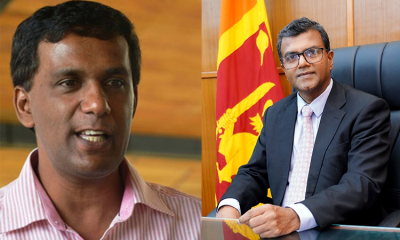
Whistleblowers ask Treasury Chief to resign over theft of USD 2.5 mn
-
 News6 days ago
Church calls for Deputy Defence Minister’s removal, establishment of Independent Prosecutor’s Office
-

 News3 days ago
USD 2 mn bribe: CID ordered to arrest Shasheendra R, warrant issued against ex-SriLankan CEO’s wife
-

 Features6 days ago
The Digital Pulse: How AI is redefining health care in Sri Lanka?