
Features
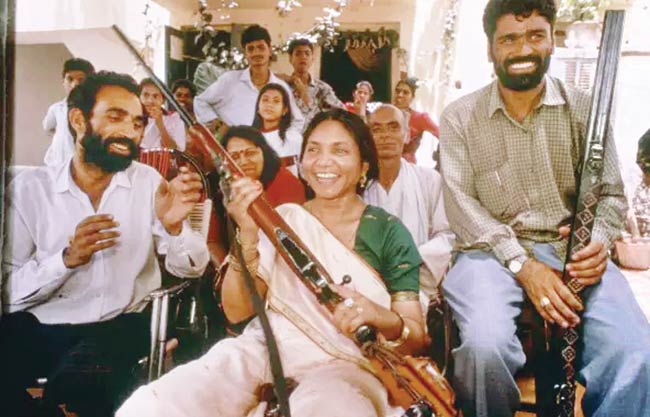
Queens and Bandits in Rajasthan, India

by Jayantha Perera
The Delhi Office of the World Bank offered me several consultancies in the late 1990s. As a consultant anthropologist, I assisted the State Government of Uttar Pradesh to develop a detailed Action Plan for water-user associations. Then I worked on several short-term assignments in Andra Pradesh and moved to the State of Rajasthan to work on irrigation development.
Rajasthan is one of the most fascinating states in India because of its long history, culture, and diversity. I travelled all over Rajasthan, studying ancient and modern irrigation systems. I formulated an Action Plan for water-user associations and participatory rehabilitation of irrigation systems under the Rajasthan Water Resources Consolidation Project.
Once, I travelled by ‘Frontier Mail’ train to the Jambal Valley in Rajasthan from New Delhi. The British introduced ‘Frontier Mail’ from Peshawar to Bombay. After Independence, the train goes from New Delhi to Bombay. I was in a first-class berth and shared it with an old gentleman. He wore chappals and a pair of blue trousers and a white, short-sleeved shirt. He brought a small suitcase, a tiffin box (food carrier) and several water bottles.
When the train started the journey to Bombay, my berth partner smiled and took his suitcase from under the seat. He asked me if it was OK if he made his bed for the journey. When I nodded, he took a flat pillow, a thin bedsheet, a pair of dhotis (loose trousers), and a loose-fitting salwar kameez from the suitcase. He spread the bed sheet over the seat and checked his tiffin box and hung a plastic water bottle on one of the hooks above his bed/seat. He was well prepared to travel in comfort and in good spirits. He smiled and told me his journey to Bombay would take two nights and three days.
My first impression of him was that he was a Christian priest. I asked him:
“Are you a priest?”
He smiled and said, “My brother is a priest. I was an aviator.”
“Does that mean a pilot?”
“Yes, but a fighter plane pilot that belonged to the Indian Navy,” he explained.
“Why do you travel by train? You could have flown to Bombay from Delhi in two hours. As an ex-aviator, I am sure, you could get concessionry air tickets,” I showed my surprise.
“True. But I like the train journey, especially during the monsoon season,” he answered.
“Why?” I asked.
“You cannot be too sure with Air India or Indian Airlines during the monsoons. During heavy rainy seasons, it is safer to travel by train than by plane. I was an aviator; therefore, I know,” he patiently enlightened me.
I thanked him for the piece of information. He wanted to know where I was going. I told him I was going to the Jambal Valley to do research. He thought for a minute or two and asked me,
“Do you know that the Jambal Valley in Rajasthan is home to many bandits?”
I said, “Yes.”
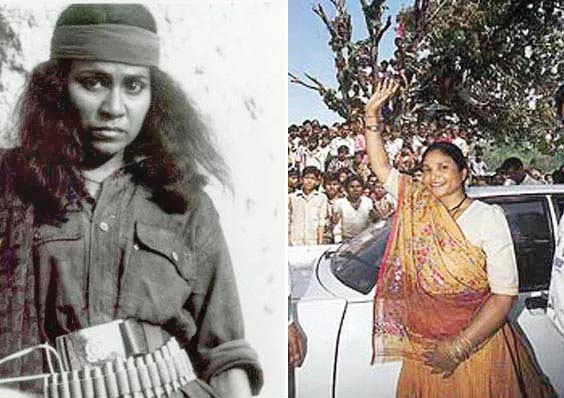
“It is known for harbouring violent gangs of criminals who find shelter in its many hidden ravines. Have you heard about Phoolan Devi, the notorious woman bandit known as the Queen of Bandits”, He inquired. I told him I had read about her and had seen a documentary film about the atrocities she had committed.
 He then advised me, “Be careful while in Jambal area. It is still notorious for dacoits and bandits. The risk is they are one day in remote villages and another in a city centre. You should be careful when you travel with others to remote places because sometimes bandits or informants are looking for information on potential victims.” This cautionary advice from a fellow traveller and former aviator added a layer of complexity to my journey, reminding me of the cultural and historical context of the region.
He opened his tiffin box and took two idlis (savoury rice cakes) and a portion of sambar (thick savoury curry) from his tiffin box and used its lid as his plate. He took about half an hour to eat his breakfast. He drank coffee from his flask. I ordered breakfast from the train cafeteria when a railway employee visited our berth to inquire about breakfast, which was part of the travel package. A few minutes later, a waiter in a white uniform served my breakfast on a tray with two fried eggs, mashed potatoes, jam, butter, and fresh bread with hot coffee and a jug of warm milk. I offered the aviator food from my tray, but he politely refused.
After breakfast, the aviator took a thin pillow from his suitcase. He adjusted the pillow on the seat and lay down for a long nap. He got up about three hours later, immediately ate the remaining food in the tiffin box and drank coffee from the flask. Then he was in a mood to talk to me. He asked me whether I had travelled in North India, especially in Rajasthan. I told him I had spent five years in Sindh, which is across the northern border of Rajasthan.
He hesitantly told me that he was a member of a squadron that bombed lower Sindh during the 1965 Indo-Pakistan war. He shared his experiences and the challenges they faced during the war. I told him my Sindhi friends had talked about the bombing of the Kotri Barrage (dam) on the Indus River and how the pilots missed it by several hundred yards. The Aviator smiled and said, “We did not want to destroy a key barrage.
Booking my lunch on the train was a complicated process, but it gave a unique perspective on travel in India. A railway inspector respectfully asked me what I would like for lunch. Then his assistant read the menu. I selected a non-veg meal of rice with mutton curry. Curious, I asked the inspector how he would get lunch for me and others on the train. He said he would telex the lunch order from the next major railway station to the railway food contractor, asking him to deliver the food for pick up to another railway station and giving the train’s arrival time. He laughed and said, “If you order ice cream, you have to be careful because if the train arrives late, the ice cream will melt, but you still pay for it!” I told him I would order mishti doi (fermented sweetened milk) in a clay cup, a local delicacy that I was eager to try.
The food tray ordered arrived on schedule. A uniformed waiter brought a small teapoy (table) to the berth and covered it with a clean white cloth. Then he set my lunch on it. Each item was wrapped separately in aluminium foil. Mutton and lentils were in small plastic pouches. Hot chapatis supplemented with fragrantly cooked rice. He brought two water bottles and a coffee flask with a ceramic cup and a saucer. He promised to collect the tray after an hour.
Around 3 pm, the train stopped at a small railway station. I heard a great commotion from the platform. A large crowd was shouting various slogans behind a young man wearing jeans and a T-shirt. He approached my berth and asked whether he could occupy the upper bed briefly. The aviator was in a deep sleep. I welcomed the young man. After completing his MBA, he was in his early thirties and returning from the University of Columbia, USA.
He would visit his great-grandmother – the queen of the old Kingdom of Jodhpur. He told me a large portion of the palace had been converted to luxury hotels. His great-grandmother lived in the main palace. I showed him my hotel booking particulars, and he confirmed that I would stay at that palace hotel. He laughed and told me we should meet in the garden in the evening for a drink.
When the train arrived at the railway station, about 200 men were waiting to receive him on the railway platform. The mob ran into the berth, literally grabbed him and his suitcase, and carried him, chanting slogans. I, too, got off the train and followed the crowd.
My room at the hotel was spooky and musty. The bed was 100 years old and surrounded by old and weathered furniture. The old mosquito net kept a battalion of mosquitos at bay. There were no other guests that night at the hotel, and the hotel cook prepared a special meal for me. After dinner at the large dining hall, I returned to my bedroom past the stuffed heads of lions, tigers, and elephants mounted on narrow corridor walls.
In the morning, I woke to the noise of hundreds of peacocks. They cried in shrilled voices. After breakfast, I hired a hotel car and travelled to the office of the Chief Engineer of the Irrigation Department. He was a thin man with large blue spectacles. His shirt looked three or four sizes bigger than what he should wear. I wondered how he held his trousers on such a thin frame without suspenders.
He greeted me and sat behind a large table covered with a thick glass plate. He smiled and directed me to sit down. He went through a file and told me that he understood my role would be to assist him in irrigation matters. I gave him a copy of my terms of reference (TOR), which he ignored. He said he was happy to share his knowledge and experience with me. I appreciated his kindness but pointed out that my understanding differed from his understanding of my TOR. According to the TOR, my role was to help him identify and resolve social issues in irrigation management. I just listened to him because he was pleasant, and I believed in what he said. He worried about my food and security and offered me his car so I could go to the city whenever I wanted.
A few days later, I told him I wanted to see irrigation projects and listen to grievances farmers had with local irrigation officers. He dismissed the idea. He gave me the impression that he could not believe I should talk to engineers and farmers without his permission and presence. He told me sternly, “If you want to learn, you have to follow my advice and timetable.” I told him the World Bank appointed me to advise him and the other staff on irrigation water management. He showed his sadness by sulking for about five minutes. Then he asked me:
“How old are you?”
“Forty-six,” I answered.
“Where did you study?”
“Sussex University in the UK, where I got my MA and PhD”
“What did you study?”
“Anthropology and Development”
“Why are you here, then?”
“Because the World Bank recruited me to work with you and your staff on irrigation water management.”
“But you are not an engineer. Do you know anything about engineering?”
“I am not an engineer, so I want to work with you on irrigation matters.”
“Then you should not work with me. I will provide a junior engineer who can go with you to the field.”
He phoned someone at the Ministry of Irrigation. After the telephone call, he told me he had misunderstood my status and role. Yes, he would like to work with me. He ordered his peon to arrange a workstation for me in his large office room. He said that he would bring lunch for me from home. I treated him as my senior and showed respect in my speech.
The chief engineer helped me to plan an irrigation strategy for Rajasthan. I learned a lot from him and from visits to very remote places where law and order were at risk. At one village, he told me that the people were so isolated and impoverished that they might not know that the British had left India 50 years ago! Arguably, the 14 days I spent with him were one of the happiest times in my career. I learned so much from him and was impressed with his patience, new ideas, and compassion for the farmers. Before I left, he took me to a famous saree shop where he told me to buy at least ten Kota cotton sarees, which were world-famous. At the end of my stay, he jokingly told me that he initially thought I was an Indian boy from Goa who did not speak Hindi.


by Jehan Perera
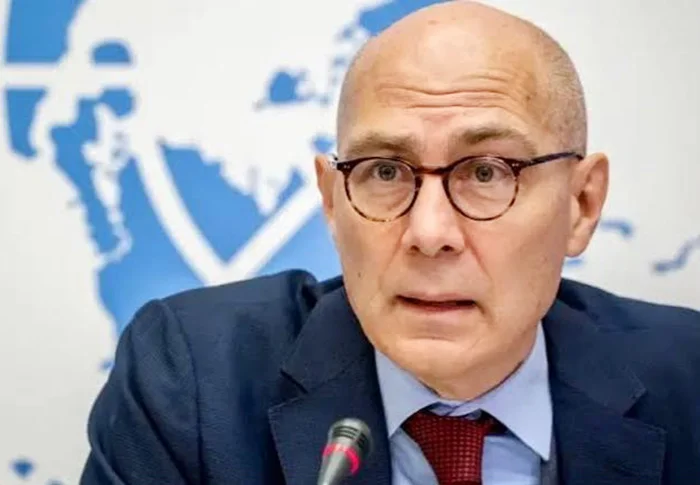
The ongoing 63rd session of the United Nations Human Rights Council, which runs from September 7 to October 7, 2026, in Geneva is important to Sri Lanka. Its outcome will send a signal to other international actors, including the European Union, as to whether Sri Lanka’s reform policy is on track. The written update on Sri Lanka, prepared by the Office of the United Nations High Commissioner for Human Rights under High Commissioner Volker Türk and presented by Deputy High Commissioner Nada Al-Nashif, has taken a more holistic approach to the government’s performance over the past year. It acknowledged the progress Sri Lanka has made under the NPP government in relation to accountability for financial fraud and other economic crimes. At the same time, the High Commissioner’s update made clear that progress in relation to economic crime cannot be equated with progress in relation to accountability for grave human rights violations committed during the armed conflict and in other periods of political violence.
The government may have felt sufficiently confident that its response to the High Commissioner’s update could be handled by its representative in Geneva and did not require the attendance of Foreign Minister Vijitha Herath. Sri Lanka’s representative Sumith Dassanayake called for a fundamental review of country-specific mandates within the UN Human Rights Council. Sri Lanka has been facing repeated scrutiny in the form of successive UNHRC resolutions from 2012 onwards. Ambassador Dassanayake argued that such mandates should not continue indefinitely and must be regularly assessed against measurable objectives and tangible outcomes. This may reflect confidence that its record of reform is beginning to receive recognition internationally. The reports and statements at the Human Rights Council acknowledged progress in the government’s efforts to address corruption and economic crime.
The government’s anti-corruption drive has included investigations into allegations involving individuals who held the highest political offices in the country. The arrest of former President Ranil Wickremesinghe in connection with alleged misuse of public funds, and the investigation into the controversial SriLankan Airlines Airbus transaction involving former President Mahinda Rajapaksa’s son, are examples of the reach of these investigations. The arrest of SLPP National Organiser and Member of Parliament Namal Rajapaksa in connection with allegations relating to the Airbus purchase scandal has also demonstrated that the government is willing to pursue cases involving politically powerful figures.
Wide Range
The ongoing investigations appear to encompass a wide range of parliamentarians and government members, both past and present. They suggest that accountability for corruption is not being confined to lower-level officials or to individuals who lack political influence. This is precisely the kind of accountability that the public has long demanded and that previous governments have too often failed to deliver. The government is also reaching into the upper levels of the military hierarchies of the past. The case in which 11 young men, most of them Tamil, disappeared after being abducted in Colombo between 2008 and 2009 involved allegations that some families were asked to pay ransoms. The investigation into this case has reached senior military figures. The willingness to pursue such cases is important because it challenges the assumption that those who exercised power during the war are beyond the reach of the law. Such cases would provide a practical test of whether the government’s commitment to accountability for economic crimes is part of a broader commitment to the rule of law.
Success in prosecuting corruption cannot substitute for justice for those who were unlawfully killed, disappeared, tortured or otherwise victimised. The UN report noted that there had been no recognition or accountability for crimes under international law, gross human rights violations and serious violations of international humanitarian law committed by all parties during the war. The government has yet to establish a credible and effective process to address the many cases of enforced disappearance, extrajudicial killing, torture and other serious violations. The government needs to take the international commitments it has inherited on human rights issues seriously. It needs to adopt a multi-pronged approach and go beyond focusing primarily on financial and corruption-related accountability.
Need Action
As a member of the international community, Sri Lanka has a responsibility to abide by the commitments it has made. It cannot selectively uphold international obligations postponing those that are politically difficult. Also, as a small country, Sri Lanka has a self-interest in ensuring the survival of international law, which is all that it has to protect it from the depredations of the bigger international actors. The erosion of international law by powerful states makes it all the more important that smaller states uphold the principles on which the international system is based. Sri Lanka cannot credibly appeal to international law when it is threatened from outside while disregarding its own obligations within. Sri Lanka also needs to win the confidence of its own population that it is committed to justice and equality for all. Public opinion polls and community-level research have disclosed that ethnic and religious minorities are appreciative of the sense of greater security they enjoy under the present government from ethnic or religious extremists.
But a sense of security is not the same as the fulfilment of rights. As far as the Tamil people are concerned, the government has yet to deliver on several of its specific promises. These include the long-standing problems of missing persons, the release of political prisoners who have been members of Tamil militant organisations, and the return of land taken over for military purposes during the war. The issue of Buddhist statues and archaeological sites found on their properties which are then taken from their control continue to trouble them especially as they see no signs of resolution of those disputes. The issue of pastureland in the east of the country in Mylathamadu is particularly concerning to them as they see orders by successive presidents, both President Ranil Wickremesinghe and President Anura Kumara Dissanayake, being disregarded on the ground. The Mylathamadu pastureland dispute is where traditional Tamil dairy farmers have engaged in multi-year protests against the ongoing encroachment of their ancestral grazing lands by Sinhalese crop cultivators relocated under government development schemes.
The government’s failure to hold Provincial Council elections is particularly troubling. The provincial council system is the only one that can provide the Tamil people and other ethnic minorities the opportunity to wield political power and exercise a measure of self-determination in the areas in which they are the numerical majority. The continued postponement of Provincial Council elections therefore has consequences that go beyond an ordinary electoral delay. It deprives communities of an important constitutional avenue for democratic participation and power-sharing. The ethnic and religious minorities appreciate what the government is doing in the larger national interest, but they must not be made to feel that their special concerns are being ignored. The government cannot resolve Sri Lanka’s entire legacy of rights violations overnight. But it does need to demonstrate that it is willing to move forward on multiple fronts, not only on a few.
 by Hasini Lecamwasam
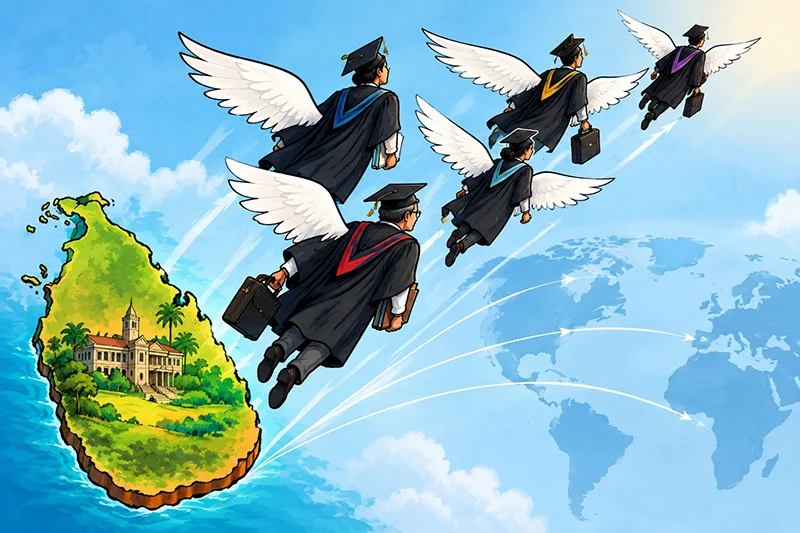
Brain drain in Sri Lanka is at an all-time high. The latest Human Flight and Brain Drain Index for 2024 shows that we are 16th of 175 countries on this count, and first in South Asia. That this is a crisis goes without saying. Brain drain affects all sectors, and is a huge strain on the resources of a developing country. Particularly in Sri Lanka, where considerable public investment is made in the moulding of professionals through the system of free education, this amounts to transferring the resources of poorer countries to richer ones with top migration destinations. It is, therefore, important to consider the push and pull factors behind skilled outmigration, specifically from the public university system of Sri Lanka, a key focus of the Kuppi column.
From frustration to exit
Several bitter realities in our crumbling public university system act as push factors in the migration decisions of academics. Many essays on this column have, over several years, attempted to highlight numerous aspects of this erosion. Perhaps, primary among them is the lack of adequate funding, which has debilitating ramifications for the system: very little investment is made in the up-keep of infrastructure (and even less in its expansion), resulting in serious constraints in accommodating growing batches of students and the wellbeing of the staff (particularly in regional universities); research funding is negligible, severely curtailing academics’ ability to effectively discharge their primary duty of teaching which should ideally be informed by their research (and the research of others, access to which is also, unfortunately, mediated by funding); a funding crunch also means a slash in (or greater constraints on) recruitments, increasing the workloads of academics, currently in service, and eating into the quality of their teaching and research.
What recruitments are done frustrate those with any faith in merit. As many of our interventions in this column have shown, recruitment processes are characterised by archaic selection criteria that place very little weight on a candidate’s postgraduate growth and the advantages of interdisciplinary training. Added to this is the general preference for ‘culturally compliant’ candidates who would not rock the boat too much. The combined effect is that those with the capacity and spirit to try out innovations in education are discouraged from joining or staying on in the public university system. Some, or many, of them may instead seek appointments abroad.
A thread that binds all of these problems together is pervasive hierarchy which, again, many interventions on this column have sought to highlight. It is the interest in preserving hierarchy that leads to the preference for alumni in recruitment processes. Hierarchy within universities can be particularly frustrating for younger faculty and women, who typically have to bear the brunt of the workload of their senior, often male, colleagues. In a context of funding, and, therefore, recruitment, restrictions, this translates into a disproportionate burden being placed on junior (usually female) faculty, seriously hindering their prospects of growing into successful academics due to the time constraints within which they have to operate. Junior academics, therefore, are more likely to look to educational institutions abroad for what they hope would be a different work culture that respects them more.
Ideological ruses
On top of these structural frustrations are also the workings of neoliberal ideology. For one, the nature of relations between the global metropole and peripheral countries like Sri Lanka largely dictates what is desirable and what is not. The apparent lifestyles of Western countries – from food to clothing, housing, appliances, and so on – have continued to lure people from the periphery with the promise of a ‘better’ life, alongside better career advancement opportunities. This, of course, masks much of the struggle that goes on behind the scenes to survive in Western societies. For instance, in most cases highly attractive public infrastructure such as roads, public transport, clean air, quality control of food, and so on belie the astronomical privatised costs of healthcare and education. Health insurance is usually mandatory and steep in most high-income settings, while even subsidised education (for which eligibility criteria are strict) creates a serious dent in household earnings. Of course, the happy images of glossy trams and gleeful international travellers don’t convey this.
A second ideological ruse is the myth of greater opportunities and recognition abroad. While there is no denying that local skilled sectors – be it higher education, health, civil service, or private white-collar positions – are replete with issues that inhibit merit-based professional advancement, the notion that things are fundamentally different in Western countries stems from an uninformed optimism. As is now increasingly known and discussed, Western labour markets are notoriously racialised, and equivalent skills are rarely treated as such. Instead, it is usually demanded that skilled migrants clear certain formal examinations in their host countries. In fields like medicine, this is followed by an interview that may also be racially prejudiced. Once these initial steps are cleared, remuneration reverts to square one irrespective of experience accumulated abroad, not to mention the many subtle aggressions, rejections, and trials one has to go through in the negotiation of everyday life. In the many cases where professional qualifications are used as leverage for a move abroad, sights are set on a better future for one’s children, which again is informed by the misplaced faith in greater opportunities and a lack of awareness of the factors outlined above. Needless to say, in the global swing to the Right, things have become even more challenging. In such a context, considering the few rare cases where skilled migrants live extremely comfortable lives as the norm becomes a dangerous misconception.
The two ideological pull factors mentioned above are complemented by a push factor, which has to do with a highly classed understanding of what a white-collar professional is due in their society. Many of these aspirations are clearly articulated in academic trade union action demanding separate quotas for school entry, increased fuel allowances, winning back the presently stalled vehicle permit scheme, salary hikes, and so on. While working people have every right to agitate for better material conditions, insofar as it remains unconnected to a broader movement for improving the conditions of the lot of the working class, it remains self-serving and very much within the class logic of capitalist society. Since these demands are articulated as a means of maintaining distinction, it is clear that they are not envisaged as part of a class movement. The frustration of not having these needs for distinction satisfied may push some to seek greener pastures abroad, at least financially, (perhaps as a means of social mobility based on it), only to be disappointed on most occasions.
What is to be done?
Addressing the systemic push factors listed above requires, first and foremost, greater allocations for free public higher education. This would immediately translate into more recruitments and less work per academic, and better research and teaching in the long haul. An increase in funding would also ideally lead to greater infrastructural investments, especially including improving the living conditions of those who work in regional universities amid untold hardships. Next, fairer, more creative, and, therefore, more effective recruitment policies are badly needed to attract talented individuals to university positions. Rather than carving out a ‘special category’ for academics to achieve this purpose, which is informed by a classed logic, this needs to be done through fundamental reforms in recruitment processes. Third, a persistent attack on the entrenched hierarchy within universities through internal reform is much called for. Reforming recruitment practices will go a long way towards addressing this. Measures should also be taken to introduce more stringent policies against SGBV (not to mention ragging, even though it is not directly connected to brain drain). Such measures would create a safer, fairer, and more attractive workplace, which would give more reasons for people to stay.
On top of greater allocations, we also need a transformation of our aspirations themselves if this situation is to change. That necessitates a kind of education capable of questioning the ‘paradise’ conception of Western societies, and lays bare their colonial material and ideological dimensions, in both their historical and contemporary manifestations. These colonial understandings of the ‘good life’, moreover, have devastating ecological implications for the planet, not to mention social justice. An education with the ability to transform this mindset would hopefully prove to be more than a mere path to social mobility, rather being a tool of social emancipation that renders mobility moot.
(Hasini Lecamwasam is with the Department of Political Science, University of Peradeniya)
Kuppi is a politics and pedagogy happening on the margins of the lecture hall that parodies, subverts, and simultaneously reaffirms social hierarchies.
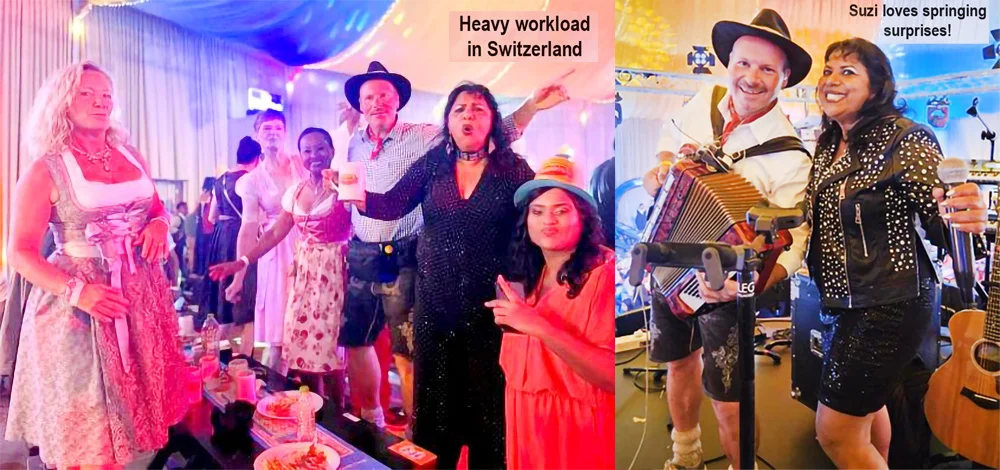
 Charming audiences in Switzerland as Suzi Flückiger, Sri Lanka’s own Suzi Croner is coming home… for a very special occasion.
The bubbly former frontline vocalist of 90s band Friends will take the stage at a popular venue in Colombo for Oktoberfest 2026.
Known in Europe for her country and classic hits, Suzi has remained a much-loved name back home. This will be a rare chance for local fans to see her live and celebrate the voice behind so many Friends memories.
Oktoberfest 2026 in Colombo promises an evening of live music, traditional Bavarian food and beer, colourful dirndls and lederhosen, folk dancing, and plenty of community cheer.

Suzi Croner (Flückiger)
Against this lively backdrop, Suzi will take the stage for a special solo set, featuring her own pre-recorded music. She performed at the event last year too, as a solo artiste, but a German band providing the music.
This year, however she says, it’s a different scene.
“The novel attraction will be the dancers from Germany — all girls, clad in German outfits,” Suzi said. She added that the event will also highlight the activities generally connected with Oktoberfest, which should generate a lot of fun and excitement for those who join her in Colombo next month.
Suzi has become a much-in-demand artiste in Europe, and has even performed Down Under, in Melbourne.
In Switzerland, where she has been based for the past 42 years, she continues to charm audiences with country and classic hits, performing at private events and community nights across Europe.
“My weekends are generally loaded with my work as a singer,” she said. “And I also play tennis three times a week, because I need to keep fit to entertain my audience in an active way.”
Her repertoire is made up mainly of Swiss, German and English songs.
And true to form, Suzi loves springing surprises.
“So watch out when you join me at Oktoberfest 2026, in Colombo!” she said.

England look to continue domineering T20 form

US Supreme Court rejects Trump mail ballot restrictions ahead of midterms

Eastern Province Divisional Secretariats recognized for outstanding performance

Students of Rahmaniya Maha Vidyalaya Eravur visit Presidential Secretariat and President’s House

Showers above 100 mm expected at times in the Western, Sabaragamuwa, Central, Uva and Southern provinces, and in Ampara and Batticaloa districts

Controversy over absence of Agriculture Minister, Deputy at NPP’s inaugural farmers’ rally

‘Dates have the highest sugar content to fight Coronavirus’

Sunday Island 27 December – Headlines

#SundayIsland 17th December – Headlines

Sunday Island – 28th March

Sunday Island Headlines – 21 March

Sunday Island – 21st February – Headlines
-

 Sports4 days ago
DDS set to lose Test captaincy
-

 News4 days ago
Sri Lanka faces new grid challenge as rooftop solar surges: former CEB GM
-

 Latest News4 days ago
Shafali, Deepti power India into sixth T20 Asia Cup final
-

 Latest News4 days ago
Sri Lanka thwart Fatima Sana challenge to secure Asia Cup final spot
-
 Opinion6 days ago
Navigating Sri Lanka’s Israeli Dilemma
-
 Features5 days ago
Lost for 90 years: Rare Goby resurfaces in Jaffna
-

 News2 days ago
Gnanasara Thero absconding after SC ruling
-

 News3 days ago
Ammunition cache found in old Kandy bungalow