
Latest News
Bumrah leads India’s fightback on 17-wicket opening day in Perth


Befitting the rivalry between Australia and India, the latest tussle for the Border Gavaskar Trophy started in eventful fashion with wild momentum swings and a DRS controversy as pace bowlers from both attacks thoroughly dominated in favourable conditions at Optus Stadium.
By the end of a madcap first day’s play, India had remarkably finished on top after stand-in captain Jasprit Bumrah tore through Australia’s top-order with spectacular seam bowling. He finished with 4 for 17 from 10 overs.
He claimed debutant Nathan McSweeney for 10 in the third over before dismissing Usman Khawaja and Steven Smith with consecutive balls in the seventh over to turn a fast-moving first Test on its head.
In just his second red-ball match opening the batting, McSweeney faced a baptism of fire and initially judged the length well before Bumrah adjusted to a fuller length and trapped him on the pads. Smith’s shift back to his favoured No.4 did not start well after he shuffled across his stumps and was plumb lbw by a wicked Bumrah delivery that decked back a mile.
Australia nosedived further when Travis Head was bowled by a cracker of a delivery from debutant quick Haarshit Rana, while Mitchell Marsh and Marnus Labuschagne fell to Mohammed Siraj.
Having started the season slowly, Labuschagne had an excruciating time. He was dropped by Virat Kohli at second slip after edging Bumrah and didn’t score in his first 24 deliveries faced. He received mock applause from the terraces when he finally broke his drought, but Labuschagne could never get going and made a painstaking 2 off 52 balls.
Bumrah wasn’t quite done as he returned in the shadows to dismiss Pat Cummins as Australia limped to stumps at 67 for 7.
It was a remarkable turnaround after India were bowled out for 150 in just 49.4 overs. Nine of Indian batters were caught behind the wicket in a mode of dismissal that has been common in Perth over the years at Optus Stadium and at the nearby WACA ground.
After India sensationally left out veteran spinners R Ashwin and Ravindra Jadeja, Bumrah elected to bat after winning the toss. With overcast skies above a green-tinged surface, it was undoubtedly an agonising decision but batting first appeared the logical move given the pitch is expected to deteriorate amid warmer weather later in the match.
With unseasonal wet weather ahead of the match, there had been particular intrigue over how the pitch would behave. There was movement and bounce, but perhaps not the minefield the scoreboard indicates.
India’s top-order were all at sea against superb new ball bowling from Mitchell Starc and Josh Hazlewood, who claimed all four wickets in the first session. Starc, especially, was outstanding to set the tone for an Australian pace attack that strangled India.
Having pushed through injury issues last summer, Starc entered the season fit and firing. He continued his strong form with fast and probing bowling, especially troubling the left-handers with an immaculate line and away swing.
Seemingly attempting to start the series in the same fashion as the Ashes series in 2021-22, Starc’s first delivery was an anti-climax and missed the leg stump of opener Yashasvi Jaiswal and flew to the boundary.
He was on target after that and his accuracy overwhelmed Jaiswal, who on his eighth delivery, as he tried to score his first runs in Australia, drove on the up and edged to McSweeney in the gully.
With his bat well in front of his body, it was an errant stroke that had echoes of an ungainly dismissal for Pakistan captain Shan Masood in last year’s Perth Test.
With captain Rohit Sharma and Shubman Gill unavailable, Devdutt Padikkal received an unexpected opportunity at No.3 after impressing in the India A matches recently. But he was totally shackled by the quicks and did not score off his first 22 deliveries faced. The pressure proved too much with Padikkal on the next ball edging Hazlewood behind with an angled bat trying to defend to covers.
All eyes were on Kohli, who received healthy applause from the 31,302 crowd although Indian fans in the terraces were vastly outnumbered in a rare sight.
India desperately needed their long-time talisman to shrug off a form slump on a ground he scored a brilliant century in the 2018-19 series. Kohli batted well outside the crease in a well-worn strategy he had successfully implemented previously in Australia.
But Hazlewood, who has had great success against Kohli over the years, adjusted and bowled a back of length. Kohli on 5 could only fend a lifting Hazlewood delivery that landed straight to first slip.
Opener K L Rahul, who just a week ago had been struck on the elbow in an intra-squad match simulation, bravely batted through the carnage. He struck India’s first boundary off the bat in the 12th over in ungainly fashion when he tried to evade a Cummins short ball only for it to hit his bat and fly over the slips.
Rahul made it to 26 before being given not out by on-field umpire Richard Kettleborough after Starc appealed for caught behind. After Australia reviewed, Snicko showed a spike as the ball passed the bat and the decission was overturned. Having indicated that the bat hit his pad, Rahul trudged off the ground shaking his head as India slumped to 47 for 4.
After lunch, allrounder Marsh made a successful return to bowling with the wickets of Dhruv Jurel, who had been selected on the back of his performances for India, and Washington Sundar.
Marsh had only bowled four overs since tearing his hamstring at the IPL. But he ran in powerfully and finished with 2-12 from 5 overs in a boost for an attack without allrounder Cameron Green, who will miss the entire series due to a back injury.
India’s hopes rested with a counterattacking Rishabh Pant and debutant Nitish Kumar Reddy, who combined for 48 runs – the biggest partnership of the innings.
Pant was typically adventurous marked by an audacious scoop for six off a full delivery from Cummins, while Reddy mixed orthodox drives with paddle sweeps to thwart offspinner Nathan Lyon.
But both were unable to kick on as India were dismissed by tea. In his first red-ball match since the New Zealand Tests in March, Cummins looked a little underdone and was unable to find a consistent length as he finished with 2-67 from 15.4 overs.
He did dismiss Pant and Reddy and left the field mightily pleased with Australia’s performance. But Cummins’ mood soured quickly and just over two hours later he trudged off the field after being dismissed by his opposite number.
Brief scores:
Australia 67 for 7 in 27 overs (Alex Carey 19*; Jasprit Bumrah 4-17, Mohammed Siraj 2-17) trail India 150 in 49.4 overs (K L Rahul 26, Nitish Kumar Reddy Reddy 41, Rishabh Pant 37; Josh Hazlewood 4-29, Mitchell Marsh 2-12, Mitchell Starc 2-14, Pat Cummins 2-67) by 83 runs
[Cricinfo]

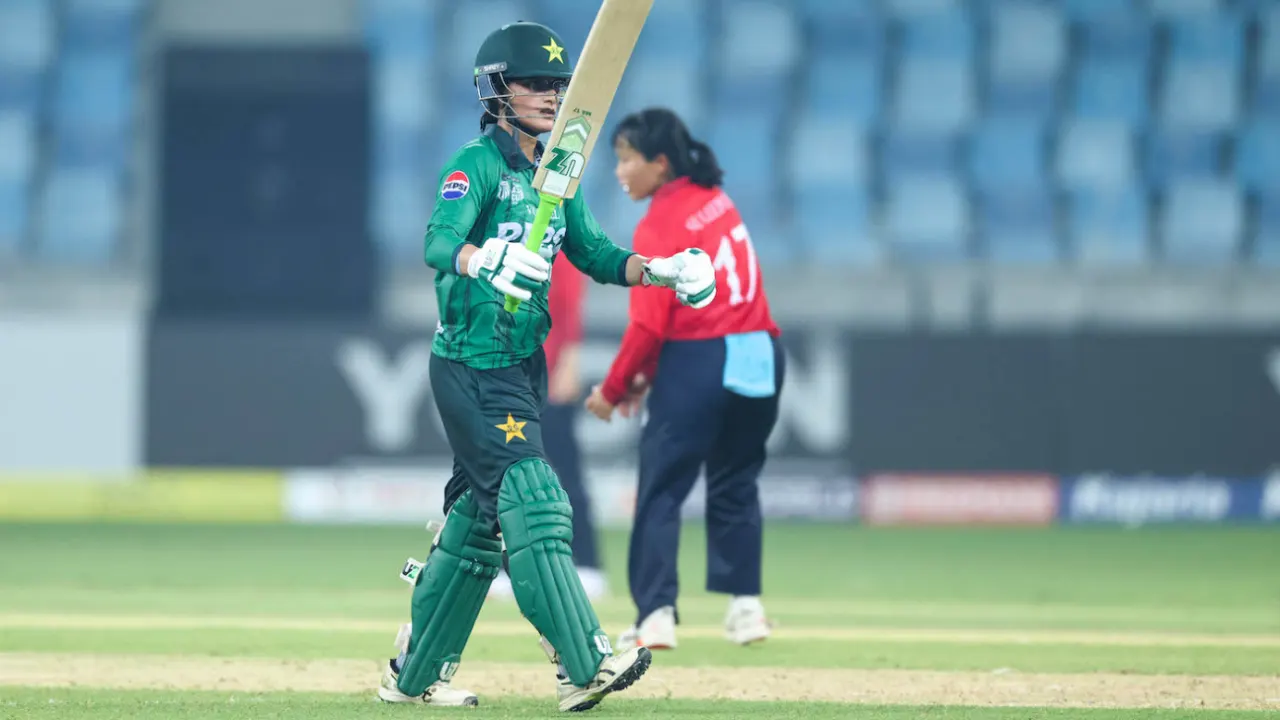
Muneeba Ali braved the oppressive heat of Dubai before Pakistan’s spinners put on a disciplined show to begin their T20 Asia Cup campaign with a commanding win over Thailand. The result knocked Thailand out of the competition as they suffered their second defeat in three matches.
On a pitch which stayed low, Fatima Sana backed her spinners to do the job by opting to bat at the toss, a decision which raised eyebrows at the time. She stood vindicated in the end as Pakistan completed a comfortable 35-run win.
But, it also brought to light Pakistan’s perennial batting woes as they managed only 119 for 9 in 20 overs despite Sana harbouring hopes of her side going beyond 150. Thailand never stood a chance of chasing the target against Pakistan’s quality spin attack and finished with 84-8 in 20 overs.
There was anticipation in the lead up to this contest as to whether the Thai left-arm orthodox bowler would surpass India’s Deepti Sharma as the highest wicket taker in the format. Thipatcha Putthawong did not make the spectators wait as she achieved the feat with a double-wicket maiden in the second over of the game.
Putthawong sent back Shawaal Zulfiqar on the second ball with the one that gripped off a length. It had Zulfiqar punch the ball right into the midriff of Suleeporn Laomi at point. Four balls later, she got her landmark wicket when Gull Feroza, back into the Pakistan side after missing the Sri Lanka T20Is, was caught at fine leg while playing the paddle.
That over tightened the screws on the Pakistan batters as they struggled to get going throughout the powerplay, which they finished with 32 for 3. Putthawong and Phannita Maya shared the six overs between themselves but it was the former’s figures of 3-0-21-1 that stood out.
Ayesha Zafar was the third batter to fall inside the powerplay, courtesy an outstanding catch by Natthakan Chantham at midwicket off Maya’s bowling.
Putthawong added another wicket to her tally in the last over of the innings. She now has 173 wickets in the format at a staggering average of 9.17 and economy of 4.11.
As has often been the case, the onus of doing the repair work fell on Muneeba, who opened the innings with Zulfiqar. She saw partners fall before putting together a solid partnership of 54 runs with Shamas.
Shamas picked up boundaries through point and wide of slip in her first four balls to kick the innings into gear. It helped Muneeba, who was struggling for breath because of the harsh Dubai weather, settle down. Muneeba often fell on her haunches to gather her breath and, at one point, had to be tended to by the team physio.
Conditions were tough for batting with the pitch playing slow and low, and the outfield being heavier than usual for a T20 game. Muneeba, nonetheless, continued to fight until the death overs and registered her fourth half-century. She finished with 54 off 52 with four boundaries and was stumped off Laomi’s bowling in the 17th over.
Shamas, who found herself in the main squad because of an injury to Najiha Alvi, made a crucial run-a-ball 20 to stop the floodgates. But her wicket, also to Laomi, re-opened the floodgates.
Laomi takes two in an over
Pakistan fans must have taken solace in the fact that Shamas was replaced by their captain, who had been at the top of her game in the T20 World Cup this year. But Sana had a brief stay at the crease. She was caught and bowled, second ball, as Laomi took a stunning catch diving forward. Both wickets fell in the 13th over of the innings. It was the second time in the innings that Pakistan lost two in an over.
Laomi varied her lengths and pace with great deception to finish as the best bowler for her side with 3-14 from four overs.
The average first-innings score at this venue in the women’s T20Is is 118, and that Pakistan managed one more was because of Tuba’s 12* off only four balls. She announced her arrival at the crease, amidst a flurry of wickets, with a gigantic six over square leg. She then hit a boundary through the covers in the last over.
Thailand might have harboured hopes of repeating the heroics from the 2022 edition of the T20 Asia Cup when they beat Pakistan. But they were eviscerated in Sadia Iqbal’s first over, the second of the run chase, as she sent back Maya and Nannapat Koncharoenkai.
Coincidentally, this over, like the second over of the first innings, ended up as a double-wicket maiden, and the two wickets in both these overs came on the second and last ball of the over across the innings.
Thailand needed one of their batters to emulate Muneeba, but they were starved of runs by Pakistan’s disciplined bowling and attacking field sets. They stood no chance at chasing the total down with the required run rate climbing every over.
The introduction of Nashra Sandhu after the powerplay further aggravated Thailand’s woes as the left-arm spinner allowed only six runs from her four overs, she picked up Chantham as well. Iqbal returned for the last over of the innings and picked up a wicket on the last ball to finish with 3 for 11 from four overs.
That Pakistan were able to secure a win despite a subpar batting performance was partly because they played a weaker opposition. But, their next opponents, India, are not likely to provide them much of a leeway.
Scores:
Pakistan Women 119 for 9 in 20 overs (Muneeba Ali 54, Sadaf Shamas 20, Umm e Hani 17, Tuba Hassan 12*; Phannita Maya 2-34, ; Thipatcha Putthawong 3-18, Sunida Chaturongrattana 1-23, Suleeporn Laomi 3-14) beat Thailand Women 84/8 in 20 overs (Naththakan Chantham 14, Naruemol Chaiwai 17, Aphisara Suwanchonrathi 13, Chanida Sutthiruang 25; Fatima Sana 1-22, Sadia Iqbal 3-11, Nashra Sandhu 1-06, Tuba Hasan 2-17) by 35 runs
[Cricinfo]
Latest News
Sun directly overhead Anamaduwa, Moragollagama, Dambulla, Manampitiya and Valaichchenai, at about 12.10 noon today (02)

The sun is going to be directly over the latitudes of Sri Lanka from 28th of August to 07th of September due to its apparent southward relative motion.
The nearest places of Sri Lanka over which the sun is overhead today (02) are Anamaduwa, Moragollagama, Dambulla, Manampitiya and Valaichchenai, at about 12.10 noon.
Latest News
Signing agreement for the establishment of BIMSTEC Technology Transfer Facility in Sri Lanka

It has been decided to establish a BIMSTEC technology transfer facility in Sri Lanka by entering into a Host Country Agreement at the second leaders’ summit of BIMSTEC (Bay of Bengal
Initiative for Multi-Sectoral Technical and Economic Cooperation) held in New Delhi, India, in 2008, with the objective of enhancing regional cooperation.
The relevant cooperation agreement was signed by the member countries at the 5th BIMSTEC summit on 30-03-2022 in Colombo.
The prime objective of this technology transfer facility is to provide technology, capacity building, and management of intellectual property for the micro, small, and medium-scale
enterprises of the BIMSTEC member countries.
According to the cooperation agreement, an agreement should be entered into between Sri Lanka, as the host country, and BIMSTEC Secretariat for formalizing the legal status, privileges, and immunities of the technology transfer facility.
The drafted agreement has received the relevant institutional approval and legal clearance.
Accordingly, the Cabinet of Ministers has approved the resolution furnished by the Minister of Science and Technology to sign the proposed agreement.

Muneeba, Pakistan’s spinners knock Thailand out of Asia Cup

Showers will occur in the Western and Sabaragamuwa provinces and in Galle, Matara, Kandy and Nuwara-Eliya districts

Sun directly overhead Anamaduwa, Moragollagama, Dambulla, Manampitiya and Valaichchenai, at about 12.10 noon today (02)

SC rejects petitioners’ request for full bench

Seven years RI for former Civil Aviation Minister Piyankara Jayaratne

40 professional organisations and TU oppose proposed 22A

‘Dates have the highest sugar content to fight Coronavirus’

Sunday Island 27 December – Headlines

#SundayIsland 17th December – Headlines

Sunday Island – 28th March

Sunday Island Headlines – 21 March

Sunday Island – 21st February – Headlines
-

 News5 days ago
Eight politicians in drug kingpin probe
-

 Features3 days ago
“Wrap Me Up in My Blazer”— A Gentlemanly Bradby Reminiscence
-

 Business5 days ago
Sri Lanka opens up: A new season of direct connectivity
-

 Features5 days ago
Redefining ageing in Sri Lanka
-

 Latest News6 days ago
Nepal-Tibet floods: What happened, what caused them and who is missing?
-

 Editorial6 days ago
Unfolding El Niño and burning issues
-

 Foreign News7 days ago
At least eight killed, hundreds missing after Nepal flash flood
-
 Latest News7 days ago
Advisory for High Waves for the sea areas extending from Colombo to Pottuvil via Galle, Matara and Hambantota