
Latest News
President Anura Kumara Dissanayake reaffirmed the governments readiness to collaborate with the International Monetary Fund (IMF) to advance Sri Lanka’s economic recovery


The government of President Anura Kumara Dissanayake reaffirmed its readiness to collaborate with the International Monetary Fund (IMF) to advance Sri Lanka’s economic recovery within the context of the mandate. Senior Mission Chief Peter Breuer and the IMF delegation met with President Dissanayake and key ministers of the newly-formed government at the Presidential Secretariat on Monday (18), to discuss the next steps in the IMF program.
The IMF team congratulated the President and his government on their decisive electoral victory, expressing optimism about the collaboration. President Dissanayake, in turn, underscored his administration’s responsibility to uphold the people’s mandate, emphasizing that the success of the IMF program hinges on rebuilding public trust in governance.
Highlighting his government’s commitment to addressing the pressing needs of the people, President Dissanayake urged the IMF to maintain a balanced approach that considers the hardships faced by citizens. He assured that under his leadership, social spending allocations would be utilized effectively, with priority given to combating child poverty and malnutrition and providing better support for differently abled individuals.
The IMF delegation noted that allocations for social spending had not been fully utilized previously, prompting President Dissanayake to pledge proactive measures to ensure efficient allocation and utilization of resources.
Governance and anti-corruption were also central to the discussions. The President reiterated his administration’s commitment to the fight against corruption, a key component of the mandate granted by the people. He assured the IMF team that his government would implement stringent laws to enhance the legislative and institutional structures to uphold transparency and accountability.
The meeting marked a positive step forward in the collaboration between the government and the IMF, laying the groundwork for a coordinated effort toward economic recovery and long-term stability.
The President in his capacity as the Minister of Finance, Minister of Labour Prof. Anil Jayantha Fernando and MP Harshana Sooriyapperuma together with representatives of the Ministry of Finance participated in this meeting.


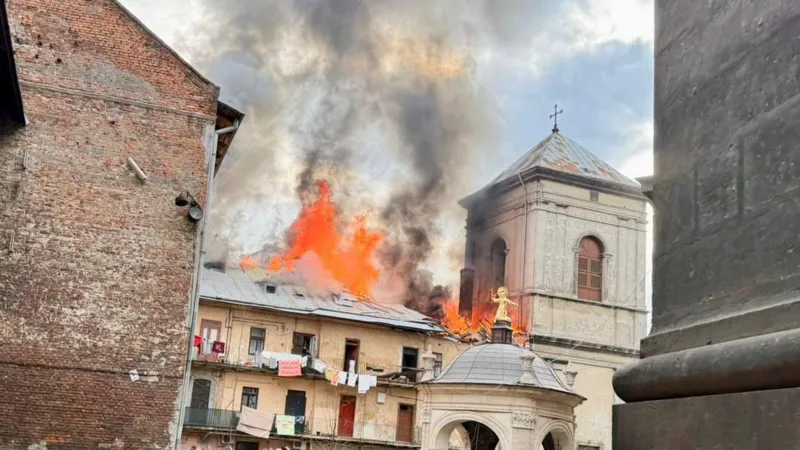
Russia has launched the largest aerial attack on Ukraine over a 24-hour period since the war began, hitting cities across the country with 948 drones.
Ukraine’s Air Force said 556 drones had been fired since 09:00 local time (07:00 GMT) on Tuesday, in an unusual daytime attack which killed at least three people and injured dozens.
In the western city of Lviv, the 16th century Bernardine monastery – part of a Unesco World Heritage site in the city centre – was damaged, local officials said.
In the neighbouring Ivano-Frankivsk region, a maternity hospital was hit.
Those strikes came after an overnight Russian attack left five people dead. Ukraine said 392 drones and 34 missiles were fired.
In his video address on Tuesday evening, Ukrainian President Volodymyr Zelensky said the scale of the latest attacks “clearly shows that Russia has no intention of really ending this war”.
Russia’s military has not publicly commented on the attacks.
A video posted earlier on Tuesday by Lviv authorities showed a fire burning through the roof of a residential building near the Bernardine monastery.
Separate footage posted on social media showed a drone flying lower over the city and hitting the residential building.
Lviv regional head Maksym Kozytskyi said 32 people were injured in the Russian attack.
In the city of Ivano-Frankivsk, two people were killed and another four – including a six-year-old child – were injured, local officials said.
Various buildings – including a maternity hospital – were damaged in the regional capital.
Ternopil – another western Ukrainian city – was also targeted on Tuesday. A number of direct hits were reported by regional authorities, but no casualties.
In the central Ukrainian city of Vinnytsia, one person was killed and 13 injured, regional head Nataliya Zabolotna said.
In the overnight Russian attacks, five people were killed when Russia targeted 11 Ukrainian regions.
Ukraine’s Air Force said it had managed to shoot down most of the Russian drones and missiles – but admitted that there were multiple direct hits across the country.
Yurii Ihnat, spokesman of the Ukrainian Air Force, said late on Tuesday that a “large number of drones” had entered Ukrainian airspace from the north of the country, “effectively moving in columns”.
“The geography of the strikes during the daytime was broader than at night… It can be said this was one of the largest attacks within a 24-hour period,” he said.
While more than four years of war have left virtually no corner of Ukraine untouched, the west of the country has been hit comparatively less intensely and frequently than other areas nearer the Russian border in the east.
Russia launched a full-scale invasion of Ukraine in February 2022, and the war continues unabated, with Moscow launching near-daily attacks on cities across the country.
Also on Tuesday, the governor of Russia’s western Kursk region said one man was killed and 13 people were injured in a Ukrainian drone attack on an agricultural enterprise.
Talks brokered by the US and aimed at reaching at a peace settlement have stalled since the start of the US-Israeli war with Iran in late February.
“Amid the news the world is drowning in every day, we will not let Ukrainian grief get lost, become just another statistic, a headline that will be casually skipped over,” wrote Ukraine’s First Lady Olena Zelenska on social media.
(BBC)

If the price of oil hits $150 a barrel it will trigger a global recession, the boss of US financial giant BlackRock has told the BBC.
Larry Fink, who leads the world’s largest asset manager, said if Iran “remains a threat” and oil prices stay high it will have “profound implications” for the world economy.
In a wide-ranging exclusive interview, he also denied there was an AI bubble, although he said the new technology meant too many people were pursuing university degrees and not enough doing technical training.
BlackRock is a financial colossus, controlling assets worth $14 trillion (£10.5tn), and is one of the biggest investors in many of the world’s largest companies.
Its size and spread gives Fink – who is one of the eight co-founders of the business, which started in 1988 – a unique insight into the health of the global economy.
The conflict in the Middle East has triggered wild moves on financial markets as people try to assess what will happen to energy costs.
For Fink, it is too early to determine the ultimate scale and outcome of the conflict, but he believes it will be one of two extreme scenarios.
In one, if the conflict is settled and Iran becomes a country that can be accepted again by the international community then the price of oil could fall back to below where it stood before the war.
But if not, he says, then there could be “years of above $100, closer to $150 oil, which has profound implications in the economy” and an outcome of “a probably stark and steep recession”.
The surge in energy costs has led to some in the UK to argue that it should be focusing more on producing its own oil and gas.
On Tuesday, industry body Offshore Energies UK said that without more domestic production, the country risks becoming reliant on imports “at a time of rising global instability”.
Fink says countries need to be pragmatic about their energy mix by using all sources available to them, but providing cheap energy is key to driving growth and raising living standards.
“Rising energy prices is a very regressive tax. It affects the poor more than the wealthy.”
While the UK already has some solar and wind power and hydrocarbons, if oil prices were to rise to $150 for three or four years, “you would have so many countries moving so rapidly towards solar and maybe even wind”.
Countries should not depend on just one source, he says.
“Use what you have unquestionably, but also aggressively move towards alternative sources too.”
Some analysts have suggested that there are some echoes of the run-up to the 2007-08 financial crisis in the markets at the moment.
Energy prices are surging and some have flagged signs of cracks in the financial system. BlackRock itself is one of several firms to have limited withdrawals by nervous investors from private credit funds.
But Fink is adamant there is no chance of a repeat of the financial trauma seen in 2007-08, when several banks around the world collapsed or had to be rescued, as he believes financial institutions today are more secure.
“I don’t see any similarities at all,” he says. “Zero.”
The issues affecting some funds account for a small fraction of the overall market and investment from institutions remains strong, he says.
Fink also rejects suggestions that the surge in investment in AI, which has seen billions of dollars invested in the new technology, has been overblown.
“I do not believe we have a bubble at all,” he says.
“Could we have one or two failures in AI? Sure, that I’m fine with.”
Last year, BlackRock was part of a consortium that bought one of the world’s largest data centre providers, Aligned Data Centres, in a $40bn deal.
“I believe there’s a race for technology dominance. I believe that if we do not invest more, China wins. I believe it’s mandatory that we are aggressively building out our AI capabilities.”
The biggest issue he feels that is hindering the expansion of AI in the US and Europe is the cost of energy.
While China is investing hugely in solar and nuclear power, in Europe “I just see a lot of talk and no action”, he says, while in the US “as much as we are energy independent, we better start focusing on solar… because we need to have cheap, inexpensive power to move into AI”.
Earlier this week, in his annual letter to shareholders, Fink said the boom in artificial intelligence risked widening inequality, with only a small number of firms and investors seeing the benefits.
However, speaking to the BBC, he emphasised AI was going to create an “enormous amount of jobs”.
He said that in his letter he had written about how many jobs would be created “related to electricians and welders and plumbers”.
In contrast, there might not be as much demand for some office jobs as AI evolves and this could lead to a rethink about what roles are needed as “society is changing and evolving”.
“We really put judgement on so many jobs and so many people who probably should not have gone into banking or media or law, [who] probably should have been a great worker with their hands, and we need to now rebalance that approach,” he says.
In the US, he says, after World War Two “we built the foundation of education, and we said to all the young people, go to college, go to college, go to college. And we probably overdid it”.
“We need to balance that out, and we need to be proud that… a career can be just as strong in these fields of plumbing and electricians.”
(BBC)

IPL captains’ meeting: What’s on the agenda?

Russia launches 948 drones at Ukraine in largest attack over 24-hour period

Oil at $150 will trigger global recession, says boss of financial giant BlackRock

Showers will occur at several places in the Western and Sabaragamuwa provinces and in Galle and Matara districts after 2.00 pm

Senior citizens above 70 years to receive March allowances on Thursday (26)

CEB Engineers warn public to be prepared for power cuts after New Year

‘Dates have the highest sugar content to fight Coronavirus’

Sunday Island 27 December – Headlines

#SundayIsland 17th December – Headlines

Sunday Island – 28th March

Sunday Island Headlines – 21 March

Sunday Island – 21st February – Headlines
-

 Features2 days ago
Trincomalee oil tank farm: An engineering marvel
-

 News6 days ago
Bailey Bridge inaugurated at Chilaw
-

 News5 days ago
CIABOC tells court Kapila gave Rs 60 mn to MR and Rs. 20 mn to Priyankara
-

 News6 days ago
Pay hike demand: CEB workers climb down from 40 % to 15–20%
-

 Features5 days ago
Science and diplomacy in a changing world
-

 News4 days ago
Colombo, Oslo steps up efforts to strengthen bilateral cooperation in key environmental priority areas
-

 Features2 days ago
The scientist who was finally heard
-
 News2 days ago
Substandard coal deepens energy crisis, warns former CEB Chief