
Latest News
Pro-EU leader claims Moldova victory despite alleged Russian meddling


Moldova’s pro-EU President Maia Sandu has claimed a second term after a tense election run-off seen as a choice between Europe and Russia.
With most preliminary results counted, Sandu was leading with almost 55% of the vote, and in a late-night speech she promised to be president for all Moldovans.
Her rival Alexandr Stoianoglo, who was backed by the pro-Russian Party of Socialists, had promised a closer relationship with Moscow.
During the vote, the president’s national security adviser said there had been “massive interference” from Russia in Moldova’s electoral process that had “high potential to distort the outcome”.
Russia had already denied meddling in the vote, which came a week after another key Eastern European election in Georgia, whose president said it had been a “Russian special operation”.
Stoianoglo, who was fired as prosecutor general by Sandu, has denied being pro-Kremlin.
As polls closed, both Maia Sandu, 52, and her rival thanked voters, with Stoianoglo speaking in Russian as well as Romanian. Although Romanian is Moldova’s main language, Russian is widely spoken because of its Soviet past.
Voting ended in Moldova at 21:00 (19:00 GMT), with a 54% turnout higher than four years ago, and especially high among expat voters at polling stations abroad.
Stoianoglo took an early lead and won the vote in Moldova itself with more than 51%, according to the preliminary results. Sandu was far ahead in the capital Chisinau, and was completely dominant among expat voters.
As she overtook her challenger late on Sunday night, there was cheering at her campaign headquarters and chants of “victory”.
In a hoarse voice she praised her compatriots for saving Moldova and giving “a lesson in democracy, worthy of being written in history books”.
Then, moving into Russian, she said: “I have heard your voice – both those who supported me and those who voted for Mr. Stoianoglo. In our choice for a dignified future, no-one lost… we need to stand united.”
Maia Sandu’s foreign policy adviser, Olga Rosca, told the BBC she was proud of the result.
Asked whether she was surprised that Stoianoglo had won in Moldova itself, she said the vote in Moldova and abroad should be seen as one and the same: “We never divide people into Moldovans at home and expatriates – we see Moldovans as one family.”
With elections coming next year she said the president had “clearly indicated she has heard the mood for change. On several occasions between the [two presidential] votes she said the fight against corruption must be intensified and justice reform must be accelerated – she’s committed to this work”.
The final result will be declared on Monday.
EU Commission President Ursula von der Leyen congratulated Sandu, saying “it takes a rare kind of strength to overcome the challenges you’ve faced in this election.
“I’m glad to continue working with you towards a European future for Moldova and its people,” her message on X said.
Casting his ballot, Alexandr Stoianoglo had promised to be an “apolitical president”, and that he had voted for “a Moldova that should develop in harmony with both the West and the East”.
Stoianoglo polled particularly well in rural areas and the south, while Sandu was ahead in the cities and with young voters.
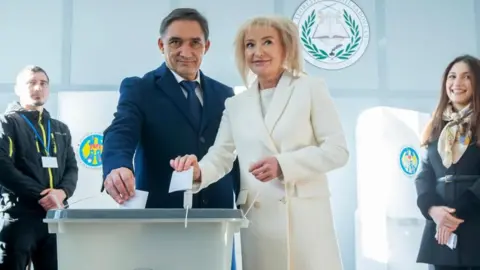
After casting her ballot, Sandu had warned of “thieves” who sought to buy their vote and their country.
Presidential national security adviser Stanislav Secrieru said Russia had organised buses and large charter flights to bring voters to polling stations.
Bomb scares had briefly disrupted voting in Moldova, at UK polling stations in Liverpool and Northampton and at Frankfurt and Kaiserslautern in Germany, he added.

Moldova’s authorities have long warned that a fugitive oligarch called Ilan Shor has spent $39m (£30m) trying to buy the election for Moscow with handouts to 138,000 Moldovans.
Shor, who is based in Moscow, denies wrongdoing but did promise cash payments to anyone prepared to back his call for a “firm No” to the EU.
Commentators and politicians had warned that a Stoianoglo victory could radically change the political landscape in the Danube and Black Sea region, not because he was some kind of “Trojan horse”, but rather because Russia has thrown its weight behind him.
There were queues at polling stations in Moscow, Italy and among voters from a mainly Russian-speaking breakaway region of Transnistria, who had to cross the River Dniester into Moldovan-controlled territory to vote. Transnistria is home to a Russian military base and a huge arms depot.
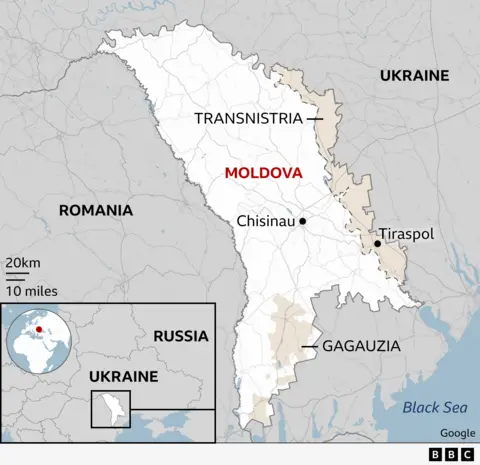
Moldova’s election commission said it was aware of reports of organised and illegal transports of voters by air and land in Russia, Belarus, Azerbaijan and Turkey, and appealed to the public to report further violations.
Although Sandu had easily won the first round of the vote, several candidates swung behind Stoianoglo, although the third-placed candidate refused to back either of the two.
The first round coincided with a nail-biting referendum on backing a change to the constitution embracing the commitment to join the EU.
In the end the vote passed by a tiny margin in favour, and Maia Sandu said there had been clear evidence of attempts to buy 300,000 votes.
[BBC]

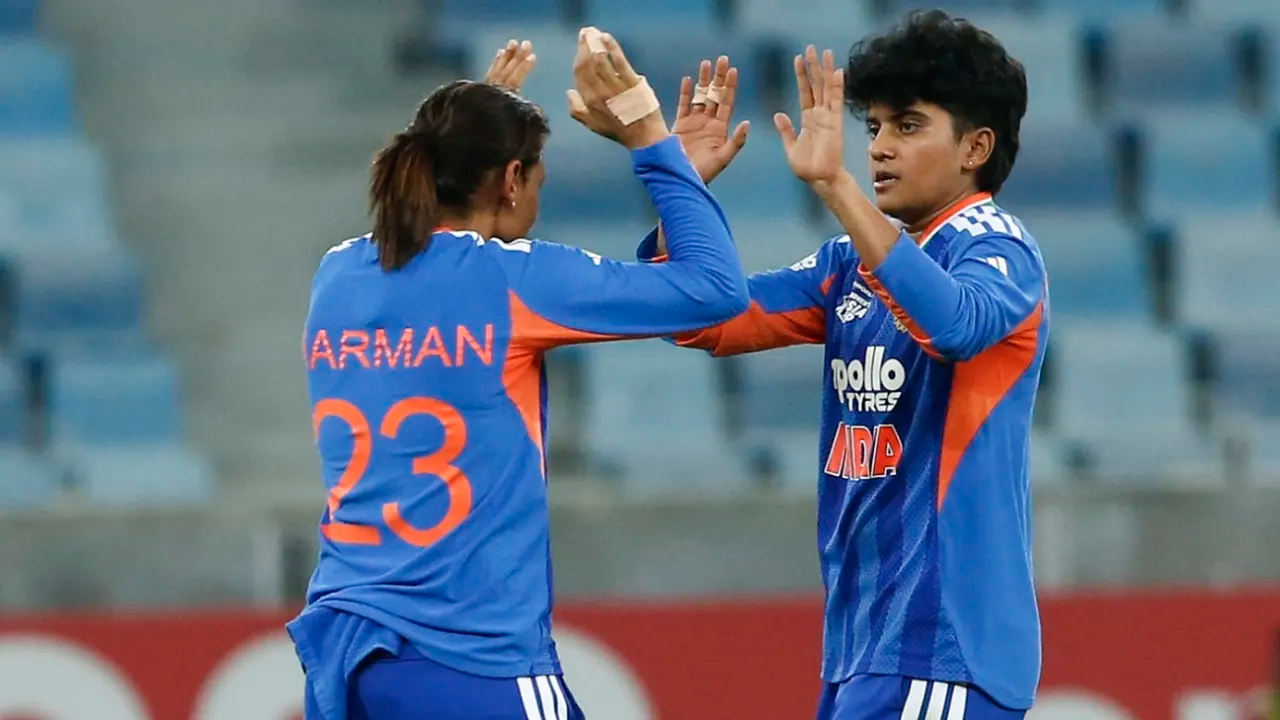
Defending gold-medal winners India overcame hosts Japan by eight wickets in the fourth quarter-final of the women’s cricket competition at the Asian Games in Nisshin on Friday. India chased down 58 in five overs to comfortably secure their place in the semi-finals. They will now face Bangladesh on September 20.
Japan did not exit the competition empty-handed. Their effort to bat as close to the full 20 overs as possible, their running between the wickets and their fielding effort were big positives. But they were bowled out for 57 in 19.5 overs after a solid start, leaving India with little to chase.
India, who opted to field, made the most of a pitch offering turn and bounce, which made stroke-making difficult for Japan. Shree Charani led the attack with another four-wicket haul, continuing an impressive run after taking 4 for 20 in the Women’s T20 Asia Cup final. She struck twice off consecutive balls in the seventh over, removing opener Haruna Iwasaki for 10 before having captain Mai Yanagida caught behind for a duck, but couldn’t convert it into a hat-trick.
Iwasaki and Ayaka Kato Stafford had put on 24 for the opening wicket, but Japan struggled to build partnerships once the stand was broken. Kato-Stafford top-scored with 25 off 47 balls, while Iwasaki made 10 off 22. Japan lost their last eight wickets for just 33 runs.
Charani finished with 4 for 10 from her four overs, while Shafali Verma took 2 for 13 and Deepti Sharma claimed 1 for 14.
Shrevanka Patil, returning to international cricket for the first time in three months after recovering from an ankle ligament injury suffered during the T20 World Cup in June, took 1 for 8 from 3.5 overs. Japan’s innings ended when Patil bowled Nonoha Yasumoto for a duck.
Chasing 58, Shafali opened the innings aggressively, smashing four boundaries in the first over to immediately put Japan under pressure. G Kamalini, who opened in place of Smriti Mandhana, and No. 3 Bharti Fulmali then threw their wickets away to fielders at long-on and point respectively. Left-arm seamer Yasumoto, who dismissed Kamalini, also delivered a wicket-maiden with the new ball.
Shafali finished the game with a six over long-on, staying unbeaten on 40 off just 15 balls. She struck six fours and two sixes at a strike rate of 266.66, as India won with 15 overs to spare.
Scores:
India Women 59 for 2 in 5 overs (Shafali Verma 40*, Richa Ghosh 12*; Nonoha Yasumoto 1-08, Ayaka Kato-Stafford 1-14) beat Japan Women 57 in 19.5 overs (Haruna Iwasaki 10, Ayaka Kato-Stafford 25; Shree Charani 4-10, Shreyanka Patil 1-08, Deepti Sharma 1-14, Shafali Verma 2-13) by eight wickets
[Cricinfo]
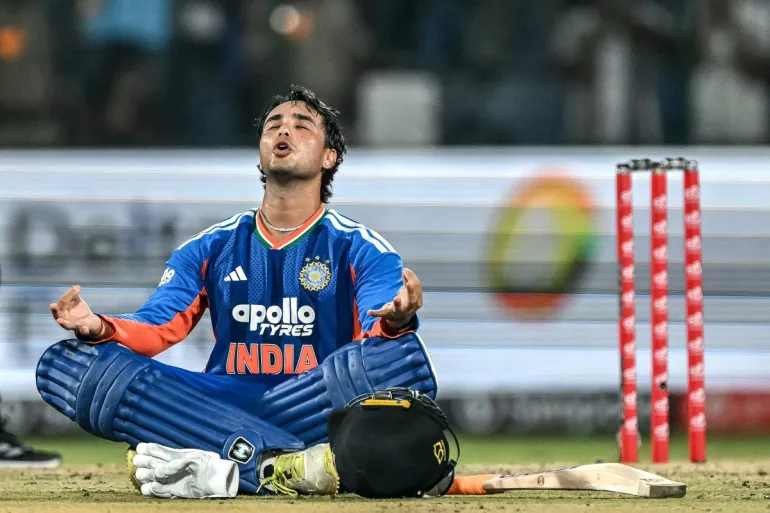
Opener Abhishek Sharma hit a record T20 century off 30 balls to set up a crushing 127 run win for India in the third match against Afghanistan and sweep the series 3-0.
Left-handed Abhishek’s ton on Thursday was the fastest in a T20 international between full Test-playing nations as he guided India to 221-7 at New Delhi’s Arun Jaitley Stadium.
Afghanistan, who were the official hosts for the series, checked the opposition surge after Abhishek departed for 108 off 34 balls and India lost their way from 142-1 in 10 overs.
But the Afghan batters once again disappointed and were bowled out for 94 in 14.1 overs.
Afghanistan had posted 156-8 and 159-8 while batting first in the first two matches.
Left-arm spinner Axar Patel struck twice in his first over to send back Rahmanullah Gurbaz, for 15 and Sediqullah Atal, for one. Afghanistan could never recover from the losses.
Seam bowler Nitish Kumar Reddy also took two wickets in one over to return figures of 3-25.
Leg-spinner Ravi Bishnoi wrapped up the Afghanistan innings with his third strike of the match.
Abhishek stood out with his third T20 century as he surpassed Zimbabwean Sikandar Raza’s ton off 33 balls against Gambia in 2024 and Finn Allen’s effort from the same number of deliveries in New Zealand’s T20 World Cup semi-final win over South Africa earlier this year in India.
The only two faster T20I hundreds came in matches between the lower-tiered associate members of the ICC.
Sahil Chauhan of Estonia holds the overall record of 27 balls after his century against Cyprus two years ago, while Muhammad Fahad needed just 29 balls for his ton for Turkey against Bulgaria in 2025.
Abhishek tore into the Afghanistan bowling attack after India were invited to bat first.
The swashbuckling opener hit a six to reach 99. He completed the hundred with a single and sat in meditation pose to celebrate.
He finally fell for 108 off 34 balls to leg-spinner Rashid Khan. The 26-year-old’s knock was laced with nine fours and 11 sixes.
His opening stand of 142 with Sanju Samson, who hit 50, put India on course for a big total but the Afghan bowlers hit back with regular wickets.
Tilak Varma was run out for two by Rashid and Samson departed after his second successive half-century as he fell to pace bowler Azmatullah Omarzai.
Omarzai struck another blow helped by a stunning catch by Rashid in the deep to send back Shivam Dube for 14.
India raised their 100 in six overs but managed just 79 from the last 60 balls.
India now head to Japan for the Asian Games starting September 19 at Nagoya-Aichi.
Afghanistan will send a largely different team to the Asian Games under Darwish Rasooli.
[Aljazeera]

United States President Donald Trump’s administration has asked lawmakers to clear the sale of 48 F-35 fighter jets to Saudi Arabia for an estimated $24.3bn.
“This proposed sale will support the foreign policy and national security objectives of the United States by improving the security of a major non-NATO ally that is a force for political stability and economic progress in the Gulf region,” the State Department said in a statement on Thursday.
The administration said the sale of the jets, the most advanced fighter aircraft the US has, would “not alter the military balance in the region” in keeping with longstanding US policy that Israel must have a military edge over potential regional adversaries.
The announcement comes after the Houthis in Yemen claimed on Wednesday they shot down a Saudi F-15 fighter jet over Marib, a key city in their battle against Saudi-backed Yemeni government forces. The group released video of fighters in the city standing before burning wreckage of what appeared to be a US-made F-15 fighter jet with Saudi Arabian markings.
The Houthis claim the aircraft was shot down with a “locally made” surface-to-air missile, which would mark a dramatic change in the group’s ability to wage war in the area. Until now, Saudi Arabia’s military has enjoyed relative air superiority in Yemen, and has relied heavily on its ability to carry out air strikes in the neighbouring country.
Intensifying fighting between Saudi Arabia and the Houthis reportedly killed at least five people, including three children, on Thursday.
[Aljazeera]

Charani, Shafali power India past Japan and into Asian Games semi-finals

Athapaththu and Dilhari muscle Sri Lanka past Malaysia in mismatch

Abhishek Sharma hits record T20 ton as India beat Afghanistan by 127 runs

Trump administration approves sale of F-35 jets to Saudi Arabia

Banton steers England into unassailable 2-0 series lead

Showers expected in the Western, Norrh-western and Sabaragamuwa provinces and in Galle, Matara, Kandy and Nuwara-Eliya Districts.

‘Dates have the highest sugar content to fight Coronavirus’

Sunday Island 27 December – Headlines

#SundayIsland 17th December – Headlines

Sunday Island – 28th March

Sunday Island Headlines – 21 March

Sunday Island – 21st February – Headlines
-

 Latest News7 days ago
Sri Lanka thwart Fatima Sana challenge to secure Asia Cup final spot
-

 News6 days ago
Gnanasara Thero absconding after SC ruling
-

 News7 days ago
Ammunition cache found in old Kandy bungalow
-

 News7 days ago
Prof. Pieris says Buddha Dhamma recognised as source of law under Constitution
-

 News6 days ago
Green Climate Fund (GCF) Regional Dialogue for East and South Asia will be held from 14 to 17 September 2026 at Cinnamon Life at City of Dreams Hotel, Colombo
-

 Opinion5 days ago
From Galkissa (Mount Lavinia) to Tambuttegama
-

 Latest News6 days ago
ITS Giuseppe Garibaldi’ departs Colombo
-

 Business6 days ago
HNB Finance strengthens Board with four independent directors