
News
SL moves up by 34 positions in new Planetary Pressures-Adjusted Human Development Index

Retains its position as the lead for SA region
Sri Lanka has retained its position as the lead for the South Asian region and moved up the rank by 34 positions in the new Planetary Pressures-Adjusted Human Development Index (PHDI) from among 169 countries and territories in the world, which takes into account countries’ carbon dioxide emissions and material footprint.
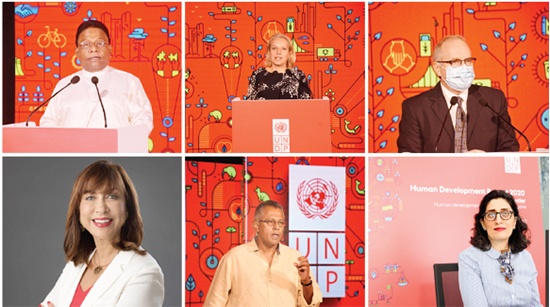
The PHDI was included as a new experimental index in the Global Human Development Report (HDR) which was launched on January 6 by the United Nations Development Program (UNDP) in Sri Lanka bringing together a wide range of high-level participation from the Government, Public and Private sector, Development partners and Civil Society Organizations (CSOs).
The 30th anniversary edition of the HDR 2020, was titled ‘The Next Frontier: Human Development and the Anthropocene’.
In the Human Development Index (HDI), Sri Lanka is positioned at 72 out of 189 countries and territories, with ‘High Human Development’ with an HDI value of 0.782. Yet there is no time for complacency. Because, Sri Lanka is one of the most vulnerable countries to climate change ranking 6th on the Climate Risk Index; the country is at crossroads with a choice to exercise – of choosing a development trajectory that progresses human development while easing pressure on the planet, the UNDP said.
“Human development has historically taken place at the cost of the land and environment around us. The COVID-19 pandemic is the latest crisis facing the world, but unless humans release their grip on nature, it won’t be the last, according to the recently launched HDR”, it noted.
Receiving the report at the virtual launch in Sri Lanka, Dullas Alahapperuma, Minister of Power stated, “the Government of Sri Lanka aims to build a Green Economy that will generate new industries by local entrepreneurs. Through renewable energy, we can create low-cost, low-carbon energy. A Green Economy will improve energy security, improve environmental and public health, and create better and more jobs. And with the vision of President Gotabaya Rajapaksa, we commit to ensure that the environment is protected in all our development plans. It is with great pleasure that we welcome UNDPs coordinated support to ushering in aspects of a Green Economy”.
Speaking at the event, Robert Juhkam, Resident Representative of UNDP in Sri Lanka said, “UNDP stands committed in supporting Sri Lanka to define and operationalize its national development plan in a way that is underpinned by Green Development thinking, with consideration for socio-economic impacts of COVID-19. UNDP commits to helping establish a platform for all partners and stakeholders to come together in achieving a Green development pathway: government, private sector, civil society, academia, development partners, and our sister UN agencies.”
Also speaking at the launch, Hanaa Singer-Hamdy, Resident Coordinator of the United Nations in Sri Lanka stated, “given the deep interconnection of planetary and social imbalances noted in the Report, I want to emphasize today the importance of ensuring justice, equality and human rights as part of this process. Seeing as no country anywhere in the world has yet achieved the ideal combination of high human development and low planetary pressure, we need such an inclusive and participatory approach where all voices are heard. Only in this way can we address the enormously complex challenge ahead of us.”
The next frontier for human development will require working with and not against nature, while transforming social norms, values, and government and financial incentives, the report argues. In her remarks, H.E Sarah Hulton, British High Commissioner to Sri Lanka emphasized that, “climate action is extremely tangible and relevant to Sri Lanka, with its rich biodiversity, climate vulnerability, reliance on nature and environment for many livelihoods whether through agriculture, fishing or tourism. In fact, maintaining the environment and protecting biodiversity through nature-based solutions is one of the key shared objectives for many of us working here in Sri Lanka including the UK and UN, in supporting the people and Government of Sri Lanka on this.”
According to the report, easing planetary pressures in a way that enables all people to flourish in this new age requires dismantling the gross imbalances of power and opportunity that stand in the way of transformation. Highlighting this through an interactive talk, Hiran Cooray, Chairman – Jetwing Symphony stated, “we need to change the way we think if we are really focused on human development and switching to a green economy. Greater collaboration and encouragement to Sri Lankans across the country who really want to make a difference is essential.”
The launch was followed by a moderated conversation on ‘A New Social Compact: Human Development with Reduced Planetary Pressures’ and was moderated by Raashid Riza, Policy and Engagement Analyst, UNDP in Sri Lanka. The panel comprised of Ms. Savera Weerasinghe, Founder, Ananta Sustainables; Dr. Ravi Fernando, Chairman/CEO, Global Strategic Corporate Sustainability; Thorsten Bargfrede, Deputy Head of Mission, Delegation of the European Union to Sri Lanka and the Maldives; and Hemantha Withanage, Executive Director/ Senior Environmental Scientist, Centre for Environmental Justice. Furthermore, Ms. Shabiya Ali Ahlam, Senior Journalist – National English Daily; Ms. Kanchana Weerakoon, Founder/President, Eco-Friendly Volunteers; and Dr. Ganeshamoorthy Murugesu, Senior Lecturer – Department of Economics, University of Colombo shared their expertise as discussants.
The virtual launch event was one engagement part of a broader series of interventions led by UNDP in Sri Lanka, working in collaboration with all stakeholders to further the conversation around the findings of the HDR 2020.

News
Formulation of a Draft Economic Development Bill to expedite the process of Digital Transformation and Digital Economic Development


It is essential to establish an institutional framework with legal powers to ensure the effective implementation of national digital policy and guidelines.
Quality human capital should be attracted to this institutional framework for the compilation of policies, implementation of policies, regulation, and empowerment of operations. The continuous participation of the private sector should also be considered in establishing a strong institutional framework.
It has been further identified that attention should also be
drawn to new fields of digital innovation, including support for artificial intelligence and related activities.
Taking into consideration the aforementioned matters, a concept paper has been formulated to prepare a Draft Economic Development Bill for the establishment of a new institutional framework.
Accordingly, the Cabinet of Ministers has approved the resolution furnished by the President in his capacity as the Minister of Digital Economy to instruct legal draftsman to formulate a Draft Economic Development Bill based on the aforementioned concept paper.
The Sri Lanka Community and Health Survey is the main data source for obtaining necessary information for reviewing progress toward achieving the national health development goals, as well as the expected sustainable development goals by 2030.
The last survey was conducted in the year 2016, and the Sri Lanka Community and Health Survey should be conducted to obtain updated data to enable the collection of related data and indicators concerning the health and well-being targets of the Global Sustainable Development Objectives.
Accordingly, the Cabinet of Ministers has approved the resolution furnished by the President in his capacity as the Minister of Finance, Planning, and Economic Development to take necessary steps to conduct the aforementioned survey.
The access to secure, reliable and affordable drinking water and adequate sanitation facilities is essential to maintain public health, promote social well-being and foster economic development.
The Sri Lankan Government recognizes water supply and sanitation services as both an economic good and a basic human need. Therefore, when pricing for water and sanitation, a balance should be maintained between the financial sustainability of the service providers and the requirement to ensure fair and affordable access for all strata in the society.
Accordingly, the Sri Lankan government has identified the necessity of a national water supply that is sensitive to gender equality and social integration applicable to all water supply and sanitation service providers. At present, there is no formal national framework for setting, reviewing, approving, and implementing tariffs for water supply systems operated by various water supply providers as well as for setting, reviewing, approving, and implementing tariffs for sanitation systems.
Therefore, the Ministry of Housing, Construction, and Water Supply has formulated a water tariff policy covering all water supply service providers under the Sri Lanka Water Supply and Sanitation Sector Reform Program, which is a policy-based loan program implemented under Asian Development Bank funds.

Formulation of a Draft Economic Development Bill to expedite the process of Digital Transformation and Digital Economic Development
Cabinet approval for Sri Lanka Community and Health Survey – 2026/2027
A National Water Tariff Policy for all Water Supply and Sanitation Services
National Policy on Green Hydrogen in Sri Lanka
Cabinet nod to amend the Customs Ordinance
Cabinet nod to submit the Anti-Corruption (Declaration of Assets and Liabilities through Centralized Electronic System) Regulations 2026, made under Section 156 of the Anti-Corruption Act, No.9 of 2023, for approval by Parliament

‘Dates have the highest sugar content to fight Coronavirus’

Sunday Island 27 December – Headlines

#SundayIsland 17th December – Headlines

Sunday Island – 28th March

Sunday Island Headlines – 21 March

Sunday Island – 21st February – Headlines
-

 Latest News6 days ago
Kusal Mendis, Pathum Nissanka, bowlers put Sri Lanka 1-0 up
-
 News6 days ago
New US tariffs proposed on 60 countries, including Sri Lanka
-
 Features5 days ago
Power crept into the Sangha and is now tearing it apart
-
 Features5 days ago
Kondachchi wind farm and battery storage project to boost energy security, says Power Ministry Secretary
-
 Features5 days ago
Saudi Arabia sets new benchmark in Hajj management as 1.7 million pilgrims complete sacred journey
-

 News3 days ago
Women’s T20 World Cup 2026 warm-up: Chamari Athapaththu’s 94 helps Sri Lanka beat Pakistan
-

 News4 days ago
Asst. Manager, security officer arrested over Rs 30 mn snatch at Horana PB branch
-

 Editorial2 days ago
Probe Sallay’s complaint